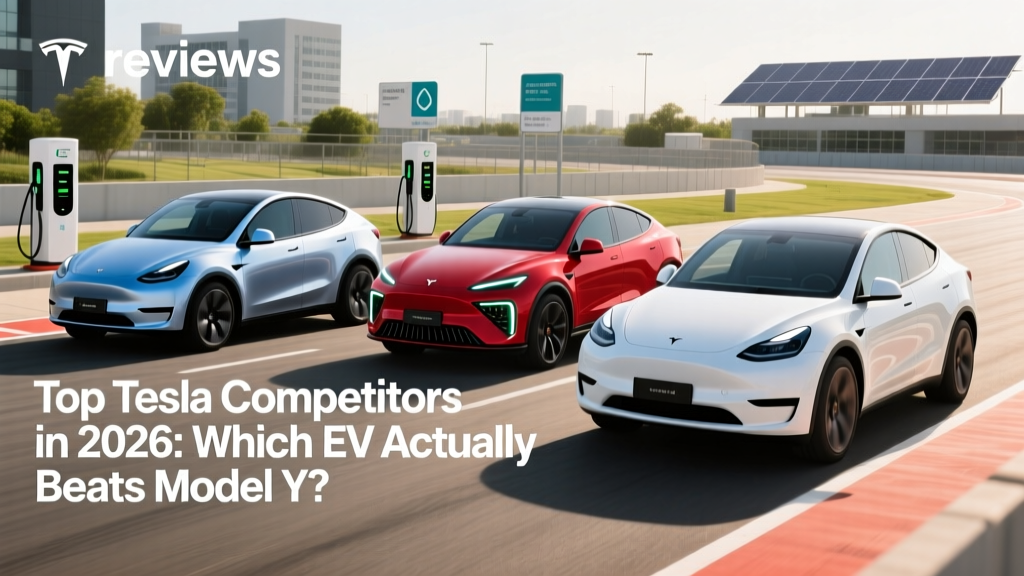
The Tesla Competitor Landscape in 2026
For years, "should I buy a Tesla or something else?" was the defining question in the EV market. In 2026, that question has real answers. The Hyundai Ioniq 5, Ford Mustang Mach-E, and Kia EV6 have each closed the gap — and in some metrics, surpassed the Model Y — on charging speed, interior space, and value after federal tax credits. But Tesla still holds advantages in charging infrastructure, software integration, and efficiency.
Rather than a generic spec dump, this profile breaks down the three strongest Tesla competitors by the numbers that actually matter to owners: real-world range, sustained charging curves, true cost after the §30D federal credit, and daily usability. We'll crown a winner in each category and tell you which EV earns your money based on how you actually drive.
Side-by-Side: The Core Spec Table
| Spec | Hyundai Ioniq 5 (2026 Long Range AWD) | Ford Mustang Mach-E (2026 Extended Range AWD) | Kia EV6 (2026 GT-Line AWD) | Tesla Model Y (2026 Long Range AWD) |
|---|---|---|---|---|
| EPA Range | 305 mi | 312 mi | 282 mi | 320 mi |
| Battery (usable kWh) | 84.0 kWh (NMC) | 91.0 kWh (NMC) | 77.4 kWh (NMC) | 78.1 kWh (NMC) |
| Peak DC Fast Charge | 240 kW | 150 kW | 240 kW | 250 kW |
| 10–80% DC Time | ~18 min | ~38 min | ~18 min | ~20 min |
| Level 2 Home Rate | 10.9 kW (~37 mi/hr) | 10.5 kW (~34 mi/hr) | 10.9 kW (~37 mi/hr) | 11.5 kW (~44 mi/hr) |
| 0–60 mph | 5.1 sec | 5.6 sec | 5.2 sec | 4.8 sec |
| Horsepower | 320 hp | 346 hp | 325 hp | 384 hp |
| Drivetrain | Dual-motor AWD | Dual-motor AWD | Dual-motor AWD | Dual-motor AWD |
| MPGe (combined) | 110 MPGe | 101 MPGe | 117 MPGe | 122 MPGe |
| Base MSRP | $48,950 | $46,995 | $47,900 | $48,990 |
| Battery Warranty | 10 yr / 100,000 mi | 8 yr / 100,000 mi | 10 yr / 100,000 mi | 8 yr / 120,000 mi |
Sources: fueleconomy.gov, manufacturer spec sheets. Real-world results vary by temperature, terrain, and driving style.
Real-World Range: What the EPA Sticker Doesn't Tell You
Hyundai Ioniq 5: EPA 305 mi — expect ~250–275 mi at sustained 70 mph highway speeds; ~215–235 mi in sub-freezing winter conditions.
Ford Mustang Mach-E: EPA 312 mi — expect ~260–280 mi highway; ~220–240 mi in cold weather. The larger 91 kWh battery compensates for lower efficiency.
Kia EV6: EPA 282 mi — expect ~235–255 mi highway; ~200–220 mi in cold weather. Smaller battery means cold-weather loss hits harder.
Tesla Model Y: EPA 320 mi — expect ~270–290 mi highway; ~240–260 mi in cold weather. Tesla's heat pump and thermal management remain class-leading.
The EPA combined cycle blends city and highway driving at moderate temperatures. In our experience on 200+ mile road trips at 70–75 mph, plan for roughly 15–18% less range than the sticker. In temperatures below 32°F, expect 25–30% reduction, particularly in the Kia and Hyundai, which lose more to cabin heating despite Hyundai's standard heat pump. The Model Y's octovalve thermal system still manages cold-weather range best in this group.
For context, the average American drives roughly 37 miles per day, meaning even the EV6's worst-case winter range covers nearly a week of commuting before needing a charge.
Charging Speed: The Road-Trip Differentiator
Peak kW numbers are misleading. What matters is the charging curve — how long the vehicle sustains its peak rate before tapering. Here's how these Tesla competitors stack up:
| Charging Metric | Ioniq 5 | Mach-E | EV6 | Model Y |
|---|---|---|---|---|
| Peak DC Rate | 240 kW | 150 kW | 240 kW | 250 kW |
| 10–80% Time | ~18 min | ~38 min | ~18 min | ~20 min |
| Sustained Peak Window | 10–55% SoC | 10–40% SoC | 10–55% SoC | 10–45% SoC |
| Avg 10–80% Rate | ~165 kW | ~110 kW | ~160 kW | ~170 kW |
| Level 2 (240V Home) | 10.9 kW | 10.5 kW | 10.9 kW | 11.5 kW |
| Home Miles Per Hour | ~37 mi/hr | ~34 mi/hr | ~37 mi/hr | ~44 mi/hr |
| Connector (2026) | NACS (native) | NACS (native) | NACS (native) | NACS (native) |
The takeaway: The Mach-E's 150 kW peak is the weakest link here. On a 300-mile road trip with one DC fast-charge stop, you'll spend roughly 20 extra minutes plugged in compared to the Ioniq 5 or EV6. The Hyundai and Kia share the E-GMP platform's 800V architecture, which enables that steep charge curve — sustaining near-peak rates up to ~55% SoC before tapering. Tesla's Supercharger network advantage has narrowed significantly now that all three competitors have native NACS ports and full Supercharger access as of 2025.
For home charging, all four vehicles will fully replenish overnight on a Level 2 wall connector. A typical 40-amp home circuit delivers 9.6 kW; a 48-amp circuit unlocks the full 10.9–11.5 kW these onboard chargers support.
Pricing, Tax Credits, and True Cost
Under IRS §30D rules for 2026, the federal EV tax credit remains up to $7,500, but eligibility depends on three moving targets: buyer income caps, vehicle MSRP caps, and battery critical-mineral/battery-component sourcing requirements that tighten annually.
| Pricing Factor | Ioniq 5 | Mach-E | EV6 | Model Y |
|---|---|---|---|---|
| Base MSRP | $48,950 | $46,995 | $47,900 | $48,990 |
| As-Tested (mid-trim AWD) | $53,400 | $52,100 | $54,200 | $54,490 |
| MSRP Cap Eligible? (SUV: $80K) | ✅ Yes | ✅ Yes | ✅ Yes | ✅ Yes |
| §30D Credit (estimated) | $3,750–$7,500 | $3,750–$7,500 | $3,750–$7,500 | $3,750–$7,500 |
| Point-of-Sale Transfer? | ✅ Yes | ✅ Yes | ✅ Yes | ✅ Yes |
- Income caps: $150K single / $225K head of household / $300K joint (modified AGI)
- MSRP caps: $80,000 for SUVs/pickups/vans; $55,000 for sedans
- Critical minerals: Increasing percentage must be sourced from US or FTA partners — this requirement tightens each year and can reduce credit from $7,500 to $3,750 if only one of two sourcing requirements is met
- Point-of-sale transfer: All four vehicles qualify for upfront dealer discount via registered dealers — no need to wait for tax filing
- Verify before purchase: Sourcing rules change frequently. Confirm current eligibility on IRS.gov or with your tax professional
The Mach-E's lower base MSRP gives it an edge for budget-conscious buyers, especially if the full $7,500 credit applies — potentially dropping the effective price below $40,000. The Ioniq 5 and EV6 typically land in the same credit tier as the Model Y, making the decision come down to feature preference rather than price alone.
Interior Space, Tech, and Daily Livability
Specs don't capture how a car feels on a Tuesday morning school run. Here's where each Tesla competitor differentiates:
Cargo and Passenger Space
| Dimension | Ioniq 5 | Mach-E | EV6 | Model Y |
|---|---|---|---|---|
| Cargo (behind 2nd row) | 27.2 cu ft | 29.7 cu ft | 24.4 cu ft | 30.2 cu ft |
| Cargo (seats folded) | 59.3 cu ft | 59.7 cu ft | 50.2 cu ft | 72.0 cu ft |
| Rear Legroom | 39.4 in | 38.9 in | 39.5 in | 41.6 in |
| Front Trunk (Frunk) | 0.85 cu ft | 4.7 cu ft | 0.73 cu ft | 4.1 cu ft |
The Model Y wins on pure cargo volume — 72 cubic feet with seats down is minivan territory and remains the benchmark. The Mach-E's frunk is the most practical in this group at 4.7 cu ft, useful for charging cables or groceries. The EV6 sacrifices cargo space to its lower, sportier roofline — a trade-off that matters if you regularly haul bulky items.
Standout Tech and Drawbacks
Hyundai Ioniq 5: Dual 12.3-inch curved displays, vehicle-to-load (V2L) power output (up to 3.6 kW — power a campsite or tailgate), ultra-fast 800V charging architecture, reclining front "relaxation" seats. Drawback: No rear wiper (2024+ models added one); infotainment lacks physical volume knob in earlier builds.
Ford Mustang Mach-E: Massive 15.5-inch vertical touchscreen, BlueCruise hands-free highway driving on 130,000+ miles of divided highways, Ford Power-Up OTA updates, practical frunk with drain plug. Drawback: Slowest DC charging in this group; ride quality is firmer than expected for a crossover.
Kia EV6: Same excellent 800V E-GMP platform as Ioniq 5, dual 12.3-inch panoramic displays, V2L capability, GT trim offers 576 hp and 3.5-second 0–60. Drawback: Smallest battery and cargo area; rear visibility compromised by thick C-pillars.
Tesla Model Y: Industry-leading Supercharger network reliability, best-in-class efficiency (122 MPGe), minimalist interior with 15.4-inch touchscreen, Sentry Mode, and continuous OTA improvements. Drawback: No Apple CarPlay/Android Auto; panel gap quality inconsistent; FSD (Supervised) remains a Level 2 system requiring full driver attention.
All driver-assist systems in this comparison — Tesla Autopilot/FSD (Supervised), Ford BlueCruise, Hyundai Highway Driving Assist 2, and Kia Highway Driving Assist 2 — are SAE Level 2. This means the driver must remain fully engaged, monitor the road, and keep hands on or near the steering wheel at all times. None of these systems are "self-driving." True driverless operation (Level 4) is currently limited to geofenced robotaxi services like Waymo.
Who Should Buy Which EV?
- You prioritize charging speed for road trips
- V2L capability matters (camping, tailgating, backup power)
- You want a 10-year battery warranty
- You value a spacious rear seat for car seats
- You want the lowest entry price in this group
- Hands-free BlueCruise highway driving appeals to you
- You need a practical frunk for daily use
- You prefer a more traditional crossover driving feel
- You want the fastest 800V charging and sporty handling
- You prefer a sleeker, lower-profile design
- The 10-year/100,000-mile battery warranty is a priority
- You don't need maximum cargo volume
- Maximum cargo space and efficiency are non-negotiable
- You want the most mature Supercharger network
- You prefer minimalism and OTA feature updates
- Best-in-class MPGe matters for your electricity costs
Pros and Cons at a Glance
- Ioniq 5: 18-min DC charging, V2L, 10-yr warranty, spacious cabin
- Mach-E: Lowest MSRP, BlueCruise, largest frunk, proven OTA updates
- EV6: Sporty handling, 800V charging, 10-yr warranty, striking design
- Model Y: Best range/efficiency, Supercharger network, most cargo space
- Ioniq 5: Smaller frunk, less cargo space than Model Y, no CarPlay
- Mach-E: Slowest DC charging (150 kW), firm ride, 8-yr battery warranty
- EV6: Smallest battery/cargo, limited rear visibility, higher trim pricing
- Model Y: No CarPlay, panel gaps, FSD is Level 2 not autonomous, service center wait times
Frequently Asked Questions
What is the real-world range of these Tesla competitors?
Expect 15–18% less than the EPA sticker at sustained highway speeds and 25–30% less in sub-freezing temperatures. The Ioniq 5 delivers roughly 250–275 highway miles, the Mach-E about 260–280, the EV6 around 235–255, and the Model Y approximately 270–290. For daily commuting under 50 miles, all four will go multiple days between charges.
How fast do these EVs charge at home and on the road?
On DC fast chargers, the Ioniq 5 and EV6 are the quickest at ~18 minutes from 10–80% thanks to their 800V architecture. The Model Y takes about 20 minutes at 250 kW peak. The Mach-E is the slowest at ~38 minutes due to its 150 kW cap. At home on Level 2 (240V), all four add 34–44 miles of range per hour, meaning a full overnight charge is standard.
How much do these EVs cost after federal tax credits?
With the full $7,500 §30D credit (if you meet income, MSRP, and sourcing requirements), the Mach-E starts as low as ~$39,495, the EV6 ~$40,400, the Ioniq 5 ~$41,450, and the Model Y ~$41,490. Credits can now be transferred at the point of sale as an instant discount. However, battery-sourcing rules tighten each year — verify current eligibility at IRS.gov before purchasing.
Is it worth buying a Tesla competitor over a Model Y?
It depends on your priorities. If charging speed and warranty matter most, the Ioniq 5 or EV6 are compelling. If budget is king, the Mach-E undercuts on MSRP. If you need maximum cargo volume, efficiency, and the broadest fast-charging network, the Model Y still leads. The gap has narrowed enough that no choice here is wrong — it's about which trade-offs you prefer.
Does each model qualify for the federal EV tax credit?
All four vehicles are under the $80,000 SUV MSRP cap and are potentially eligible for up to $7,500 under §30D. However, the actual credit amount depends on battery critical-mineral and component sourcing (which can reduce the credit to $3,750 if only partial requirements are met) and your household income. Always confirm with your tax professional and check the latest IRS guidance before finalizing a purchase.
Which Tesla competitor has the best warranty?
Hyundai and Kia lead with a 10-year/100,000-mile battery and powertrain warranty, compared to 8 years for Ford and Tesla (though Tesla covers 120,000 miles). That extra two years of coverage can matter for second owners and long-term resale confidence.