Why "Tesla Colorized" Is Trending in 2026
Search interest in Tesla colorized has surged as owners look to personalize vehicles that roll off the Fremont, Austin, and Berlin lines in a notoriously narrow palette. Tesla's factory color lineup for 2026 remains tight — five core hues for the Model 3 and Model Y — which has pushed buyers toward vinyl wraps, Paint Protection Film (PPF) with tint, and boutique paint shops. This guide breaks down what's actually available, what it costs, and how color decisions interact with the things EV buyers actually care about: range, thermal load, resale value, and warranty.
Tesla's 2026 Factory Color Menu (Model 3 & Model Y)
Before going aftermarket, it helps to know the baseline. For the 2026 model year, Tesla offers the following exterior colors on the Model 3 and Model Y. Pearl White Multi-Coat remains the default no-cost option in the U.S. market, while every other color carries a premium.
| Color | Upcharge (USD) | Finish | Notes |
|---|---|---|---|
| Pearl White Multi-Coat | $0 | Tri-coat pearl | Default; highest resale volume |
| Solid Black | $1,500 | Metallic | Shows swirl marks easily |
| Midnight Silver Metallic | $1,500 | Metallic | Reads grey in overcast light |
| Deep Blue Metallic | $1,500 | Metallic | Strongest regional demand (West Coast) |
| Red Multi-Coat | $2,500 | Tri-coat | Premium pigment; longest lead time |
| Quicksilver (Cybertruck-only) | N/A | Stainless | Not offered on 3/Y |
Tesla's paint thickness typically measures 100–140 microns — on the softer side of the industry — which is why PPF and wraps have become de rigueur among owners who plan to keep their cars beyond the 4-year/50,000-mile basic warranty.
Aftermarket Colorizing: Wraps, PPF, and Custom Paint
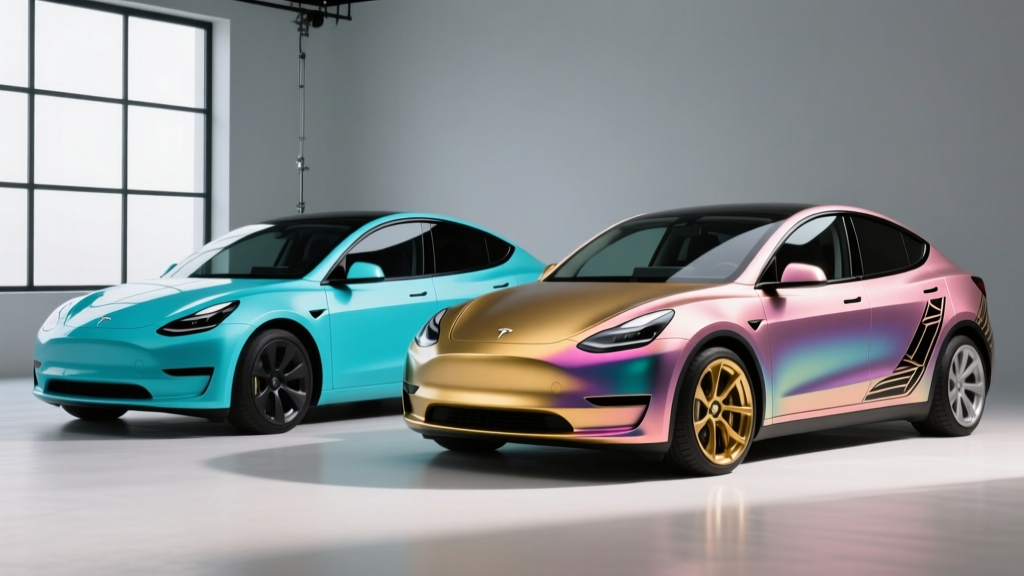
"Tesla colorized" in the wild usually means one of three approaches. Each has different cost curves, durability, and implications for the underlying paint and warranty.
1. Vinyl Wraps
A full-body vinyl wrap from 3M, Avery Dennison, or KPMF runs $2,800–$5,500 installed on a Model 3, and $3,400–$6,200 on a Model Y due to the larger surface area. Matte, satin, chrome, and color-shift films are the most requested. Lifespan is typically 5–7 years before edge-lift and UV fade become visible. A wrap preserves the factory paint underneath, which matters for lease returns and resale.
2. Paint Protection Film (PPF) with Tint
Colorized PPF (XPEL Stealth, SunTek React, 3M Paint Shield) combines chip protection with a tint or matte effect. Full-body PPF on a Model Y typically costs $6,500–$9,500 in 2026. It's the most durable option — 10-year warranties are standard — but also the most expensive.
3. Custom Respray
A high-quality multi-stage respray at a boutique shop (House of Kolor, local PPG-certified facilities) runs $7,000–$14,000. This permanently alters the car and can complicate warranty claims if Tesla attributes a defect (e.g., panel-gap sensor issues, door-handle delamination) to the respray process. Most owners avoid this route unless the car is out of warranty.
Does Color Actually Affect Range or Cabin Temperature?
Yes — but the magnitude is smaller than forum posts suggest. Darker exteriors absorb more solar radiation, which increases cabin heat soak and forces the HVAC system (and therefore the traction battery) to work harder in summer. A NREL study on vehicle solar load found cabin temperature deltas of 8–12°F between white and black vehicles in direct sun, translating to roughly 1–3% additional HVAC energy consumption in peak summer conditions.
For a 2026 Model Y Long Range (EPA 320 miles), that's a real-world difference of approximately 3–9 miles on a 95°F day. Cold-climate owners will see the inverse benefit: black cars gain a trivial amount of passive solar warming in winter. The effect is measurable but not decision-driving unless you live in Phoenix, Dubai, or the Central Valley.
Resale, Insurance, and Warranty Considerations
Tesla resale data from Recurrent and iSeeCars consistently shows Pearl White and Deep Blue Metallic holding value best in the U.S. market, while Red Multi-Coat and aftermarket colors tend to narrow the buyer pool. A professionally installed, documented wrap that can be removed to reveal clean factory paint is usually neutral-to-positive for resale; a respray is typically negative unless executed to concours standards.
Insurance-wise, notify your carrier. Most insurers (GEICO, Progressive, State Farm) treat wraps as "custom equipment" requiring a rider — typically $5–$15/month for a $5,000 wrap. Failure to declare it can result in a denied claim after a parking-lot scrape.
Tesla's 4-year/50,000-mile basic and 8-year/120,000-mile (Model 3 RWD) or 8-year/100,000-mile (Model Y) battery & drive unit warranty is not automatically voided by a wrap or PPF. However, any damage caused during installation — heat-gun warping of trim, fluid spills on HV components, sensor recalibration issues — is the owner's responsibility.
Real-World Spec Context: What You're Colorizing
For buyers weighing color options alongside the mechanicals, here's the 2026 baseline for the two most-wrapped Teslas.
| Spec | Model 3 Long Range AWD | Model Y Long Range AWD |
|---|---|---|
| EPA Range | 363 mi | 320 mi |
| Battery (usable) | ~75 kWh (NMC) | ~75 kWh (NMC) |
| Peak DC Charge | 250 kW | 250 kW |
| 10–80% DC Time | ~27 min | ~29 min |
| Level 2 (11.5 kW) | ~44 mi/hr | ~41 mi/hr |
| 0–60 mph | 4.2 sec | 4.8 sec |
| Horsepower | ~384 hp | ~384 hp |
| MPGe (combined) | 132 MPGe | 122 MPGe |
| Base MSRP | $47,740 | $48,630 |
| Battery Warranty | 8 yr / 120,000 mi | 8 yr / 120,000 mi |
Federal Tax Credit and Color Decisions
The IRS §30D clean vehicle credit does not differentiate by paint color. A colorized Tesla — whether factory Red Multi-Coat or a wrapped Pearl White — qualifies identically, provided the buyer and vehicle meet the 2026 rules:
- MSRP caps: $55,000 for sedans (Model 3), $80,000 for SUVs/trucks (Model Y)
- Buyer AGI caps: $150k single / $225k HOH / $300k joint
- Battery critical-mineral and component sourcing thresholds (phased annually)
- Point-of-sale transfer available at delivery
Aftermarket wrap costs are not included in the vehicle's MSRP for credit purposes — they're a separate service invoice. Plan your color strategy around the MSRP cap accordingly; loading a Model 3 with $2,500 Red Multi-Coat plus FSD and wheels can push close to the $55k sedan ceiling.
Pros and Cons of Colorizing Your Tesla
- Personalization in a sea of white and silver
- PPF preserves factory paint for resale
- Matte/satin finishes hide micro-scratches better than gloss black
- Reversible (wraps) for lease returns
- $3,000–$9,500 out-of-pocket with no tax-credit offset
- Insurance rider required
- Warranty disputes possible if installer damages trim or sensors
- Cheap wraps peel at edges within 2–3 years
Frequently Asked Questions
Does a vinyl wrap void my Tesla warranty?
No, but any damage caused during installation is not covered. Use a Tesla-familiar installer who avoids heat near cameras, ultrasonic sensors, and the 12V/48V harness.
Which color hides dirt and scratches best?
Midnight Silver Metallic and satin-grey wraps hide road film and light scratches best. Solid Black shows everything — it's the highest-maintenance factory option.
Can I colorize just the roof or accents?
Yes. Chrome-delete wraps (gloss black over the window trim) cost $400–$800 and are the single most common "colorized" mod on Teslas. Roof-only wraps run $600–$1,200.
Will a dark wrap reduce my range in summer?
Measurably, yes — roughly 1–3% in extreme heat due to added HVAC load. Not meaningful for most owners, but real in desert climates.
How do I find a reputable Tesla wrap shop?
Look for XPEL, 3M, or Avery Dennison certified installers with documented Model 3/Y portfolios. Ask about sensor and trim removal procedures — good shops remove door handles and mirror caps rather than cutting around them.