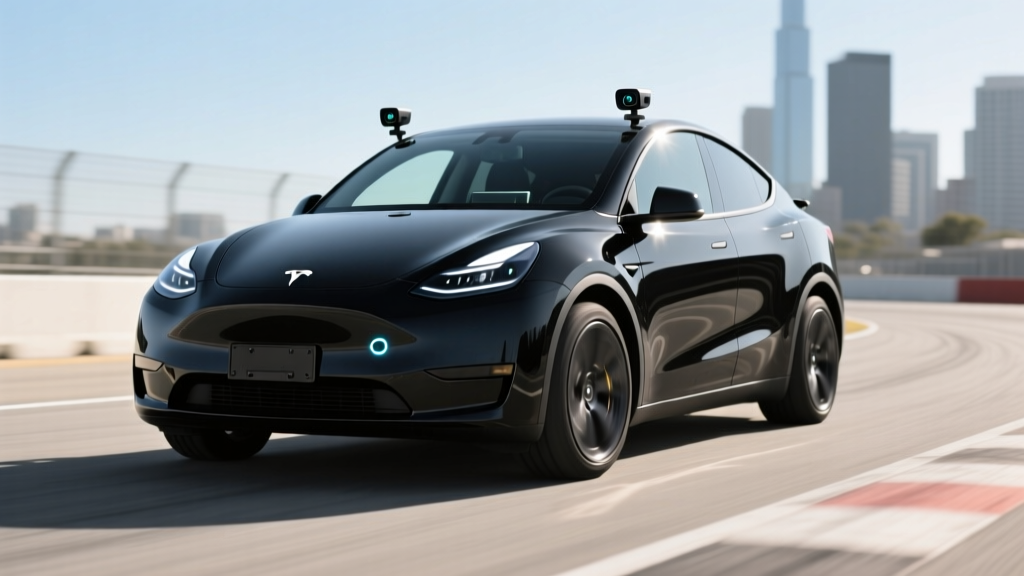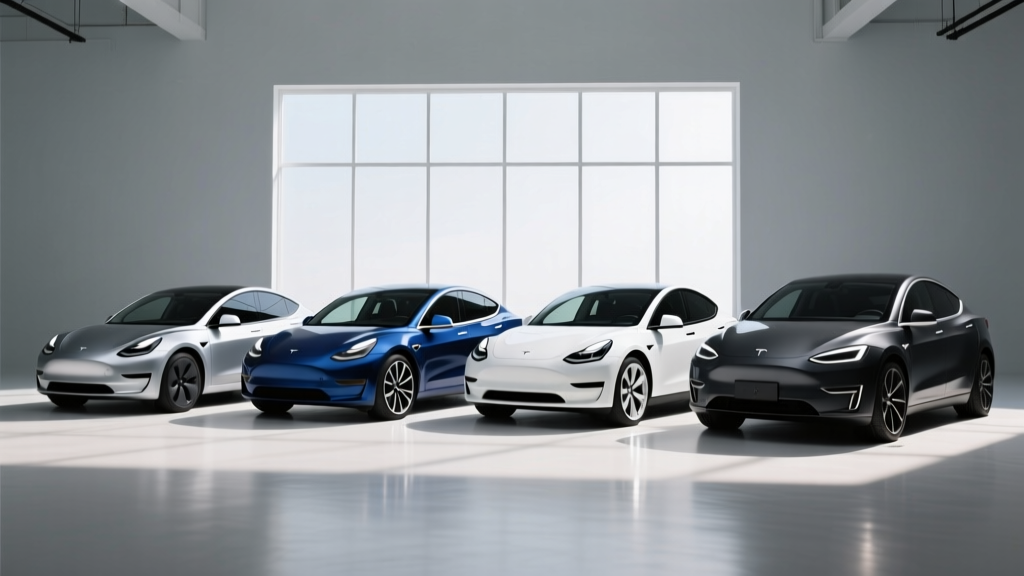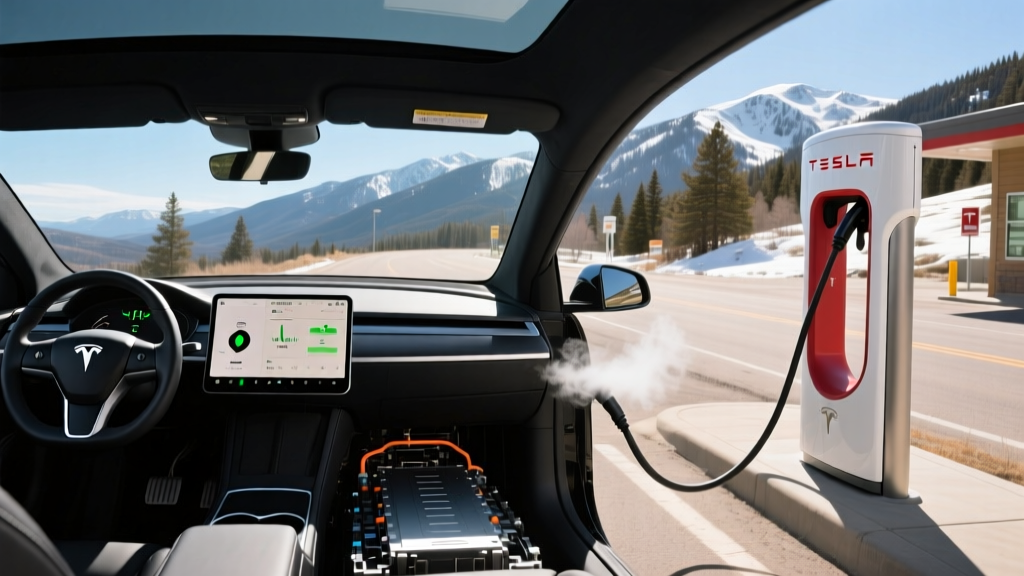
Colorado Springs sits at 6,035 feet of elevation, flanked by Pikes Peak and surrounded by highways that demand real range. For local EV shoppers, the question isn't just whether a Tesla is a good car — it's whether a Tesla is a good car here, on I-25 corridor commutes, freezing January mornings, and mountain weekend trips. This review breaks down the 2026 Tesla Model Y Long Range AWD — the best-selling Tesla and the most practical choice for Springs drivers — with exact numbers on range, charging, pricing, and high-altitude ownership realities.
2026 Tesla Model Y: Quick Verdict for Colorado Springs Buyers
The refreshed Model Y (sometimes called the "Juniper" update) continues to dominate the midsize electric SUV segment. For Colorado Springs specifically, it offers three decisive advantages: access to the Supercharger network for Front Range and mountain travel, a heat pump that preserves range in sub-zero temperatures, and a dual-motor AWD system that handles black ice on Nevada Avenue and snow on Woodmen Road without drama. The trade-off is a firm ride on rough pavement, a minimalist interior that frustrates some buyers, and a base price that still pushes past $45,000 before incentives.
| Spec | Value |
|---|---|
| EPA Range | 320 miles |
| Battery (usable) | ~75 kWh, NMC chemistry |
| Drivetrain | Dual-motor AWD |
| Horsepower | 384 hp (combined) |
| 0–60 mph | 4.8 seconds |
| Peak DC Fast Charge | 250 kW (CCS/NACS) |
| 10–80% DC Time | ~25 minutes |
| Level 2 Home Charge | 11.5 kW (~44 mi/hr) |
| Efficiency | 117 MPGe combined / 29 kWh/100 mi |
| Cargo (rear seats up) | 30.2 cu ft |
| Cargo (rear seats folded) | 72.0 cu ft |
| Base MSRP | $44,990 (before destination) |
| Battery Warranty | 8 years / 120,000 miles |
Real-World Range at 6,000 Feet and Below Zero
Real-World Expectation (Colorado Springs):
• Summer city/highway mix: ~280–300 miles
• Highway-only at 75 mph on I-25: ~250–270 miles
• Winter (20°F–35°F), mixed driving: ~220–250 miles
• Winter highway with cabin heat: ~200–230 miles
Colorado Springs drivers face two range-reducers that most national reviews ignore: altitude-related cold snaps and sustained highway speeds across wide-open terrain. The Model Y's NMC battery holds roughly 75 kWh of usable energy. In practice, Tesla's thermal management system — which includes a standard heat pump — cuts winter range loss roughly in half compared to resistive-heater EVs. On a 30°F morning with the cabin set to 68°F, expect about a 20–25% reduction from the EPA sticker.
Highway driving on I-25 toward Pueblo or northbound to Denver at 75 mph pushes consumption to around 32–34 kWh/100 mi, dropping effective range to the mid-250s. The good news: thinner air at 6,035 feet actually reduces aerodynamic drag slightly, recovering perhaps 1–2% efficiency compared to sea-level highway driving — a small but measurable altitude bonus.
For a typical Springs-to-Denver round trip (~140 miles), even in January, a full charge provides comfortable margin without needing a mid-trip top-up. Trips to Buena Vista or Breckenridge over mountain passes will consume more energy on the climb but recover significant range through regenerative braking on the descent.
Charging in Colorado Springs: Home and Public
Charging infrastructure is the make-or-break factor for EV ownership in any midsize city. Colorado Springs has a solid but not overwhelming public network, making home charging essential.
Home Level 2 Charging
The Model Y accepts up to 11.5 kW on Level 2 AC, which translates to roughly 44 miles of range per hour of charging. A full overnight session (8–10 hours) on a Tesla Wall Connector or equivalent J1772/NACS station replenishes the entire battery. Most Springs homeowners with a 200-amp electrical panel can add a 60-amp dedicated circuit for $800–$1,500 (electrician labor + permit), though older homes near downtown may need a panel upgrade adding $1,500–$3,000. Colorado Springs Utilities offers a time-of-use rate that makes overnight charging significantly cheaper than peak-hour charging.
DC Fast Charging
| Level | Power | Speed | Typical Use |
|---|---|---|---|
| Level 1 (120V) | ~1.4 kW | ~5 mi/hr | Emergency / trickle |
| Level 2 (240V home) | 11.5 kW | ~44 mi/hr | Daily overnight |
| DC Fast (V3 Supercharger) | 250 kW peak | ~162 mi in 15 min | Road trips |
| DC Fast (50 kW public) | 50 kW | ~180 mi/hr | Backup / errands |
Colorado Springs has multiple Tesla Supercharger stations, including the 12-stall location near the Citadel Mall and the 8-stall station at Chapel Hills Mall. All are V3 (250 kW capable). The Model Y's charging curve peaks near 250 kW below 30% SoC, holds above 150 kW through about 55%, then tapers progressively. A 10–80% session takes roughly 25 minutes — enough time for a quick meal or grocery run.
For non-Tesla public charging, the Model Y now ships with a NACS port. Tesla includes a CCS adapter (or one can be purchased for ~$175) for Electrify America and other CCS networks. Springs has a handful of Electrify America and ChargePoint DC stations, though reliability varies — a known advantage of the Supercharger network's uptime record.
Pricing, Trims, and Federal Tax Credit Eligibility
The 2026 Model Y lineup is streamlined compared to prior years. Here's how pricing breaks down before destination fees and incentives:
| Trim | MSRP | Est. §30D Credit | Effective Price |
|---|---|---|---|
| Long Range AWD | $44,990 | Up to $7,500* | ~$37,490 |
| Performance AWD | $48,990 | Up to $7,500* | ~$41,490 |
*Federal §30D credit eligibility depends on buyer income, vehicle MSRP cap (SUVs: $80,000), battery critical-mineral sourcing, and final assembly in North America. Rules change frequently — verify current eligibility at IRS.gov or through a tax professional. The credit can be transferred to the dealer at point of sale as an immediate price reduction.
The Model Y qualifies under the SUV MSRP cap of $80,000, well above its price. However, the battery-sourcing and critical-minerals requirements under §30D have tightened. Tesla's Fremont and Austin factories handle final assembly (North American requirement met), but the percentage of credit available depends on the specific battery cell supply chain at time of purchase. Some buyers may qualify for the full $7,500; others may see a reduced credit of $3,750 or none at all depending on the sourcing phase-in. Always confirm with your tax advisor before assuming the full amount.
Income caps remain in effect: modified adjusted gross income (MAGI) cannot exceed $150,000 (single), $225,000 (head of household), or $300,000 (joint). Colorado also offers a state EV tax credit of up to $5,000 for vehicles under certain price thresholds — check the Colorado Energy Office for current-year details.
Performance, Efficiency, and Daily Drivability
The dual-motor Long Range Model Y produces 384 horsepower and hits 60 mph in 4.8 seconds. That's brisk for a family SUV and more than adequate for merging onto I-25 from Academy Boulevard or overtaking on two-lane mountain roads. The Performance trim drops the 0–60 to 3.5 seconds with 455 hp, though at a $4,000 premium and with slightly reduced range.
Efficiency is where Tesla's engineering advantage shows. At 117 MPGe combined (29 kWh/100 mi), the Model Y is among the most efficient vehicles in its class. For context, that translates to roughly $0.04–$0.06 per mile on Colorado Springs Utilities' residential electric rate — compared to $0.12–$0.15 per mile for a comparable gas SUV at $3.20/gallon. Over 15,000 miles per year, the fuel savings alone approach $1,200–$1,500.
Ride quality has improved with the Juniper refresh: revised damper tuning and acoustic glass reduce road noise and soften impacts. The suspension is still firmer than a Hyundai Ioniq 5 or Ford Mustang Mach-E, which some buyers appreciate for sporty handling and others find harsh on Springs' occasional rough pavement.
Interior, Cargo, and Technology
The refreshed Model Y interior is more refined than prior years, with ventilated front seats, ambient lighting, power-folding second-row seats, and a rear touchscreen for passengers. The 15.4-inch center display handles all vehicle controls — there are no physical buttons for climate, mirrors, or glovebox. This minimalist approach is polarizing: some owners love the clean aesthetic, others find it distracting while driving.
Cargo space is generous at 30.2 cu ft behind the second row and 72.0 cu ft with seats folded — enough for camping gear, ski equipment, or a full Costco haul. The front trunk (frunk) adds additional sealed storage. Rear legroom is adequate for adults on shorter trips but tighter than the Ioniq 5's stretched wheelbase allows.
On the technology front, Tesla's infotainment remains the segment benchmark for responsiveness, navigation accuracy, and over-the-air updates. The built-in trip planner automatically routes through Superchargers and preconditions the battery for optimal charging speed — a feature that matters on cold Colorado mornings when a cold battery charges significantly slower.
Autopilot and Full Self-Driving (Supervised)
Tesla Autopilot and FSD (Supervised) require the driver to remain fully engaged, with hands on the wheel and eyes on the road at all times. These are not self-driving systems. The vehicle can steer, accelerate, and brake within its lane, but the driver is legally and operationally responsible. Only Level 4 services (e.g., Waymo in designated geofenced areas) operate without a human driver.
Autopilot comes standard and handles highway lane-keeping and adaptive cruise competently on I-25. FSD (Supervised), available as a $8,000 option or $99/month subscription, adds automated lane changes, navigation-guided on/off-ramp handling, and city-street steering. In Colorado Springs, FSD performs adequately on major arterials like North Nevada and South Academy but can struggle with faded lane markings, construction zones, and unplowed snow-covered roads. Treat it as a driver-assistance convenience, not a replacement for attention.
Pros and Cons for Springs Owners
Pros
- Supercharger network provides reliable road-trip charging across Colorado and the West
- Heat pump preserves winter range far better than resistive-heater EVs
- Dual-motor AWD handles snow and ice with excellent traction control
- Best-in-class efficiency (29 kWh/100 mi) keeps per-mile cost low
- Over-the-air updates continuously add features and improvements
- Strong cargo capacity (72 cu ft) for an SUV this size
- Battery preconditioning for faster DC charging in cold weather
Cons
- Firm ride quality noticeable on rough and uneven roads
- All controls routed through touchscreen — no physical buttons or stalks
- FSD (Supervised) is expensive ($8,000) and still requires full driver attention
- Public non-Tesla charging reliability in Springs is inconsistent
- Insurance premiums tend to be 15–30% higher than comparable gas SUVs
- Second-row legroom is tighter than key competitors (Ioniq 5, Mach-E)
- Base price still above $45K before credits; not all buyers qualify for full §30D credit
Who Should Buy a Tesla in Colorado Springs?
Buy the Model Y Long Range if:
- You can install a Level 2 home charger (garage or driveway with 240V access)
- You commute on the Front Range and want the lowest per-mile fuel cost
- You take regular road trips to Denver, the mountains, or out of state and value Supercharger reliability
- You need AWD for snow but don't want a truck-sized vehicle
- You prioritize efficiency and tech over plush ride quality
Consider a competitor (Ioniq 5, Mach-E, RAV4 PHEV) if:
- You cannot install home charging and rely entirely on public infrastructure
- You prefer physical buttons, stalks, and traditional control layouts
- You need maximum rear-seat legroom for tall passengers or car seats
- Your budget is firm below $35,000 even after incentives
- You want a softer, more comfort-oriented ride
For the Colorado Springs driver with home charging access, the Model Y Long Range AWD remains the most rational electric SUV choice in 2026. The Supercharger network removes the biggest pain point of EV road trips, the heat pump addresses Colorado's cold-weather range loss, and the efficiency figures keep operating costs low. It isn't the most comfortable or the cheapest option in the segment, but it's the most complete package for high-altitude, four-season electric driving.
Frequently Asked Questions
What is the real-world range of the Model Y in Colorado Springs?
Expect 280–300 miles in summer mixed driving and 220–250 miles in winter. Highway-only driving at 75 mph reduces range to roughly 250–270 miles in mild weather. Cold temperatures and cabin heating are the biggest range killers, but the Model Y's heat pump mitigates this better than most EVs.
How fast does the Model Y charge at home and on the road?
At home on a 240V Level 2 connection, the Model Y charges at up to 11.5 kW, adding about 44 miles of range per hour. An overnight charge (8–10 hours) fully replenishes the battery. On a V3 Supercharger (250 kW), a 10–80% session takes approximately 25 minutes, adding about 162 miles in 15 minutes at peak rate.
Does the Tesla Model Y qualify for the $7,500 federal EV tax credit?
The Model Y is eligible under the §30D program's SUV MSRP cap ($80,000) and is assembled in North America. However, the actual credit amount depends on battery critical-mineral sourcing requirements, which phase in over time, and your personal income (caps: $150K single / $300K joint). Some buyers qualify for the full $7,500, some for $3,750, and some for nothing. Verify at IRS.gov before purchasing.
How much does it cost to charge a Model Y at home in Colorado Springs?
Colorado Springs Utilities' residential rates average around $0.10–$0.13 per kWh. A full charge (~75 kWh) costs approximately $7.50–$9.75, providing roughly 300 miles of range. That works out to about $0.03–$0.04 per mile — roughly one-third the fuel cost of a comparable gas SUV.
Is the Model Y good in snow and ice?
Yes. The dual-motor AWD system provides independent torque control to front and rear axles, and the low center of gravity (battery pack under the floor) reduces body roll. Combined with winter tires, the Model Y performs well in Colorado Springs snow conditions. Regenerative braking settings can be adjusted for low-traction surfaces.
Is it worth buying a Tesla vs. competitors in 2026?
Against the Hyundai Ioniq 5, Ford Mustang Mach-E, and Kia EV6, the Model Y wins on efficiency, Supercharger access, and cargo space. The Ioniq 5 offers faster 800V charging and a more comfortable ride; the Mach-E provides a more traditional interior layout. If Supercharger reliability and range efficiency are your top priorities, the Model Y remains the strongest overall package. If ride comfort or physical controls matter more, test-drive the alternatives.
What is the battery warranty on the Model Y?
Tesla covers the Model Y's battery and drive unit for 8 years or 120,000 miles (whichever comes first), with a guaranteed minimum 70% capacity retention over that period. Real-world data from high-mileage Teslas suggests NMC batteries typically retain 85–90% capacity at 100,000 miles with normal charging habits.