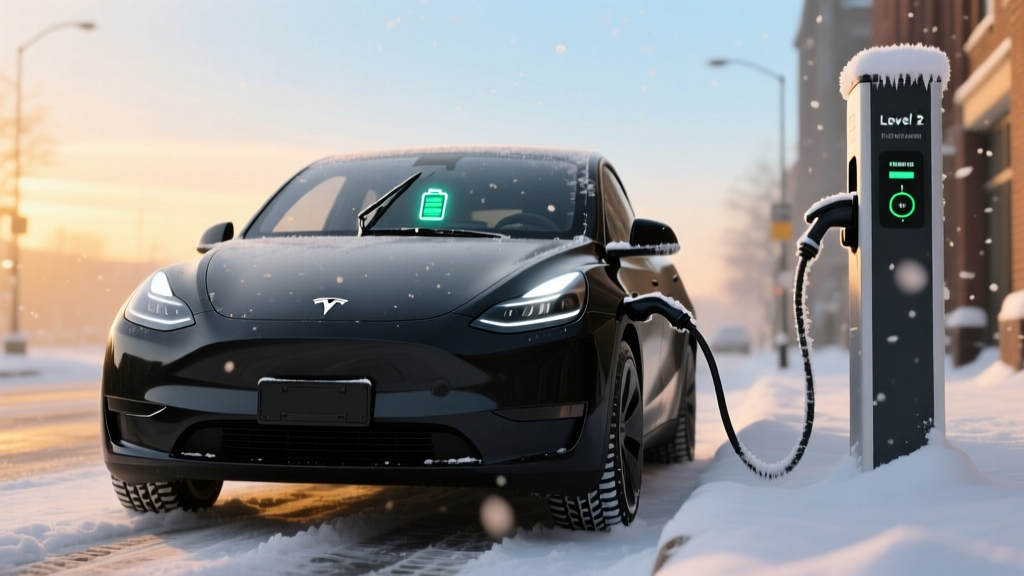
If you live where winters drop below freezing, you've probably wondered how a Tesla handles the cold. The short answer: Teslas remain among the most capable EVs in winter conditions, but you will lose range, face slower initial charging, and need to plan differently than you would in July. This guide breaks down exactly what happens to a Tesla in cold weather — with real numbers from the 2026 Model Y and Model 3 lineup, charging data, and ownership strategies that minimize winter range loss.
Which Tesla Models Are We Talking About?
For the 2026 model year, Tesla's core lineup includes the Model 3 (sedan) and Model Y (compact SUV), both available in Rear-Wheel Drive, Long Range AWD, and Performance trims. The Model S and Model X continue in limited production, while the Cybertruck occupies its own niche. This guide focuses on the Model 3 and Model Y, since they represent the vast majority of Tesla buyers and share the same thermal management architecture.
| Spec | Model 3 Long Range AWD | Model Y Long Range AWD |
|---|---|---|
| EPA Range | 341 miles | 320 miles |
| Battery Capacity (usable) | ~75 kWh (NMC) | ~75 kWh (NMC) |
| Battery Chemistry | NMC (Nickel Manganese Cobalt) | NMC (Nickel Manganese Cobalt) |
| Drivetrain | Dual-Motor AWD | Dual-Motor AWD |
| Horsepower | ~346 hp | ~384 hp |
| 0–60 mph | 4.2 seconds | 4.8 seconds |
| MPGe (combined) | 132 MPGe | 122 MPGe |
| Efficiency | 25 kWh/100 mi | 28 kWh/100 mi |
| Max DC Fast Charge | 250 kW | 250 kW |
| 10–80% DC Charge Time | ~27 minutes | ~27 minutes |
| Level 2 Home Charge Rate | 11.5 kW (~44 mi/hr) | 11.5 kW (~44 mi/hr) |
| Cargo Volume | 23 cu ft (trunk + frunk) | 72 cu ft (rear seats folded + frunk) |
| Rear Legroom | 35.3 in | 41.6 in |
| Battery Warranty | 8 yr / 120,000 mi | 8 yr / 120,000 mi |
| Base MSRP | $47,740 | $48,630 |
The Cold-Weather Range Reality: What EPA Numbers Don't Tell You
EPA range estimates are generated under controlled, moderate-temperature conditions. They don't account for the physics of lithium-ion batteries in sub-freezing air, and they don't reflect the energy cost of cabin heating. Here's what actually happens to a Tesla in cold weather:
Model 3 Long Range AWD: EPA 341 mi → Expect ~260–290 mi at 20°F with cabin heat active. At 0°F or below, expect 220–260 mi depending on trip length and preconditioning.
Model Y Long Range AWD: EPA 320 mi → Expect ~240–275 mi at 20°F. At 0°F or below, expect 210–245 mi.
Why? Cold increases battery internal resistance (reducing usable energy), and cabin heating draws 2–5 kW continuously. Short trips in extreme cold produce the worst efficiency because the battery and cabin must heat from cold every time. Longer trips improve as the battery reaches operating temperature and regenerative braking recovers.
According to testing data from fueleconomy.gov and independent EV testers, most Teslas lose between 15% and 30% of their EPA range in sustained sub-freezing driving. The loss is most severe in stop-and-go city driving at very low temperatures and least severe on longer highway trips where the battery warms up and sustains its temperature.
Cold-Weather Range Loss by Temperature
- 32–40°F: ~10–15% range loss vs. EPA
- 20–32°F: ~15–22% range loss
- 0–20°F: ~22–30% range loss
- Below 0°F: ~30–40% range loss (extreme conditions, short trips worst)
Winter Charging: Slower Starts, Heat Pump Advantages
Cold batteries charge more slowly — that's electrochemistry, not a Tesla defect. When you pull up to a Supercharger in January with a cold-soaked battery, the car must first warm the pack before it can accept peak power. Here's how Tesla's charging system handles winter:
| Charging Method | Peak Rate | Cold-Weather Behavior |
|---|---|---|
| DC Fast Charge (Supercharger V3/V4) | 250 kW peak | Without preconditioning: may start at 30–60 kW, ramping to 150–200+ kW after 10–15 min. With navigation preconditioning: near-peak speeds within 5 min. |
| 10–80% (preconditioned) | ~27 minutes | Add 5–15 minutes if battery is cold-soaked and not preconditioned |
| Level 2 Home (11.5 kW / 48A) | ~44 mi/hr added | Minimal cold impact on Level 2 — battery warms during slow charge |
| Level 1 (120V / 12A) | ~1.4 kW / ~4 mi/hr | May not gain charge in extreme cold if heating draws more than charge rate |
The Preconditioning Advantage
Tesla's navigation-based battery preconditioning is one of the brand's strongest winter features. When you enter a Supercharger as your destination, the car begins heating the battery en route, so it arrives at an optimal temperature for fast charging. This can shave 10–15 minutes off a cold-weather DC charging session. Always navigate to your Supercharger stop, even if you know the route — preconditioning only activates with an active navigation destination to a charger.
The Heat Pump Factor
All current Tesla models use an octovalve heat pump system (introduced on Model Y in 2021 and Model 3 in the 2024 Highland refresh). Unlike resistive heaters that consume 3–5 kW, the heat pump moves thermal energy more efficiently, drawing roughly 1–2 kW for cabin heating in moderate cold (above ~15°F). Below that threshold, resistive heating supplements the heat pump, and efficiency drops. Still, Tesla's thermal management system — which scavenges waste heat from the battery and drive motors — remains among the most efficient in the EV industry.
Tesla Model 3 and Model Y: Performance, Tech, and Daily Livability
Performance
The dual-motor AWD system provides excellent traction in snow and ice, with independent torque control at each axle. The Model 3 Long Range hits 60 mph in 4.2 seconds; the Model Y in 4.8 seconds. Both offer low centers of gravity from the floor-mounted battery pack, contributing to stable handling on slick roads. Tesla's traction control software is widely regarded as among the best in the industry for winter conditions.
Interior and Technology
Tesla's minimalist cabin centers on a 15.4-inch touchscreen that controls virtually every function. The 2026 Model 3 (Highland generation) features ventilated front seats, ambient lighting, rear-seat touchscreen, and significantly improved sound insulation over pre-2024 models. The Model Y received its Juniper refresh for the 2025 model year, bringing similar interior upgrades plus a power-folding second row.
Standout tech features:
- Over-the-air updates that continuously add features
- Sentry Mode dashcam recording (useful for winter hit-and-runs)
- Heated seats (all positions) and heated steering wheel — standard
- Scheduled departure preconditioning (warm cabin + battery on your commute schedule)
- Phone-as-key with automatic climate activation as you approach
Notable drawbacks:
- No physical buttons for climate, wipers, or glovebox — all touchscreen-controlled
- Turn signal stalks removed on refreshed models (steering-wheel buttons instead — divisive in winter when wearing gloves)
- Visibility: Model 3's rear window is small; Model Y's rear wiper was absent until recent refreshes
- Panel gap quality remains inconsistent, which can let in cold drafts
Cargo and Passenger Space
The Model Y is the clear winner for families: 72 cu ft of cargo with rear seats folded, a usable frunk, and 41.6 inches of rear legroom. The Model 3 sedan offers 23 cu ft total (trunk + frunk) and tighter rear seating at 35.3 inches of legroom. For winter gear — ski equipment, boots, bulky coats — the Model Y's hatchback design is substantially more practical.
Pricing, Trims, and Federal Tax Credit Eligibility
For 2026, Tesla pricing starts at approximately $38,990 for the Model 3 RWD and $44,990 for the Model Y RWD (before destination). The Long Range AWD trims — the ones most winter buyers should target — start around $47,740 (Model 3) and $48,630 (Model Y).
| Trim | Base MSRP | Est. After §30D Credit | Credit Eligibility Notes |
|---|---|---|---|
| Model 3 RWD | $38,990 | ~$31,490 (if eligible) | LFP battery — critical mineral sourcing may limit credit to $3,750 or $0 depending on current-year rules |
| Model 3 Long Range AWD | $47,740 | ~$40,240 (if eligible) | NMC battery — MSRP under $55K cap; buyer income limits apply |
| Model Y RWD | $44,990 | ~$37,490 (if eligible) | Sourcing rules apply; check current-year IRS guidance |
| Model Y Long Range AWD | $48,630 | ~$41,130 (if eligible) | MSRP under $80K SUV cap; income caps apply |
- Max credit: $7,500 (split: $3,750 for battery components + $3,750 for critical minerals)
- MSRP caps: $55,000 for sedans (Model 3) / $80,000 for SUVs (Model Y)
- Buyer income caps: $150K single / $225K head of household / $300K joint (modified AGI)
- Battery sourcing: Must meet escalating domestic-content and critical-mineral thresholds — check the latest at IRS.gov §30D page
- Point-of-sale transfer: Eligible buyers can transfer the credit to the dealer for an upfront price reduction
- Caveat: LFP battery models (Model 3 RWD) may receive reduced or no credit depending on mineral sourcing compliance for the current tax year
Tesla in Cold Weather vs. Key Competitors
How does a Tesla stack up against other EVs that winter buyers consider?
vs. Hyundai Ioniq 5 AWD: The Ioniq 5 charges faster on paper (peak 350 kW on 800V architecture, 10–80% in ~18 min when preconditioned). However, Tesla's Supercharger network reliability in remote winter corridors still outperforms third-party CCS networks. The Ioniq 5 has a physical wiper stalk and more traditional controls — a plus with gloves on.
vs. BMW iX xDrive50: The iX is significantly more expensive (~$87K) but offers superior cabin insulation, a more luxurious heated interior, and comparable cold-weather range retention. It uses CCS charging, which means relying on Electrify America or other networks on road trips.
vs. Ford Mustang Mach-E AWD: Close competitor in price and range. The Mach-E's cold-weather range loss has been documented at similar levels to Tesla (~20–30%). Ford's BlueCruise offers hands-free driving on mapped highways — a winter comfort advantage — but Tesla's Supercharger network remains a decisive road-trip edge.
- Heat pump + octovalve thermal management is best-in-class for efficiency
- Navigation-based battery preconditioning optimizes winter DC charging
- Supercharger network is the most reliable winter road-trip infrastructure
- Excellent dual-motor AWD traction control on snow and ice
- Scheduled preconditioning warms cabin and battery before your commute
- Over-the-air updates continuously improve thermal algorithms
- 15–30% range loss in sub-freezing temps — worse on short trips
- DC charging significantly slower without preconditioning
- Turn-signal buttons on steering wheel are awkward with winter gloves
- Touchscreen-only climate controls require taking gloves off
- No head-up display (defroster fog can obscure minimal instrument cluster)
- Panel gaps can cause cold air drafts in some vehicles
Who Should Buy a Tesla for Cold-Weather Driving?
Choose Tesla (Model Y Long Range AWD) if:
- You take regular winter road trips and want Supercharger reliability
- You can charge at home (Level 2) and precondition before every departure
- You value best-in-class thermal management software
- You need AWD traction and cargo space for ski gear or family winter travel
Look elsewhere if:
- You can't install home charging — cold-soaked public charging is frustrating without preconditioning
- You prefer physical buttons, stalks, and traditional controls (glove-friendly)
- Your daily winter commute is under 20 miles round-trip — a PHEV may be more efficient for short cold trips
- You need over 300 miles of real-world winter range — no current Tesla delivers that below 20°F
Winter Ownership Tips: Maximizing Your Tesla in the Cold
- Always precondition before departure. Use Scheduled Departure or manually activate climate 15–20 minutes before leaving while plugged in. This warms the battery using grid power, preserving range.
- Navigate to every Supercharger. Even if you've been there 100 times, active navigation triggers battery preconditioning.
- Charge to 80–90% in winter, not 70%. The range buffer matters more when you're losing 20%+ to cold. (NMC batteries tolerate higher states of charge better in cold weather than in summer heat.)
- Use seat heaters over cabin air heat when possible. Seat heaters draw ~100W per seat vs. 2,000–5,000W for cabin air heating. In moderate cold, this can save 5–10% of range.
- Keep winter tires on from November through March. Tesla's all-season tires are adequate but not optimal on ice. Winter tires dramatically improve braking distance and regenerative braking effectiveness on cold, slick surfaces.
- Garage your car if possible. A garage at 40°F vs. outdoors at 10°F means dramatically faster initial charging and less preconditioning energy.
Frequently Asked Questions
What is the real-world range of a Tesla in cold weather?
For the 2026 Model Y Long Range AWD (EPA 320 mi), expect approximately 240–275 miles at 20°F and 210–245 miles at 0°F or below. The Model 3 Long Range AWD (EPA 341 mi) returns roughly 260–290 miles at 20°F and 220–260 miles at extreme cold. Short trips worsen these numbers; longer highway drives improve them as the battery reaches operating temperature.
How fast does a Tesla charge in cold weather?
At a 250 kW Supercharger with a preconditioned battery, expect 10–80% in about 27 minutes regardless of outside temperature. Without preconditioning, a cold-soaked battery may start charging at 30–60 kW and take 40–50+ minutes for the same session. Always use navigation to trigger preconditioning.
How much does a Tesla cost after federal tax credits?
A 2026 Model 3 Long Range AWD at $47,740 MSRP could cost approximately $40,240 if you qualify for the full $7,500 §30D credit. However, eligibility depends on your income (under $150K single / $300K joint), battery component and critical mineral sourcing compliance, and MSRP caps. The LFP-powered Model 3 RWD may receive a reduced credit or none at all due to mineral sourcing. Always verify current-year rules at IRS.gov.
Is Tesla worth buying over competitors for winter driving?
For road-trippers who need reliable winter charging infrastructure, Tesla's Supercharger network remains a decisive advantage. The thermal management system (heat pump + octovalve) is best-in-class. However, if you prioritize physical controls, traditional ergonomics, or CCS charging flexibility, the Hyundai Ioniq 5 or Ford Mach-E are strong alternatives with similar cold-weather range retention.
Does Tesla's battery warranty cover cold-weather degradation?
Tesla's battery warranty covers 8 years / 120,000 miles (Long Range AWD) with a minimum 70% capacity retention threshold. Normal cold-weather range reduction is not a warranty claim — it's expected physics. However, if your battery drops below 70% of original capacity within the warranty period regardless of cause, Tesla will repair or replace it.
Do I need winter tires on my Tesla?
Strongly recommended if you regularly drive on snow or ice. Tesla's stock all-season tires provide adequate cold-weather grip but cannot match dedicated winter tires on ice or packed snow. Winter tires also improve regenerative braking effectiveness, which is limited on slippery surfaces regardless of tire choice. Many Tesla owners run a dedicated set of winter wheels and tires from November through March.