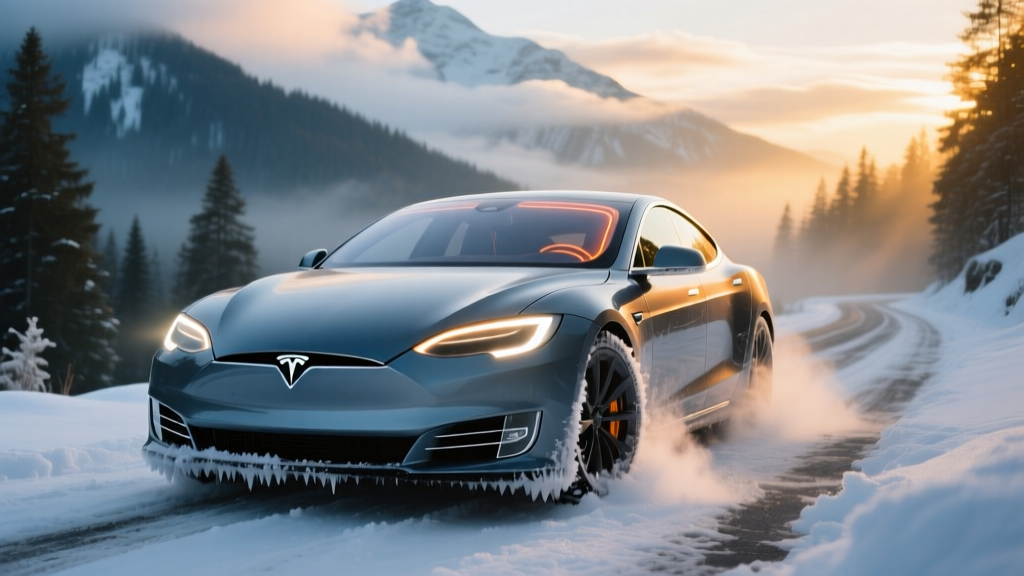
If you've ever watched your Tesla's range drop dramatically on a freezing morning and wondered whether there's a fix, you're not alone. Searches for "what is the cold weather feature on Tesla" spike every winter — and the answer isn't a single button, but a suite of thermal management technologies and driver-facing tools designed to fight one of an EV's biggest weaknesses: lithium-ion batteries hate the cold.
This guide walks through every cold-weather system Tesla builds into its 2026 lineup — from the octovalve heat pump to battery preconditioning and scheduled departure — and pairs them with hard data on how much range you actually lose below freezing. We'll also cover the full spec profile for each model so you know exactly what you're buying.
The Core Answer: Tesla's Cold Weather Feature Suite
Tesla doesn't offer one "cold weather mode." Instead, it bundles several systems under software controls that activate automatically or via the app:
- Battery preconditioning — warms the pack ahead of driving or Supercharging using grid power (when plugged in) or battery energy.
- Octovalve heat pump — scavenges waste heat from the drive unit, battery, and ambient air to heat the cabin 2-4x more efficiently than resistive heaters.
- Scheduled Departure — preconditions battery and cabin at a set time while plugged in, so you leave with a warm pack and full range.
- Camp Mode / Dog Mode / Sentry with climate — maintain cabin temps during extended stops in cold conditions.
- Heated seats, steering wheel, and (on some trims) rear seats — use far less energy than cabin air heating.
- Navigation-routed preconditioning — the car warms the battery automatically when you navigate to a Supercharger in cold weather.
Together, these are what Tesla owners and forums shorthand as "the cold weather feature." None of them eliminate cold-weather range loss — physics doesn't allow that — but they meaningfully reduce it.
How Much Range Do Teslas Actually Lose in Cold Weather?
Every lithium-ion pack loses capacity and gains internal resistance as temperature drops. Based on aggregated fleet data from Recurrent Auto and real-world owner logs, expect these losses in a 2026 Tesla when ambient temps sit between 20°F and 32°F:
EPA range is measured at ~72°F. At 25°F, expect 70-80% of EPA range for highway driving. Below 10°F, losses can reach 35-40% without preconditioning. Scheduled Departure while plugged in recovers 10-15% of that loss.
| Model / Trim | EPA Range (mi) | Real-World Cold Range (mi) | % Loss |
|---|---|---|---|
| Model 3 Long Range AWD | 363 | ~275-290 | ~20-25% |
| Model 3 RWD (LFP) | 272 | ~195-215 | ~25-30% |
| Model Y Long Range AWD | 320 | ~240-260 | ~20-25% |
| Model S Long Range | 402 | ~305-325 | ~20-25% |
| Model X Long Range | 335 | ~250-270 | ~20-25% |
| Cybertruck AWD | 340 | ~255-275 | ~20-25% |
LFP (lithium iron phosphate) packs in the Model 3 RWD suffer slightly worse cold-weather losses than NMC packs — one of the trade-offs for their longer cycle life and lower cost. If you live where winters regularly dip below freezing, NMC-equipped Long Range trims are the better fit.
Full 2026 Tesla Lineup: Specs That Matter in Winter
| Spec | Model 3 LR AWD | Model Y LR AWD | Model S LR | Cybertruck AWD |
|---|---|---|---|---|
| Battery (usable kWh) | 75 kWh NMC | 75 kWh NMC | 95 kWh NMC | 123 kWh NMC |
| EPA Range | 363 mi | 320 mi | 402 mi | 340 mi |
| MPGe (combined) | 132 MPGe | 122 MPGe | 122 MPGe | 76 MPGe |
| Efficiency | 25 kWh/100mi | 28 kWh/100mi | 28 kWh/100mi | 48 kWh/100mi |
| Max DC Charge (kW) | 250 kW | 250 kW | 250 kW | 250 kW |
| 10-80% DCFC | ~25 min | ~25 min | ~30 min | ~35 min |
| Level 2 (kW / mi-hr) | 11.5 kW / 44 mi/hr | 11.5 kW / 39 mi/hr | 11.5 kW / 41 mi/hr | 11.5 kW / 28 mi/hr |
| 0-60 mph | 4.2 sec | 4.8 sec | 3.1 sec | 3.9 sec |
| Horsepower | 346 hp | 384 hp | 670 hp | 600 hp |
| Drivetrain | Dual-Motor AWD | Dual-Motor AWD | Dual-Motor AWD | Dual-Motor AWD |
| Cargo (cu ft) | 23 (trunk+frunk) | 76 (rear folded) | 28 (trunk+frunk) | ~68 (vault+frunk) |
| Rear Legroom (in) | 35.3 | 37.3 | 35.4 | ~36 |
| Battery Warranty | 8 yr / 120,000 mi | 8 yr / 120,000 mi | 8 yr / 150,000 mi | 8 yr / 120,000 mi |
| Base MSRP | $47,740 | $48,240 | $74,990 | $79,990 |
Source: fueleconomy.gov and Tesla's 2026 spec sheets.
The Heat Pump and Octovalve: Why They Matter
Pre-2021 Teslas used resistive (PTC) cabin heaters — essentially electric space heaters that could pull 3-5 kW continuously. That's 10-20% of your pack on a cold highway drive just keeping you warm.
The current-generation octovalve heat pump, standard across the 2026 lineup, pulls heat from three sources: ambient air, drive-unit waste heat, and battery waste heat. It delivers roughly 2-4 units of cabin heat per unit of electrical energy consumed (COP of 2-4 vs. 1.0 for resistive). The result: cabin heating in a Model Y at 30°F draws about 1-2 kW instead of 4 kW, adding roughly 15-25 miles of range back per 100 miles driven.
Below about 10°F, heat pump efficiency drops and the system supplements with a low-power resistive element. Still better than pure PTC, but don't expect miracles in deep sub-zero.
Preconditioning Done Right: The Owner's Playbook
The single biggest cold-weather mistake new Tesla owners make is skipping preconditioning. Here's the protocol that minimizes range loss and charging delays:
- Set Scheduled Departure in the Tesla app for your typical leave time, with "Off-Peak Charging" windows if your utility offers them. The car wakes itself, warms battery and cabin on grid power, and tops off to your charge limit.
- Always navigate to Superchargers — even if you know the route. Navigation triggers automatic battery preconditioning 15-45 minutes before arrival, which can cut a cold-weather 10-80% charge from 50+ minutes down to ~25.
- Use heated seats and steering wheel first — they draw ~100W combined vs. 1-3 kW for cabin air heat. Set cabin temp to 66-68°F rather than 72°F.
- Keep plugged in when parked — even a 120V outlet lets the car run battery thermal management without draining SoC.
Pros — Tesla in Cold Weather
- Heat pump is best-in-class efficiency
- Preconditioning is automatic via navigation
- Supercharger network is most reliable in winter conditions
- AWD traction across all dual-motor trims
- Over-the-air updates keep improving thermal algorithms
Cons — Tesla in Cold Weather
- LFP packs (Model 3 RWD) lose more range below freezing
- Door handles and window seals can freeze shut
- No physical buttons — glove use requires touchscreen tweaks
- Regen braking is limited on cold packs until warmed
- Cybertruck's stainless body holds cold and condensates
Pricing, Trims, and Federal Tax Credit Eligibility
Under current IRS §30D rules, Tesla's 2026 lineup faces a mixed credit picture:
| Model | Base MSRP | As-Tested (typical) | §30D Eligibility | After Max Credit |
|---|---|---|---|---|
| Model 3 LR AWD | $47,740 | $51,240 | Up to $7,500* | ~$40,240 |
| Model 3 RWD | $38,990 | $41,490 | Up to $7,500* | ~$31,490 |
| Model Y LR AWD | $48,240 | $52,740 | Up to $7,500* | ~$40,740 |
| Model S LR | $74,990 | $82,490 | Eligible (under $55k sedan cap? NO — sedan cap is $55k; Model S exceeds) | $74,990 (no credit) |
| Model X LR | $79,990 | $87,490 | Eligible (SUV/van cap $80k — borderline) | Varies |
| Cybertruck AWD | $79,990 | $94,990 | Eligible (truck cap $80k — base only) | Base only ~$72,490 |
*Eligibility depends on buyer AGI ($150k single / $300k joint), battery critical-mineral and component sourcing rules, and MSRP caps by vehicle class. Point-of-sale transfer is available at participating dealers. Verify on irs.gov before purchase.
Should You Buy a Tesla for Cold-Weather Driving?
- You have home Level 2 charging (critical for preconditioning on grid power)
- You value the Supercharger network for winter road trips where other networks are less reliable
- You want OTA-improving thermal management year over year
- You drive a Long Range NMC trim in cold climates
- You need a physical-button interior for gloved operation
- You want 800V architecture for faster cold-weather DCFC recovery (Ioniq 5)
- You need true off-road winter capability (Rivian)
Frequently Asked Questions
What is the cold weather feature on Tesla called?
There's no single named feature. The umbrella term covers battery preconditioning, the octovalve heat pump, Scheduled Departure, and navigation-routed thermal prep. Tesla's owner manual groups them under "cold weather best practices" rather than one branded mode.
Does preconditioning really save range?
Yes. On a 25°F morning, preconditioning a Model Y Long Range while plugged in typically recovers 15-25 miles of otherwise-lost range per full charge versus driving cold. It also enables full regen braking from mile one.
Do Teslas lose range in winter more than other EVs?
About the same, actually. Independent testing shows most EVs lose 20-30% at 25°F. Tesla's heat pump is slightly more efficient than competitors using resistive heat, but battery chemistry physics applies to everyone. Hyundai's Ioniq 5 with its heat pump performs similarly.
Should I buy the LFP Model 3 RWD in a cold climate?
If winters regularly drop below 25°F, the LFP Model 3's steeper cold-weather loss (25-30% vs. 20-25% for NMC) is a real drawback. The 272-mile EPA range becomes ~200 miles in cold highway driving. Long Range NMC trims are worth the premium in Minnesota, New England, or mountain states.
Does Tesla's battery warranty cover cold-related degradation?
The 8-year/120,000-mile (150,000 on Model S/X) battery warranty covers capacity loss below 70% of original, regardless of climate. Normal cold-weather range reduction is not a warranty claim — that's chemistry, not failure. Document SoH via the car's service menu.
How do I precondition a Tesla remotely?
Open the Tesla app → Climate → turn on. The car will warm the cabin and, if plugged in, begin battery preconditioning. For daily automation, use Scheduled Departure in the app's Charging tab — set your leave time and the car handles everything on grid power.
Does Autopilot work in snow?
Autopilot and FSD (Supervised) are SAE Level 2 driver-assist systems. They require full driver engagement at all times. In heavy snow, lane markings disappear and camera visibility drops — the system will issue warnings and disengage. You are always responsible for the vehicle. Winter tires are strongly recommended on any Tesla driven in snow.
For current federal incentive details, always verify on IRS.gov §30D guidance. Range and efficiency data from fueleconomy.gov and Tesla's 2026 model-year spec sheets.