When buyers search for the "Tesla chip," they are usually asking one of two questions: what silicon powers Tesla's driver-assistance stack in 2026, and does it affect range, charging, or ownership in a measurable way? The short answer is that Tesla's in-house FSD (Full Self-Driving) computer — now in its Hardware 4 (HW4) generation across Model 3, Model Y, Model S, and Model X — does not directly change EPA range or battery chemistry, but it reshapes camera fidelity, processing throughput, and the ceiling for FSD (Supervised) capability. This review breaks down what the Tesla chip actually does, how it interacts with the 2026 lineup's battery and charging hardware, and whether it should influence your purchase decision.
What the Tesla Chip Actually Is (and Is Not)
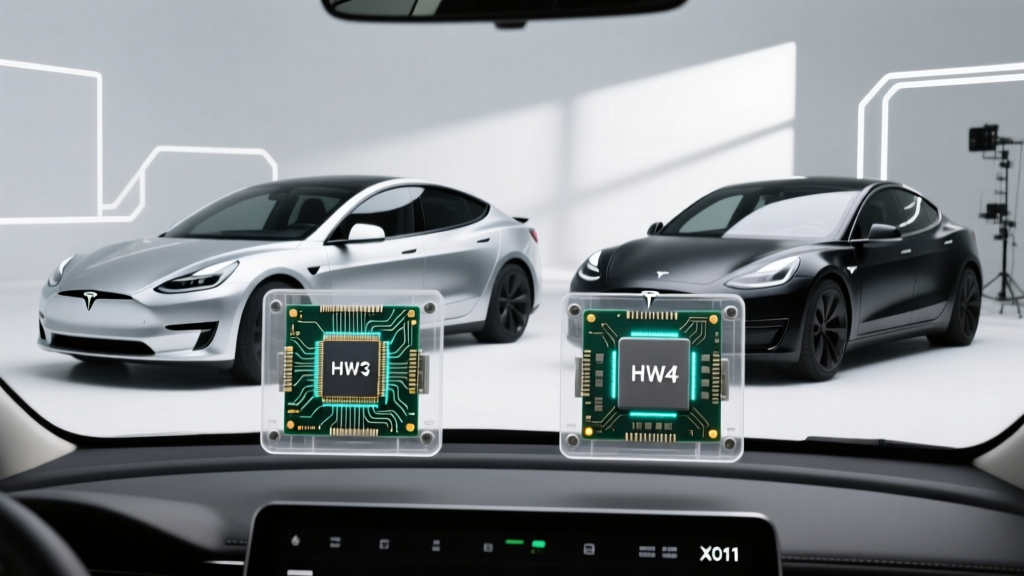
Tesla designs its own inference silicon for Autopilot and FSD (Supervised). The current-generation HW4 computer, rolled out broadly starting in 2023 and standard on all 2026 vehicles, features a redesigned neural-network accelerator that Tesla claims delivers roughly 2–3× the compute throughput of the older HW3 unit. Cameras on HW4 vehicles operate at higher resolution (up to 5 megapixels vs. 1.2 MP on HW3) and have improved low-light performance thanks to updated lens assemblies and sensor tuning.
The Tesla chip does not manage battery thermal conditioning, motor control, or charging curves — those are handled by separate powertrain and BMS (battery management system) controllers. So while HW4 improves the vision pipeline, it will not add miles to your EPA sticker. What it does change is how confidently FSD (Supervised) handles complex intersections, construction zones, and poorly marked roads.
2026 Tesla Lineup: Chip, Range, and Battery Specs
Every new Tesla sold in 2026 ships with HW4. Below is a consolidated spec table for the highest-volume models. Battery chemistry varies by trim: the Standard Range (RWD) Model 3 and Model Y use LFP (lithium iron phosphate) packs, while Long Range and Performance trims use NMC (nickel manganese cobalt) chemistry for higher energy density.
| Spec | Model 3 RWD | Model 3 Long Range AWD | Model Y Long Range AWD | Model Y Performance |
|---|---|---|---|---|
| EPA Range | 272 mi | 363 mi | 320 mi | 298 mi |
| Battery (usable) | ~60 kWh LFP | ~79 kWh NMC | ~79 kWh NMC | ~79 kWh NMC |
| 0–60 mph | 5.8 sec | 4.2 sec | 4.8 sec | 3.5 sec |
| Horsepower | 271 hp | 346 hp | 384 hp | 455 hp |
| Drivetrain | RWD | Dual-Motor AWD | Dual-Motor AWD | Dual-Motor AWD |
| Efficiency (MPGe) | 132 MPGe | 134 MPGe | 117 MPGe | 111 MPGe |
| Tesla Chip | HW4 | HW4 | HW4 | HW4 |
| Base MSRP | $38,990 | $45,240 | $46,380 | $52,490 |
Source: fueleconomy.gov and Tesla.com order pages. MSRPs reflect 2026 model-year pricing before incentives.
Real-World Range: What the EPA Sticker Doesn't Tell You
EPA Estimate: 363 miles
Highway (70–75 mph, mild weather): ~290–310 miles
Cold weather (below 30°F, mixed driving): ~240–270 miles
City / stop-and-go with regen: ~340–360 miles
Tesla's EPA range numbers are among the most optimistic in the industry because the test cycle's city-heavy profile favors regenerative braking. On sustained highway runs at 70–75 mph, expect to use 75–85% of the EPA sticker in moderate temperatures. In freezing conditions, LFP packs (Model 3 RWD, Model Y RWD) lose a larger share of range — sometimes 30–35% — because LFP chemistry is more sensitive to low temperatures and the pack must be actively heated. NMC Long Range models fare slightly better, losing roughly 20–28% in deep cold.
The Tesla chip (HW4) does not factor into range loss. Thermal management, driving speed, terrain, and ambient temperature remain the dominant variables. If range predictability matters to you, the Long Range AWD trims with NMC packs offer the widest real-world buffer.
Charging Speed: DC Fast Charge and Home Level 2
Charging infrastructure is where ownership gets practical. The Tesla chip plays no role here — charging speed is governed by the battery's C-rate capability, thermal preconditioning, and the Supercharger network. Tesla's North American Charging Standard (NACS) connector is now the industry default, and Tesla vehicles natively use it without adapters.
| Charging Level | Power (kW) | Rate (mi/hr) | 10–80% Time | Notes |
|---|---|---|---|---|
| Level 1 (120V) | ~1.4 kW | 3–5 mi/hr | N/A (days) | Emergency / trickle only |
| Level 2 (240V home) | 11.5 kW | ~37 mi/hr | ~7–8 hours (0–100%) | Tesla Wall Connector, 48A circuit |
| DC Fast (V3 Supercharger) | Peak 250 kW | ~1,000 mi/hr peak | ~25–30 min | Sustained rate drops above 60% SoC |
| DC Fast (V4 Supercharger) | Peak 300+ kW | ~1,200 mi/hr peak | ~18–22 min | Available at select corridors; model-dependent |
A critical detail many buyers miss: peak kW is not sustained kW. A Model 3 Long Range might hit 250 kW at a low state of charge (SoC), but the charge curve tapers significantly above 60% SoC. The 10–80% time of 25–30 minutes at a V3 Supercharger reflects this taper. Preconditioning the battery by navigating to a Supercharger in the Tesla nav system is essential — arriving with a cold pack can double your charging time.
Pricing, Trims, and Federal Tax Credit Eligibility
| Model / Trim | Base MSRP | Est. §30D Credit | Effective Price | MSRP Cap Status |
|---|---|---|---|---|
| Model 3 RWD | $38,990 | Up to $7,500 | ~$31,490 | Under $55K cap ✓ |
| Model 3 Long Range AWD | $45,240 | Up to $7,500 | ~$37,740 | Under $55K cap ✓ |
| Model Y Long Range AWD | $46,380 | Up to $7,500 | ~$38,880 | Under $80K cap ✓ |
| Model Y Performance | $52,490 | Up to $7,500 | ~$44,990 | Under $80K cap ✓ |
| Model S / Model X | $79,990+ | $0 (exceeds MSRP cap) | $79,990+ | Over $55K sedan / $80K SUV cap ✗ |
- MSRP Caps: Sedans (Model 3) must be under $55,000; SUVs (Model Y) under $80,000. Model S and Model X exceed these caps and do not qualify.
- Buyer Income Limits (2026 tax year): AGI must not exceed $150,000 (single), $225,000 (head of household), or $300,000 (married filing jointly). The credit phases out at these thresholds — check your prior-year or current-year AGI, whichever is lower.
- Battery Sourcing (§30D): The full $7,500 credit requires meeting both critical-mineral and battery-component sourcing thresholds. Tesla's US-built LFP packs have faced scrutiny on critical-mineral sourcing; some trims may qualify for only $3,750 (the battery-component half). Verify current eligibility at IRS.gov §30D before purchase.
- Point-of-Sale Transfer: Eligible buyers can transfer the credit to the dealer at purchase, reducing the out-of-pocket price immediately rather than waiting for a tax refund.
Cargo, Interior Space, and Daily Practicality
The Tesla chip conversation rarely touches interior utility, but it matters for buyers cross-shopping the Model Y against the Hyundai Ioniq 5 or Ford Mustang Mach-E. Here are the hard numbers:
- Model 3: 23 cu ft trunk (rear seats up), 65 cu ft with seats folded. Rear legroom: 35.2 in. Front trunk (frunk): 4.1 cu ft.
- Model Y: 30 cu ft cargo behind second row, 72 cu ft with seats folded. Optional third row reduces cargo. Rear legroom: 41.6 in. Frunk: 4.1 cu ft.
The Model Y's taller roofline and hatchback design make it meaningfully more practical for families and cargo than the Model 3 sedan. If you regularly haul strollers, hockey gear, or luggage for four, the Model Y's volume advantage is substantial.
Tech, Autopilot, and the HW4 Advantage
The Tesla chip's primary value proposition is the vision pipeline. HW4's higher-resolution cameras and improved neural-network processing deliver:
- Better object detection at distance: HW4 can resolve objects and lane markings further ahead, improving highway Autopilot smoothness and lane-change decisions.
- Improved low-light and rain performance: Updated camera sensors reduce noise in dusk, dawn, and precipitation scenarios.
- FSD (Supervised) capability ceiling: Complex urban scenarios — unprotected left turns, construction-zone rerouting, parking-lot navigation — show measurably fewer disengagements on HW4 vehicles in Tesla's internal data.
The 15.4-inch center touchscreen handles all vehicle controls, navigation, and entertainment. Tesla's infotainment remains one of the fastest and most responsive in the industry, though the lack of Apple CarPlay and Android Auto is a persistent complaint among cross-shoppers accustomed to phone projection.
Warranty and Battery Longevity
Tesla's warranty structure is competitive but not class-leading:
- Basic Vehicle: 4 years / 50,000 miles
- Battery & Drive Unit (Model 3/Y RWD with LFP): 8 years / 100,000 miles, 70% minimum capacity retention
- Battery & Drive Unit (Long Range / Performance, NMC): 8 years / 120,000 miles, 70% minimum capacity retention
Tesla's 70% retention threshold is standard for the industry. Real-world degradation data from fleet aggregators shows most NMC packs retaining 88–92% capacity at 100,000 miles. LFP packs tend to degrade more slowly overall but can exhibit more variance in state-of-charge estimation accuracy, which is why Tesla recommends periodic 100% charges for LFP vehicles to recalibrate the BMS.
Pros, Cons, and Who Should Buy
Pros
- Class-leading Supercharger network reliability
- HW4 chip provides best-in-class vision processing for Level 2 ADAS
- Strong efficiency (MPGe) across the lineup
- Over-the-air updates continuously add features
- Point-of-sale tax credit transfer available
Cons
- No Apple CarPlay / Android Auto
- FSD (Supervised) is expensive and still requires full driver attention
- LFP cold-weather range loss is significant
- Insurance premiums run 15–25% above segment average
- Model S/X excluded from federal tax credit
Who This EV Suits Best
Choose the Model 3 RWD if: You commute under 40 miles round-trip, have reliable home Level 2 charging, live in a mild climate, and want the lowest entry price after tax credits.
Choose the Model 3 Long Range AWD if: You take regular road trips of 200–300 miles, drive in cold weather, and want the widest real-world range buffer.
Choose the Model Y Long Range AWD if: You need family cargo space, tow occasionally (up to 3,500 lbs rated), and want SUV practicality with strong range.
Look elsewhere if: You demand physical controls, want CarPlay integration, or need Level 4 autonomy (no consumer vehicle offers this today).
Frequently Asked Questions
What is the real-world range of a 2026 Tesla Model 3 Long Range?
The EPA rates it at 363 miles, but sustained highway driving at 70–75 mph yields approximately 290–310 miles in mild weather and 240–270 miles in sub-freezing temperatures. City driving with regenerative braking can approach the EPA sticker.
How fast does a Tesla charge at home and on the road?
At home on a Level 2 Tesla Wall Connector (11.5 kW / 48A), a Model 3 Long Range gains roughly 37 miles per hour, fully charging overnight in 7–8 hours. On a V3 Supercharger (250 kW peak), 10–80% takes 25–30 minutes with a preconditioned battery. V4 Superchargers at select locations can reduce this to 18–22 minutes.
How much does a Tesla cost after the federal tax credit?
A 2026 Model 3 RWD starts at $38,990 and may qualify for up to $7,500 under IRS §30D, bringing the effective price to approximately $31,490 — subject to buyer income limits, battery-sourcing rules, and the $55,000 MSRP cap for sedans. Model S and Model X do not qualify due to price-cap exceedance.
Does the Tesla chip (HW4) affect range or efficiency?
No. The HW4 FSD computer handles camera processing and neural-network inference for Autopilot and FSD (Supervised). It does not control battery management, motor output, or thermal conditioning. Range and efficiency are determined by battery chemistry, aerodynamics, driving behavior, and ambient temperature.
Is a Tesla worth buying vs. the Hyundai Ioniq 5 or Ford Mustang Mach-E?
Tesla's advantages are the Supercharger network, HW4 vision processing, and software ecosystem. The Ioniq 5 offers faster 800V DC charging (10–80% in ~18 minutes), CarPlay, and more distinctive styling. The Mach-E offers a more traditional cockpit layout. If Supercharger access and ADAS capability are priorities, Tesla leads. If charging speed and interior ergonomics matter more, cross-shop aggressively.
Does the 2026 Tesla Model Y qualify for the $7,500 federal EV tax credit?
The Model Y Long Range and Performance both fall under the $80,000 SUV MSRP cap and may qualify for up to $7,500, depending on the buyer's AGI and the vehicle's battery-sourcing compliance. Some trims may only qualify for $3,750 if critical-mineral thresholds are not fully met. Always verify at IRS.gov before purchasing.