Tesla's China Surge: Why Q1 2026 Matters to American Buyers
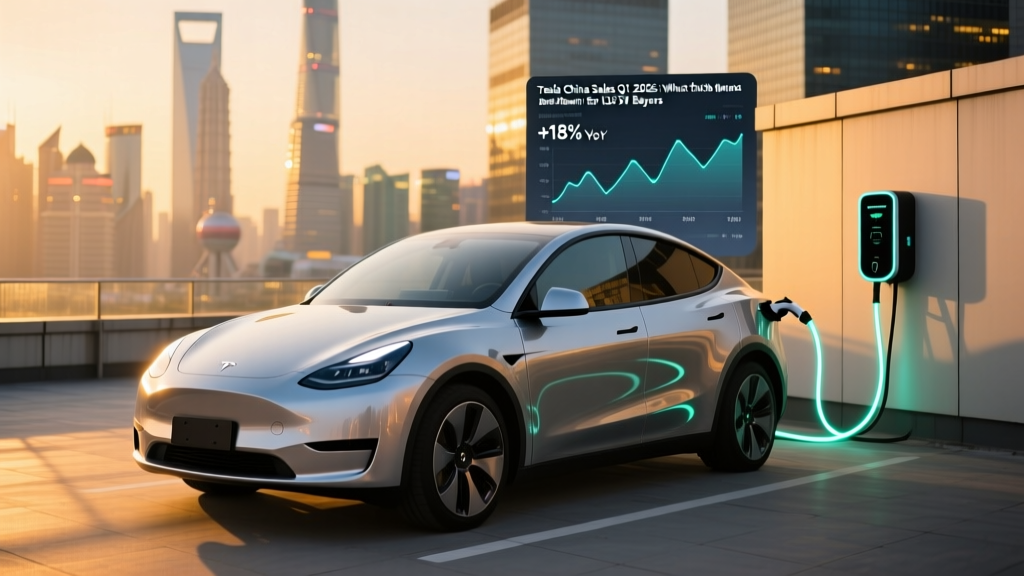
Tesla China sales Q1 2026 figures have drawn widespread attention, and for good reason. Giga Shanghai — Tesla's highest-throughput factory globally — reported approximately 228,000 vehicle deliveries in the first quarter of 2026, a figure that underscores China's role as both Tesla's largest market and its primary export hub. For US-based EV shoppers, these numbers aren't just corporate earnings fodder. They directly influence the vehicles sitting on American lots: pricing pressure, battery chemistry availability, and trim-level configurations all trace back to what happens in Shanghai.
This analysis breaks down what Tesla's China performance in early 2026 means for US buyers considering a Model 3 or Model Y today, with a hard look at real specs, real-world range, charging realities, and tax credit eligibility.
The Shanghai Effect: How China Production Shapes US Inventory
Giga Shanghai produces both the Model 3 (Highland refresh and subsequent updates) and Model Y (Juniper refresh) for domestic Chinese consumption and export to Europe, Asia-Pacific, and select other markets. While US-market Teslas are built primarily at Giga Texas (Model Y) and Giga Fremont (Model 3), China's production scale exerts competitive pressure on global pricing.
In Q1 2026, Tesla's China-made vehicles benefited from:
- LFP battery scale: CATL-supplied lithium iron phosphate (LFP) cells, standard in base Model 3/Y trims, continued to drop in cost — giving Tesla margin room to cut US prices on RWD trims.
- Export volume shifts: As BYD and NIO intensified competition in China, Tesla redirected more Shanghai-built units to international markets, stabilizing global supply chains.
- Pricing signal: Chinese-market Model 3 pricing (starting around ¥231,900 / ~$32,000) set a benchmark that pressured Tesla to keep US MSRPs competitive, contributing to the 2026 Model 3 RWD starting at $38,990.
The practical takeaway: strong China sales volumes help keep US Tesla pricing from creeping upward, even as tariff and sourcing complexities evolve.
Model 3 (2026): Specs, Range, and Real-World Efficiency
The 2026 Tesla Model 3 continues with the refreshed "Highland" platform introduced in late 2023, now in its third model year with minor software and efficiency tweaks. Here's the full spec breakdown for the US market:
| Spec | RWD (Base) | Long Range AWD | Performance |
|---|---|---|---|
| EPA Range | 272 mi | 341 mi | 315 mi |
| Battery (usable) | ~57 kWh (LFP) | ~75 kWh (NMC) | ~75 kWh (NMC) |
| Drivetrain | RWD, single motor | AWD, dual motor | AWD, dual motor |
| Horsepower | 271 hp | 346 hp | 510 hp |
| 0-60 mph | 5.8 sec | 4.2 sec | 2.9 sec |
| MPGe (combined) | 132 MPGe | 125 MPGe | 118 MPGe |
| kWh/100 mi | 25 kWh | 27 kWh | 29 kWh |
| Peak DC Charge | 170 kW | 250 kW | 250 kW |
| 10-80% DCFC Time | ~25 min | ~18 min | ~18 min |
| Level 2 Rate | 11.5 kW (~44 mi/hr) | 11.5 kW (~44 mi/hr) | 11.5 kW (~44 mi/hr) |
| Base MSRP | $38,990 | $45,990 | $52,990 |
The Model 3 RWD's EPA-estimated 272 miles assumes mixed driving at moderate temperatures. In real-world highway testing at 70-75 mph, expect approximately 235-250 miles before needing a charge. In cold weather (below 32°F), range can drop 20-30%, bringing usable range down to roughly 190-215 miles. The LFP battery in the RWD trim is also more sensitive to cold-weather charging slowdowns — preconditioning via the Tesla app or navigation is essential before DC fast charging in winter. The Long Range AWD, with its NMC pack and heat pump, fares better, typically delivering 290-310 miles on the highway and 250-270 in freezing conditions.
Model Y (2026): The Volume Leader Under Pressure
The refreshed Model Y (internally "Juniper") entered production at Giga Texas in early 2025 and carries into 2026 with updated styling, improved ride quality, and a ventilated-seat option. It remains the best-selling EV in the US and a primary beneficiary of Tesla's global pricing strategy influenced by China volumes.
| Spec | RWD (Base) | Long Range AWD | Performance |
|---|---|---|---|
| EPA Range | 280 mi | 330 mi | 300 mi |
| Battery (usable) | ~60 kWh (LFP) | ~75 kWh (NMC) | ~75 kWh (NMC) |
| Drivetrain | RWD, single motor | AWD, dual motor | AWD, dual motor |
| Horsepower | 295 hp | 384 hp | 510 hp |
| 0-60 mph | 5.5 sec | 4.1 sec | 3.1 sec |
| MPGe (combined) | 123 MPGe | 117 MPGe | 111 MPGe |
| kWh/100 mi | 27 kWh | 29 kWh | 30 kWh |
| Peak DC Charge | 170 kW | 250 kW | 250 kW |
| 10-80% DCFC Time | ~28 min | ~20 min | ~20 min |
| Level 2 Rate | 11.5 kW (~37 mi/hr) | 11.5 kW (~37 mi/hr) | 11.5 kW (~37 mi/hr) |
| Base MSRP | $42,990 | $48,990 | $54,990 |
| Cargo (rear seats up) | 30.2 cu ft (76 cu ft max with seats folded) | ||
| Rear Legroom | 40.5 in | ||
The Model Y's cargo advantage over the Model 3 (which offers 23 cu ft trunk + frunk) is a decisive factor for families. The Juniper refresh also improved rear-seat comfort with a longer cushion and acoustic glass, addressing two of the prior generation's most common complaints.
Charging Deep Dive: What US Owners Actually Experience
Tesla's Supercharger network remains the gold standard for public DC fast charging, with over 6,500 V4 stalls operational in the US as of Q1 2026. But peak kW ratings only tell part of the story.
A Model 3 Long Range peaks at 250 kW, but only between roughly 10-30% State of Charge (SoC). From 30-60%, the rate tapers to ~180 kW; from 60-80%, it drops further to ~100 kW. The 10-80% time of ~18 minutes is accurate, but that last 20% (80-100%) can add another 20-25 minutes. For road trips, plan stops around the 10-80% window and skip topping off unless you're at your destination.
Home charging: Both the Model 3 and Model Y accept 11.5 kW on Level 2 (48-amp circuit, requiring a 60-amp breaker). A full home installation with a Tesla Wall Connector typically runs $800-$2,000 depending on panel proximity and whether your electrical panel needs a 200-amp upgrade ($1,500-$3,000 additional). On 11.5 kW, the Model 3 RWD adds roughly 44 miles per hour of charging — enough to fully replenish overnight for any daily commute.
Level 1 (120V) charging via the Mobile Connector adds only 3-5 miles per hour. It's viable for overnight top-ups if you drive under 40 miles daily, but not practical as a primary charging strategy.
Per fueleconomy.gov, the Model 3 RWD's 25 kWh/100 mi efficiency translates to roughly $0.10-$0.14 per mile on the US average electricity rate of $0.17/kWh — compared to $0.14-$0.18 per mile for a 30 MPG gas car at $3.50/gallon.
Federal Tax Credit Eligibility: The §30D Reality for 2026
The IRS §30D clean vehicle credit remains available for 2026 Tesla purchases, but eligibility hinges on several conditions that change periodically. Here's what applies to Tesla's US-built vehicles as of early 2026:
- MSRP caps: Sedans (Model 3) must be under $55,000; SUVs/trucks (Model Y) under $80,000. All current Model 3 and Model Y trims fall within these limits.
- Buyer income caps: Modified adjusted gross income (MAGI) must not exceed $150,000 (single), $225,000 (head of household), or $300,000 (married filing jointly).
- Battery sourcing requirements: A percentage of critical minerals and battery components must be sourced from the US or FTA partners. Tesla's LFP cells (from CATL, China) face increasing scrutiny under these rules, and the RWD trims using LFP may see reduced credit eligibility (potentially $3,750 instead of $7,500) depending on the latest Treasury Department guidance.
- Point-of-sale transfer: Buyers can transfer the credit to the dealer at purchase, reducing the out-of-pocket price immediately rather than waiting for tax filing.
| Model/Trim | MSRP | Est. §30D Credit | Effective Price |
|---|---|---|---|
| Model 3 RWD | $38,990 | $3,750 - $7,500* | $31,490 - $35,240 |
| Model 3 Long Range AWD | $45,990 | $7,500 | $38,490 |
| Model Y RWD | $42,990 | $3,750 - $7,500* | $35,490 - $39,240 |
| Model Y Long Range AWD | $48,990 | $7,500 | $41,490 |
| Model Y Performance | $54,990 | $7,500 | $47,490 |
*LFP battery trims (RWD) may qualify for only $3,750 if battery-component sourcing thresholds are not fully met. Consult a tax professional and check the latest fueleconomy.gov tax credit listings before purchasing. NMC trims (Long Range, Performance) built with US/assembled battery packs have consistently qualified for the full $7,500.
Driver Assistance: Autopilot, FSD, and What They Actually Do
Tesla's Autopilot and Full Self-Driving (Supervised) are Level 2 driver-assistance systems under the SAE J3016 framework. This means the driver must remain fully attentive, keep hands on the wheel (or demonstrate engagement via camera monitoring), and be prepared to take over at any moment. These systems are not self-driving. Only Level 4 robotaxi services like Waymo operate without a human driver in defined geofenced areas.
Autopilot (included): Adaptive cruise control + lane centering on highways. Competent for long-distance driving but requires active supervision.
FSD Supervised ($8,000 one-time or $99/month): Adds automated city-street navigation, stop-sign/light recognition, and lane changes on navigation-guided routes. In 2026, FSD has improved substantially in urban scenarios, but still struggles with construction zones, unprotected left turns in heavy traffic, and adverse weather. NHTSA continues to monitor Tesla's ADAS under its Standing General Order for crash reporting.
Warranty and Long-Term Ownership
Tesla's warranty structure is straightforward and competitive with the EV segment:
- Basic vehicle: 4 years / 50,000 miles (whichever comes first)
- Battery & drive unit (RWD / LFP): 8 years / 100,000 miles, minimum 70% capacity retention
- Battery & drive unit (Long Range / Performance / NMC): 8 years / 120,000 miles, minimum 70% capacity retention
LFP batteries in the RWD trims have demonstrated excellent longevity in real-world data, with many owners reporting less than 5% degradation after 60,000 miles. LFP chemistry also tolerates regular 100% charging without the accelerated wear seen in NMC packs — Tesla recommends charging LFP vehicles to 100% at least weekly for calibration. NMC owners should follow the 80% daily / 100% for trips guideline to maximize pack life.
Insurance remains a cost factor: Tesla Model Y insurance averages $2,200-$2,800/year depending on state and driver profile — roughly 20-35% higher than comparable non-EV crossovers, per industry data.
How China Sales Volume Benefits US Tesla Buyers
The connection between Tesla China sales Q1 2026 and the American showroom floor operates through three channels:
- Cost deflation through scale: Giga Shanghai's massive output (estimated 950,000+ units annually) drives down per-unit costs for shared components — stamped body panels, interior trim, thermal management systems. These savings help Tesla maintain competitive US pricing even without direct Shanghai-to-US vehicle imports.
- LFP battery cost advantage: China dominates LFP cell production. As Tesla's China volumes grow, CATL and BYD's battery costs fall further, directly benefiting the RWD trims sold in the US at lower price points.
- Competitive positioning: With BYD selling over 4 million NEVs annually and challenging Tesla globally, Tesla cannot afford to let US pricing drift upward. China sales volume provides the revenue base to subsidize aggressive US pricing.
Pros, Cons, and Who Should Buy
Pros
- Best-in-class Supercharger network access (17,000+ stalls in North America)
- Excellent energy efficiency (25-30 kWh/100 mi across trims)
- Strong performance even in base RWD trims
- Over-the-air updates add features post-purchase
- LFP battery longevity in RWD trims
- Class-leading software and app integration
Cons
- FSD ($8,000) remains Level 2 — expensive for supervised driving
- Minimalist interior lacks physical controls (no turn signal stalk, no speedometer cluster)
- Higher insurance premiums than non-EV competitors
- RWD LFP trims lose more range in cold weather
- Rear-seat comfort still trails Hyundai Ioniq 5 and Kia EV6
- Tax credit uncertainty on LFP battery trims
Who This EV Suits Best
- Commuters (Model 3 RWD): If your round trip is under 100 miles and you can charge at home, the $38,990 Model 3 RWD with LFP is arguably the best value-per-mile EV on the market. Charge to 100% nightly without battery anxiety.
- Families (Model Y Long Range AWD): The 330-mile range, 76 cu ft cargo space, and available 7-seat configuration make this the default family EV. The $41,490 effective price (after $7,500 credit) undercuts most competitors.
- Road trippers (Model 3 Long Range): 341 miles EPA + Supercharger network = the least stressful long-distance EV ownership experience available. Plan 15-20 minute stops every 2.5-3 hours.
- Not ideal for: Buyers who prioritize traditional interior ergonomics, need a pickup truck bed, or lack reliable home charging access.
Frequently Asked Questions
What is the real-world range of the 2026 Tesla Model 3 and Model Y?
The Model 3 RWD delivers roughly 235-250 highway miles (EPA 272), dropping to 190-215 in freezing weather. The Model 3 Long Range achieves 290-310 highway miles (EPA 341). The Model Y Long Range returns approximately 275-295 highway miles (EPA 330). All figures assume 70-75 mph driving; efficiency drops further at 80+ mph.
How fast do the Model 3 and Model Y charge at home and on the road?
On DC fast charging, Long Range and Performance trims peak at 250 kW and charge 10-80% in 18-20 minutes. RWD/LFP trims peak at 170 kW, taking 25-28 minutes for the same window. At home on a Level 2 Wall Connector (11.5 kW), both add 37-44 miles per hour — a full charge takes 6-8 hours overnight.
Does the 2026 Tesla Model 3 or Model Y qualify for the $7,500 federal tax credit?
Long Range and Performance trims with NMC batteries assembled in the US have consistently qualified for the full $7,500 §30D credit. RWD trims with LFP batteries may qualify for $3,750 or $7,500 depending on current Treasury guidance on battery-component sourcing. All trims fall under the MSRP caps ($55K sedans, $80K SUVs). Buyer income must not exceed $150K/$225K/$300K (single/HOH/MFJ). Verify eligibility at fueleconomy.gov before purchase.
Is a Tesla worth buying vs. competitors like the Hyundai Ioniq 5 or Ford Mustang Mach-E?
The Tesla advantage in 2026 remains the Supercharger network and software ecosystem. The Ioniq 5 charges faster (10-80% in ~18 min on 350 kW chargers) and offers a more comfortable rear seat, but its public charging experience depends on third-party networks. The Mach-E offers a more conventional interior but trails in range and efficiency. If charging convenience and software polish are priorities, Tesla wins. If interior quality and physical controls matter more, cross-shop the Ioniq 5.
How does Tesla China sales volume affect US pricing?
Giga Shanghai's massive scale (228,000+ units in Q1 2026 alone) drives down component and LFP battery costs across Tesla's global operations. This scale, combined with competitive pressure from BYD in China, helps Tesla maintain aggressive US pricing. Without China volume, US MSRPs would likely be $3,000-$5,000 higher per vehicle.
What's the total 5-year cost of ownership for a Tesla Model Y?
Assuming 15,000 miles/year, home charging at $0.14/kWh, and $2,500/year insurance: approximately $52,000-$56,000 over 5 years (including purchase after tax credit, electricity, insurance, and maintenance). A comparably equipped gas SUV at 25 MPG and $3.50/gallon would cost roughly $48,000-$53,000 over the same period, with higher fuel costs offsetting the EV's higher insurance and upfront price. The gap narrows further with state incentives and solar-powered home charging.