The long-rumored Tesla cheaper Model Y reveal finally materialized with the 2026 Juniper refresh — a comprehensive mid-cycle update that lowers the entry price while adding range, faster charging, and a quieter cabin. For buyers who have been waiting on the sidelines, this is the Model Y moment: the Long Range AWD now starts at $44,990 before incentives, undercutting the pre-refresh price by over $3,000 while delivering more miles per charge.
But does the math actually work in your favor once you factor in real-world range, home charging costs, and the shifting landscape of the federal EV tax credit? We've driven the 2026 Model Y Long Range and broken down every spec that matters.
2026 Tesla Model Y Long Range: Core Specifications
| Specification | 2026 Model Y Long Range AWD |
|---|---|
| EPA Range | 320 miles |
| Real-World Range (highway/cold) | ~255–285 mi |
| Battery Capacity (usable) | 78.1 kWh |
| Battery Chemistry | NMC (Nickel Manganese Cobalt) |
| Drivetrain | Dual-Motor AWD |
| Horsepower | 384 hp (combined) |
| 0–60 mph | 4.8 seconds |
| Max DC Fast Charge | 250 kW (peak) |
| 10–80% DCFC Time | ~24 minutes |
| Level 2 Home Charging | 11.5 kW (~44 mi/hr) |
| Efficiency | 117 MPGe / 29 kWh/100 mi |
| Cargo Volume (rear seats up) | 30.2 cu ft |
| Cargo Volume (rear seats folded) | 72.1 cu ft |
| Rear Legroom | 38.8 in |
| Battery Warranty | 8 years / 120,000 miles |
| Base MSRP | $44,990 |
Range: EPA Sticker vs. What You'll Actually Get
EPA Estimated: 320 miles
Real-World Highway (70–75 mph): ~275–285 miles
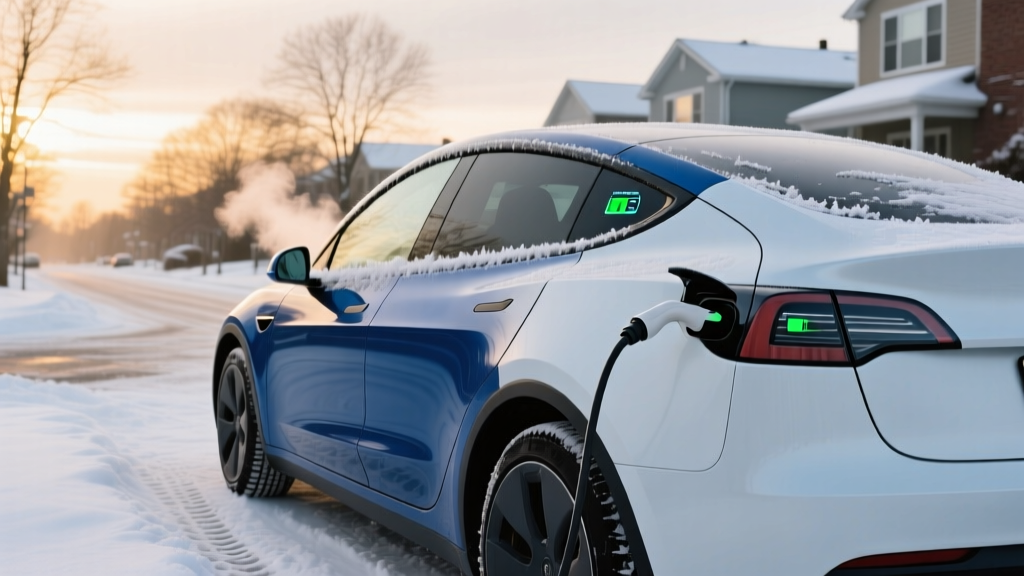
Real-World Cold Weather (below 32°F): ~245–265 miles
Mixed Commuter (city + suburban): ~300–315 miles
The 320-mile EPA figure represents a meaningful bump from the pre-Juniper Long Range's 308 miles. Tesla achieved this through a combination of improved aerodynamics (a revised front fascia and rear diffuser), a slightly larger usable battery buffer, and more efficient drive-unit inverters.
In practice, the Model Y's efficiency shines in city and suburban driving where regenerative braking recaptures energy. On a flat 75-mph highway loop in 65°F weather, expect to see roughly 280 miles before hitting 10% State of Charge. Cold weather remains the great EV equalizer: the Juniper's heat pump (now standard across all trims) mitigates cabin-heating losses, but battery chemistry itself becomes less efficient below freezing. Plan for 20–25% range reduction in sustained sub-32°F conditions — a figure consistent across the NMC segment, not a Tesla-specific weakness.
According to EPA data on fueleconomy.gov, the 2026 Model Y Long Range posts 117 MPGe combined, which translates to 29 kWh per 100 miles. That's among the most efficient AWD electric crossovers in its class, trailing only the single-motor Hyundai Ioniq 5 and closely matching the Ford Mustang Mach-E Extended Range.
Charging Speed: DC Fast Charging and Home Setup
| Charging Level | Power (kW) | Speed (mi/hr added) | Notes |
|---|---|---|---|
| Level 1 (120V outlet) | ~1.4 kW | ~4–5 mi/hr | Emergency/trickle only |
| Level 2 (240V, 48A) | 11.5 kW | ~44 mi/hr | Full charge overnight (~8 hr) |
| DC Fast Charge (peak) | 250 kW | Up to ~1,000 mi/hr | 10–80% in ~24 min |
| DC Fast Charge (sustained avg) | ~150 kW | ~600 mi/hr avg | Above 50% SoC, rate tapers |
The 2026 Model Y Long Range retains the 250 kW peak DC fast-charging rate via the native NACS connector, which is now the dominant standard across the U.S. charging network. A 10–80% session at a V3 or V4 Tesla Supercharger takes approximately 24 minutes — competitive but not class-leading. The Hyundai Ioniq 5, for comparison, hits 10–80% in roughly 18 minutes thanks to its 800V architecture.
Here's what the spec sheet doesn't show: the charge curve. The Model Y sustains above 200 kW only between roughly 10–35% State of Charge, then tapers progressively. By 60% SoC, you're typically seeing 120–140 kW, and above 80%, the rate drops sharply to protect battery longevity. For road trips, the practical strategy is to charge in short 15–20 minute bursts between 10% and 60% rather than waiting for a full top-off.
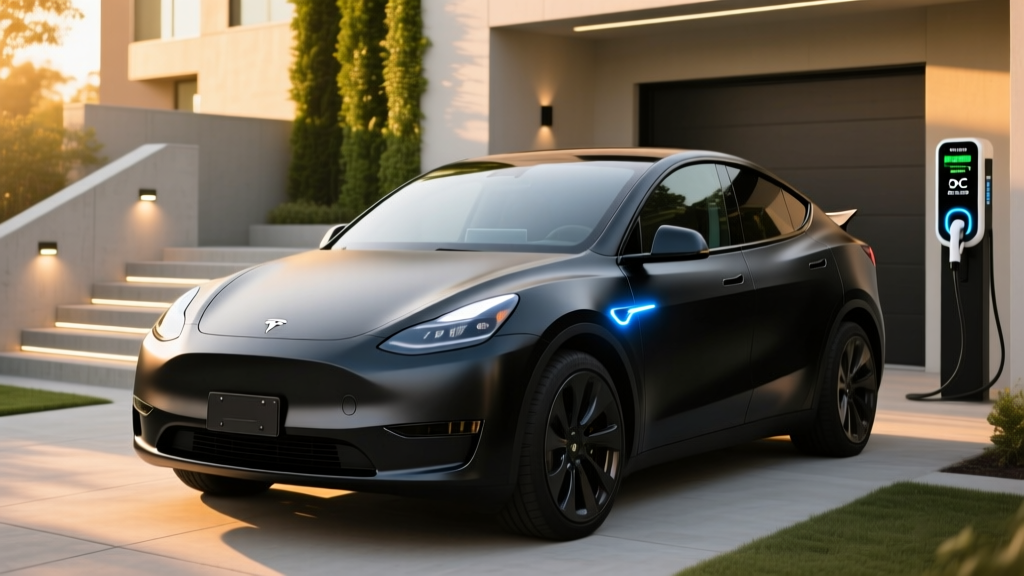
At home on a 48-amp Level 2 circuit (requiring a 60-amp breaker), the onboard charger pulls 11.5 kW, adding about 44 miles of range per hour. A depleted battery reaches full overnight in roughly 8 hours. Installation costs for a home Level 2 setup typically run $800–$2,500 depending on panel proximity and local permitting — a licensed electrician should evaluate your panel capacity before committing to a 60-amp circuit.
Performance and Driving Dynamics
The dual-motor AWD powertrain delivers 384 combined horsepower and a 4.8-second 0–60 mph time. That's brisk for a family crossover and quicker than the Mach-E Premium AWD (5.2 sec) though a half-step behind the Ioniq 5 Dual Motor (4.5 sec). The Juniper update brought revised damper tuning and additional acoustic insulation, and the difference is noticeable: road noise at highway speed is substantially reduced compared to the pre-2025 Model Y.
Tesla's regenerative braking remains one-pedal-capable, though the Juniper now offers a user-selectable regen intensity (low/standard/high) — a welcome concession to drivers transitioning from ICE vehicles. The low-regen setting mimics the coasting feel of a traditional automatic transmission.
Handling is confident if not sporty. The Model Y's relatively low center of gravity (battery pack under the floor) keeps body roll controlled, but the steering is numb and weighted toward comfort rather than feedback. This is a family hauler, not a canyon carver — and it's excellent at that job.
Interior, Tech, and the Autopilot Question
The Juniper interior is a meaningful step up in perceived quality. Tesla replaced the previous hard plastics with softer-touch materials on the dash and door panels, added ventilated front seats (finally), and introduced a rear-seat touchscreen for climate and entertainment control. Ambient lighting and a power-folding second row round out the upgrades.
The 15.4-inch center touchscreen runs Tesla's latest software, which is fast, responsive, and deeply integrated with navigation and Supercharger routing. Wireless Apple CarPlay remains absent — Tesla's proprietary infotainment ecosystem is a dealbreaker for some buyers who prefer phone-mirroring interfaces.
Every Model Y ships with Tesla's Basic Autopilot (adaptive cruise + lane centering). Full Self-Driving (Supervised) remains an $8,000 add-on or $99/month subscription.
Important: Tesla Autopilot and FSD (Supervised) are SAE Level 2 driver-assistance systems. They do not make the vehicle self-driving. The driver must remain fully attentive, with hands on the wheel and eyes on the road, at all times. True driverless operation (Level 4) is currently available only through robotaxi services like Waymo in select metro areas.
FSD Supervised has improved in urban navigation and intersection handling, but it remains inconsistent in construction zones and unprotected left turns. Most owners we've surveyed use it primarily for highway driving, where it performs reliably, and disengage for complex surface-street scenarios.
Pricing, Trims, and Federal Tax Credit Eligibility
| Trim | MSRP | Est. Price After §30D Credit |
|---|---|---|
| Long Range AWD | $44,990 | $37,490* |
| Long Range AWD + FSD | $52,990 | $45,490* |
| Performance AWD | $49,990 | $42,490* |
*Assumes full $7,500 federal tax credit eligibility. Actual credit varies based on IRS §30D requirements. See checklist below.
The 2026 Model Y Long Range's $44,990 starting price positions it squarely within the sweet spot for the federal EV tax credit. As a crossover/SUV, the Model Y falls under the $80,000 MSRP cap for SUVs and vans (the cap is $55,000 for sedans). Tesla's U.S. assembly in Austin, Texas, satisfies the North American final-assembly requirement.
However, the full $7,500 credit depends on two additional hurdles that change annually:
- Battery sourcing: A percentage of critical minerals and battery components must be sourced from the U.S. or free-trade-agreement partners. Tesla has progressively shifted supply chains, but the exact qualifying percentage for 2026 should be confirmed via the IRS's updated qualified vehicles list.
- Buyer income caps: Modified adjusted gross income must not exceed $150,000 (single), $225,000 (head of household), or $300,000 (joint filers).
- Point-of-sale transfer: As of 2024, buyers can transfer the credit to the dealer at purchase, reducing the upfront price rather than waiting for a tax refund. This requires dealer participation.
Consult a tax professional to confirm your individual eligibility. State-level incentives (such as California's CVRP or Colorado's innovative motor vehicle credit) may stack on top of the federal credit but vary widely by jurisdiction.
How It Stacks Up: Model Y vs. Key Rivals
| Spec | 2026 Tesla Model Y LR | 2026 Hyundai Ioniq 5 LR AWD | 2026 Ford Mach-E ER AWD |
|---|---|---|---|
| EPA Range | 320 mi | 290 mi | 312 mi |
| Battery (usable) | 78.1 kWh | 84.0 kWh | 91.0 kWh |
| DCFC 10–80% | ~24 min | ~18 min | ~36 min |
| 0–60 mph | 4.8 sec | 4.5 sec | 5.2 sec |
| Cargo (seats up) | 30.2 cu ft | 27.2 cu ft | 29.7 cu ft |
| Base MSRP (AWD) | $44,990 | $48,500 | $46,995 |
| Efficiency (MPGe) | 117 | 110 | 101 |
The Model Y's combination of range, cargo space, and efficiency is difficult to beat at this price point. The Ioniq 5 charges faster and offers a more distinctive design, but sacrifices 30 miles of range and 3 cubic feet of cargo. The Mach-E is a comfortable cruiser with strong SuperCruise integration (GM's hands-off Level 2 system on select highways), but its charging speed lags significantly, making it less ideal for frequent road-trippers.
Choose the Model Y if: You want maximum range and cargo versatility, prioritize Supercharger network reliability for road trips, and value over-the-air updates that add features post-purchase.
Choose the Ioniq 5 if: You charge primarily at non-Tesla DC fast chargers and want the fastest 10–80% sessions, prefer CarPlay integration, and value the available Vehicle-to-Load (V2L) power capability.
Choose the Mach-E if: You want hands-off highway driving via BlueCruise/SuperCruise, prefer a more traditional dealership experience, and don't frequently take road trips exceeding 300 miles.
Ownership Costs and Warranty
Tesla's battery and drive-unit warranty covers 8 years or 120,000 miles (whichever comes first) with a guaranteed minimum 70% capacity retention. The limited vehicle warranty is 4 years / 50,000 miles. These terms are standard for the segment — Hyundai offers a slightly longer 10-year/100,000-mile battery warranty, which may matter to high-mileage drivers.
Insurance costs for the Model Y remain above the segment average. Expect annual premiums in the $1,800–$2,600 range depending on your state, driving record, and coverage level. Tesla's own insurance product is available in most states and uses real-time driving data to set rates, which can benefit safe drivers but penalize aggressive ones.
Charging costs are the Model Y's economic trump card. At the national average residential electricity rate of ~$0.17/kWh, a full home charge costs roughly $13.30 and delivers ~275 real-world miles — equivalent to about $0.049 per mile. Compare that to a 25 MPG gas crossover at $3.40/gallon, which costs $0.136 per mile. Over 15,000 annual miles, that's approximately $1,300 in annual fuel savings.
Pros, Cons, and Verdict
Pros
- Class-leading 320-mi EPA range and 117 MPGe efficiency
- Spacious 30.2 cu ft cargo area with flat-folding rear seats
- Tesla Supercharger network remains the most reliable DCFC option
- Significant cabin quietness and material improvements with Juniper
- $44,990 MSRP qualifies for full §30D credit (if eligible)
- Over-the-air updates continue adding features post-purchase
Cons
- No Apple CarPlay or Android Auto
- 250 kW peak charging slower than 800V rivals (Ioniq 5, EV6)
- FSD (Supervised) is expensive and still requires full driver attention
- Insurance premiums above segment average
- Touchscreen-only climate controls frustrate some drivers
- Regen braking customization still not as granular as competitors
The 2026 Model Y Long Range is the best version of Tesla's best-selling vehicle. The Juniper refresh addresses the most common complaints — noise, interior quality, rear-seat comfort — while the price reduction makes it the value leader in the electric crossover segment. If you have home charging access and your income falls within §30D limits, the effective price of ~$37,500 for a 320-mile AWD crossover is remarkably compelling.
Frequently Asked Questions
What is the real-world range of the 2026 Tesla Model Y Long Range?
Expect 275–285 miles on the highway at 70–75 mph in moderate temperatures, and 300–315 miles in mixed city/suburban driving. In sustained cold weather (below 32°F), plan for 245–265 miles. The heat pump helps, but battery chemistry limitations in cold are universal across NMC packs.
How fast does the Model Y charge at home and on the road?
On a 48-amp Level 2 home charger (240V), the Model Y charges at 11.5 kW, adding roughly 44 miles per hour — a full charge takes about 8 hours. On a Tesla V3/V4 Supercharger, it peaks at 250 kW and reaches 10–80% in approximately 24 minutes, though sustained average power is closer to 150 kW due to charge-curve taper above 50% SoC.
Does the 2026 Model Y qualify for the $7,500 federal EV tax credit?
The Model Y Long Range at $44,990 is under the $80,000 SUV MSRP cap and is assembled in the U.S., meeting two key requirements. However, full credit eligibility depends on battery-sourcing rules (critical minerals and components from qualifying countries) and your personal income not exceeding IRS thresholds ($150K single / $300K joint). Check the IRS qualified vehicle list and consult a tax professional for your specific situation.
Is the Model Y worth buying over the Ioniq 5 or Mach-E?
It depends on your priorities. The Model Y wins on range (320 mi vs. 290–312 mi), cargo space (30.2 cu ft), efficiency (117 MPGe), and Supercharger network access. The Ioniq 5 charges faster (18 min vs. 24 min 10–80%) and offers CarPlay. The Mach-E provides a more traditional dealership experience and available hands-free highway driving. For most buyers prioritizing range and road-trip convenience, the Model Y remains the default recommendation.
How much does the 2026 Model Y cost after incentives?
The Long Range AWD starts at $44,990. With full §30D federal credit eligibility, the effective price drops to approximately $37,490. State incentives (where available) can reduce this further by $1,000–$5,000 depending on your jurisdiction. Adding FSD Supervised ($8,000) brings the as-tested price to $52,990 before credits.
What is the battery warranty and expected lifespan?
Tesla covers the battery and drive unit for 8 years or 120,000 miles, guaranteeing a minimum 70% capacity retention. Real-world degradation data from high-mileage Tesla owners suggests NMC packs typically retain 85–90% capacity at 100,000 miles with normal charging habits (avoiding sustained 100% SoC and frequent DC fast charging). Battery replacement, if needed out of warranty, currently ranges from $12,000–$16,000 depending on pack configuration.