If you live in Charlottesville, Virginia, and you're researching a Tesla purchase, the Model Y remains the most practical choice for the region's mix of mountain driving, cold Blue Ridge winters, and road-trip corridors along I-64 and US-29. This guide covers the 2026 Tesla Model Y (including the refreshed "Juniper" variant) with a specific lens on what ownership looks like from Charlottesville — from real-world range in Virginia's climate to charging logistics and federal tax credit eligibility.
2026 Tesla Model Y: Quick Verdict for Charlottesville Buyers
The 2026 Model Y Long Range AWD delivers an EPA-estimated 320 miles of range, a refined suspension over the pre-2025 models, and access to Tesla's Supercharger network — the most reliable DC fast-charging option along the I-64 corridor between Richmond and Charlottesville. The starting MSRP of $44,990 places it under the IRS §30D SUV cap of $80,000, though federal tax credit eligibility depends on your income, battery sourcing, and point-of-sale transfer rules current for the 2026 tax year.
For Charlottesville specifically, the Model Y's combination of standard AWD (useful on Skyline Drive and winter commutes), strong regenerative braking for mountain descents, and proximity to multiple Supercharger stations makes it a compelling daily driver and road-trip vehicle.
Spec Table: 2026 Tesla Model Y Long Range AWD
| Specification | Value |
|---|---|
| EPA Range | 320 miles |
| Battery Capacity | ~75 kWh usable (NMC chemistry) |
| Drivetrain | Dual-Motor AWD |
| Horsepower | 384 hp (combined) |
| 0-60 mph | 4.8 seconds |
| Max DC Fast Charge | 250 kW peak |
| 10-80% DC Fast Charge | ~25 minutes |
| Level 2 Home Charging | 11.5 kW (~44 mi/hr at 48A) |
| Efficiency | 122 MPGe combined / 28 kWh/100 mi |
| Cargo Volume | 30.2 cu ft (rear seats up) / 72.1 cu ft (folded) |
| Rear Legroom | 41.6 inches |
| Base MSRP | $44,990 |
| Battery Warranty | 8 years / 120,000 miles (min 70% retention) |
Real-World Range: What to Expect Driving Around Charlottesville
EPA Estimate: 320 miles
Real-World Highway (70+ mph, I-64 corridor): ~260–280 miles
Real-World City/Mixed (Charlottesville area): ~290–310 miles
Cold Weather (below 32°F, Blue Ridge winter): ~220–260 miles
The EPA's 320-mile figure assumes a mix of city and highway driving at moderate temperatures. In practice, Charlottesville owners should plan for less.
Highway driving on I-64: Sustained speeds of 70-75 mph between Charlottesville and Richmond (roughly 70 miles) or toward Staunton will pull range down to approximately 260–280 miles on a full charge. Aerodynamic drag scales with the square of speed, and the Model Y's crossover profile creates more drag than the Model 3 sedan.
Mountain routes: If your commute involves elevation changes — say, driving up toward Waynesboro over Afton Mountain or north on US-29 toward Madison — expect range to fluctuate. Climbing consumes significantly more energy, but regenerative braking on descents recovers a meaningful portion (often 30-50% of the climb's energy cost). Net impact on a round-trip with equal elevation gain and loss is moderate.
Winter impact: Charlottesville averages 15–20 days per year below freezing, with occasional dips into the teens. Lithium-ion batteries lose efficiency in cold temperatures, and cabin heating (even with the Model Y's heat pump) draws substantial power. Expect a 15-25% range reduction in sustained cold weather. Preconditioning the battery while plugged in at home mitigates this significantly — always precondition before a winter DC fast-charge session, as a cold battery will charge far slower.
Source: fueleconomy.gov — 2026 Tesla Model Y
Charging in Charlottesville: Superchargers, Home Setup, and Public Options
Charging infrastructure is often the deciding factor for EV buyers in mid-sized metros. Charlottesville is reasonably well-served, though planning is still required for longer trips.
Tesla Supercharger Access
Tesla operates a Supercharger station in Charlottesville (V4 stalls, capable of up to 250 kW for compatible vehicles), located near the Fashion Square Mall area off US-29. Additional Superchargers are available in:
- Richmond (~70 miles east) — multiple stations, 8-16 stalls each
- Staunton/Waynesboro (~30-40 miles west on I-64) — critical for Shenandoah Valley trips
- Harrisonburg (~60 miles north on I-81) — for trips toward Winchester or D.C.
- Lynchburg (~65 miles south on US-29)
At a V4 Supercharger, the Model Y Long Range peaks at approximately 250 kW, sustaining high charge rates between 10-50% SoC before tapering. A typical 10-80% session takes about 25 minutes. Above 80%, the charge curve drops sharply to protect battery longevity — expect 80-100% to add another 20-25 minutes. For road trips, plan stops at 80% to maximize time efficiency.
Home Level 2 Charging
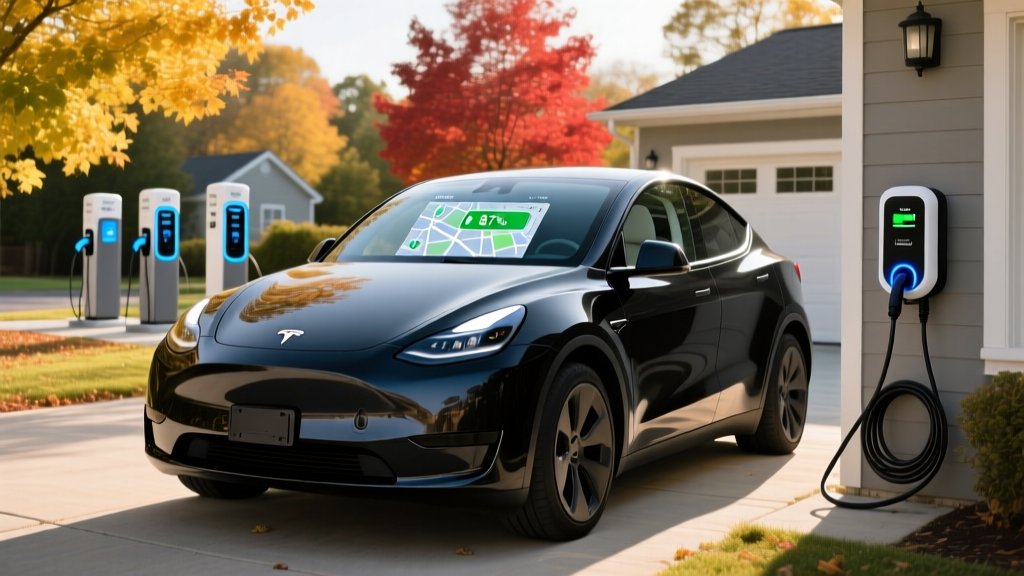
Most Charlottesville Tesla owners install a Tesla Wall Connector on a 240V/60A circuit, delivering up to 11.5 kW (44 miles of range per hour of charging). An overnight session of 8 hours adds roughly 350 miles — more than enough to replenish a full day's driving.
Installation cost in the Charlottesville area: Expect $800–$2,500 for a standard Wall Connector installation, depending on panel proximity and whether your electrical panel needs upgrading. Older homes near the Downtown or Belmont neighborhoods may require a panel upgrade ($1,500–$3,000 additional) if the existing service is 100A. Most newer construction in areas like Crozet, Earlysville, or Fontaine supports 200A service without modification. Always get a quote from a licensed electrician before committing.
Public Level 2 and Non-Tesla DC Charging
Charlottesville has several public Level 2 stations (ChargePoint, EVgo) at locations including the Downtown Mall parking garages, UVA grounds, and various shopping centers. These are useful for topping off during errands but too slow for primary charging. Non-Tesla DC fast chargers (Electrify America, EVgo) are available in the region but require a CCS adapter — Tesla includes a CCS adapter or offers one for purchase, though Supercharger access remains the faster, more seamless option for NACS-equipped vehicles.
| Charging Method | Power (kW) | Miles Added per Hour | 10-80% Time |
|---|---|---|---|
| Level 1 (120V household) | 1.4 kW | ~5 mi/hr | N/A (days) |
| Level 2 (240V/48A home) | 11.5 kW | ~44 mi/hr | ~6-7 hours |
| Tesla Supercharger (V4) | 250 kW peak | ~1,000 mi/hr (peak) | ~25 minutes |
| CCS DC Fast (EA/EVgo) | 150-350 kW | Varies | ~22-30 minutes |
Pricing, Trims, and Federal Tax Credit Eligibility
The 2026 Tesla Model Y is offered in several configurations. Here's how pricing breaks down before any incentives:
| Trim | MSRP | §30D Credit Potential | Effective Price |
|---|---|---|---|
| Model Y Long Range AWD | $44,990 | Up to $7,500* | As low as ~$37,490* |
| Model Y Performance AWD | $49,990 | Up to $7,500* | As low as ~$42,490* |
*Federal tax credit eligibility under IRS §30D is NOT guaranteed. It depends on multiple factors that change periodically:
- Buyer income caps: Modified AGI must not exceed $150,000 (single), $225,000 (head of household), or $300,000 (joint filers)
- MSRP cap: The Model Y qualifies as an SUV under IRS definitions, so the cap is $80,000 — all trims clear this
- Battery sourcing requirements: A percentage of critical minerals and battery components must be sourced from the U.S. or free-trade-agreement countries. These thresholds tighten annually, and Tesla's sourcing has varied by production batch
- Point-of-sale transfer: As of 2024, buyers can transfer the credit to the dealer at purchase, reducing the upfront cost rather than waiting for a tax refund. This is available in 2026 if the credit is still active and the vehicle qualifies
Important: The §30D credit's future is subject to legislative changes. Some provisions may be modified or sunset. Always verify current eligibility on irs.gov and consult a tax professional before relying on the credit in your purchase decision.
Virginia does not currently offer a state EV purchase incentive as of 2026, though the state does not charge sales tax on the first $5,000 of an EV trade-in value (confirm current rules with the Virginia DMV).
Performance, Efficiency, and Daily Driving
The 2026 Model Y Long Range AWD produces 384 combined horsepower from its dual-motor setup, reaching 0-60 mph in 4.8 seconds. The Performance trim drops that to approximately 3.5 seconds with 510 hp. Both trims feature Tesla's single-speed reduction gear — no traditional transmission, just instant torque delivery.
Efficiency is rated at 122 MPGe combined (28 kWh per 100 miles) by the EPA. In Charlottesville-area driving with moderate hills and a mix of city/highway use, expect real-world consumption between 27-32 kWh/100mi depending on speed, temperature, and climate control usage.
The Juniper refresh (introduced for the 2025 model year and carried into 2026) brought a noticeably improved suspension tune — the harsh ride that plagued pre-2025 Model Ys on rough pavement has been substantially addressed. Charlottesville's mix of well-maintained arterials and older residential streets (looking at you, Ridge-McIntire and parts of Preston Avenue) is handled more competently now.
Driver Assistance: Autopilot and FSD
SAE Automation Level: Level 2 — The driver must remain fully engaged and supervising at all times. Tesla Autopilot and Full Self-Driving (Supervised) are not autonomous driving systems. You are legally and operationally responsible for the vehicle.
Tesla's basic Autopilot (included standard) handles adaptive cruise control and lane-centering on highways — useful for the I-64 commute to Richmond or trips toward D.C. FSD (Supervised), a $8,000 add-on or $99/month subscription, adds automatic lane changes, navigation-guided on/off-ramp handling, and limited city-street steering. In Charlottesville's downtown grid with pedestrians, cyclists, and unpredictable traffic on the Downtown Mall, FSD requires constant vigilance. It is a convenience feature, not a replacement for an attentive driver.
Cargo, Interior, and Family Practicality
The Model Y's crossover form factor is its strongest practicality argument over the Model 3. With 30.2 cubic feet behind the second row and 72.1 cu ft with seats folded, it handles Costco runs, UVA move-in day, and camping gear for Shenandoah National Park trips without issue.
Key interior dimensions:
- Rear legroom: 41.6 inches — comfortable for adults on longer trips
- Front trunk (frunk): 4.1 cu ft — useful for charging cables, groceries, or a laptop bag
- Optional third row: Available but extremely tight (best for small children only); reduces cargo to 12.8 cu ft
The minimalist interior centers on a 15.4-inch touchscreen handling virtually all vehicle controls. No physical instrument cluster — speed and navigation are displayed on the main screen. The 2026 Juniper refresh added ambient lighting, ventilated front seats, and a rear-seat touchscreen for passengers. Build quality from the Fremont and Austin factories has improved, though panel-gap variance remains a known Tesla characteristic.
Pros and Cons for the Charlottesville Tesla Buyer
Pros
- Access to Tesla Supercharger network — the most reliable DC fast-charging option in Virginia
- AWD standard on all trims — valuable for Blue Ridge winter conditions
- 320-mile EPA range covers most regional round-trips without charging
- Strong regenerative braking recovers energy on mountain descents
- Over-the-air updates continuously add features
- Low running costs vs. gas: ~$0.04–0.06/mile on home solar, ~$0.08–0.12/mile on grid power
- Eligible for HOV lane access on Virginia highways (confirm current DMV rules)
Cons
- $8,000 FSD add-on is expensive for a Level 2 system with no hands-off capability
- No Apple CarPlay or Android Auto — Tesla's proprietary infotainment only
- Service center access: nearest dedicated Tesla Service Center is in Richmond (~70 mi); mobile service covers Charlottesville but with scheduling delays
- Tire wear is accelerated due to vehicle weight and instant torque — budget for replacements every 25,000–35,000 miles
- Insurance premiums run 15-25% higher than comparable gas crossovers (get a quote before buying)
- Third-row option is impractical for anyone over age 8
Who Should Buy the Model Y in Charlottesville?
The 2026 Model Y is best suited for Charlottesville-area buyers who:
- Commute regionally: The Richmond commute (~70 mi each way) is easily covered with a nightly home charge, with range to spare even in winter
- Have home charging access: A garage or driveway with 240V circuit access is essential for convenient ownership
- Take regular road trips: The Supercharger network makes D.C., Raleigh, and Roanoke trips straightforward with one brief stop
- Need cargo versatility: Families, outdoor enthusiasts, and anyone hauling gear regularly benefits from the crossover form factor
It's less ideal for buyers who want a traditional dealership experience, prefer physical buttons over touchscreen controls, need a third row for older children, or lack reliable home charging access.
Model Y vs. Key Competitors
The Model Y's main rivals in the $40,000–$55,000 electric crossover segment include:
- Hyundai Ioniq 5: Faster 10-80% charging (18 min on 350 kW chargers), more comfortable ride, but fewer public charging options and slightly less range (305 mi EPA)
- Ford Mustang Mach-E: Engaging driving dynamics, BlueCruise hands-off highway driving (on approved roads), but lower efficiency and a less mature charging ecosystem
- Kia EV6: Shares the Ioniq 5's excellent 800V charging architecture with a sportier design, but similar charging-network limitations
The Model Y's decisive advantage in Charlottesville remains the Supercharger network. While competitors gain access to Tesla's network via adapters, the native integration (navigation preconditions the battery automatically for optimal charge speed, payment is seamless, stall availability is shown in real-time) provides a noticeably smoother road-trip experience.
Frequently Asked Questions
What is the real-world range of the 2026 Tesla Model Y in Charlottesville?
Expect 260–280 miles on highway trips at 70+ mph, 290–310 miles in mixed city driving, and 220–260 miles in sustained cold weather below freezing. The EPA sticker reads 320 miles, but real-world conditions — especially Virginia's winter temperatures and mountain driving — reduce that figure.
How fast does the Model Y charge at home and on the road?
On a home Level 2 Wall Connector (240V/48A), the Model Y charges at 11.5 kW, adding about 44 miles of range per hour — a full overnight session easily replenishes daily driving. At a Tesla V4 Supercharger, it peaks at 250 kW and charges from 10-80% in approximately 25 minutes.
Does the 2026 Model Y qualify for the $7,500 federal EV tax credit?
The Model Y's MSRP is under the $80,000 SUV cap, so it clears that hurdle. However, eligibility also depends on your income (AGI caps apply), battery component and critical-mineral sourcing requirements that tighten annually, and whether the §30D program remains active. Verify on irs.gov and consult a tax professional.
Is there a Tesla Service Center in Charlottesville?
No. The nearest dedicated Tesla Service Center is in Richmond, approximately 70 miles east. Tesla offers mobile service for many repairs in the Charlottesville area, but scheduling can take 1-3 weeks depending on demand. For warranty-covered body work, Tesla-approved body shops exist in the region.
How does the Model Y handle Charlottesville winters?
Standard AWD, a heat pump for efficient cabin heating, and preconditioning features make the Model Y competent in Virginia winter conditions. Range drops 15-25% in sustained cold, but the 320-mile EPA baseline provides enough buffer for most local driving. Snow traction is good with all-season tires; dedicated winter tires improve braking and cornering on icy roads.
What's the total cost to charge a Model Y at home in Charlottesville?
Dominion Energy's residential rate in the Charlottesville area averages approximately $0.13–0.15/kWh (2026). Charging the Model Y's ~75 kWh battery from 10-80% (~52.5 kWh) costs roughly $6.80–$7.90 at home — about 2–3 cents per mile. Compare that to a gas crossover averaging 25 MPG at $3.20/gallon: roughly 12.8 cents per mile.
Should I get the Long Range or the Performance trim?
The Long Range AWD ($44,990) offers the best range and value for most buyers. The Performance ($49,990) adds roughly 0-60 improvement to 3.5 seconds, larger brakes, and a sport-tuned suspension — but sacrifices about 15-20 miles of EPA range. Unless track-day capability matters to you, the Long Range is the more practical Charlottesville daily driver.
Sources: EPA fueleconomy.gov, Tesla.com specifications, IRS Clean Vehicle Credits. Specs and pricing reflect 2026 model year information available at time of publication. Tax credit rules are subject to change — verify current eligibility before purchasing.