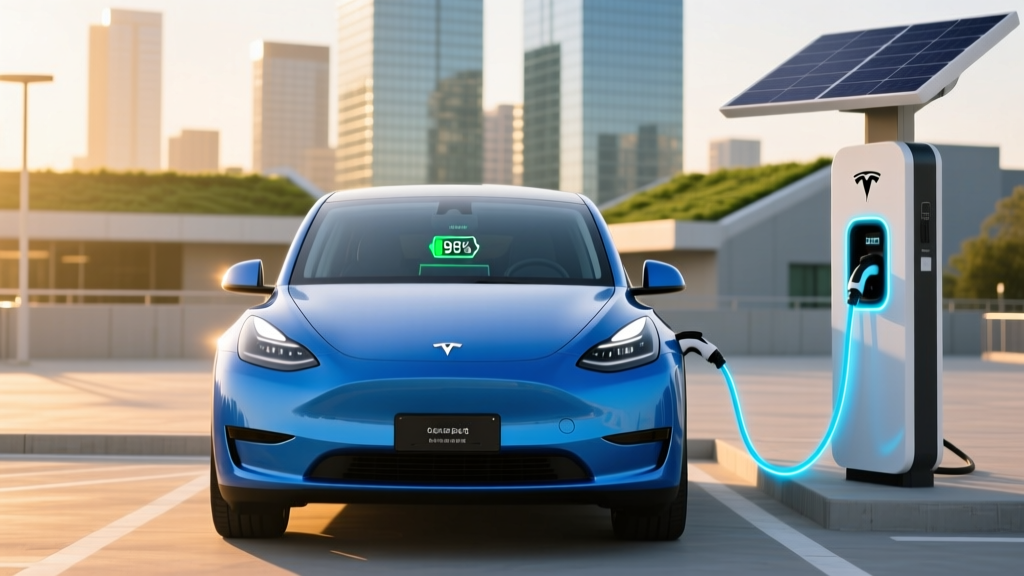
If you own a Tesla—or are about to buy one—you have almost certainly seen conflicting advice about whether to charge the battery all the way to 100%. Some forums say never do it. Tesla's own in-car slider sometimes recommends 80%. Yet for certain models, the manual explicitly tells you to charge to 100% regularly. The confusion comes down to one critical distinction: battery chemistry. This guide cuts through the noise with exact specs, real-world charging data, and practical rules for every 2026 Tesla model.
The Chemistry Question: LFP vs NMC in the 2026 Tesla Lineup
Tesla uses two lithium-ion battery chemistries across its 2026 fleet, and each has different care requirements:
| Model / Trim | Chemistry | Usable Capacity (kWh) | Daily Charge Recommendation |
|---|---|---|---|
| Model 3 RWD | LFP (Lithium Iron Phosphate) | ~60 kWh | 100% — charge fully at least weekly |
| Model 3 Long Range AWD | NMC (Nickel Manganese Cobalt) | ~82 kWh | 80% daily; 100% for trips only |
| Model 3 Performance | NMC | ~82 kWh | 80% daily; 100% for trips only |
| Model Y RWD (if available) | LFP | ~60 kWh | 100% — charge fully at least weekly |
| Model Y Long Range AWD | NMC | ~82 kWh | 80% daily; 100% for trips only |
| Model Y Performance | NMC | ~82 kWh | 80% daily; 100% for trips only |
| Model S / Model X (all trims) | NMC | ~100 kWh | 80% daily; 100% for trips only |
| Cybertruck AWD / Cyberbeast | NMC (4680 cells) | ~123 kWh | 80% daily; 100% for trips only |
Why the difference? LFP cells have a very flat voltage curve, which means the battery management system (BMS) cannot accurately estimate state of charge (SoC) at partial levels. Charging to 100% regularly recalibrates the BMS so your range estimate stays accurate. NMC cells, by contrast, experience accelerated degradation when held at high SoC for extended periods—so Tesla recommends 80% for daily driving and reserving 100% for road-trip departure.
Real-World Range: What You Actually Get at 100%
EPA estimates are measured under controlled lab conditions. Real-world range depends heavily on speed, temperature, terrain, and climate-control usage. Here is what 2026 Tesla models deliver with a full charge:
| Model | EPA Range (mi) | Real-World Highway ~70°F | Real-World Winter ~25°F | MPGe (combined) | kWh/100 mi |
|---|---|---|---|---|---|
| Model 3 RWD (LFP) | 272 | ~235–250 | ~190–215 | 132 | 25 |
| Model 3 Long Range AWD | 363 | ~305–325 | ~255–280 | 132 | 25 |
| Model 3 Performance | 315 | ~265–285 | ~220–245 | 119 | 28 |
| Model Y Long Range AWD | 320 | ~270–290 | ~225–250 | 122 | 28 |
| Model Y Performance | 285 | ~245–260 | ~200–220 | 111 | 30 |
| Model S Long Range | 402 | ~340–360 | ~285–315 | 120 | 28 |
| Model X Long Range | 335 | ~285–305 | ~235–260 | 103 | 33 |
| Cybertruck AWD | 340 | ~285–310 | ~240–265 | 87 | 39 |
Source: fueleconomy.gov (EPA estimates). Real-world figures based on aggregated owner data and independent testing at highway speeds.
Charging Speed: DC Fast Charge, Level 2, and the 100% Penalty
Charging a Tesla to 100% does not happen at the same speed as charging to 80%. DC fast charging follows a curve: peak power arrives at low SoC and tapers significantly above 80%. Here is what the full charge timeline looks like:
| Model | Peak DC kW | 10–80% Time | 80–100% Additional Time | Level 2 (240V / 48A) | Level 2 Miles/Hr |
|---|---|---|---|---|---|
| Model 3 RWD (LFP) | 170 kW | ~25 min | ~25–30 min | 11.5 kW | ~37 mi/hr |
| Model 3 Long Range | 250 kW | ~18 min | ~25–30 min | 11.5 kW | ~44 mi/hr |
| Model Y Long Range | 250 kW | ~20 min | ~25–30 min | 11.5 kW | ~38 mi/hr |
| Model S / X | 250 kW | ~22 min | ~30–35 min | 11.5 kW | ~34 mi/hr |
| Cybertruck AWD | 250 kW (800V arch) | ~20 min | ~30–35 min | 11.5 kW | ~30 mi/hr |
The 80–100% taper explained: Above 80% SoC, the BMS reduces current to protect cell longevity and manage heat. A 250 kW peak charge rate may drop to 30–50 kW by 90%, and under 15 kW by 95%. This means the last 20% can take as long as the first 60%. On road trips, it is almost always faster to charge to 80% and drive on, stopping again if needed.
Home charging note: kW is the rate of power delivery; kWh is the total energy stored. A 48-amp Level 2 home charger on a 240V circuit delivers up to 11.5 kW of power. Charging a 60 kWh LFP pack from 0–100% at home takes roughly 6–7 hours. An 82 kWh NMC pack takes about 8–9 hours. Most owners charge overnight and never visit a DC fast charger for daily needs.
Performance, Space, and Daily Usability
Across the lineup, Tesla pairs instant electric torque with a low center of gravity (battery pack under the floor). Performance figures for the 2026 models:
| Model | 0–60 mph (sec) | Horsepower | Drivetrain |
|---|---|---|---|
| Model 3 RWD | 5.8 | 271 hp | Rear-Wheel Drive |
| Model 3 Long Range AWD | 4.2 | 346 hp | Dual-Motor AWD |
| Model 3 Performance | 2.9 | 510 hp | Dual-Motor AWD |
| Model Y Long Range AWD | 4.8 | 384 hp | Dual-Motor AWD |
| Model Y Performance | 3.5 | 456 hp | Dual-Motor AWD |
| Model S Long Range | 3.1 | 670 hp | Dual-Motor AWD |
| Model X Long Range | 3.8 | 670 hp | Dual-Motor AWD |
| Cybertruck AWD | 3.9 | 600 hp | Dual-Motor AWD |
| Cybertruck Cyberbeast | 2.6 | 845 hp | Tri-Motor AWD |
Cargo and passenger space varies significantly. The Model 3 offers 23 cu ft of trunk space plus a small frunk, with 35.3 inches of rear legroom—adequate for adults on shorter trips. The Model Y provides up to 76 cu ft with rear seats folded and 40.5 inches of rear legroom, making it the practical family choice. The Model S delivers 28 cu ft of rear cargo plus a 5.3 cu ft frunk with 35.4 inches rear legroom. The Model X offers up to 88 cu ft with seats folded and falcon-wing rear doors that ease child-seat installation. The Cybertruck provides a 6.5-foot bed (67 cu ft) and a front trunk.
Pricing, Trims, and Federal Tax Credit Eligibility
Base MSRP figures for the 2026 Tesla lineup (before destination or incentives):
| Model / Trim | Base MSRP | §30D Credit Eligible? | Est. After-Credit Price |
|---|---|---|---|
| Model 3 RWD | $38,990 | Yes (up to $7,500, subject to sourcing rules) | ~$31,490 |
| Model 3 Long Range AWD | $45,740 | Yes (up to $7,500) | ~$38,240 |
| Model 3 Performance | $52,990 | Yes (up to $7,500) | ~$45,490 |
| Model Y Long Range AWD | $44,990 | Yes (up to $7,500) | ~$37,490 |
| Model Y Performance | $49,990 | Yes (up to $7,500) | ~$42,490 |
| Model S Long Range | $79,990 | No (exceeds $55,000 sedan MSRP cap) | $79,990 |
| Model X Long Range | $84,990 | No (exceeds $80,000 SUV MSRP cap) | $84,990 |
| Cybertruck AWD | $79,990 | No (exceeds $80,000 truck MSRP cap) | $79,990 |
- MSRP cap: Sedans ≤ $55,000; SUVs/trucks/vans ≤ $80,000
- Buyer income cap: AGI ≤ $150,000 (single) / $225,000 (head of household) / $300,000 (joint)
- Battery sourcing: Must meet critical-minerals and battery-component requirements (phased thresholds increase annually through 2029)
- Point-of-sale transfer: Eligible buyers can apply the credit at purchase, reducing the upfront price directly
- Vehicle assembly: Final assembly must occur in North America
Source: IRS §30D Clean Vehicle Credit. Eligibility changes frequently—verify at purchase time with your tax professional.
Driver Assistance: Autopilot, FSD, and SAE Level Reality
Tesla Autopilot and Full Self-Driving (Supervised) are not self-driving systems. The driver must remain fully engaged, hands on or near the wheel, eyes on the road, and ready to take over at any moment. These are advanced driver-assistance features, comparable to GM Super Cruise or Ford BlueCruise in SAE classification—not Level 4 robotaxi systems like Waymo.
Autopilot (standard on all 2026 Teslas) includes Traffic-Aware Cruise Control and Autosteer for lane-centering on highways. Full Self-Driving (Supervised), available as a $8,000 add-on or $99/month subscription, adds automatic lane changes, traffic-light and stop-sign recognition, Navigate on Autopilot for highway interchanges, and enhanced city-street steering. FSD has improved substantially in 2025–2026, but it still requires constant supervision and makes occasional errors at complex intersections or construction zones.
Tesla's infotainment runs on a 15.4-inch center touchscreen (Model 3/Y) or 17-inch (Model S/X/Cybertruck) with a responsive interface, integrated navigation with real-time Supercharger routing, over-the-air updates, and a growing library of in-car entertainment (Netflix, YouTube, games) while parked. No Apple CarPlay or Android Auto is offered—a notable drawback for some buyers.
Warranty, Longevity, and Battery Degradation
Tesla's 2026 warranty coverage:
- Basic vehicle: 4 years / 50,000 miles
- Battery & drive unit (Model 3/Y RWD): 8 years / 100,000 miles
- Battery & drive unit (Model 3/Y Long Range & Performance, Model S/X, Cybertruck): 8 years / 120,000 miles (150,000 miles for Model S/X)
- Capacity retention threshold: Tesla warrants that the battery will retain at least 70% of original capacity during the warranty period
Real-world degradation data: Aggregated fleet data shows Tesla NMC packs typically lose 5–8% capacity in the first 50,000 miles, then degrade more slowly. LFP packs show slightly less early degradation (3–5%) and are inherently more cycle-durable—often exceeding 3,000 full cycles before reaching 80% state of health. For an LFP Model 3 RWD owner, that translates to well over 300,000 miles of usable battery life under normal conditions. Following the 100% charging guidance for LFP actually helps longevity by keeping the BMS calibrated.
Who Should Buy Which Tesla?
- You want the lowest entry price (~$31,490 after credit)
- You can charge at home nightly and don't mind charging to 100%
- Your daily commute is under 150 miles round-trip
- You prioritize efficiency and simplicity over all-weather traction
- You need 300+ miles of real-world range for road trips
- You want dual-motor AWD for snow or rain
- You prefer charging to 80% daily for long-term NMC health
- You need extra cargo space (Model Y) or back-seat room
- Budget is above $80K and you want luxury sedan/SUV space
- You value the longest range in the lineup (Model S: 402 mi EPA)
- You accept no federal tax credit due to MSRP caps
- You need a truck bed and up to 11,000-lb towing capacity
- You want 800V fast-charging architecture
- You accept the polarizing design and premium pricing
Pros and Cons Across the 2026 Tesla Lineup
- Access to the Tesla Supercharger network (17,000+ stalls in North America)—still the most reliable public DC network
- Class-leading efficiency (kWh/100 mi) translates to lower charging costs
- Over-the-air updates continuously add features
- LFP option (Model 3/Y RWD) allows worry-free 100% daily charging
- Strong resale value relative to most EVs
- Integrated navigation with real-time Supercharger availability and preconditioning
- No Apple CarPlay or Android Auto
- Model 3 Highland removed turn-signal stalks (steering-wheel buttons instead)—divisive ergonomics
- FSD (Supervised) requires constant attention; not autonomous
- Insurance costs often 15–25% higher than comparable non-Tesla EVs
- Service center wait times can be long in high-population areas
- Model S/X/Cybertruck exceed MSRP caps for the federal tax credit
Frequently Asked Questions
Should I charge my Tesla to 100% every day?
If your Tesla has an LFP battery (2026 Model 3 RWD, some Model Y RWD), yes—Tesla recommends charging to 100% at least once per week to keep the battery management system calibrated. If your Tesla has an NMC battery (Long Range, Performance, Model S/X, Cybertruck), set the daily limit to 80% and only charge to 100% right before a long road trip.
Does charging to 100% damage the battery?
For NMC chemistry, regularly holding the battery at 100% for extended periods (days or weeks) accelerates degradation. Occasional 100% charges followed by immediate driving cause minimal harm. For LFP chemistry, 100% charging is the intended operating mode and does not cause excess wear.
How long does it take to charge a Tesla from 80% to 100%?
On a DC fast charger, the 80–100% top-up takes an additional 25–35 minutes due to the charge-curve taper. On a Level 2 home charger (11.5 kW), the last 20% takes roughly 1.5–2 hours depending on pack size. This is why road-trip strategy favors charging to 80% and driving on.
What is the real-world range of a Tesla at 100% charge?
Expect 10–15% below the EPA sticker at sustained highway speeds in warm weather, and 20–30% below in freezing temperatures. A Model 3 Long Range rated at 363 miles EPA typically delivers 305–325 miles on a 70°F highway drive and 255–280 miles in 25°F winter conditions.
Does the Tesla Model 3 qualify for the $7,500 federal tax credit?
The 2026 Model 3 RWD ($38,990), Long Range ($45,740), and Performance ($52,990) all fall under the $55,000 sedan MSRP cap and are assembled in the US. Eligibility for the full $7,500 credit depends on your income (AGI ≤ $150K single / $300K joint), battery-sourcing compliance, and point-of-sale transfer rules. Verify current status at fueleconomy.gov and consult a tax professional.
Is a Tesla worth buying versus competitors?
The Model 3 and Model Y remain benchmarks for efficiency, charging infrastructure access, and software integration. Competitors like the Hyundai Ioniq 6, BMW i4, Ford Mustang Mach-E, and Chevrolet Equinox EV offer compelling alternatives—some with CarPlay, more traditional controls, or lower insurance costs. The Tesla advantage narrows if you cannot charge at home, since public-charging reliability outside the Supercharger network remains inconsistent. If home charging is available, a Tesla's total cost of ownership is among the lowest in the EV segment.