If you've spent any time in a Tesla forum or owner's group, you've seen the debate: Tesla's factory paint palette is notoriously limited, and owners are increasingly turning to vinyl wraps, ceramic coatings, and aftermarket solutions to personalize their vehicles. The trend of Tesla changing colors has exploded in 2026, driven by both aesthetic desire and practical paint-protection needs. But before you wrap your Model 3, you need to know exactly what you're working with — the car itself, its real-world capabilities, and whether it's the right EV for your garage.
This guide covers everything about Tesla's 2026 color options and the color-change movement, then delivers a full, data-driven review of the 2026 Tesla Model 3 Long Range AWD — the most popular canvas for customization. We'll walk through EPA range, charging speeds, battery chemistry, tax-credit eligibility, and honest ownership trade-offs.
Tesla's 2026 Factory Paint Colors and the Custom Color Movement
Tesla currently offers five factory paint colors for the Model 3 in the U.S. market:
- Pearl White Multi-Coat — no-cost option; the most common Tesla on the road
- Solid Black — $1,500 upcharge
- Deep Blue Metallic — $1,500 upcharge
- Midnight Silver Metallic — $1,500 upcharge
- Ultra Red — $2,500 upcharge (introduced as a replacement for Red Multi-Coat)
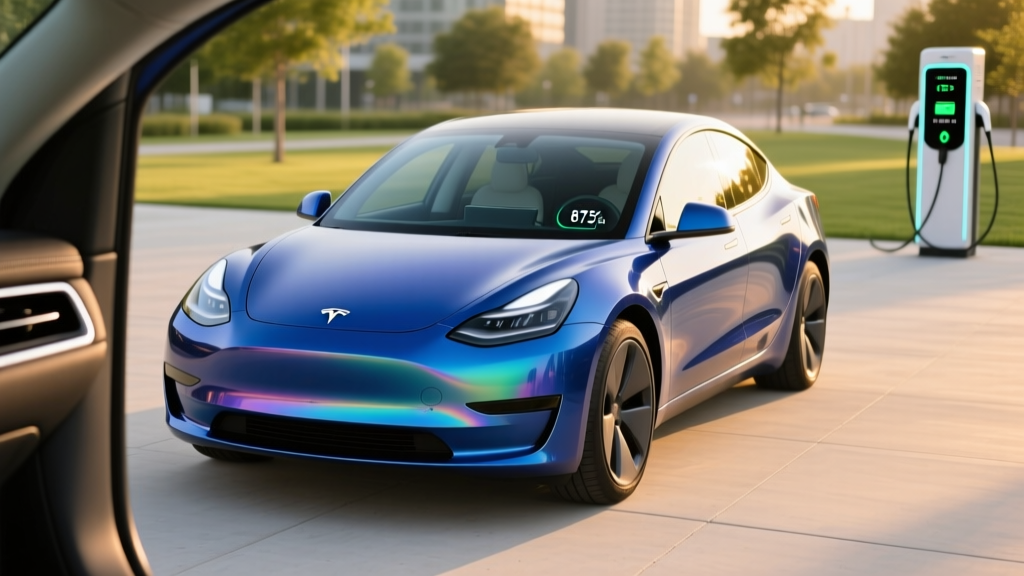
That's it. Five colors for a vehicle with over a million units on U.S. roads. This scarcity is exactly why Tesla changing colors via vinyl wrap has become a $2,000–$5,000 aftermarket industry. Popular wrap choices include satin chrome, matte military green, brushed titanium, and color-shift films that change hue depending on the viewing angle.
Wrap vs. Factory Paint: Cost and Durability
| Option | Typical Cost | Durability | Resale Impact |
|---|---|---|---|
| Factory paint ($0–$2,500) | Included or upcharge at purchase | Standard automotive clear coat; chips and swirls over time | Neutral; original paint preferred by most buyers |
| Full vinyl wrap | $2,500–$5,000 | 3–5 years with proper care; UV and wash-sensitive | Can be removed to reveal original paint; mixed buyer reaction |
| PPF (paint protection film) + ceramic coat | $3,000–$6,000 | 7–10 years for PPF; 2–5 years for ceramic | Positive; preserves factory paint underneath |
| Tesla's Paint Protection Film (dealer-installed) | ~$1,500–$2,500 partial coverage | OEM-grade; front-end coverage only | Positive; Tesla-branded option |
Most owners who pursue Tesla changing colors opt for a full wrap over a respray. Wraps are reversible, protect the original paint, and cost roughly half what a quality respray would. The downside: wraps require hand-washing, don't love automatic car washes, and need replacement every 3–5 years depending on climate and sun exposure.
2026 Tesla Model 3 Long Range AWD: Full Spec Breakdown
Here's the complete spec sheet for the 2026 Model 3 Long Range AWD — the variant most owners wrap, given its popularity and premium positioning.
| Specification | Value |
|---|---|
| EPA Range | 363 miles |
| Battery Capacity (usable) | ~79 kWh (NMC chemistry) |
| Drivetrain | Dual-motor AWD |
| Horsepower | ~384 hp combined |
| 0–60 mph | 4.2 seconds |
| Top Speed | 125 mph |
| Max DC Fast Charge Rate | ~170 kW peak |
| 10–80% DC Fast Charge Time | ~27 minutes |
| Level 2 Home Charge Rate | 11.5 kW (~44 miles/hr) |
| MPGe (combined) | 131 MPGe |
| Efficiency | 26 kWh/100 mi |
| Cargo Volume | 23 cu ft (trunk + frunk combined) |
| Rear Legroom | 35.3 inches |
| Battery Warranty | 8 years / 120,000 miles (70% capacity retention) |
| Base MSRP | $47,740 (before destination) |
Real-World Range: What the EPA Sticker Doesn't Tell You
EPA Estimate: 363 miles
Real-World Highway (70–75 mph, mild weather): ~290–310 miles
Real-World City/Suburban Mix: ~320–345 miles
Cold Weather (below 30°F, highway): ~230–270 miles
Cold Weather + Cabin Heating (worst case): ~200–240 miles
Tesla's efficiency engineering is legitimately class-leading. The Model 3 Long Range achieves 26 kWh/100 mi on the EPA cycle, which is exceptional for a dual-motor AWD sedan. But the EPA test cycle includes generous low-speed and moderate-temperature assumptions that don't reflect most drivers' reality.
On a 75-mph highway run in 70°F weather, expect to use about 300 of your 363 EPA miles. That's still strong — enough for a Los Angeles to Las Vegas run with a brief Supercharger stop — but it's not the sticker number. Cold weather is the bigger penalty: lithium-ion batteries lose efficiency in low temperatures, and cabin heating (even with Tesla's heat pump) draws significant energy. In sub-30°F conditions on the highway, plan for 230–270 miles of practical range before needing to charge.
The Model 3's heat pump, standard since the 2021 refresh, mitigates cold-weather loss compared to resistive-heating EVs, but it doesn't eliminate it. Preconditioning the battery while plugged in before departure recovers some of this loss and also improves your first DC fast-charge session of the day.
Charging Speed: Home and DC Fast Charging Explained
| Charging Method | Power (kW) | Miles Added per Hour | Typical Use Case |
|---|---|---|---|
| Level 1 (120V household outlet) | ~1.4 kW | ~5 mi/hr | Emergency / overnight trickle |
| Level 2 (240V home charger, 48A) | 11.5 kW | ~44 mi/hr | Daily home charging |
| Tesla Supercharger V3 (DC fast) | Up to 170 kW peak | ~175 mi in 15 min | Road trips |
| CCS DC Fast Charger (with adapter) | Up to 150 kW | ~150 mi in 15 min | Non-Tesla network charging |
The Model 3 Long Range peaks at approximately 170 kW on a V3 Supercharger, but that peak only holds between roughly 10–30% State of Charge (SoC). Above 50%, the charge curve tapers significantly — a physics-driven limitation of NMC battery chemistry and thermal management. Your 10–80% session takes about 27 minutes, which is competitive but not class-leading. The Hyundai Ioniq 6, for example, hits 10–80% in about 18 minutes thanks to its 800V architecture.
For home charging, a 48-amp Level 2 wall connector on a 60-amp circuit delivers 11.5 kW, adding roughly 44 miles of range per hour. A full overnight charge (8 hours) replenishes about 350 miles — more than the car's total range. Installation costs vary widely: expect $800–$2,000 for a straightforward install near your electrical panel, or $2,500–$5,000+ if you need a panel upgrade or long conduit runs. Always get a quote from a licensed electrician before committing.
Tesla now includes a CCS adapter with new vehicles, opening access to Electrify America, EVgo, and other non-Tesla networks. The Supercharger network remains the most reliable DC fast-charging ecosystem in the U.S., with over 6,000 V3/V4 stalls nationally, but CCS access is a valuable backup for travel in areas with sparse Supercharger coverage.
Battery Chemistry, Degradation, and Warranty Coverage
The 2026 Model 3 Long Range AWD uses an NMC (nickel manganese cobalt) lithium-ion battery pack with approximately 79 kWh of usable capacity. NMC chemistry offers higher energy density than LFP (lithium iron phosphate), which is why the Long Range variant achieves 363 miles in a relatively compact sedan.
The trade-off: NMC batteries degrade slightly faster than LFP over time and are more sensitive to sustained high SoC. Tesla recommends daily charging to 80–90% for NMC packs and reserving 100% charges for road trips. Following this guidance, real-world degradation data from Tesla owner communities suggests approximately 8–12% capacity loss over the first 100,000 miles, with the curve flattening significantly afterward.
Tesla's battery warranty covers 8 years or 120,000 miles (whichever comes first) with a guaranteed minimum of 70% capacity retention. This means if your battery drops below 70% of its original capacity within the warranty period, Tesla will repair or replace it. For the Long Range, 70% of 363 miles is approximately 254 miles — still a usable daily range for most drivers.
For comparison, the base Model 3 RWD uses an LFP battery (~60 kWh), which Tesla recommends charging to 100% regularly. LFP degrades more slowly and tolerates full charges better, but sacrifices range (EPA 272 miles) and cold-weather performance. If you're choosing between trims and plan to keep the car 8+ years, the LFD battery's longevity profile is worth considering.
Pricing, Trims, and Federal Tax Credit Eligibility
| Trim | Base MSRP | Estimated Price After §30D Credit | Key Differentiator |
|---|---|---|---|
| Model 3 RWD | $38,990 | ~$31,490 (if eligible for $7,500) | LFP battery, 272-mi range, best value |
| Model 3 Long Range AWD | $47,740 | ~$40,240 (if eligible for $7,500) | NMC battery, 363-mi range, dual-motor |
| Model 3 Performance | $54,990 | ~$47,490 (if eligible for $7,500) | Track mode, 315-mi range, 2.9s 0–60 |
The IRS §30D federal tax credit offers up to $7,500 for qualifying new EVs, but eligibility is anything but automatic. Here's what determines whether you get it on a Tesla Model 3:
- MSRP cap: The Model 3 qualifies as a sedan, so the MSRP cap is $55,000. All current Model 3 trims fall under this limit.
- Buyer income cap: Modified adjusted gross income (MAGI) must not exceed $150,000 (single), $225,000 (head of household), or $300,000 (joint filers).
- Battery sourcing requirements: The $7,500 credit splits into two halves — $3,750 for critical-minerals sourcing and $3,750 for battery-component manufacturing. Tesla has worked to qualify for the full $7,500, but sourcing rules tighten annually. As of 2026, the Model 3 Long Range AWD is generally eligible for the full credit, but always verify on the fueleconomy.gov tax credit lookup before purchasing.
- Point-of-sale transfer: Since 2024, buyers can transfer the credit to the dealer at purchase, reducing the out-of-pocket price immediately rather than waiting for a tax refund. This is available for the Model 3.
Consult a tax professional to confirm your personal eligibility — income phase-outs and sourcing-rule changes can shift the numbers.
Technology, Driver Assistance, and Interior
The refreshed Model 3 (codenamed "Highland") carries significant interior and tech upgrades over the pre-2024 versions:
- 15.4-inch center touchscreen with faster processor and improved UI responsiveness
- Rear 8-inch touchscreen for climate and media control by rear passengers
- Ventilated front seats (Long Range and Performance)
- Ambient lighting and acoustic glass for noticeably quieter cabin
- Autopilot (standard): adaptive cruise, lane centering, automatic emergency braking — SAE Level 2 driver assistance, not self-driving
- Full Self-Driving (Supervised) ($8,000 option or $99/month): adds automated lane changes, intersection handling, and parking — still SAE Level 2, requires continuous driver supervision
Tesla Autopilot and FSD (Supervised) are Level 2 driver-assistance systems. The driver must remain fully attentive, keep hands on the wheel (or demonstrate attention via the cabin camera), and be prepared to take over at any moment. These systems are not autonomous. True driverless operation (Level 4) currently exists only in geofenced robotaxi services like Waymo.
The minimalist interior remains polarizing. There are no physical stalks (turn signals are steering-wheel buttons), no instrument cluster, and no Apple CarPlay or Android Auto. Everything routes through Tesla's proprietary OS. For some, this is refreshingly clean; for others, it's a dealbreaker — especially the stalkless turn signals, which draw consistent criticism in real-world use.
Pros, Cons, and Who Should Buy the Model 3
- Class-leading efficiency (26 kWh/100 mi)
- 363-mi EPA range on Long Range AWD
- Access to Tesla Supercharger network
- Strong resale value relative to EV peers
- Over-the-air updates continuously add features
- Qualifies for full $7,500 federal tax credit (verify annually)
- Limited factory paint options (drives wrap aftermarket demand)
- No Apple CarPlay / Android Auto
- Stalkless turn signals frustrate many drivers
- DC fast-charge speed (170 kW peak) lags 800V competitors
- Rear seat space is tight for taller passengers (35.3" legroom)
- FSD ($8,000) remains Level 2 despite the name
Who the Model 3 Suits Best
Ideal for: Daily commuters with home charging access, tech-forward buyers who value OTA updates and Supercharger access, and couples or small families who don't need SUV cargo space. The Long Range AWD handles road trips well — LA to San Francisco or NYC to DC on a single charge is realistic with conservative driving.
Consider alternatives if: You regularly carry rear-seat adults (the Model Y offers more rear headroom and legroom), you need towing capacity (the Model 3 isn't rated for towing), or you want the fastest possible DC charging (the Ioniq 6 or Porsche Taycan charge faster).
Frequently Asked Questions
What is the real-world range of the Tesla Model 3 Long Range?
The EPA rates it at 363 miles, but expect 290–310 miles on highway trips at 70–75 mph, and 230–270 miles in cold weather (below 30°F). City and suburban driving in mild weather gets closest to the EPA number, around 320–345 miles.
How fast does the Model 3 charge at home and on road trips?
At home on a 48-amp Level 2 charger, it adds about 44 miles of range per hour (11.5 kW). On a Tesla V3 Supercharger, it peaks at ~170 kW and charges from 10–80% in approximately 27 minutes. Charge speed tapers significantly above 80% SoC.
How much does the Model 3 cost after the federal tax credit?
The Long Range AWD starts at $47,740. If you qualify for the full $7,500 §30D credit (income, MSRP, and battery-sourcing requirements all met), the effective price drops to approximately $40,240. The base RWD model drops to around $31,490 with the credit. Always verify current eligibility on IRS.gov and fueleconomy.gov before purchasing.
Is the Model 3 worth buying vs. the Hyundai Ioniq 6 or BMW i4?
The Model 3 wins on efficiency, Supercharger network access, and total cost of ownership. The Ioniq 6 charges faster (18 min 10–80%) and offers CarPlay. The BMW i4 provides a more traditional luxury interior and better rear-seat comfort. If Supercharger reliability and software are priorities, the Model 3 remains the default choice. If charging speed or interior quality matter more, test-drive the competitors.
Does wrapping a Tesla void the warranty?
A professionally installed vinyl wrap does not void Tesla's vehicle or battery warranty. However, if wrap removal damages factory paint, that specific damage won't be covered. Choose a reputable installer and keep documentation. PPF (paint protection film) is also warranty-safe and offers better long-term protection.
How much does it cost to change a Tesla's color with a wrap?
A quality full-body vinyl wrap on a Model 3 typically costs $2,500–$5,000 depending on film type (gloss, matte, satin, color-shift), installer reputation, and region. Premium films like 3M or Avery Dennison with professional installation average around $3,500. Expect the wrap to last 3–5 years with proper care.