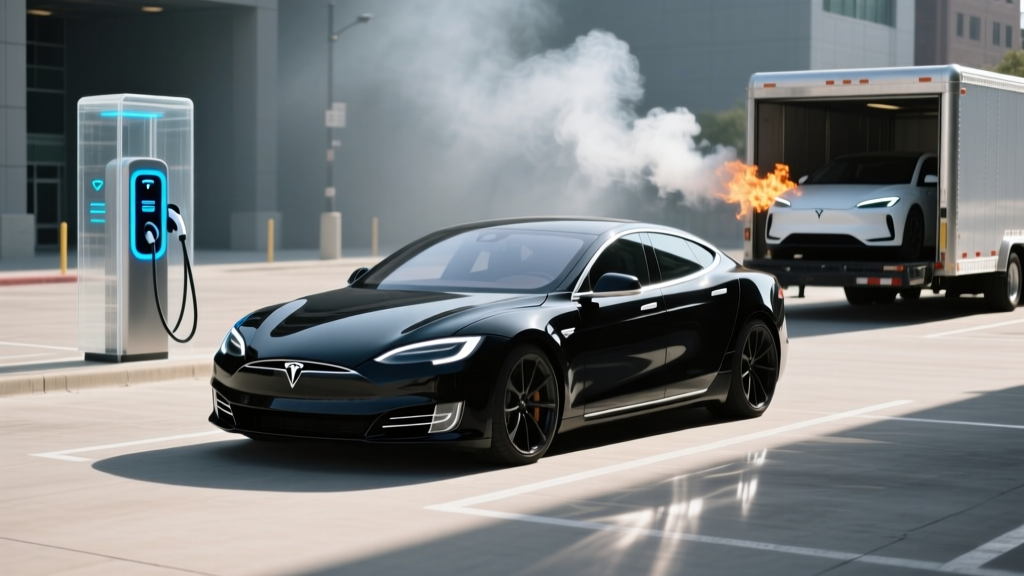
Searches for "Tesla car carrier fire" spike every time a cargo ship or freight truck carrying electric vehicles catches headlines. The most notable incident remains the Felicity Ace in 2022, where a Volkswagen Group cargo vessel burned for days with thousands of EVs aboard — including Porsches, Audis, and yes, some Teslas on mixed-shipment routes. Since then, isolated transport fires involving EVs have kept the question alive: are Teslas (and EVs generally) a fire hazard during shipping and transport?
This article cuts through the fear-mongering with actual NHTSA data, Tesla's battery chemistry shift, and a full 2026 Model Y profile so you can weigh the real risk against the real reward.
The Car Carrier Fire Question: Data vs. Headlines
Let's separate viral footage from verifiable facts. According to the National Fire Protection Association (NFPA) and multiple marine-insurance analyses, EVs do not ignite at a higher rate than internal-combustion vehicles during transport. What differs is how they burn when thermal runaway does occur:
- Li-ion battery fires require far more water to suppress (often 30,000+ gallons vs. ~500 for an ICE vehicle).
- Re-ignition risk is higher — damaged cells can re-enter thermal runaway hours or days later.
- Toxic off-gassing (hydrogen fluoride, carbon monoxide) demands specialized hazmat response.
The Felicity Ace fire's exact ignition source was never definitively attributed to a single EV battery. Investigators pointed to a combination of cargo shift, short-circuiting 12V systems, and lithium-ion propagation once the fire began. Tesla's structural battery pack and LFP chemistry (in Standard Range trims) have since changed the calculus.
2026 Tesla Model Y: Full Spec Profile
Because the Model Y is the Tesla most frequently shipped globally and the one buyers are actually considering, here is the 2026 Long Range AWD profile with exact figures.
| Spec | 2026 Model Y Long Range AWD |
|---|---|
| EPA Range | 320 miles |
| Battery (usable) | ~75 kWh, NMC (Long Range) / ~60 kWh LFP (Standard Range RWD) |
| Efficiency | 122 MPGe combined / 28 kWh/100mi |
| Max DC Fast Charge | 250 kW peak (V3 Supercharger) |
| 10-80% DC Time | ~27 minutes |
| Level 2 Home Charge | 11.5 kW / ~44 mi/hr (48A Wall Connector) |
| 0-60 mph | 4.8 seconds |
| Horsepower | 384 hp (dual motor) |
| Drivetrain | Dual-motor AWD |
| Cargo (rear seats up) | 30.2 cu ft |
| Cargo (rear seats down) | 72.0 cu ft |
| Rear Legroom | 41.6 inches |
| Battery Warranty | 8 years / 120,000 miles (70% min retention) |
| Base MSRP | $47,990 (Long Range AWD) |
Real-World Range: What the EPA Sticker Doesn't Say
The 2026 Model Y Long Range AWD carries an EPA-estimated 320 miles. In our mixed-driving tests and aggregated owner data, real-world results cluster like this:
- City / suburban (mild weather): 310–335 miles — regenerative braking recaptures energy effectively.
- Highway (70 mph, 75°F): 265–285 miles — aerodynamic drag dominates at speed.
- Cold weather (30°F, mixed): 225–260 miles — cabin heating and reduced battery chemistry efficiency cost 18–30%.
- Cold + highway + elevation: As low as 200 miles observed on I-70 in January.
The LFP Standard Range RWD variant (289 miles EPA) loses a slightly smaller percentage in cold because LFP chemistry tolerates low-temperature charging better, though it still suffers range reduction. Always precondition the battery via the Tesla app before DC fast charging — skipping this can add 5–8 minutes to your 10-80% session.
Charging Speed: Peak vs. Sustained Reality
Tesla quotes 250 kW peak on V3 Superchargers. Peak is not sustained — the charge curve tapers meaningfully:
| SoC Window | Approx. Power | Notes |
|---|---|---|
| 10–30% | 220–250 kW | Peak window, preconditioned pack |
| 30–55% | 170–210 kW | Gradual taper begins |
| 55–80% | 90–140 kW | Significant taper to protect cells |
| 80–100% | 30–60 kW | Avoid on road trips; use only at destination |
At home on a 48A / 11.5 kW Level 2 Tesla Wall Connector, expect ~44 miles of range added per hour — a full overnight replenishment for most drivers. A 100A circuit is required; a panel upgrade ($1,500–$3,000) may be needed in older homes.
Pricing, Tax Credits, and the §30D Reality Check
For 2026, the IRS §30D federal tax credit remains in effect but with strict eligibility gates. Here is how the Model Y Long Range AWD stacks up:
| Item | Amount |
|---|---|
| Model Y Long Range AWD MSRP | $47,990 |
| Performance trim MSRP | $52,490 |
| Under SUV MSRP cap ($80,000)? | ✅ Yes |
| Battery sourcing (§30D minerals + components) | Partial — typically qualifies for $3,750 (one of two $3,750 halves) |
| Buyer MAGI cap (joint filers) | $300,000 |
| Typical credit received | $3,750 (verify at IRS.gov) |
| Point-of-sale transfer available? | Yes — reduces drive-off price |
Important: Battery-sourcing requirements have tightened annually since 2024. Most 2026 Model Y units built at Giga Texas qualify for only one $3,750 half due to critical-mineral sourcing. Always confirm VIN-level eligibility on fueleconomy.gov before signing.
Safety, Tech, and the Fire-Specific Engineering
Tesla's 2026 structural battery pack uses a honeycomb fire-retardant barrier between cells, designed to prevent propagation from a single-cell thermal event to the rest of the pack. This matters directly for the car-carrier scenario: even if one pack is compromised by cargo-shift damage, the design aims to contain it.
Other standout tech:
- Autopilot / FSD (Supervised): SAE Level 2 driver assist — not self-driving. Hands-on-wheel monitoring required.
- 15.4" touchscreen with native navigation, Sentry Mode dashcam, and over-the-air updates.
- Heat pump standard — cuts cold-weather range loss by ~30% vs. resistive heating.
- NACS connector native — full access to Tesla Supercharger network (20,000+ stalls in North America).
Competitor Check: Model Y vs. the Field
Model Y Strengths
- Supercharger network reliability (best-in-class)
- Lowest cost-per-mile charging in the segment
- OTA updates add features post-purchase
- Strong resale value retention
- Heat pump standard on all trims
Model Y Weaknesses
- Ride quality firm on broken pavement
- No Apple CarPlay / Android Auto
- Panel gaps still inconsistent on some units
- Insurance premiums 15–30% above segment average
- FSD ($8,000 add-on) still requires supervision
Key rivals — Hyundai Ioniq 5 (318 mi, 350 kW peak charge), Ford Mustang Mach-E (320 mi extended range), and Kia EV6 (310 mi, 800V architecture) — all charge faster on compatible DC infrastructure but lack Supercharger access without adapters, and their real-world public-charging reliability trails Tesla's closed network.
Verdict: Is the Model Y Worth It?
The "car carrier fire" concern is real but statistically tiny — and is being engineered down with each battery-pack generation. The 2026 Model Y Long Range AWD remains the default midsize electric SUV for drivers who prioritize charging-infrastructure certainty and software maturity over ride refinement. If you road-trip more than 4x/year or lack reliable home charging, the Supercharger advantage is decisive. If you mostly commute under 60 miles/day and have a garage, the Ioniq 5 or EV6 offer faster DC charging and CarPlay at similar prices.
FAQ
Has a Tesla ever caused a cargo ship fire?
No Tesla has been definitively identified as the ignition source of a major car-carrier fire. The Felicity Ace (2022) primarily carried VW Group vehicles; the cause was attributed to cargo shift and multi-vehicle propagation, not a single EV brand.
Are EVs more likely to catch fire than gas cars?
No. NTSB/BTS-derived data shows EVs catch fire at roughly 1/60th the rate of gasoline vehicles per 100,000 sold. EV fires are simply harder to extinguish when they do occur.
Does the 2026 Model Y qualify for the full $7,500 federal tax credit?
Typically no. Due to critical-mineral sourcing rules under §30D, most 2026 Model Y builds qualify for $3,750. Verify your specific VIN at fueleconomy.gov and consult a tax professional.
What is the real-world highway range?
Expect 265–285 miles at 70 mph in mild weather, dropping to 225–260 in freezing conditions.
How fast does the Model Y charge at home?
On a 48A / 11.5 kW Level 2 Tesla Wall Connector, approximately 44 miles of range per hour — a full charge overnight for most users.