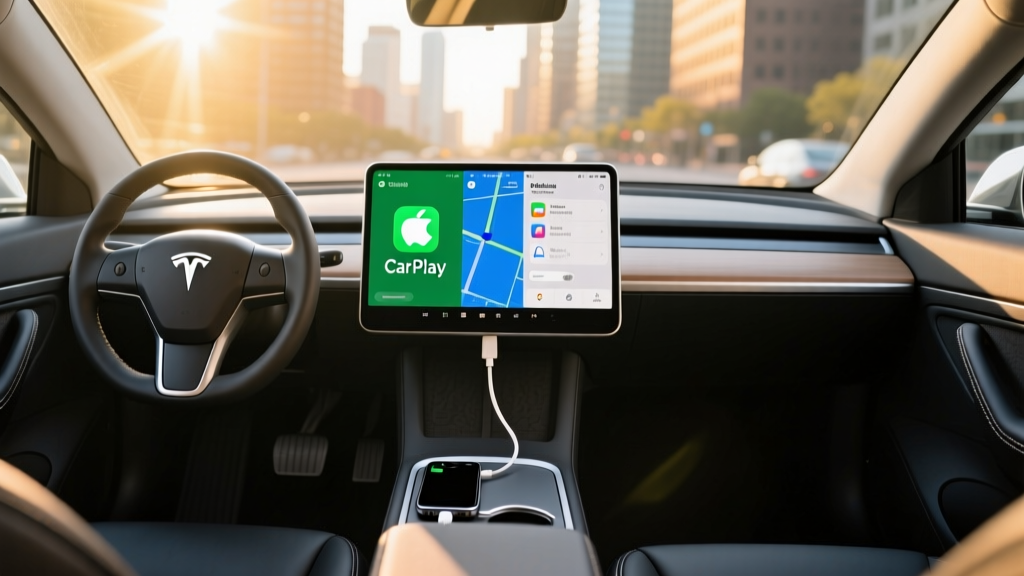
If you've ever searched "Tesla and CarPlay" hoping to mirror your iPhone on a Model 3 or Model Y touchscreen, you already know the answer is frustrating: Tesla does not support Apple CarPlay — not wired, not wireless, not via any official integration. In 2026, as nearly every other mainstream automaker offers wireless CarPlay as standard, Tesla remains the most conspicuous holdout in the industry.
This isn't a spec oversight. It's a deliberate architectural choice by Tesla that ties directly into how its vehicles handle navigation, media, over-the-air updates, and driver-assistance visualization. Below, we explain exactly why CarPlay isn't coming to Tesla, what you get instead, the workarowners actually use, and whether this should affect your purchase decision — all while reviewing the Tesla Model Y, the vehicle most buyers cross-shopping against CarPlay-equipped rivals.
Why Tesla Refuses to Support Apple CarPlay
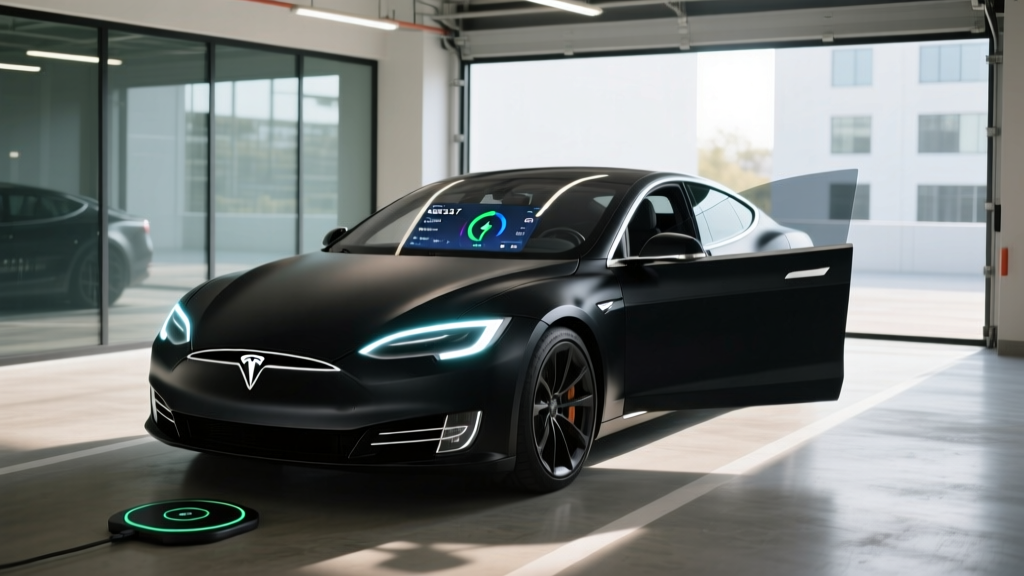
Tesla's infotainment system is not a conventional head unit. It's a vertically integrated, Linux-based computing platform that controls virtually every aspect of the car — from navigation and media to suspension damping, thermal management, and Autopilot visualization. Apple CarPlay, by design, hands control of the screen (or a portion of it) to Apple's software stack. For Tesla, that's a non-starter.
Here's the core conflict: Tesla's navigation system feeds directly into the vehicle's energy management. When you enter a destination, the car calculates whether you'll need to stop to charge, preconditions the battery for fast charging at the next Supercharger, and adjusts estimated arrival SoC (State of Charge) in real time based on elevation, wind, and traffic. CarPlay's Apple Maps or Waze cannot do this because they have no access to Tesla's proprietary battery and thermal APIs.
Additionally, Tesla's touchscreen visualizes Autopilot and FSD (Supervised) data — rendering detected vehicles, lane markings, pedestrians, and traffic lights in real time. This is a SAE Level 2 driver-assistance system, and Tesla considers the visualization part of the safety feedback loop. Handing screen real estate to CarPlay would compromise that feedback.
Bottom line: Tesla views CarPlay as a regression in user experience, not an enhancement. The company has invested heavily in its own software stack and has no incentive to cede control to a third-party interface.
2026 Tesla Model Y: The EV Most Buyers Compare to CarPlay-Equipped Rivals
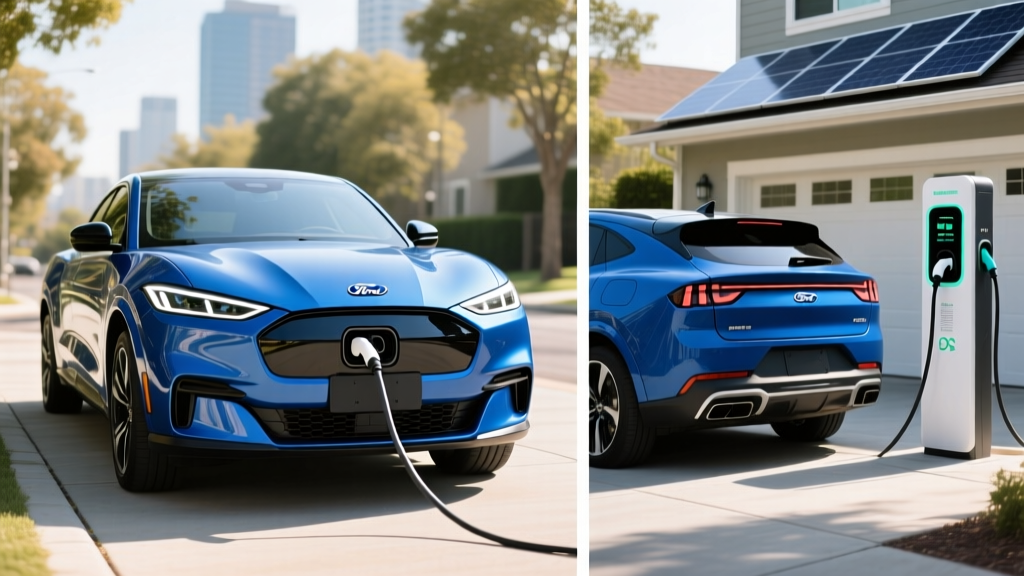
The Model Y remains Tesla's best-selling vehicle and the one most frequently cross-shopped against CarPlay-equipped competitors like the Hyundai Ioniq 5, Ford Mustang Mach-E, and Chevrolet Equinox EV. Here's a full spec breakdown for the 2026 Model Year lineup.
| Spec | Long Range RWD | Long Range AWD | Performance AWD |
|---|---|---|---|
| EPA Range | 337 mi | 316 mi | 293 mi |
| Battery (usable) | ~78 kWh (NMC) | ~78 kWh (NMC) | ~78 kWh (NMC) |
| Drivetrain | Rear-Wheel Drive | Dual-Motor AWD | Dual-Motor AWD |
| Horsepower | 346 hp | 384 hp | 456 hp |
| 0-60 mph | 5.8 sec | 4.8 sec | 3.5 sec |
| Max DC Fast Charge | 250 kW | 250 kW | 250 kW |
| 10-80% DCFC Time | ~27 min | ~27 min | ~27 min |
| Level 2 Home Charge | 11.5 kW (~44 mi/hr) | 11.5 kW (~44 mi/hr) | 11.5 kW (~44 mi/hr) |
| MPGe (combined) | 122 MPGe | 116 MPGe | 111 MPGe |
| Cargo (rear seats up) | 30.2 cu ft | 30.2 cu ft | 30.2 cu ft |
| Cargo (rear seats folded) | 72.1 cu ft | 72.1 cu ft | 72.1 cu ft |
| Rear Legroom | 37.0 in | 37.0 in | 37.0 in |
| Base MSRP | $44,990 | $47,990 | $52,990 |
Source: fueleconomy.gov and Tesla's official order page. Specs reflect 2026 model year.
Real-World Range: What the EPA Number Doesn't Tell You
EPA Estimated Range (Long Range AWD): 316 miles
Real-World Expectation: 260–290 miles on highway trips at 70-75 mph; 230–260 miles in sub-freezing temperatures (below 32°F / 0°C). City driving with regenerative braking can match or exceed the EPA sticker, reaching 310–340 miles in mild conditions.
Tesla's efficiency is among the best in the segment, thanks to its heat pump (standard on all trims), low drag coefficient, and aggressive regenerative braking. However, like all EVs, the Model Y loses range at sustained highway speeds and in cold weather. The heat pump mitigates cold-weather cabin-heating losses significantly compared to resistive heaters, but battery chemistry itself becomes less efficient below freezing.
On a real-world 300-mile highway road trip at 72 mph in 65°F weather, expect to arrive with approximately 10-15% SoC remaining in the Long Range AWD — tight, but doable. In winter, plan a Supercharger stop.
Charging Speed: Supercharger Network vs. CCS Competitors
| Charging Level | Power / Rate | Miles Added per Hour |
|---|---|---|
| Level 1 (120V household) | ~1.4 kW | ~4-5 mi/hr |
| Level 2 (240V, 48A Wall Connector) | 11.5 kW | ~44 mi/hr |
| DC Fast Charge (V3 Supercharger) | Peak 250 kW | ~1,000 mi/hr at peak |
| DC Fast Charge (V4 Supercharger) | Peak 250 kW* | ~1,000 mi/hr at peak |
*The 2026 Model Y's onboard architecture caps at ~250 kW. Newer Tesla architectures (Cybertruck, next-gen) support higher rates, but the current Model Y does not.
The Model Y's charge curve is well-managed. It holds near-peak 250 kW from roughly 10% to 45% SoC, then tapers progressively. From 10-80%, expect approximately 27 minutes at a V3 Supercharger. Above 80%, charging slows dramatically — adding the final 20% can take another 20+ minutes. This is normal for NMC lithium-ion chemistry and is why Tesla's navigation system recommends charging to 80% on road trips unless you need the full battery.
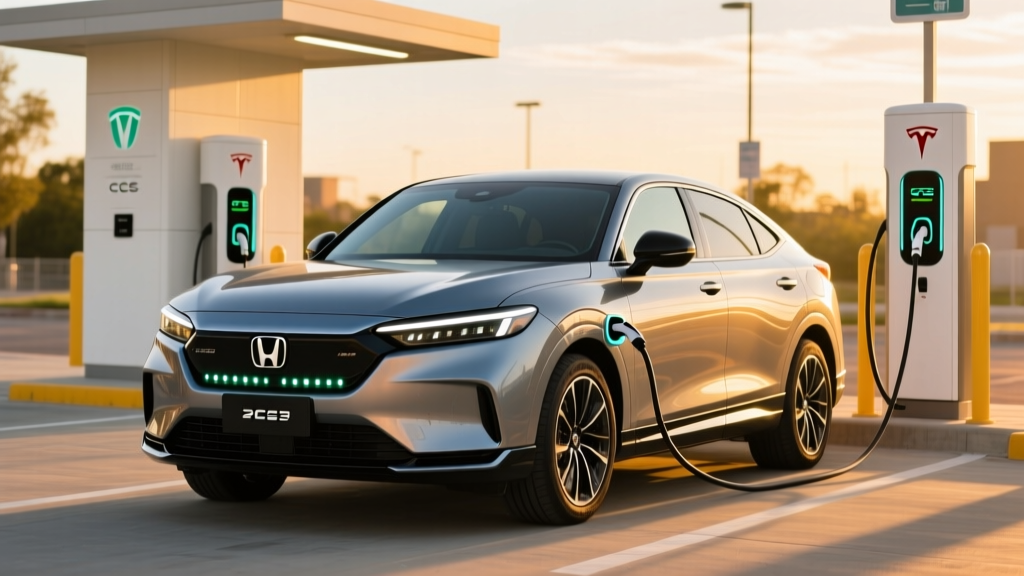
One major 2026 advantage: Tesla's Supercharger network now serves non-Tesla EVs at many locations, but Tesla owners still benefit from the most reliable, most widely deployed DC fast-charging network in North America. Plug-in and charge with no app, no RFID card, no payment fumbling — it's all tied to your Tesla account.
What Tesla's Infotainment Offers Instead of CarPlay
Tesla's 15.4-inch center touchscreen (in the refreshed Model Y) runs a proprietary OS that includes:
- Native navigation with real-time traffic, Supercharger routing, and battery-aware ETA
- Spotify, Apple Music, Tidal, YouTube Music — all natively integrated with your account login
- Bluetooth audio for any app on your phone (podcasts, audiobooks, etc.)
- Phone mirroring for calls, contacts, and text-message readouts via Bluetooth
- Theater mode (parked): Netflix, YouTube, Disney+, Twitch, TikTok
- Gaming: Cyberpunk 2077, Stardew Valley, and more via the onboard GPU
- Voice commands: "Navigate to...", "Play...", "Call..." with reasonable accuracy
- Over-the-air updates that regularly add features without dealer visits
For most media consumption, Tesla's native integration is arguably superior to CarPlay — you get full-screen album art, lyrics, and queue management without phone dependency. The gap is most noticeable in two areas: Waze preference (Tesla Maps doesn't crowdsource police/hazard reports like Waze) and contacts/calendar integration (Tesla's phone integration is functional but less polished than CarPlay's contact-card display).
Workarounds: Can You Get CarPlay-Like Functionality in a Tesla?
Several aftermarket solutions attempt to bridge the gap, though none are officially supported by Tesla or Apple:
- CarPlay AI Boxes (HDMI/carplay adapters): These devices (e.g., Carlinkit T2C Plus) connect via Tesla's browser or USB and stream a CarPlay-like interface to the touchscreen. Quality varies, latency is noticeable, and Tesla software updates can break compatibility.
- Phone-as-dashboard via browser: Some owners run a phone-based browser interface, but this is clunky and not recommended while driving.
- Dedicated phone mount + CarPlay on phone screen: The simplest, most reliable option. Mount your phone on the dash and use CarPlay on the phone's own screen for Waze or specific apps, while the Tesla handles primary navigation and media.
Warning: Aftermarket CarPlay adapters for Tesla are not endorsed by either company. They may interfere with OTA updates, introduce security vulnerabilities, and will not integrate with Tesla's battery-aware navigation or Autopilot visualization. Use at your own risk.
Pricing, Tax Credit, and Total Cost
| Trim | Base MSRP | §30D Credit Eligibility | Est. After Credit |
|---|---|---|---|
| Long Range RWD | $44,990 | Eligible (up to $7,500)* | ~$37,490 |
| Long Range AWD | $47,990 | Eligible (up to $7,500)* | ~$40,490 |
| Performance AWD | $52,990 | Eligible (up to $7,500)* | ~$45,490 |
*Federal §30D tax credit eligibility depends on multiple factors. See IRS guidelines. Key requirements for 2026:
- MSRP cap: SUVs must be under $80,000 (all Model Y trims qualify)
- Buyer income cap: AGI must not exceed $150,000 (single), $225,000 (head of household), or $300,000 (joint)
- Battery sourcing: Critical minerals and battery components must meet escalating domestic/F TA content thresholds — Tesla's US-built batteries currently satisfy these requirements
- Point-of-sale transfer: You can transfer the credit to the dealer at purchase, reducing your out-of-pocket cost immediately rather than waiting for tax filing
The Model Y's total cost of ownership remains compelling. Electricity costs roughly $0.13–0.18/kWh nationally (varies by utility), translating to approximately $0.04–0.05 per mile — versus $0.12–0.16 per mile for a comparable gas SUV at current fuel prices. Over five years and 75,000 miles, fuel savings alone can exceed $6,000–$8,000.
Pros and Cons: The Tesla and CarPlay Trade-Off
Pros
- Supercharger network: most reliable DC fast-charging in North America
- Best-in-class efficiency: 122 MPGe combined (Long Range RWD)
- OTA updates continuously add features post-purchase
- Native Spotify/Apple Music integration superior to CarPlay for media
- Excellent cargo space: 72.1 cu ft with seats folded
- Strong §30D tax credit eligibility
- Heat pump standard — better cold-weather range retention
Cons
- No Apple CarPlay or Android Auto — period
- No Waze integration (hazard/police crowdsource reporting)
- Touchscreen controls for wipers, mirrors, and glovebox frustrate some buyers
- 250 kW peak charge rate trails Hyundai/Kia's 800V architecture (~350 kW)
- Insurance premiums often higher than segment average
- No physical buttons — steep learning curve for first-time EV buyers
- Rear-seat entertainment screen (refreshed Model Y) is small and limited
Should You Buy a Tesla or Choose a CarPlay-Equipped Competitor?
Choose the Tesla Model Y if:
- You prioritize charging-network reliability above all else
- You're comfortable with touchscreen-only controls and native app integration
- You want the most energy-efficient electric SUV in its class
- You primarily use Spotify or Apple Music (natively integrated)
- You value OTA software improvements and Tesla's Autopilot/FSD ecosystem
Choose a CarPlay-equipped competitor (Ioniq 5, Mach-E, Equinox EV) if:
- Waze is your primary navigation app and you need crowdsource hazard alerts
- You prefer familiar CarPlay/Android Auto interfaces with physical-button backup
- You want faster peak charging (Ioniq 5 at 350 kW on 800V architecture)
- You need CarPlay for fleet-management or business apps on the road
- You want a more traditional dealership service experience
Warranty, Battery Longevity, and Ownership Costs
Tesla's warranty coverage for the 2026 Model Y:
- Basic vehicle: 4 years / 50,000 miles
- Battery & drive unit (Long Range/Performance): 8 years / 120,000 miles, with a minimum 70% capacity retention guarantee
- RWD battery (LFP on base trims if applicable): 8 years / 100,000 miles, 70% retention
Tesla's NMC batteries have demonstrated strong longevity in fleet data. Most Model 3/Y packs lose approximately 5-10% capacity in the first 50,000 miles, then degradation flattens significantly. Real-world reports from high-mileage owners suggest 85-90% State of Health (SoH) at 100,000 miles is typical. Replacement cost, if needed out of warranty, ranges from $12,000–$16,000 depending on pack configuration.
Who the 2026 Model Y Suits Best
Ideal for: Daily commuters with home charging access, small-to-medium families needing cargo versatility, road-trippers who value Supercharger network reliability, and tech-forward buyers who prefer native software integration over phone mirroring.
Not ideal for: Buyers who depend on Waze for navigation, fleet operators requiring CarPlay-based telematics, or drivers who strongly prefer physical controls and conventional infotainment interfaces.
Frequently Asked Questions
Will Tesla ever add Apple CarPlay?
There is no indication that Tesla plans to support CarPlay. CEO Elon Musk has previously stated that Tesla's native interface is superior, and the company continues to invest in its own software ecosystem. As of 2026, no Tesla model supports CarPlay in any form.
Can I use my iPhone with a Tesla at all?
Yes — via Bluetooth. You can stream audio from any iPhone app (podcasts, audiobooks, music), make and receive calls, and see message notifications on the Tesla screen. Apple Music is also natively integrated, allowing you to log in and stream directly without your phone.
Is Tesla's built-in navigation better than Apple Maps or Google Maps?
For EV-specific routing, yes. Tesla's navigation accounts for battery state, Supercharger locations, elevation changes, wind speed, and traffic to provide accurate arrival SoC estimates. It also preconditions the battery when a Supercharger is your destination, enabling faster charging. For general point-of-interest search or Waze-style hazard reporting, CarPlay-based apps still have an edge.
Do aftermarket CarPlay adapters for Tesla work well?
They work with caveats. Devices like the Carlinkit T2C Plus stream a CarPlay-like interface to the Tesla browser, but latency, reliability, and update compatibility are ongoing concerns. They are not officially supported and should not be considered a permanent solution.
Does the 2026 Tesla Model Y qualify for the $7,500 federal tax credit?
Yes, all 2026 Model Y trims currently qualify, provided the buyer meets IRS income requirements (AGI caps of $150K single / $300K joint) and the vehicle's battery sourcing continues to meet §30D critical-mineral and component thresholds. The credit can be transferred at point of sale to reduce your purchase price immediately.
What's the real-world range of the Model Y Long Range AWD?
The EPA rates it at 316 miles. In real-world highway driving at 70-75 mph, expect 260–290 miles. In freezing temperatures, plan for 230–260 miles. City driving with regenerative braking can match or exceed 316 miles in mild weather.