Quick Verdict: Which Tesla Hauls the Most?
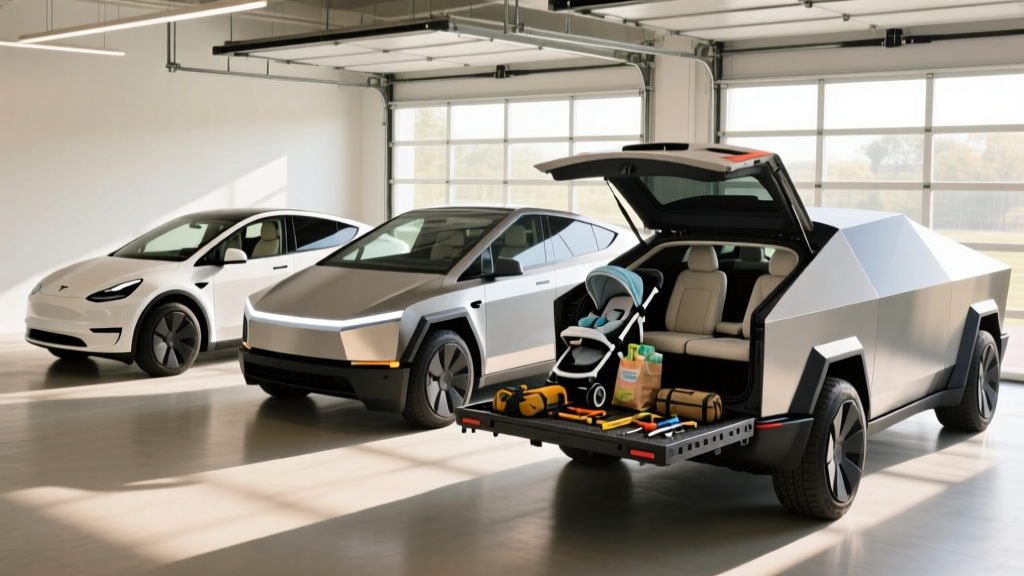
If you're searching for Tesla cargo solutions, the answer depends entirely on what you're hauling and how far you need to drive. The Model Y remains the volume king for everyday families with up to 76.2 cubic feet of combined cargo space and an EPA range of up to 320 miles. The Model X offers a wider, taller load floor and available six-seat layouts, while the Cybertruck dominates for heavy, dirty, or oversized payloads with its 6.5-foot stainless-steel bed and 11,000-pound tow rating.
Below, we break down exact cargo dimensions, range, charging speeds, and real-world ownership economics across all three utility-focused Teslas currently on sale for the 2026 model year.
Tesla Cargo Space: Side-by-Side Dimensions
Tesla doesn't sell a single model called the "Tesla Cargo" — buyers looking for maximum utility typically cross-shop three vehicles. Here's how the physical space actually measures up with all seats folded:
| Spec | Model Y (Long Range) | Model X | Cybertruck (AWD) |
|---|---|---|---|
| Rear cargo (seats up) | 30.2 cu ft | 37.1 cu ft | N/A (bed: 43.5 cu ft) |
| Max cargo (seats folded) | 76.2 cu ft | 88.1 cu ft | 100.8 cu ft (w/ vault + frunk) |
| Frunk volume | 4.1 cu ft | 7.1 cu ft | 7.1 cu ft |
| Cargo floor length (max) | ~67 in | ~78 in | 72 in (bed) + extendable |
| Opening width | ~43 in | ~48 in | 64 in (bed width) |
| Towing capacity | 3,500 lbs | 5,000 lbs | 11,000 lbs |
| Payload capacity | ~900 lbs | ~1,100 lbs | 2,500 lbs |
Key takeaway: For flat-pack furniture runs, camping gear, and grocery hauls, the Model Y's hatch is unmatched in its price class. For contractors, landscapers, or anyone hauling wet/dirty items, the Cybertruck bed is the only practical Tesla option. The Model X sits in between — more enclosed volume than the Y, but without the open-bed utility of the truck.
Range, Efficiency & Real-World Expectations
EPA range stickers don't tell the full story when you're loading a Tesla with cargo. Weight, aerodynamic drag (especially roof boxes on the Y and X), and highway speeds all cut into the advertised number. Here's what to expect:
Real-World Range Reality Check
Model Y Long Range AWD: EPA 320 miles. Expect ~270-290 mi highway at 75 mph; ~220-240 mi in sub-30°F cold. With a roof cargo box, deduct another 15-20%.
Model X Long Range: EPA 335 miles. Expect ~275-300 mi highway; ~230-250 mi cold. Heavier curb weight and lower efficiency compound losses when loaded.
Cybertruck AWD: EPA 340 miles (with range extender). Expect ~260-280 mi highway unloaded; ~200-220 mi when towing a 5,000-lb trailer. The stainless exoskeleton is heavy, and the truck's 6,600+ lb curb weight shows at highway speed.
| Metric | Model Y LR | Model X LR | Cybertruck AWD |
|---|---|---|---|
| EPA range | 320 mi | 335 mi | 340 mi |
| Battery (usable) | 75 kWh (NMC) | 95 kWh (NMC) | 123 kWh (NMC) |
| MPGe (combined) | 122 MPGe | 102 MPGe | 66 MPGe |
| kWh/100 mi | 28 | 33 | 48 |
| Drivetrain | Dual-motor AWD | Dual-motor AWD | Dual-motor AWD |
| 0-60 mph | 4.8 sec | 3.8 sec | 3.9 sec |
| Horsepower | 384 hp | 670 hp | 600 hp |
The Model Y's 122 MPGe combined makes it the cheapest Tesla to feed. According to fueleconomy.gov, the Model Y costs roughly $550/year in electricity (at $0.15/kWh national average), while the Cybertruck runs closer to $1,020/year — still cheaper than a comparable gas truck, but the efficiency gap is massive.
Charging Speed: DC Fast & Home Level 2
Cargo-hauling road trips live or die by charging speed. Here's how each model performs at a DC fast charger and on a home Level 2 setup:
| Spec | Model Y LR | Model X LR | Cybertruck AWD |
|---|---|---|---|
| Max DC fast charge | 250 kW | 250 kW | 350 kW |
| 10-80% DC time | ~25 min | ~30 min | ~22 min |
| Sustained peak (real) | ~170 kW avg | ~160 kW avg | ~220 kW avg |
| Level 2 home rate | 11.5 kW (~44 mi/hr) | 11.5 kW (~36 mi/hr) | 11.5 kW (~28 mi/hr) |
| Connector | NACS (native) | NACS (native) | NACS (native) |
| Overnight L2 (0-100%) | ~7.5 hrs | ~9.5 hrs | ~12 hrs |
Charging-curve reality: All three Teslas peak at their rated kW only between roughly 10-30% State of Charge. Above 50%, the curve tapers significantly. If you arrive at a Supercharger at 20% SoC, expect the average charge rate to be well below the peak number — this is why we list sustained averages. The Cybertruck's 800-volt architecture lets it sustain higher power longer, giving it the fastest real-world 10-80% time despite its massive battery.
For home charging, a 48-amp Level 2 wall connector on a 60-amp circuit delivers the full 11.5 kW to all three vehicles. Expect to pay $500-$1,500 for a professional installation (equipment + electrician + permit), assuming your electrical panel has capacity. A 200-amp panel upgrade can add $1,500-$3,000.
Pricing, Trims & Federal Tax Credit Eligibility
Here's where the math gets complicated. The federal EV tax credit under IRS §30D has strict income caps, MSRP limits, and battery-sourcing requirements that change yearly. For 2026, the key rules are:
- Income caps: AGI ≤ $150,000 (single) / $300,000 (joint)
- MSRP caps: $55,000 for sedans; $80,000 for SUVs and trucks
- Credit amount: Up to $7,500, split between critical-minerals ($3,750) and battery-component ($3,750) sourcing requirements
- Point-of-sale transfer: Eligible buyers can apply the credit at purchase, reducing the drive-off price
| Trim | MSRP | Vehicle class | Max §30D credit | Net price (if eligible) |
|---|---|---|---|---|
| Model Y Long Range | $48,990 | SUV | Up to $7,500 | ~$41,490 |
| Model Y Performance | $52,490 | SUV | Up to $7,500 | ~$44,990 |
| Model X Long Range | $79,990 | SUV | Up to $7,500 | ~$72,490 |
| Cybertruck AWD | $79,990 | Truck | Up to $7,500 | ~$72,490 |
| Cybertruck Cyberbeast | $99,990 | Truck | $0 (over MSRP cap) | $99,990 |
Critical caveat: Battery-sourcing requirements tighten annually. Whether a specific Tesla qualifies for the full $7,500, a partial $3,750, or nothing at all depends on the production month and the origin of the critical minerals and battery components in your specific VIN. Always verify eligibility on the IRS clean vehicle credit page or via Tesla's checkout tool before committing. Consult a tax professional for your personal situation.
Tech, Driver Assistance & Interior Utility
All three vehicles share Tesla's current infotainment platform — a 15.4-inch center touchscreen running Tesla's proprietary OS. There's no Apple CarPlay or Android Auto; Tesla's native navigation, streaming apps, and phone-as-key ecosystem are the only options.
Autopilot & Full Self-Driving (Supervised)
Tesla's Autopilot (standard) provides adaptive cruise and lane-centering on highways. Full Self-Driving (Supervised), a $8,000 option or $99/month subscription, adds automated lane changes, traffic-light recognition, and city-street navigation.
SAE Level 2 — NOT self-driving. Despite the "Full Self-Driving" name, this is an SAE Level 2 driver-assist system. The driver must remain fully engaged, hands on or near the wheel, and eyes on the road at all times. It does not replace the driver. Only Level 4 services like Waymo operate without a human driver, and those are limited to geofenced urban areas.
Cargo-Specific Tech Highlights
- Model Y: Power liftgate, 60/40 split-folding rear seats, optional third-row seats (for children only — 27.8 inches of legroom), under-floor rear storage bin, camp mode for overnight trips.
- Model X: Falcon-wing rear doors open vertically (easier loading in tight parking spots), available six-seat layout with walk-through to optional third row, power-folding second and third rows, air suspension lowers the vehicle for loading.
- Cybertruck: Powered tonneau cover, 120V and 240V bed outlets (up to 9.6 kW V2L — enough to power tools or a campsite), lockable under-bed storage, air suspension with 16 inches of travel, built-in ramp for ATVs or motorcycles.
Notable Drawbacks
- Minimalist interior means no physical buttons for climate, mirrors, or glovebox — all screen-controlled.
- Model Y and X rear visibility is limited; rely heavily on the backup camera.
- Cybertruck's size (223.7 in long, 95 in wide w/ mirrors) makes tight parking garages and drive-throughs challenging.
- No spare tire on any Tesla — run-flat tire foam kit only.
Warranty & Long-Term Battery Outlook
| Coverage | Model Y | Model X | Cybertruck |
|---|---|---|---|
| Basic vehicle | 4 yr / 50,000 mi | 4 yr / 50,000 mi | 4 yr / 50,000 mi |
| Battery & drive unit | 8 yr / 120,000 mi | 8 yr / 150,000 mi | 8 yr / 150,000 mi |
| Battery retention guarantee | ≥70% capacity | ≥70% capacity | ≥70% capacity |
All three use NMC (nickel-manganese-cobalt) battery chemistry, which offers higher energy density than LFP but is more sensitive to sustained high SoC. Tesla recommends daily charging to 80% for NMC packs, reserving 100% for road trips. Long-term degradation data from high-mileage fleets suggests most Tesla NMC packs retain 85-90% capacity after 100,000 miles — well above the 70% warranty threshold.
Who Should Buy Which Tesla for Cargo?
Decision Framework
Choose the Model Y if: You need 30-76 cu ft of enclosed cargo space, commute daily, want the lowest cost-per-mile, and rarely tow more than 3,500 lbs. Best for: families, commuters, weekend campers, budget-conscious buyers.
Choose the Model X if: You need the most enclosed cargo volume Tesla offers (88 cu ft), want falcon-wing doors for curbside loading, or need seating for up to seven. Best for: large families, those who value luxury and space over efficiency.
Choose the Cybertruck if: You need an open bed for dirty/wet/oversized loads, tow over 5,000 lbs regularly, or need V2L power output for job sites or off-grid camping. Best for: contractors, outdoor enthusiasts, heavy towers.
Pros & Cons at a Glance
Pros
- Model Y: Best value — 320 mi range, 76 cu ft cargo, ~$41K after credit
- Model X: Most enclosed space, falcon-wing doors, premium interior
- Cybertruck: 11,000-lb tow, 9.6 kW V2L, unmatched bed utility
- All three: Supercharger network access, OTA updates, strong resale
- All three: Dual-motor AWD standard, excellent traction in snow
Cons
- Model Y: Tight third row, limited rear visibility, no physical buttons
- Model X: $80K price, lower efficiency, aging platform design
- Cybertruck: Polarizing styling, massive footprint, Cyberbeast loses credit
- All three: No CarPlay/Android Auto, service center wait times
- All three: NMC battery requires 80% daily charge limit
Frequently Asked Questions
What is the real-world range of the Tesla Model Y with cargo?
The Model Y Long Range has an EPA range of 320 miles. With a full load of passengers and cargo, highway driving at 75 mph, expect 260-280 miles. In cold weather (below 30°F), range can drop to 220-240 miles. Adding a roof cargo box or bike rack can reduce range by an additional 10-20% due to aerodynamic drag.
How fast does the Cybertruck charge on a road trip?
The Cybertruck AWD peaks at 350 kW on a V4 Supercharger and charges from 10-80% in approximately 22 minutes. However, the sustained average charge rate is closer to 220 kW, so plan for 25-minute stops in practice. At home on a 48-amp Level 2 charger, a full charge takes roughly 12 hours.
Does the Tesla Model X qualify for the $7,500 federal tax credit?
The Model X Long Range at $79,990 MSRP sits under the $80,000 SUV cap, so it can qualify — but only if the buyer meets income limits (≤$300,000 joint AGI) and the specific VIN meets critical-mineral and battery-component sourcing requirements. Always verify on the IRS clean vehicle credit page before purchasing.
Is the Tesla Model Y worth buying over the Ford Mustang Mach-E or Hyundai Ioniq 5?
The Model Y wins on Supercharger network access, cargo volume (76.2 cu ft vs. 59-60 for competitors), and software integration. The Ioniq 5 charges faster on non-Tesla DC networks (800V architecture) and offers a more conventional interior. The Mach-E offers a sportier drive. If Supercharger reliability and cargo space are your top priorities, the Y leads. If you prefer physical controls or faster CCS charging, test-drive the alternatives.
Can I put a roof rack on the Tesla Model Y?
Yes. Tesla sells an official roof rack for the Model Y rated for 165 lbs dynamic load. Aftermarket options from Yakima and Thule also fit. Expect a 10-15% range reduction at highway speeds due to increased drag — more if you add a cargo box. Always precondition the battery before DC fast-charging with a loaded roof to maintain charge speed.
What's the biggest drawback of the Cybertruck for daily driving?
Size and visibility. At 223.7 inches long and 95 inches wide with mirrors, the Cybertruck doesn't fit many standard parking spaces or older garage doors. The angular stainless-steel body creates large blind spots, and the camera-based mirror system takes time to adjust to. For daily commuting in urban areas, the Model Y or Model X is far easier to live with.