Why Tesla Crash Safety Demands a Closer Look
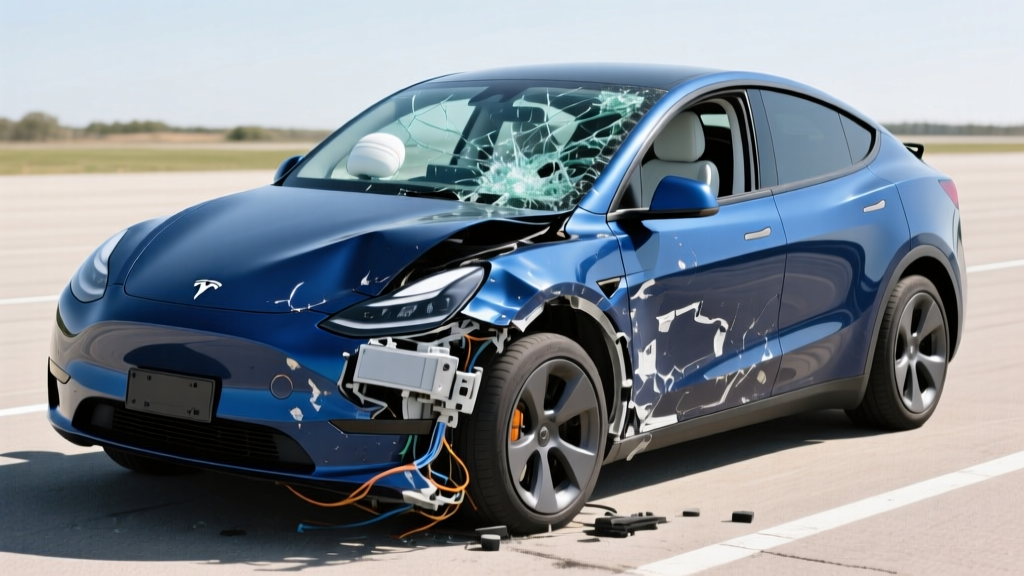
Search "Tesla car wreck" and you'll find a polarized internet: viral videos of crumpled Model Ys, counterarguments about 5-star safety ratings, and heated debates over battery fire risk. As someone who has owned three Teslas and spent years analyzing EV crash data, I can tell you the truth lives in the numbers — not the headlines. This guide dissects what actually happens when a Tesla is involved in a collision, using the best-selling Model Y as our primary reference point, and helps you understand the real safety, repair, and ownership implications before you buy.
2026 Tesla Model Y: Core Specs at a Glance
| Spec | Long Range AWD | Performance | RWD (Base) |
|---|---|---|---|
| EPA Range | 320 miles | 295 miles | 300 miles |
| Battery (usable) | ~75 kWh (NMC) | ~75 kWh (NMC) | ~60 kWh (LFP) |
| 0–60 mph | 4.8 sec | 3.5 sec | 5.8 sec |
| Horsepower | 384 hp | 456 hp | 295 hp |
| Drivetrain | Dual-Motor AWD | Dual-Motor AWD | RWD |
| Peak DC Charge | 250 kW | 250 kW | 170 kW |
| 10–80% DC Time | ~27 min | ~27 min | ~30 min |
| Base MSRP | $47,990 | $52,490 | $39,990 |
| Federal Tax Credit | Up to $7,500* | Up to $7,500* | Up to $7,500* |
*IRS §30D eligibility subject to income caps ($150k single / $300k joint), MSRP caps ($55k SUV), and battery-sourcing requirements. Verify current-year rules at irs.gov. Point-of-sale transfer available.
Crash Test Ratings: What NHTSA and IIHS Actually Say
The Model Y has consistently earned top marks from both major U.S. safety agencies. The National Highway Traffic Safety Administration (NHTSA) awarded the Model Y a 5-Star Overall Safety Rating across all trim levels and crash configurations — frontal, side barrier, side pole, and rollover. In rollover resistance specifically, the Model Y's low center of gravity (thanks to the floor-mounted battery pack) gives it a significant advantage over comparable ICE crossovers.
The Insurance Institute for Highway Safety (IIHS) named the Model Y a Top Safety Pick+ in prior model years, with "Good" ratings across all crashworthiness categories. The structural advantage here is physics: the rigid battery enclosure acts as a stressed member, reinforcing the floor pan and reducing cabin intrusion during side impacts. In a Tesla car wreck involving a side collision, this architecture has proven effective at preserving occupant survival space.
Battery Safety in a Tesla Car Wreck: Fire Risk in Perspective
The most emotionally charged question after any EV collision: will the battery catch fire? Let's look at data, not fear.
Tesla's battery packs are housed in a reinforced enclosure with multiple layers of protection — a titanium shield plate (on newer models), structural cross-members, and individual cell modules separated by fire-resistant barriers. In the event of a severe impact that compromises the pack, the vehicle's high-voltage system is designed to disconnect within milliseconds via pyrotechnic cut-off switches.
Tesla's own safety reports and NHTSA data indicate that EV battery fires remain statistically rare compared to internal-combustion engine vehicle fires. According to NHTSA analyses and independent reviews, EVs experience fires at a lower rate per 100,000 vehicles than gasoline vehicles. However, when a lithium-ion battery fire does occur, it burns hotter, longer, and is more difficult for first responders to extinguish — often requiring thousands of gallons of water and extended monitoring for thermal re-ignition.
Repair Costs After a Tesla Collision: The Honest Numbers
This is where Tesla ownership diverges sharply from conventional vehicles. Tesla's vertical integration, proprietary parts supply chain, and aluminum-intensive construction mean collision repair is often more expensive and takes longer than comparable ICE vehicles.
| Repair Scenario | Estimated Cost Range | Typical Timeline |
|---|---|---|
| Minor fender/bumper (no structural) | $1,500 – $4,500 | 1–3 weeks |
| Front-end collision (hood, lights, sensors) | $5,000 – $14,000 | 3–6 weeks |
| Side impact with panel/battery proximity | $8,000 – $25,000+ | 4–10 weeks |
| Battery pack replacement (impact damage) | $15,000 – $22,000 | 6–12 weeks |
| Full structural/total-loss threshold | $30,000+ | Vehicle often totaled |
Several factors drive these costs higher than expected:
- Sensor recalibration: Every Tesla carries 8+ cameras, ultrasonic sensors (or Tesla Vision camera-only arrays on newer builds), and radar (on older models). After body panel work, these require precise recalibration — adding $500–$1,500 to most repairs.
- Aluminum body panels: The Model Y uses significant aluminum in its body structure. Aluminum requires specialized welding equipment and certified technicians, limiting the number of qualified body shops.
- Parts availability: Tesla controls its parts supply chain. During high-demand periods, body panels and trim pieces can take 2–4 weeks to arrive, extending repair timelines beyond what traditional automaker dealer networks experience.
- Mega-castings: The refreshed Model Y uses large single-piece rear and front underbody castings. While this improves structural rigidity and reduces manufacturing cost, a mega-casting that cracks in a collision may require replacement of the entire sub-assembly — a costly proposition that can push a repairable-looking car into total-loss territory.
Insurance Costs: What Tesla Owners Actually Pay
Insurance premiums for Teslas are consistently higher than segment averages. According to industry data, Model Y insurance averages $2,400–$3,600 per year for a typical driver, depending on state, driving record, and coverage level. That's roughly 20–40% more than a comparably priced ICE crossover like the Toyota RAV4 or Honda CR-V.
The drivers of higher premiums are straightforward: higher repair costs (as detailed above), elevated parts prices, a smaller network of certified repair facilities, and Tesla's performance potential (even the base RWD Model Y hits 60 mph in under 6 seconds).
Tesla offers its own insurance product in many states, priced using real-time driving data from the vehicle's Safety Score system. For careful drivers, Tesla Insurance can undercut traditional carriers by 10–20%. For aggressive drivers, it can be significantly more expensive. Worth quoting both ways.
Range, Charging, and Efficiency: The Daily Ownership Picture
If you're researching Tesla safety because you're considering a purchase, you'll also want the full picture of what owning a Model Y looks like day to day.
| Efficiency Metric | Long Range AWD | Performance | RWD |
|---|---|---|---|
| EPA Combined MPGe | 119 MPGe | 111 MPGe | 123 MPGe |
| kWh per 100 miles | 28 kWh | 30 kWh | 27 kWh |
| EPA Range | 320 mi | 295 mi | 300 mi |
Charging speed breakdown:
| Level | Power / Rate | Miles Added per Hour | Notes |
|---|---|---|---|
| Level 1 (120V) | ~1.4 kW | ~3–4 mi/hr | Emergency/trickle only |
| Level 2 (240V home) | 7.6–11.5 kW | ~30–44 mi/hr | Full charge overnight |
| DC Fast Charge | Peak 250 kW (LR/Perf) | ~1,000+ mi/hr at peak | 10–80% in ~27 min; tapers above 80% |
The 250 kW peak charge rate on Long Range and Performance trims is impressive but not sustained. The charge curve peaks early (around 10–20% SoC) and progressively tapers. By 60% SoC, you're likely seeing 100–130 kW. By 80%, it drops to roughly 50–70 kW. This is standard lithium-ion behavior — not a Tesla-specific limitation — but it matters for road-trip planning. Supercharger stops are fastest when you arrive at low SoC and leave at 80%.
Tax Credit Eligibility and True Cost of Ownership
Under current IRS §30D rules, the Model Y qualifies for up to $7,500 in federal tax credits — available as a point-of-sale reduction at the dealer. However, eligibility is not automatic. You must meet all of the following:
- Income cap: Modified adjusted gross income ≤ $150,000 (single) or ≤ $300,000 (married filing jointly)
- MSRP cap: Vehicle MSRP must not exceed $80,000 for SUVs/vans/pickups (Model Y qualifies as SUV)
- Battery sourcing: Required percentages of critical minerals and battery components must be sourced from the U.S. or FTA partners — Tesla has largely met these thresholds for U.S.-built Model Y vehicles, but verify current-year compliance at fueleconomy.gov
- Not a commercial purchase: Must be for personal use, primarily in the U.S.
| Trim | MSRP | Est. After $7,500 Credit | 5-Yr Est. Fuel/Charging Savings vs. ICE* |
|---|---|---|---|
| RWD | $39,990 | ~$32,490 | $5,000 – $8,000 |
| Long Range AWD | $47,990 | ~$40,490 | $5,000 – $8,000 |
| Performance | $52,490 | ~$44,990 | $5,000 – $8,000 |
*Savings estimates assume 12,000 miles/year, $0.13/kWh home charging vs. $3.40/gal gasoline at 25 MPG combined. Actual savings vary by electricity rate, driving habits, and gas prices.
Pros, Cons, and Who Should Buy a Model Y
- 5-star NHTSA rating; top IIHS crashworthiness scores
- 320-mile EPA range (Long Range) — among the best in its class
- 250 kW DC fast charging on a robust Supercharger network
- Best-in-class efficiency (27–30 kWh/100 mi)
- Strong over-the-air update cadence keeps tech current
- Low center of gravity = excellent rollover resistance
- $7,500 federal tax credit eligibility (with caveats)
- Repair costs after a wreck are above segment average
- Insurance premiums 20–40% higher than ICE crossovers
- Aluminum body and mega-castings complicate collision repair
- Parts wait times can extend repair by weeks
- FSD (Supervised) is Level 2 only — not autonomous
- Limited third-party body shop network vs. legacy brands
- No physical instrument cluster; all info on central screen
Who the Model Y suits best: Tech-forward commuters and small-to-mid-size families who have reliable home charging access, drive 200+ miles per week, and value low running costs over low insurance premiums. It's also a strong road-trip vehicle thanks to Supercharger network density — but plan for cold-weather range loss in northern climates.
Who should look elsewhere: Drivers without home charging access (public-only charging erodes the cost advantage), those in hail-prone or high-collision-density areas where insurance costs compound, and buyers who prioritize the lowest possible repair and insurance bills over performance and tech.
Frequently Asked Questions
What is the real-world range of the Tesla Model Y?
The EPA rates the Long Range AWD at 320 miles. In real-world highway driving at 70–75 mph, expect 270–290 miles. In cold weather (below freezing), that can drop to 220–250 miles. The RWD model's LFP battery handles cold slightly worse than NMC but offers excellent longevity and can be charged to 100% daily without degradation concerns.
How fast does the Model Y charge at home and on the road?
At home on a Level 2 (240V, 48A) Wall Connector, the Model Y adds roughly 44 miles of range per hour — a full overnight charge from 20% to 100% takes about 7–8 hours. On a DC fast charger (Supercharger or compatible CCS/NACS station), the Long Range peaks at 250 kW and charges from 10–80% in approximately 27 minutes, though the charge curve tapers significantly above 80%.
How much does a Model Y cost after federal tax credits?
The base RWD Model Y starts at $39,990 and can drop to approximately $32,490 after the full $7,500 §30D credit — if you meet income caps, the vehicle meets battery-sourcing requirements, and MSRP stays under $80,000. Always confirm eligibility at irs.gov and with your tax professional before relying on the credit in your budget.
Is the Tesla Model Y worth buying vs. competitors like the Ioniq 5 or EV6?
The Model Y leads in charging network access (Superchargers), efficiency, and software ecosystem. The Hyundai Ioniq 5 and Kia EV6 offer 800V architectures with faster peak charge times (~18 min 10–80%), more conventional interiors, and often lower insurance costs. If Supercharger access matters in your region, Tesla wins. If repair cost and insurance premiums are a priority, the Korean alternatives are compelling.
Are Teslas more likely to catch fire in a wreck than gas cars?
No. Available data from NHTSA and independent analyses show EVs experience fires at a lower rate per 100,000 vehicles than gasoline-powered cars. However, when a battery fire does occur, it requires specialized firefighting response and can reignite hours after initial extinguishment. First responders are increasingly trained for this, and Tesla provides emergency response guides for every model.
What should I do immediately after a Tesla car wreck?
Follow standard post-accident protocol: ensure occupant safety, call emergency services, and document the scene. Additionally, disable the vehicle's high-voltage system via the touchscreen (Controls → Safety → Power Off) if safe to do so. Do not touch exposed orange high-voltage cables. Have the vehicle towed to a Tesla-certified collision center — not a generic body shop — for proper high-voltage system evaluation.