Can You Take a Tesla Through an Automated Car Wash?
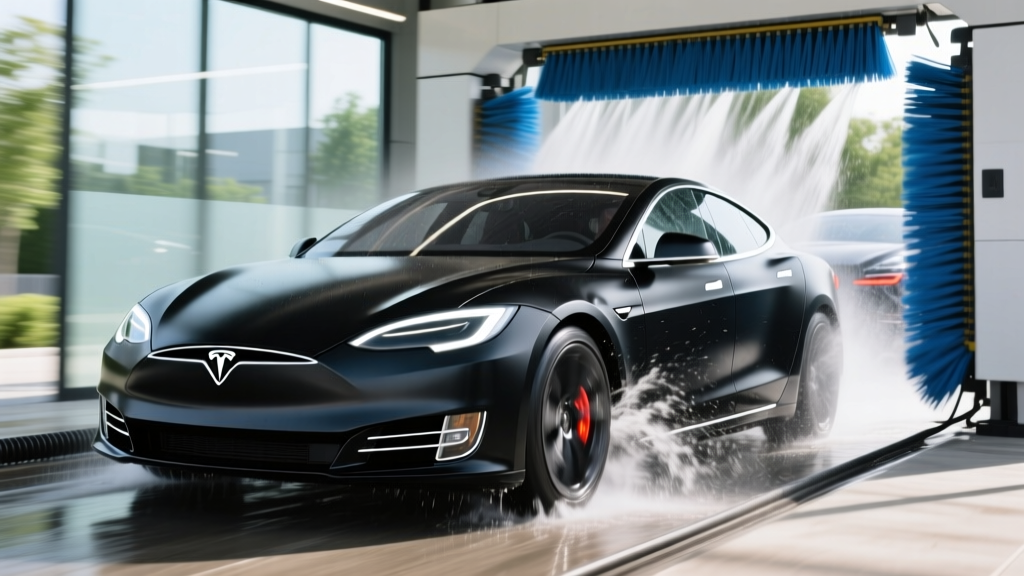
Every Tesla built since 2019 includes a dedicated Car Wash Mode accessible from the Controls menu on the touchscreen. When activated, it closes all windows, locks the charge port door, disables automatic wipers (so spinning brushes won't trigger them mid-cycle), and disables the walk-away auto-lock so doors don't unlock as you pass the payment kiosk. On vehicles with power-folding mirrors (Model S, Model X, refreshed Model 3, Model Y Juniper), Car Wash Mode also folds the mirrors to protect them from brush contact.
The short answer: yes, every current Tesla can go through a touchless or soft-touch automated car wash. But the type of wash matters far more than the car itself. Below, we break down the right method by model, then give you the full 2026 spec profile so you know exactly what you're washing — and what it cost.
Car Wash Mode: What It Does and How to Activate It
Car Wash Mode was introduced via OTA in 2019 and is standard on every Model 3, Model Y, Model S, Model X, and Cybertruck running Tesla's current software. Here's what it does mechanically:
- Closes all windows and the panoramic roof (where equipped) to prevent water intrusion from high-pressure jets.
- Locks the charge port door so the wash mechanism or a stray brush cannot pop it open.
- Disables automatic wipers — critical, because wipers deploying against a spinning brush can bend the wiper arm or crack the windshield.
- Disables walk-away auto-lock so the car doesn't lock/unlock erratically as you walk alongside it at the pay station.
- Folds side mirrors on equipped trims to prevent brush impact.
- Disables parking sensor chimes so the proximity alarms don't scream as you approach the wash track.
To activate: tap Controls → Service → Car Wash Mode on the center screen. You can also add it to the bottom shortcut bar for one-tap access. The car will remind you to exit Car Wash Mode once you exceed 10 mph after the wash.
Touchless vs. Brush vs. Hand Wash: Which Is Safe for Tesla Paint?
This is where the real decision happens. Tesla's water-based paint is thinner and softer than legacy automaker finishes, particularly on Model 3 and Model Y produced at Giga Texas and Giga Shanghai. Here's the hierarchy:
Touchless (Recommended)
High-pressure water and detergent only — no physical contact. Safest for Tesla paint, ceramic coatings, and PPF. The only risk is if the facility uses reclaimed water with embedded grit, which can cause micro-marring. Ask the operator.
Soft-Touch / Cloth Brush (Acceptable with Caution)
Modern "soft-cloth" tunnels use closed-cell foam or microfiber strips. These are generally safe if the facility maintains its equipment. Older brush washes with nylon bristles will leave swirl marks on any Tesla within one visit. Check for visible dirt trapped in the brush material before committing.
Old-School Bristle Brush (Avoid)
Spinning nylon bristle brushes will scratch Tesla paint aggressively. Avoid any wash with visible stiff bristles.
Hand Wash (Best Finish, Highest Effort)
Two-bucket method with grit guards and a pH-neutral car shampoo. This is the only method that preserves a ceramic-coated or PPF-wrapped Tesla long-term.
2026 Tesla Lineup: Range, Charging, and Performance Specs
Here's what's actually in the 2026 Tesla fleet you might be driving through that wash bay. All figures are EPA-published or manufacturer-confirmed for the current model year.
| Spec | Model 3 Long Range AWD | Model Y Long Range AWD | Model S Long Range | Model X Long Range | Cybertruck AWD |
|---|---|---|---|---|---|
| EPA Range | 363 mi | 320 mi | 402 mi | 335 mi | 340 mi |
| Battery (usable) | 75 kWh (NMC) | 75 kWh (NMC) | 95 kWh (NMC) | 95 kWh (NMC) | 123 kWh (NMC 4680 cells) |
| Peak DC Charge | 250 kW | 250 kW | 250 kW | 250 kW | 350 kW (400V arch) |
| 10–80% DC Time | ~25 min | ~27 min | ~30 min | ~32 min | ~18 min |
| Level 2 Home (kW) | 11.5 kW (~44 mi/hr) | 11.5 kW (~44 mi/hr) | 11.5 kW (~44 mi/hr) | 11.5 kW (~44 mi/hr) | 11.5 kW (~44 mi/hr) |
| 0–60 mph | 4.2 sec | 4.8 sec | 3.1 sec | 3.8 sec | 3.9 sec |
| Horsepower | 346 hp | 384 hp | 670 hp | 670 hp | 600 hp |
| Drivetrain | Dual-motor AWD | Dual-motor AWD | Dual-motor AWD | Dual-motor AWD | Dual-motor AWD |
| Efficiency | 132 MPGe / 25 kWh/100mi | 122 MPGe / 28 kWh/100mi | 120 MPGe / 28 kWh/100mi | 105 MPGe / 32 kWh/100mi | 72 MPGe / 47 kWh/100mi |
| Cargo (rear + frunk) | 23 + 3.1 cu ft | 76 + 4.1 cu ft | 28 + 5.3 cu ft | 88 + 6.6 cu ft | ~100 cu ft (vault+frunk) |
| Base MSRP | $47,740 | $48,990 | $79,990 | $84,990 | $79,990 |
Sources: fueleconomy.gov, Tesla spec pages. Prices reflect 2026 model year before destination fees.
Federal Tax Credit Eligibility (§30D) for 2026 Tesla Models
The IRS §30D Clean Vehicle Credit remains in effect for 2026, but eligibility is a moving target due to battery-sourcing and critical-minerals requirements that tighten annually. Here's the current landscape:
| Requirement | 2026 Rule | Tesla Status |
|---|---|---|
| MSRP Cap (sedans) | ≤ $55,000 | Model 3 LR qualifies |
| MSRP Cap (SUVs/trucks/vans) | ≤ $80,000 | Model Y, Cybertruck qualify at base |
| Buyer Income Cap (MFJ) | ≤ $300,000 AGI | Buyer-dependent |
| Buyer Income Cap (single) | ≤ $150,000 AGI | Buyer-dependent |
| Cattery Component Mfg (N. America) | 100% of components | Met (all US-built) |
| Critical Minerals (US/FTA-sourced) | 80% threshold (2026) | Model 3/Y met; S/X/Cybertruck vary by batch |
| Max Credit | $7,500 | Model 3/Y: $7,500 likely; S/X: partial or $0 |
| Point-of-Sale Transfer | Allowed | Available at Tesla checkout |
Bottom line: The Model 3 Long Range at $47,740 MSRP can drop to roughly $40,240 after the full $7,500 credit (if you meet income and sourcing requirements). The Model Y Long Range at $48,990 drops to ~$41,490. The Model S, Model X, and Cybertruck exceed the $55,000 sedan cap or sit at the $80,000 SUV/truck threshold — the Cybertruck at $79,990 base qualifies by MSRP, but its 4680-cell critical-mineral sourcing has been inconsistent quarter-to-quarter. Always verify on fueleconomy.gov's credit lookup tool before purchasing.
Charging at Home and on the Road: What Every Tesla Owner Needs to Know
Charging speed is the metric that determines whether your Tesla is a commuter appliance or a road-trip machine. Here's the breakdown across all three charging levels:
| Level | Connector | Max Power (kW) | Miles Added/Hour | Typical Use |
|---|---|---|---|---|
| Level 1 (120V) | NACS (J3400) | 1.4 kW | ~3–5 mi/hr | Emergency / overnight trickle |
| Level 2 (240V) | NACS (J3400) | 11.5 kW | ~44 mi/hr | Home daily charging |
| DC Fast (Supercharger) | NACS (J3400) | 250–350 kW | ~1,000+ mi/hr (peak) | Road trips |
kW vs. kWh reminder: kW (kilowatts) measures power — how fast energy flows into the battery. kWh (kilowatt-hours) measures energy — the total capacity of the battery. Think of kW as the width of the hose and kWh as the size of the bucket. A 250 kW charger fills a 75 kWh battery fast, but only at peak — the charge curve tapers significantly above 80% state of charge to protect cell longevity.
Home Level 2 Installation
Tesla's Gen 3 Wall Connector delivers up to 11.5 kW (48A) on a 60A circuit. Most homes with a 200A panel can accommodate this without an upgrade. Expect $500–$1,500 for the electrician's run if the panel is close to the garage; $2,000–$4,000+ if a panel upgrade or long conduit run is required. The Wall Connector itself retails for ~$475.
Supercharger Network
Tesla's Supercharger network now has 70,000+ global connectors. V3 stalls peak at 250 kW; V4 stalls support up to 350 kW for compatible vehicles (Cybertruck currently benefits most). Real-world 10–80% charge times are listed in the spec table above. Note that charging speed drops significantly above 80% SoC — Tesla recommends charging to 80% at Superchargers and only going to 100% when you need the full range for your next leg.
Battery Warranty, Degradation, and Longevity
Tesla's battery and drive unit warranty for 2026 models:
- Model 3 and Model Y: 8 years / 120,000 miles (Long Range AWD), whichever comes first, with minimum 70% capacity retention.
- Model S and Model X: 8 years / 150,000 miles, minimum 70% retention.
- Cybertruck: 8 years / 120,000 miles, minimum 70% retention.
All current Teslas use NMC (nickel manganese cobalt) chemistry, including the 4680-format cells in the Cybertruck. NMC offers higher energy density than LFP (lithium iron phosphate), which translates to more range per kWh of battery weight — but it degrades slightly faster over time and should not be routinely charged to 100% for daily use. Tesla's software recommends an 80% daily charge limit for NMC packs. If you want LFP's 100% daily-charge tolerance and longer cycle life, you'd need to look at the base Model 3 RWD (which has historically used LFP, though 2026 availability varies by market).
Real-world degradation data from fleet studies (including Tesla's own impact reports) shows most NMC packs lose roughly 10–12% capacity in the first 100,000 miles, then flatten out. A Model 3 LR with 150,000 miles typically retains 85–88% of original range.
Pros and Cons Across the 2026 Tesla Lineup
Pros
- Best-in-class Supercharger network — still the most reliable DC fast-charging ecosystem in North America
- OTA updates continuously add features (Car Wash Mode itself was an OTA addition)
- Class-leading efficiency (kWh/100mi) across Model 3 and Model Y
- Strong resale value relative to most EV competitors
- Heat pump standard on all models — real cold-weather advantage
- Point-of-sale tax credit transfer available at checkout
Cons
- Paint quality remains inconsistent — PPF or ceramic coating strongly recommended
- No Apple CarPlay or Android Auto; Tesla-only infotainment ecosystem
- FSD (Supervised) is SAE Level 2 — not self-driving, requires constant attention
- Model S/X pricing puts them above MSRP caps for the full $7,500 credit
- Cybertruck efficiency is poor (47 kWh/100mi) — expensive to charge on road trips
- Service center wait times can stretch weeks in rural markets
Who Should Buy Which Tesla?
Model 3 Long Range AWD: Best for commuters and couples who want maximum range-per-dollar and don't need cargo volume. The 363-mile EPA range and $47,740 MSRP (potentially $40,240 after credit) make it the value leader.
Model Y Long Range AWD: Best for families. 76 cu ft of cargo with seats folded, available third row (small children only), and the SUV MSRP cap means full credit eligibility. The best-selling vehicle in the world for a reason.
Model S / Model X: Best for buyers who want performance luxury and don't need the tax credit. 402-mile range on the S is still class-leading. The X's falcon-wing doors are genuinely useful in tight parking spots.
Cybertruck: Best for truck buyers who want a statement vehicle with real utility (11,000-lb towing capacity, stainless vault). Efficiency and charging infrastructure access remain compromises vs. the F-150 Lightning or Rivian R1T for pure road-trip practicality.
Frequently Asked Questions
Can I take my Tesla through a touchless car wash?
Yes. Touchless car washes are the safest automated option for any Tesla. Activate Car Wash Mode from Controls → Service before entering. Ensure windows are fully closed (Car Wash Mode does this automatically) and the charge port is locked.
Will a brush car wash damage my Tesla's paint?
Modern soft-cloth/foam brush washes are generally acceptable, but Tesla's water-based paint is softer than legacy finishes and will show swirl marks over time from repeated brush contact. If your Tesla has PPF or ceramic coating, stick to touchless or hand wash only.
Does Car Wash Mode turn off automatically?
No. Car Wash Mode stays active until you manually disable it or drive above 10 mph, at which point the car will prompt you to exit the mode. It does not auto-deactivate at low speeds, so remember to turn it off after leaving the wash.
Can water damage the Tesla's battery or motors?
No. Tesla's battery pack and drive units are sealed to IP67 standards — submersible in 1 meter of water for 30 minutes. Driving through rain, puddles, and car washes poses no risk to the powertrain. However, Tesla explicitly warns against deliberately driving through standing water deeper than the lower door sill (~8 inches).
What about the Cybertruck's stainless steel body in a car wash?
The stainless steel exoskeleton won't scratch like paint, but alkaline or acid-based wash chemicals can cause surface discoloration or oxidation spots. Use only touchless washes with pH-neutral soap, or hand wash with a dedicated stainless steel cleaner. Avoid any car wash that sprays acid-based wheel cleaner — it can etch the body panels.
Does my Tesla qualify for the $7,500 federal tax credit?
It depends on three factors: the vehicle's MSRP (sedans ≤$55,000; SUVs/trucks ≤$80,000), your adjusted gross income (≤$300,000 married filing jointly; ≤$150,000 single), and whether the battery's critical minerals and components meet 2026 sourcing thresholds. Model 3 LR and Model Y LR currently qualify for the full credit for eligible buyers. Model S, Model X, and Cybertruck eligibility varies. Verify at fueleconomy.gov and consult a tax professional — this is not tax advice.