The Rise of Tesla Campers: Why EVs Are Reshaping Overlanding
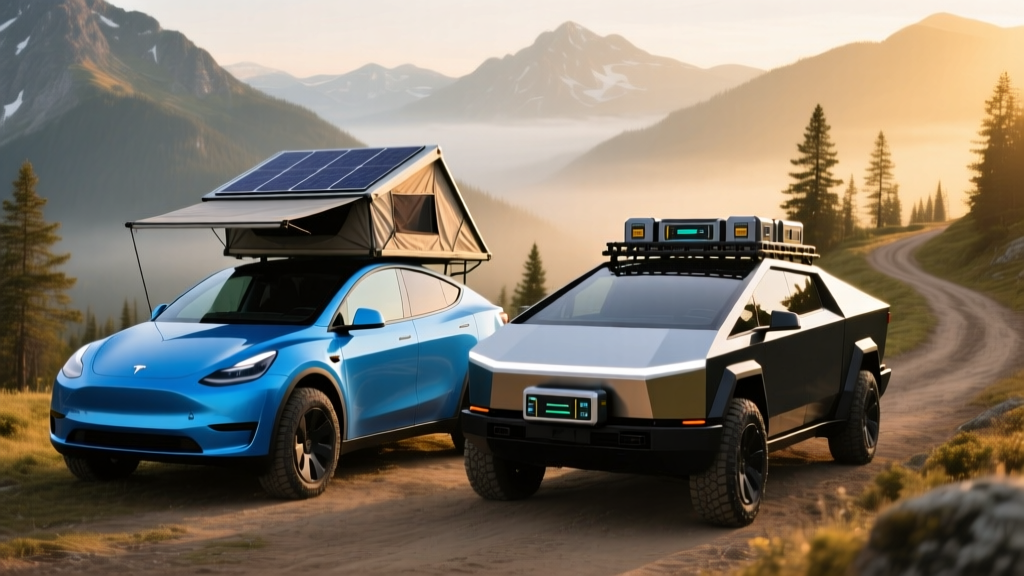
The idea of camping in an electric vehicle used to sound like a contradiction. But in 2026, Tesla campers have become a legitimate category — not because Tesla sells a factory RV, but because the Model Y, Cybertruck, and even the refreshed Model X have become platforms for some of the most capable, quiet, and energy-efficient overland rigs on the road. With Camp Mode, a massive Supercharger network, and a growing aftermarket of rooftop tents, slide-out kitchens, and bed platforms, Tesla owners are turning their EVs into basecamps that can run climate control all night without a generator.
This guide evaluates the two most popular Tesla camper platforms — the 2026 Model Y Long Range AWD and the 2026 Cybertruck AWD — through the lens of real-world camping utility: range under load, charging logistics in remote areas, onboard power, and the total cost of building each into a capable overland vehicle.
2026 Tesla Model Y Long Range AWD: The Default Camper Platform
The Model Y remains the most popular Tesla for camper conversions, and for good reason. Its hatchback cargo area, flat-folding rear seats, and relatively low curb weight make it a practical sleeper for two. With the 2025 Juniper refresh now fully in production for 2026, the Long Range AWD variant brings meaningful improvements in efficiency and cabin comfort.
| Spec | Value |
|---|---|
| EPA Range | 320 miles |
| Battery (usable) | ~78 kWh (NMC) |
| Drivetrain | Dual-motor AWD |
| Horsepower | 384 hp |
| 0–60 mph | 4.8 seconds |
| Efficiency | 122 MPGe / 27 kWh/100 mi |
| Max DC Fast Charge | 250 kW |
| 10–80% DC Charge | ~25 minutes |
| Level 2 Charge Rate | 11.5 kW (~44 mi/hr) |
| Cargo Volume (rear seats folded) | 72.1 cu ft |
| Cargo Volume (rear seats up) | 26.6 cu ft |
| Rear Legroom | 41.6 in |
| Towing Capacity | 3,500 lbs |
| Battery/Drive Unit Warranty | 8 yr / 120,000 mi |
| Base MSRP | $48,990 |
Camp Mode: The Feature That Makes It Work
Tesla's Camp Mode keeps the HVAC system running while parked, maintaining a set temperature through the night without the vehicle entering sleep mode. On a mild 60°F night, Camp Mode draws roughly 1–2 kWh over 8 hours. In freezing conditions with the heat pump running, consumption climbs to 8–12 kWh overnight — still only 10–15% of the 78 kWh battery. That means you can sleep comfortably in sub-freezing temperatures and still wake up with over 250 miles of range remaining. No idling, no carbon monoxide risk, no generator noise.
Charging Logistics for Overland Trips
The Model Y's 250 kW peak DC fast-charge rate means a 10–80% session takes roughly 25 minutes at a V3 or V4 Supercharger. However, sustained charge rate matters more than peak. The NMC battery holds above 150 kW through about 50% SoC, then tapers progressively. On a road trip, plan for 20–25 minute stops every 2–2.5 hours of driving.
For remote camping, the growing NACS adapter ecosystem lets you access Electrify America and other networks, and the Model Y's 11.5 kW Level 2 onboard charger means a full charge in roughly 7 hours on a 48-amp home wall connector or destination charger at a campground.
2026 Tesla Cybertruck AWD: The Heavy-Duty Camper Build
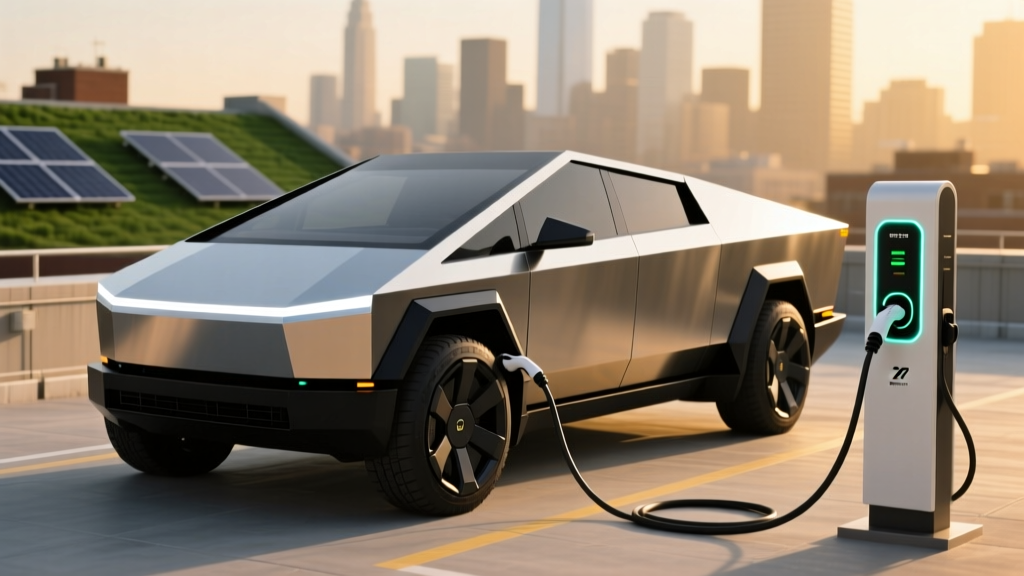
The Cybertruck entered the overland conversation the moment Tesla demonstrated its stainless steel exoskeleton and 11,000-lb towing capacity. For 2026, the AWD dual-motor variant (formerly badged simply as the base AWD, now the volume seller) offers the best balance of range, payload, and price for a camper build.
| Spec | Value |
|---|---|
| EPA Range | 340 miles |
| Battery (usable) | ~123 kWh (NMC) |
| Drivetrain | Dual-motor AWD |
| Horsepower | 600 hp |
| 0–60 mph | 3.9 seconds |
| Efficiency | 79 MPGe / 42 kWh/100 mi |
| Max DC Fast Charge | 250 kW (peak, limited by 800V architecture) |
| 10–80% DC Charge | ~35 minutes |
| Level 2 Charge Rate | 11.5 kW (~24 mi/hr due to lower efficiency) |
| Bed Length | 6 ft (72 in) |
| Bed Width (between wheel wells) | ~48 in |
| Payload Capacity | 2,500 lbs |
| Towing Capacity | 11,000 lbs |
| Battery/Drive Unit Warranty | 8 yr / 120,000 mi |
| Base MSRP | $79,990 |
The 6-Foot Bed: A Natural Camper Platform
The Cybertruck's 6-foot vault bed is enclosed by the motorized tonneau cover, which locks and seals against weather. Aftermarket companies like Basecamp Off-Road and Eureka Overland now offer slide-out kitchen systems and drawer modules designed specifically for the Cybertruck bed dimensions. The 2,500-lb payload capacity means you can load a full kitchen, water tanks, recovery gear, and a rooftop tent without approaching limits.
The 120V and 240V bed outlets (up to 9.6 kW combined) are a game-changer for campsite power. You can run an induction cooktop, electric cooler, lights, and charge devices simultaneously — essentially turning the truck into a mobile power station. This is the single biggest advantage the Cybertruck has over the Model Y as a camper platform.
Charging Infrastructure: Where Tesla Campers Actually Win
The Supercharger network remains the most reliable DC fast-charging ecosystem in North America. As of early 2026, there are over 6,500 Supercharger stations in the U.S., and Tesla's Trip Planner automatically routes through them with SoC projections. For camping trips along interstate corridors (think: I-70 through Colorado, I-40 through the Southwest), charging is rarely an issue.
| Charging Method | Model Y LR AWD | Cybertruck AWD |
|---|---|---|
| Level 1 (120V, 12A) | ~1.4 kW (~5 mi/hr) | ~1.4 kW (~3 mi/hr) |
| Level 2 (240V, 48A) | 11.5 kW (~44 mi/hr) | 11.5 kW (~24 mi/hr) |
| DC Fast Charge (peak) | 250 kW | 250 kW |
| 10–80% DC Time | ~25 min | ~35 min |
| Sustained Rate (20–60%) | ~170–200 kW avg | ~160–190 kW avg |
The critical limitation for remote camping: Superchargers are concentrated along highways. If your campsite is 60+ miles off the nearest interstate, you'll need to charge to 90–100% at the last Supercharger before heading in. The Model Y's heat pump and efficient drivetrain give it an edge here — it sips energy at low speeds on dirt roads, often regaining range through regenerative braking on downhill grades.
Pricing, Tax Credits, and Total Build Cost
Building a Tesla camper isn't just about the vehicle MSRP. Aftermarket overland gear adds $3,000–$15,000+ depending on ambition. Here's how the numbers break down for each platform.
| Item | Model Y LR AWD | Cybertruck AWD |
|---|---|---|
| Base MSRP | $48,990 | $79,990 |
| Typical Camper Build (gear) | $3,000–$8,000 | $8,000–$15,000 |
| As-Tested (with common options) | $51,490 | $84,990 |
| Federal §30D Credit Eligible? | Yes (if income/MSRP rules met) | No — MSRP exceeds $80,000 cap for trucks |
| Effective Price (after max credit) | ~$44,490 | $84,990 |
Tax credit details: The Model Y Long Range AWD qualifies for the full $7,500 federal tax credit under IRS §30D, provided the buyer meets income caps ($150,000 single / $300,000 joint modified AGI) and the vehicle's MSRP stays under the $80,000 SUV/truck cap. As of 2026, the credit can be transferred at the point of sale, reducing the purchase price directly. The Cybertruck AWD at $79,990 base sits right at the cap — but any factory options pushing the MSRP above $80,000 disqualify it. Always verify current sourcing and eligibility rules at IRS.gov before purchasing, as critical-mineral and battery-component requirements tighten annually.
Pros, Cons, and the Verdict for Tesla Campers
Model Y as Camper — Pros
- Flat-folding rear seats create a 6'2" sleeping platform inside the cabin
- Low energy consumption at camp (1–2 kWh/night in mild weather)
- Eligible for $7,500 federal tax credit
- Quiet HVAC — no generator noise to disturb neighbors or wildlife
- Access to full Supercharger network for route planning
- Lowest cost of any Tesla camper platform
Model Y as Camper — Cons
- No built-in 120V/240V outlets for powering external devices
- Ground clearance (6.6 in) limits off-road capability
- Rooftop tent adds drag and cuts highway range by ~15–20%
- Cargo width between wheel wells (~40 in) limits bed platform design
- No spare tire — relies on tire sealant kit
Cybertruck as Camper — Pros
- 6-ft enclosed vault bed with locking tonneau cover
- 120V/240V bed outlets (up to 9.6 kW) power full campsite
- 2,500-lb payload handles heavy overland builds
- 16+ in ground clearance with adaptive air suspension
- Stainless steel exoskeleton resists trail pinstriping and dents
- 11,000-lb towing for teardrop and off-road trailers
Cybertruck as Camper — Cons
- MSRP near or above §30D $80K cap — tax credit unlikely
- Lower efficiency (42 kWh/100 mi) means more frequent charging
- 35-minute 10–80% charge time vs. 25 min for Model Y
- Width (80+ in) can be tight on narrow forest roads
- Higher upfront cost ($80K+ before gear)
- Bed outlet power draws from the main battery — reduces driving range
Which Tesla Camper Build Suits You?
Choose the Model Y if:
- Your camping is primarily car-camping at established sites near paved roads
- You want the lowest total build cost and qualify for the $7,500 credit
- You prioritize energy efficiency and maximum real-world range
- You camp in mild to moderate climates (Camp Mode handles cold, but cabin insulation is thinner than a truck)
- You want a daily driver that moonlights as a weekend camper
Choose the Cybertruck if:
- You need serious off-road capability and ground clearance for remote BLM/USFS sites
- You want to power a full campsite (induction cooktop, fridge, lights) from the vehicle
- You plan to tow a trailer (teardrop, bike rack trailer, off-road camper)
- You need 2,500+ lbs of payload for heavy overland gear and water
- Budget is secondary to capability
Tesla Camper FAQ
What is the real-world range of a Tesla camper setup?
For the 2026 Model Y Long Range AWD with a rooftop tent and gear, expect 240–270 highway miles in fair weather and 200–230 miles in cold conditions. The Cybertruck AWD under similar load delivers 220–260 highway miles, dropping to 160–190 when towing. Always charge to 90–100% before heading to remote sites with no charging infrastructure.
How fast does a Tesla camper charge on the road?
The Model Y peaks at 250 kW and charges 10–80% in about 25 minutes at a V3/V4 Supercharger. The Cybertruck also peaks at 250 kW but takes roughly 35 minutes due to its larger 123 kWh battery. Both vehicles taper charge rate significantly above 80% SoC — avoid charging past 80% on road trips unless you're at your final stop for the night.
How much does a Tesla camper build cost after tax credits?
A Model Y camper build starts at roughly $44,500–$51,000 after the $7,500 federal credit (assuming eligibility), plus $3,000–$8,000 in aftermarket gear. A Cybertruck build starts at $80,000–$85,000 (no credit due to MSRP cap) plus $8,000–$15,000 in overland equipment. Total all-in cost: ~$48K–$59K for Model Y, ~$88K–$100K for Cybertruck.
Does the Tesla Model Y qualify for the federal EV tax credit?
Yes, as of 2026 the Model Y Long Range AWD qualifies for the full $7,500 §30D credit, subject to buyer income limits ($150K single / $300K joint MAGI), MSRP under $80,000, and battery-sourcing requirements that tighten each year. The credit can be applied at point of sale. Verify current rules at IRS.gov and check fueleconomy.gov for the latest qualifying vehicle list.
Can you sleep inside a Tesla without a tent?
Yes. The Model Y's rear seats fold completely flat, creating a sleeping surface roughly 6'2" long and 40" wide between the wheel wells. With a 3-inch foam pad and window covers, it's a viable standalone sleeper. Camp Mode maintains climate control through the night. The Cybertruck bed (72" × 48") also works with a bed platform, though the tonneau cover limits vertical space unless you add a bed rack with a rooftop tent.
Is Tesla's Autopilot or FSD useful for road trips to campgrounds?
Tesla's Autopilot and Full Self-Driving (Supervised) are SAE Level 2 driver-assistance systems — they do not make the vehicle self-driving. The driver must remain attentive, hands on or near the wheel, at all times. That said, Autopilot significantly reduces fatigue on long highway drives to remote campgrounds. FSD (Supervised) handles on-ramps, lane changes, and some surface streets, but performance on unpaved or poorly marked forest roads is unreliable. Never rely on it off-pavement.
What's the biggest risk of Tesla camping in remote areas?
Charging access. If your campsite is more than 80–100 miles from the nearest Supercharger or Level 2 destination charger, you risk insufficient range for the round trip — especially with rooftop tent drag, cold weather, and elevation gain. Mitigate this by charging to 100% before departing the last charger, minimizing HVAC use at camp in extreme cold, and carrying a portable Level 1 charger as a backup for emergency top-ups from any 120V outlet (at ~3–5 miles per hour of charge).