What Is Camp Mode in a Tesla?
Camp Mode is a climate-control setting available on every current Tesla (Model 3, Model Y, Model S, Model X, and Cybertruck) that keeps the HVAC system, interior 12V/USB outlets, and touchscreen running continuously while the vehicle is parked. Unlike standard climate, which shuts down after a timeout, Camp Mode is designed to run for hours—or an entire night—without the car powering itself off.
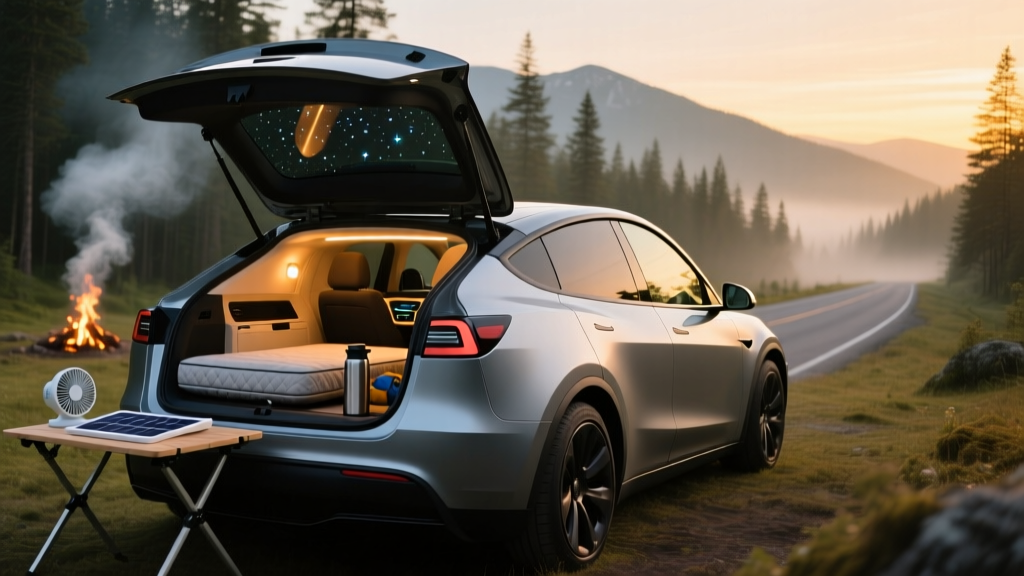
In practice, Camp Mode turns a Tesla into a climate-controlled shelter. The heat pump (standard on Model Y and refreshed Model 3 Highland) or resistive PTC heater maintains cabin temperature, the touchscreen stays on for media, and the USB/12V ports remain energized for laptops, CPAP machines, or small appliances. It is the feature most frequently cited by overlanders, festival-goers, and car-campers who have abandoned tent setups in favor of sleeping inside the cabin.
Which Tesla Models Support Camp Mode (2026)?
Every Tesla sold in the U.S. since late 2019 includes Camp Mode, Dog Mode, and Sentry Mode as software features. As of the 2026 model year, the lineup includes:
- Model 3 (Highland refresh) — RWD, Long Range AWD, Performance
- Model Y (Juniper refresh) — Long Range AWD, Performance
- Model S — Long Range, Plaid
- Model X — Long Range, Plaid
- Cybertruck — AWD, Cyberbeast
Activation is identical across all of them: tap the climate icon on the touchscreen, then select "Camp" from the mode menu. There is no separate subscription, no FSD requirement, and no trim-level restriction.
How Much Battery Does Camp Mode Actually Use?
This is the question that matters most to anyone planning an overnight stay. Power draw depends on three variables: outside temperature, target cabin temperature, and whether the heat pump or resistive heater is doing the work.
| Scenario | Avg. kW Draw | kWh Used (8 hrs) | Approx. Range Loss (Model Y LR) |
|---|---|---|---|
| Mild night (55–65°F), cabin 68°F | 0.4–0.7 kW | 3–5 kWh | 10–17 miles |
| Cool night (35–45°F), cabin 70°F | 0.8–1.4 kW | 7–11 kWh | 24–38 miles |
| Cold night (15–25°F), cabin 72°F | 1.5–2.5 kW | 12–20 kWh | 41–68 miles |
| Hot day (95°F+), cabin 72°F A/C | 1.0–1.8 kW | 8–14 kWh | 27–48 miles |
For context, the 2026 Model Y Long Range AWD carries a usable battery of approximately 75 kWh (NMC chemistry) and an EPA range of 320 miles. An 8-hour night in 40°F weather will consume roughly 9 kWh—about 12% of the pack and 38 EPA miles. That leaves plenty of buffer for a morning drive to a charger, provided you planned for it.
Model Y Long Range (2026) — Camp Mode Baseline Specs
Because the Model Y is the Tesla most commonly used for car camping, here are the full 2026 specs that frame the Camp Mode experience.
| EPA Range | 320 miles |
| Battery (usable) | ~75 kWh, NMC |
| MPGe (combined) | 122 MPGe / 28 kWh/100 mi |
| Peak DC Fast Charge | 250 kW (V3 Supercharger) |
| 10–80% DC Time | ~25 minutes |
| Level 2 Home Charge | 11.5 kW / ~44 mi/hr |
| 0–60 mph | 4.8 seconds |
| Horsepower | 384 hp (dual motor) |
| Drivetrain | AWD, dual motor |
| Cargo (rear seats up) | 30.2 cu ft |
| Cargo (rear seats folded) | 72.1 cu ft |
| Base MSRP | $47,990 |
| Battery Warranty | 8 yr / 120,000 mi (70% retention) |
Charging Strategy When Camping
The biggest mistake first-time EV campers make is arriving at a campsite with a low state of charge and no plan. Camp Mode is forgiving, but it is not free energy.
| Level | Power | Miles Added per Hour | Best Use |
|---|---|---|---|
| Level 1 (120V outlet) | ~1.4 kW | ~5 mi/hr | Emergency trickle at a cabin or campground pedestal |
| Level 2 (240V, NEMA 14-50) | ~11.5 kW | ~44 mi/hr | Overnight at home or RV-site chargers |
| DC Fast (V3 Supercharger) | Up to 250 kW | ~1,000+ mi/hr (peak) | Top-up before heading to camp |
A practical rule: arrive at your campsite with at least 30% state of charge above what you need to reach the next Supercharger. That buffer covers a cold night of Camp Mode plus morning HVAC and seat-heater use before you break camp.
If you are camping at an RV park with a 50-amp NEMA 14-50 outlet, Tesla's Mobile Connector can replenish roughly 350 miles overnight—more than enough to offset a full night of Camp Mode and still leave you with a full battery in the morning.
Comfort, Space, and the Sleeping Setup
The Model Y's 72.1 cu ft of cargo volume with the rear seats folded creates a nearly flat load floor roughly 74 inches long and 41 inches wide between the wheel wells—enough for two adults on a queen-sized inflatable mattress with a few inches to spare. The Model 3 is tighter (~64.9 cu ft max cargo) and the trunk opening is narrower, making it better suited for a single sleeper.
Key comfort features that activate during Camp Mode:
- Heat pump HVAC — efficient heating without the energy penalty of resistive elements (Model Y, Model 3 Highland).
- Heated front and rear seats — use these instead of raising cabin temp; they draw far less energy.
- Heated steering wheel — negligible draw, big comfort gain.
- USB-C ports (up to 65W PD on newer models) — enough to run a laptop or CPAP without a separate power station.
- Touchscreen media — Netflix, YouTube, Spotify all remain available.
- Sentry Mode auto-disable — Camp Mode suppresses Sentry to avoid unnecessary wake-ups and camera recording.
Ventilation matters. With windows sealed, CO₂ levels in a two-person cabin can climb above 1,500 ppm over 6–8 hours, causing grogginess. Crack one window 1–2 inches, or use the "climate on, recirculation off" setting to pull fresh air through the HEPA filter (Bioweapon Defense Mode on Model S/X/Y).
Pricing, Trims, and Federal Tax Credit (2026)
Here is what the 2026 Tesla lineup costs before and after potential incentives.
| Model / Trim | Base MSRP | §30D Credit (max) | Effective Price* |
|---|---|---|---|
| Model 3 RWD | $39,990 | Up to $7,500 | ~$32,490 |
| Model 3 Long Range AWD | $45,990 | Up to $7,500 | ~$38,490 |
| Model Y Long Range AWD | $47,990 | Up to $7,500 | ~$40,490 |
| Model Y Performance | $52,490 | Up to $7,500 | ~$44,990 |
| Cybertruck AWD | $79,990 | $0 (over MSRP cap) | $79,990 |
*Effective price assumes full §30D eligibility. Actual credit depends on buyer income, battery critical-mineral and component sourcing, and MSRP caps. As of 2026, SUVs (Model Y, Model X, Cybertruck) must be under $80,000 MSRP; sedans (Model 3, Model S) under $55,000. Buyer AGI limits: $300K joint / $225K head of household / $150K single. Credit can now be transferred to the dealer at point of sale as an instant discount. Always verify current rules at IRS.gov §30D.
Pros and Cons of Tesla Camp Mode
Pros
- No idle emissions — safe in enclosed or forested campsites
- Heat pump makes overnight heating remarkably efficient (3–5 kWh mild nights)
- Silent operation — no generator noise, no campground complaints
- USB-C PD outlets eliminate the need for a separate power station
- Flat load floor in Model Y fits a queen mattress
- Over-the-air updates continue to refine the feature
Cons
- No dedicated 120V AC outlet (must use an inverter for AC appliances)
- Range loss is non-trivial in sub-freezing temps (up to 20 kWh/night)
- No built-in window screens — ventilation vs. bugs is a trade-off
- Model 3 trunk opening is too narrow for easy mattress loading
- Camp Mode still requires planning around charger proximity
- Touchscreen glow can be disruptive; no full "display off" mode while climate runs
Is Camp Mode Worth It vs. a Portable Power Station?
A common comparison is running a Jackery or EcoFlow power station in a tent versus sleeping inside the Tesla. The math favors the car in almost every scenario:
- A 2 kWh EcoFlow Delta Max costs ~$1,800 and can run a small heater for 4–5 hours. The Tesla's 75 kWh battery holds 37× that energy, already paid for as part of the vehicle.
- The Tesla's heat pump delivers roughly 3–4 kW of thermal output per 1 kW of electrical input (COP 3–4). Resistive space heaters in a tent deliver 1:1. The car is fundamentally more efficient at making heat.
- Safety: no carbon monoxide risk, no propane handling, no generator noise.
Where a power station still wins: boondocking more than one night without charger access, or camping in a tent away from the vehicle entirely. For car-adjacent camping, Camp Mode is the superior solution.
Who Should (and Shouldn't) Rely on Camp Mode?
Ideal use cases:
- Weekend car-campers at established campsites within 50 miles of a Supercharger
- Overlanders using the Tesla as a base-camp sleep module
- Music festivals and tailgates where generator noise is prohibited
- Emergency shelter during power outages (V2H not yet available on U.S. Teslas, but Camp Mode keeps the cabin livable)
Less ideal:
- Multi-day boondocking far from charging infrastructure — range attrition compounds
- Extreme cold (below 0°F) where resistive heating dominates and consumption doubles
- Users who need a full-size bed platform — Model S/X cargo floors are less flat than Model Y
Frequently Asked Questions
Does Camp Mode drain the 12V battery?
No. Camp Mode keeps the high-voltage traction battery engaged, which continuously tops up the 12V (or 16V lithium in newer models) via the DC-DC converter. You will not wake to a dead 12V battery as you might in an ICE car left in accessory mode.
Can I use Camp Mode while plugged into a charger?
Yes. If you are at a Level 2 destination charger or a Supercharger, Camp Mode will run and the battery will charge simultaneously. This is the ideal setup for RV-park camping with a 14-50 outlet.
Does Camp Mode work with the panoramic glass roof?
Yes, but the glass roof radiates heat faster than a steel roof in cold weather and absorbs solar gain in summer. Expect ~10–15% higher HVAC consumption compared to a vehicle with an insulated steel roof. A reflective sunshade (Tesla sells one for ~$105) significantly reduces summer heat load.
Will Sentry Mode record while Camp Mode is on?
No. Camp Mode automatically suppresses Sentry Mode to prevent constant camera wake-ups and to conserve energy. If you want security recording while sleeping, you would need to exit Camp Mode and use Sentry—but this will interrupt continuous climate.
How do I minimize range loss overnight?
Three tactics: (1) Set cabin temp to 64–66°F and rely on heated seats/blankets rather than heating the whole cabin to 72°F. (2) Precondition the cabin while still plugged in before arriving at camp. (3) Park in a sheltered spot out of wind—convective heat loss from the body panels is significant at highway-camping altitudes.
Does the 2026 Model Y Juniper refresh change Camp Mode?
The Juniper update adds ventilated front seats, ambient lighting, and a rear touchscreen, all of which remain active in Camp Mode. The underlying heat-pump HVAC architecture is unchanged from the prior generation, so energy consumption figures remain consistent with the table above.
Is Camp Mode available on non-Tesla EVs?
Several competitors offer similar features—Hyundai calls it "Utility Mode" (Ioniq 5/6), Ford offers it on the F-150 Lightning and Mustang Mach-E, and Rivian has "Camp Mode" on the R1T and R1S. Tesla's implementation remains the most mature, largely because of the heat pump's efficiency and the Supercharger network's density near popular camping destinations.
Sources: fueleconomy.gov — 2026 Tesla Model Y, IRS.gov — Clean Vehicle Credit §30D, Tesla Model Y Owner's Manual.