What Is Tesla Camp Mode and Why Does It Matter?
If you've ever searched "what is Tesla Camp Mode" before a road trip or backcountry weekend, you're not alone. Camp Mode is a dedicated climate-control setting available across the entire Tesla lineup — Model 3, Model Y, Model S, and Model X — that keeps the cabin heated or cooled while the vehicle is parked, without the car automatically shutting down after a set period. Unlike standard climate preconditioning, which times out, Camp Mode runs indefinitely until you manually turn it off or the battery reaches a low-state-of-charge threshold (typically around 20%).
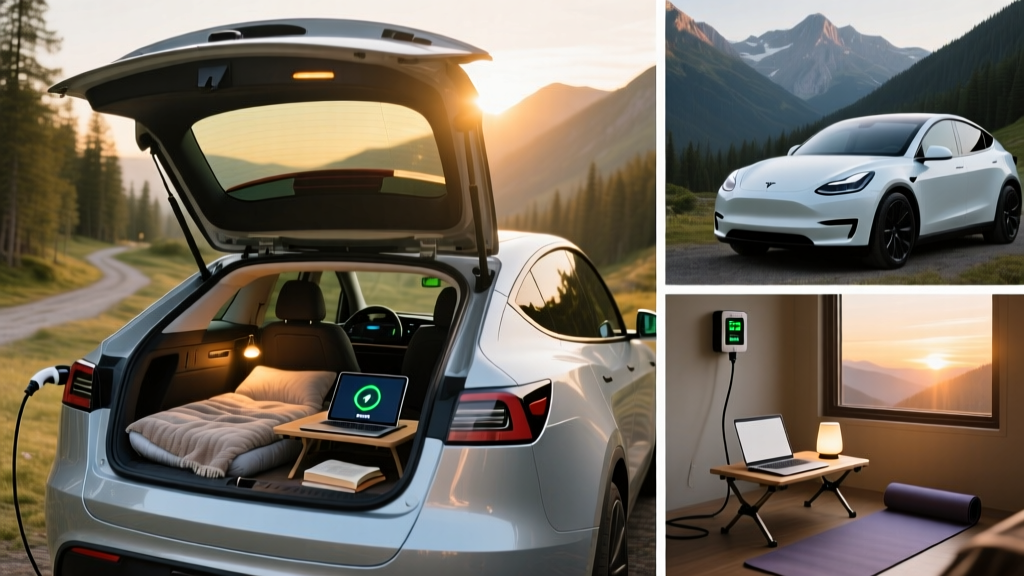
For EV owners who overland, car-camp, or simply need a climate-controlled nap during a long drive, Camp Mode transforms a Tesla into a surprisingly capable mobile shelter. But it's not free energy — understanding the real-world battery drain, efficiency impact, and which model handles overnight use best is essential before you commit to sleeping in your EV.
How Tesla Camp Mode Works: The Technical Details
When you activate Camp Mode (via the climate menu on the touchscreen or the Tesla app), the vehicle overrides its normal sleep-state behavior. Here's what changes:
- Climate system stays active — HVAC maintains your target temperature using the heat pump (on models equipped with one) or resistive PTC heater.
- USB ports and 12V/16V accessory outlets remain powered — useful for charging phones, running CPAP machines, or powering a small fan.
- Touchscreen stays on — displaying ambient visuals, a campfire animation, or media playback.
- Sentry Mode is disabled — to reduce battery drain from camera processing.
- Walk-away auto-lock is suspended — the car won't lock itself if your phone drifts out of Bluetooth range.
- No automatic shutoff timer — the system runs until you disable it or the battery hits its low-SoC safeguard.
On 2026 models equipped with Tesla's heat pump (standard on Model Y since 2021 and on refreshed Model 3 Highland/Model S), Camp Mode is remarkably efficient in moderate temperatures. The heat pump moves thermal energy rather than generating it resistively, drawing significantly less power than the older PTC heater systems found in pre-2021 Model 3 vehicles.
Battery Drain and Range Impact: What to Actually Expect
This is where most Camp Mode questions converge. The short answer: overnight drain depends heavily on ambient temperature, cabin insulation, and which model you're in.
- Mild weather (55–70°F / 13–21°C): ~1–2% SoC loss (roughly 3–6 miles of range on a Model Y Long Range)
- Cool weather (35–50°F / 2–10°C): ~3–5% SoC loss (roughly 8–15 miles)
- Cold weather (15–30°F / -9 to -1°C): ~6–10% SoC loss (roughly 16–30 miles)
- Extreme cold (below 15°F / -9°C): ~10–15%+ SoC loss, with the heat pump working harder and potentially falling back to resistive heating
Source: Aggregated owner data from Tesla forums and real-world testing. Individual results vary based on cabin size, insulation, and whether you're using a mattress/covers that retain body heat.
For context, a 2026 Model Y Long Range AWD with its 78.1 kWh (usable) LFP or NMC battery pack and EPA-estimated 320 miles of range will lose approximately 10–15 miles of range overnight in 40°F weather. That's manageable for most campers who arrive with an 80%+ charge, but it becomes a planning factor in remote areas without charging access.
Which 2026 Tesla Is Best for Camp Mode? Model-by-Model Breakdown
| Spec | Model 3 LR | Model Y LR | Model S LR | Model X LR |
|---|---|---|---|---|
| EPA Range | 363 mi | 320 mi | 402 mi | 335 mi |
| Battery (usable) | 78.1 kWh NMC | 78.1 kWh NMC | 95 kWh NMC | 95 kWh NMC |
| Heat Pump | Yes | Yes | Yes | Yes |
| Cargo (rear seats folded) | 23 cu ft | 72 cu ft | 28 cu ft (trunk) | 88 cu ft |
| Sleeping Length (est.) | ~6'2" | ~6'6" | ~6'0" | ~6'8" |
| Overnight Drain (40°F) | ~3–5% | ~3–5% | ~2–4% | ~4–6% |
| Base MSRP (2026) | $47,740 | $48,630 | $79,990 | $84,990 |
Charging Specs: What Each Tesla Can Handle Before and After Your Trip
Knowing your charging speed matters when you're planning a camping trip — you'll want to arrive charged and minimize time at public stations on the way home.
| Charging Type | Model 3 LR | Model Y LR | Model S/X LR |
|---|---|---|---|
| Max DC Fast Charge | 250 kW | 250 kW | 250 kW |
| 10–80% DCFC Time | ~25 min | ~27 min | ~30 min |
| Level 2 Home (kW) | 11.5 kW (48A) | 11.5 kW (48A) | 11.5 kW (48A) |
| Level 2 Miles/Hour | ~44 mi/hr | ~40 mi/hr | ~34 mi/hr |
| Connector | NACS (native) | NACS (native) | NACS (native) |
All current Teslas use the North American Charging Standard (NACS) connector natively and access the Supercharger network — which, as of 2026, includes over 6,000 V3 (250 kW) and growing V4 stalls in North America. For camping trips, the ability to precondition the battery en route to a Supercharger means you'll hit peak charge rates upon arrival, even in cold weather.
EPA estimates are measured under controlled conditions. For the 2026 Model Y Long Range (EPA 320 mi), expect approximately 270–290 miles on highway road trips at 70–75 mph, and 240–260 miles in cold weather (below 35°F) due to increased HVAC load and reduced battery efficiency. Camping overnight in cold weather compounds this — budget an extra 5–10% range buffer for Camp Mode drain.
Performance, Efficiency, and Daily-Driving Specs
Camp Mode is a feature, not a reason to buy — so here's how these vehicles perform as daily drivers that happen to double as camping platforms.
| Metric | Model 3 LR | Model Y LR | Model S LR | Model X LR |
|---|---|---|---|---|
| 0–60 mph | 4.2 sec | 4.8 sec | 3.1 sec | 3.8 sec |
| Horsepower | 346 hp | 384 hp | 670 hp | 670 hp |
| Drivetrain | Dual-Motor AWD | Dual-Motor AWD | Dual-Motor AWD | Dual-Motor AWD |
| MPGe (combined) | 134 MPGe | 122 MPGe | 120 MPGe | 102 MPGe |
| kWh/100 mi | 25 | 28 | 28 | 33 |
Source: fueleconomy.gov (EPA)
Pricing, Tax Credits, and Total Cost Considerations
Understanding the real cost of a Tesla — after incentives — matters especially if you're buying partly for the lifestyle use case that Camp Mode enables.
| Model / Trim | Base MSRP | §30D Credit Eligible? | Est. After Credit |
|---|---|---|---|
| Model 3 Long Range AWD | $47,740 | Yes (up to $7,500) | ~$40,240 |
| Model Y Long Range AWD | $48,630 | Yes (up to $7,500) | ~$41,130 |
| Model S Long Range | $79,990 | No (over MSRP cap) | $79,990 |
| Model X Long Range | $84,990 | No (over MSRP cap) | $84,990 |
- MSRP caps: $55,000 for sedans (Model 3), $80,000 for SUVs/trucks/vans (Model Y). Model S sedan at $79,990 is under the SUV cap but classified as a sedan — exceeds the $55K cap. Model X exceeds the $80K SUV cap.
- Income limits: AGI ≤ $150K (single), $225K (head of household), $300K (joint filers).
- Battery sourcing: Critical minerals and battery component requirements phase in annually. Verify current-year compliance on IRS.gov before purchase.
- Point-of-sale transfer: Eligible buyers can transfer the credit to the dealer at purchase, reducing the upfront cost rather than waiting for a tax refund.
Always confirm eligibility with a tax professional — rules change and individual circumstances vary.
Warranty, Reliability, and Ownership Practicalities
Tesla's battery and drive unit warranty provides solid protection for the components that matter most during Camp Mode use:
- Battery warranty: 8 years / 120,000 miles (Model 3/Y Long Range), 8 years / 150,000 miles (Model S/X) — whichever comes first, with minimum 70% capacity retention guaranteed.
- Drive unit warranty: Same terms as battery coverage.
- Vehicle limited warranty: 4 years / 50,000 miles bumper-to-bumper.
Camp Mode use does not void the battery warranty. The drain is well within normal operating parameters — Tesla engineered the thermal management system to handle sustained HVAC operation. That said, regularly draining the battery below 20% (which Camp Mode's safeguard is designed to prevent) accelerates degradation in NMC chemistry packs.
Pros and Cons of Using a Tesla for Camping
Pros
- Heat pump makes overnight climate control highly efficient in mild-to-cool weather
- Access to 50,000+ Superchargers means easy trip planning across North America
- Silent operation — no generator noise at campsites
- USB/12V power for devices, CPAP machines, and small appliances
- No carbon monoxide risk (unlike idling a gas vehicle)
- Model Y and X offer flat, spacious sleeping platforms with seats folded
- Over-the-air updates continually improve the feature
Cons
- Cold weather (below 30°F) significantly increases overnight battery drain
- No dedicated ventilation mode without full climate — condensation can build up
- Model 3 cargo space is tight for taller sleepers
- No built-in window screens — aftermarket solutions required for airflow with windows cracked
- Remote campsites without cell service limit app-based monitoring
- Model S/X pricing eliminates federal tax credit eligibility
- No factory-installed camping accessories (mattresses, privacy shades are aftermarket)
Who Should Use Tesla Camp Mode?
Camp Mode is best suited for:
- Weekend car-campers who park at established campgrounds with nearby charging and want a quiet, climate-controlled sleep without a tent.
- Overlanders and road-trippers who need flexible overnight options between destinations and value the Supercharger network for quick top-ups.
- Festival-goers and tailgaters who want air conditioning or heat in a parking-lot setting.
- CPAP users who need reliable 12V power overnight without a portable battery station.
It's less ideal for extreme cold-weather camping (below 15°F) where battery drain becomes substantial, or for extended off-grid stays (3+ nights) where you can't recharge.
Frequently Asked Questions
Does Camp Mode drain the battery significantly?
In mild weather, expect 1–2% SoC loss over 8 hours — roughly 3–6 miles of range on a Model Y. In cold weather (below 35°F), that increases to 3–10% depending on how hard the heat pump works. The system automatically shuts down if the battery drops to approximately 20% SoC to protect your ability to drive to a charger.
Can I use Camp Mode while plugged into a charger?
Yes. If you're at a destination with Level 2 access (a campground with EV hookups, for example), Camp Mode will run off grid power and preserve your battery entirely. This is the ideal scenario for multi-night camping.
Is Camp Mode the same as Dog Mode or Sentry Mode?
No. Dog Mode maintains cabin temperature for pets and displays a message on the screen, but it has a different timeout behavior and doesn't keep USB ports active for accessories. Sentry Mode uses cameras for security monitoring and is automatically disabled when Camp Mode is active to reduce drain.
Does using Camp Mode void my Tesla warranty?
No. Camp Mode is a factory-supported feature. Using it as intended does not affect your battery or drive unit warranty coverage.
Can I monitor Camp Mode battery drain remotely?
Yes, via the Tesla app — provided you have cell service at your campsite. The app shows real-time SoC and estimated range, so you can check drain from your tent or while hiking nearby.
What's the best Tesla model for sleeping overnight?
The Model Y Long Range offers the best combination of cargo space (72 cu ft with seats folded), heat pump efficiency, range (320 mi EPA), and price (~$41,130 after the federal credit). The Model X provides more room but at nearly double the cost and without tax-credit eligibility.