Search "Tesla driver sleeping" on any forum and you'll find thousands of owners who've turned their Model Y or Model 3 into a makeshift camper. Whether it's a cross-country road trip, a music festival parking lot, or a deliberate choice to skip hotels, sleeping in a Tesla is one of the most discussed ownership experiences in the EV world. But how well does it actually work — and what does it mean for your battery, your comfort, and your next-day range?
In this review, we evaluate the 2026 Tesla Model Y Long Range AWD not just as a daily-driver EV, but as a legitimate overnight platform. We'll cover Camp Mode energy consumption, cabin dimensions for sleeping, HVAC noise levels, and then give you the full spec breakdown — range, charging, pricing, and tax-credit eligibility — so you know exactly what you're buying.
Why Tesla Owners Sleep in Their Cars (and Why It Works)
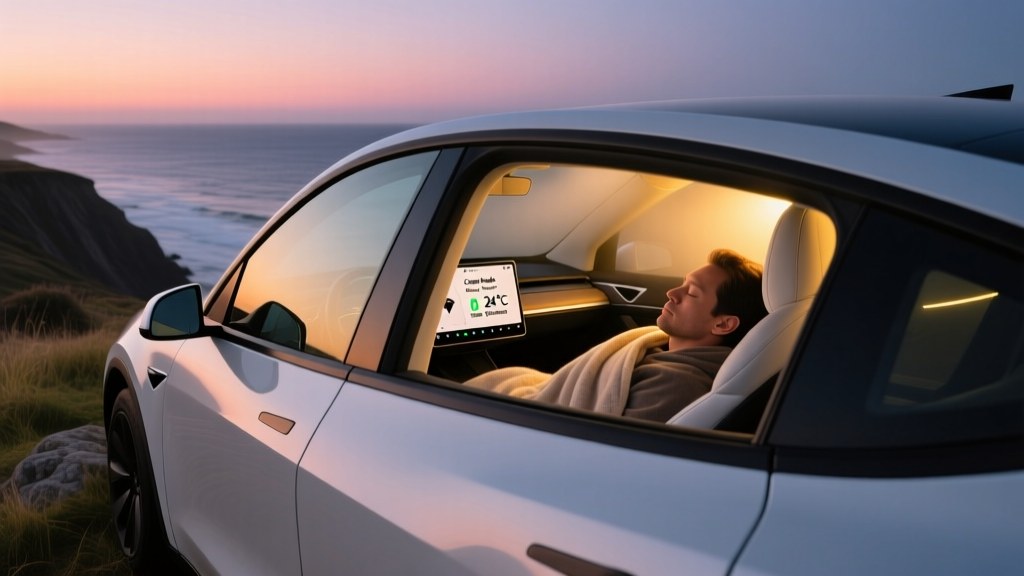
Unlike a gas car, a Tesla has no engine idling, no carbon-monoxide risk, and no fuel consumption while parked. The high-voltage traction battery powers the HVAC system directly, keeping the cabin at your chosen temperature for hours with minimal energy draw. Tesla's Camp Mode — accessible from the climate menu — is designed specifically for this: it maintains airflow, keeps USB ports powered, and prevents the car from locking you out or shutting down.
On a typical 65°F night, Camp Mode consumes roughly 1–1.5 kWh over 8 hours. On a 75 kWh usable battery, that's about 2% of total capacity. In freezing weather with the heat pump running harder, expect 2.5–4 kWh overnight — still a manageable 5% or less. This is the core reason EV sleeping works: the energy penalty is small, the cabin stays quiet, and you wake up to a pre-conditioned car.
Mild weather (60–70°F): ~1–1.5 kWh / 8 hrs (~2% SoC)
Cold weather (20–35°F): ~2.5–4 kWh / 8 hrs (~4–5% SoC)
Hot weather (90°F+, A/C): ~1.5–2 kWh / 8 hrs (~2–3% SoC)
2026 Tesla Model Y Long Range AWD: Full Spec Breakdown
The 2026 Model Y received a significant refresh (internally dubbed "Juniper") with updated styling, a quieter cabin, ventilated front seats, ambient lighting, and a rear-seat touchscreen. Here are the numbers that matter:
| Spec | 2026 Model Y Long Range AWD |
|---|---|
| EPA Range | 320 miles |
| Battery (Usable) | ~75 kWh, NMC chemistry |
| Drivetrain | Dual-Motor AWD |
| Horsepower | 384 hp |
| 0–60 mph | 4.8 seconds |
| Efficiency | 122 MPGe / 27 kWh/100mi |
| Max DC Fast Charge | 250 kW (peak) |
| 10–80% DC Charge | ~27 minutes |
| Level 2 Home Charge (11.5 kW) | ~44 mi/hr |
| Cargo (rear seats up) | 30.2 cu ft |
| Cargo (rear seats folded) | 72.1 cu ft |
| Rear Legroom | 40.5 in |
| Battery Warranty | 8 yr / 120,000 mi |
| Base MSRP | $48,990 |
Real-World Range: What to Actually Expect
The EPA rates the 2026 Model Y Long Range AWD at 320 miles. In real-world mixed driving at 70 mph, expect 270–290 miles in mild conditions. Sustained highway driving at 80 mph drops this to roughly 250–265 miles. In freezing weather (below 30°F) without preconditioning, range can fall to 220–240 miles — a 25–30% reduction that every EV buyer should budget for. Tesla's heat pump helps mitigate cabin heating draw, but cold battery chemistry still limits regen and increases rolling resistance.
For sleeping: if you go to bed at 50% SoC in winter, you'll wake up around 45–46% — plenty of buffer for a Supercharger stop in the morning.
Charging Speed: Supercharger and Home Setup
The 2026 Model Y supports Tesla's V3/V4 Supercharger network at up to 250 kW peak. In practice, the charge curve tapers significantly above 60% SoC. Expect 10–80% in roughly 27 minutes at a V3 stall, but 80–100% can take an additional 25+ minutes. Tesla now includes a NACS charge port natively, and with adapters, CCS charging is available on non-Tesla networks — though at reduced speeds on most third-party stations.
| Charging Method | Power | Miles Added / Hour | Notes |
|---|---|---|---|
| Level 1 (120V outlet) | ~1.4 kW | ~3–4 mi/hr | Emergency/trickle only |
| Level 2 (240V, 48A Wall Connector) | 11.5 kW | ~44 mi/hr | Full overnight charge in ~7 hrs |
| DC Fast (Supercharger V3) | 250 kW peak | ~1,000 mi/hr (peak) | 10–80% in ~27 min |
| DC Fast (Supercharger V4) | Up to 350 kW* | Varies | *Model Y currently limited to 250 kW acceptance |
For overnight sleeping trips, destination charging at a Level 2 hotel charger or a 240V outlet at an Airbnb is ideal — you'll wake up fully charged. On road trips, a 20-minute Supercharger stop before settling in for the night is the most efficient pattern.
Sleeping Comfort: Cabin Dimensions and Practical Setup
The Model Y's 72.1 cu ft of cargo space with rear seats folded creates a nearly flat load floor measuring approximately 74 inches long × 42 inches wide between the wheel wells. That's enough for a full-size adult to lie flat with a thin mattress or sleeping pad. The panoramic glass roof adds headroom and a sense of openness, though it also means heat loss in winter and heat gain in summer — a reflective sunshade is essential.
The Juniper refresh improved cabin insulation significantly. At idle with Camp Mode running, the heat pump produces a low hum (~35–40 dB) — quieter than most hotel room HVAC systems. Ventilated front seats (new for the refresh) add comfort for summer car-camping, and the rear-seat USB-C ports (65W) keep devices charged overnight.
Practical sleeping setup:
- Fold rear seats flat; use a 2–3" memory-foam pad cut to width
- Apply reflective windshield and rear-window sunshades (privacy + insulation)
- Set Camp Mode to your target temp (68°F is the efficiency sweet spot)
- Crack one window ~½" with a rain guard for condensation control
- Use the 12V/USB-C ports for a small fan or phone charging
Pricing, Trims, and Federal Tax Credit Eligibility
The 2026 Model Y is offered in three trims. Here's the pricing landscape:
| Trim | MSRP | §30D Credit (Est.) | Effective Price |
|---|---|---|---|
| Long Range RWD | $44,990 | Up to $7,500 | ~$37,490 |
| Long Range AWD | $48,990 | Up to $7,500 | ~$41,490 |
| Performance AWD | $53,990 | Up to $7,500 | ~$46,490 |
Critical tax-credit caveats: The IRS §30D credit requires the buyer to meet income caps ($150K single / $300K joint MAGI), the vehicle must be under the $55,000 MSRP cap for SUVs (all Model Y trims qualify), and the battery must meet critical-mineral and component sourcing thresholds that change annually. As of 2026, Tesla's battery sourcing has historically met partial or full credit requirements, but you must verify current-year eligibility at IRS.gov's qualified vehicles list before purchasing. The credit can be transferred to the dealer at point of sale as an instant discount — you don't need to wait until tax filing.
For the most current sourcing compliance data, cross-reference fueleconomy.gov for EPA-verified range and efficiency figures.
Driver-Assist Tech: Autopilot, FSD, and the Sleeping Question
Let's address a common confusion directly: you cannot legally or safely sleep while driving a Tesla. Tesla's Autopilot and Full Self-Driving (Supervised) are SAE Level 2 driver-assistance systems. They require continuous driver attention, hands-on-wheel monitoring (or camera-based gaze detection), and the driver remains fully responsible for the vehicle at all times.
Autopilot and FSD (Supervised) can steer, accelerate, and brake within their lane. The driver must remain alert, monitor the road, and intervene immediately. Sleeping, reading, or using a phone while FSD is active is dangerous, illegal in most jurisdictions, and can result in Autopilot bans from Tesla.
Where sleeping IS relevant: Camp Mode while parked, and resting at a Supercharger during a charge stop. For the latter, Tesla's cabin camera does not currently enforce attention while the vehicle is in Park, making a 25-minute nap during a charge session a common and practical road-trip strategy.
For actual autonomous driving without a human driver, only Level 4 robotaxi services like Waymo (regulated and permitted in select cities) currently operate. Tesla has not achieved or been certified for Level 4 autonomy in any production vehicle.
Pros and Cons: The Model Y as a Sleeping + Daily-Drive Platform
- Camp Mode is genuinely efficient (~1–4 kWh/night)
- Near-flat cargo floor fits an adult comfortably
- Supercharger network is the most reliable DC fast-charging ecosystem in the US
- Heat pump is standard — efficient cold-weather cabin heating
- Juniper cabin is significantly quieter than pre-2025 Model Y
- Over-the-air updates continuously add features
- 320-mi EPA range covers most single-day drives without charging
- No physical buttons — all climate/media controls are touchscreen-only
- Panoramic glass roof causes heat gain in summer (sunshade mandatory)
- 250 kW peak charge rate lags behind Hyundai/Kia's 800V architecture (~350 kW)
- Rear-seat headroom is tight for passengers over 6'2"
- FSD monthly cost ($99/mo or $8K one-time) is steep for Level 2 capability
- No spare tire — tire-repair kit only
- Insurance premiums run 15–30% higher than comparable non-Tesla SUVs
Who Should Buy the Model Y (and Who Shouldn't)
Buy the Model Y if: You want a dual-purpose daily driver and road-trip sleeper, you have access to home Level 2 charging, you value the Supercharger network for long-distance travel, and you want strong efficiency (122 MPGe) in a practical crossover form factor. It's ideal for couples who car-camp occasionally and commuters with a 40–80 mile round trip.
Look elsewhere if: You need three-row seating (Kia EV9, Rivian R1S), you want the fastest possible DC charging (Hyundai Ioniq 5, Kia EV6 with 800V), you need serious towing capacity (Rivian R1T, Ford F-150 Lightning), or you prefer physical controls and a traditional instrument cluster. If sleeping in your car is a primary use case rather than an occasional bonus, a dedicated campervan conversion or a larger SUV with more interior height may serve you better long-term.
Frequently Asked Questions
Is it safe to sleep in a Tesla overnight?
Yes. With Camp Mode enabled, the vehicle maintains climate control using the traction battery. There are no combustion gases, no carbon monoxide risk, and the cabin stays at a consistent temperature. Ensure you're parked legally and in a safe location. Keep one window slightly cracked to manage condensation in cold weather.
How much range do I lose sleeping in the car overnight?
In mild weather (60–70°F), expect to lose roughly 1–1.5 kWh over 8 hours — about 2% of the battery, or 6–8 miles of range. In freezing weather, the loss increases to 2.5–4 kWh (~5% SoC, or 15–20 miles). This is negligible for most trips, especially if you charge before settling in.
Does the 2026 Model Y qualify for the $7,500 federal tax credit?
It can, but eligibility depends on your income (≤$300K joint / $150K single MAGI), the MSRP being under $55,000 (all Model Y trims qualify as an SUV), and current-year battery sourcing rules under IRS §30D. Always verify on the IRS qualified vehicles list before purchasing, as sourcing compliance can change mid-year.
Can I sleep in a Tesla while it's charging at a Supercharger?
Yes, and this is a common road-trip practice. While the vehicle is in Park, the cabin remains climate-controlled and the charge session proceeds normally. A 25–30 minute charge session (10–80%) aligns well with a short nap. Note that some Supercharger locations have time limits or idle fees once charging completes.
What's the difference between Camp Mode and Dog Mode?
Camp Mode is designed for occupants sleeping or resting in the car — it maintains climate, keeps USB ports active, and allows the touchscreen to remain on for media. Dog Mode keeps the cabin at a set temperature for pets while the owner is away, displays a message on the screen, and locks the vehicle. Both draw from the traction battery at similar rates.
How does the Model Y compare to the Hyundai Ioniq 5 for road-trip sleeping?
The Ioniq 5 offers 800V architecture for faster DC charging (10–80% in ~18 min vs. ~27 min for the Model Y) and a V2L adapter that can power external devices. However, its cargo space with seats folded (~59 cu ft) is significantly smaller than the Model Y's 72.1 cu ft, and the Supercharger network remains more reliable than third-party CCS chargers for overnight road trips. If cabin sleeping space is the priority, the Model Y wins; if charge speed matters more, the Ioniq 5 is compelling.