If you've ever parked next to a Tesla and noticed the small lenses tucked into the fenders, pillars, and fascia, you probably asked yourself: how many cameras does a Tesla have? The short answer for every current-production Tesla — the 2026 Model 3, Model Y, Model S, and Model X — is eight external cameras, supplemented by a cabin-facing camera. But the real story isn't just the count; it's where they sit, what they power, and how they shape the ownership experience, from Autopilot functionality to how you inspect paint on delivery day.
This guide maps the full camera suite across Tesla's 2026 lineup, then pairs that hardware breakdown with the numbers buyers actually need: EPA range, battery chemistry, DC fast-charge speeds, real-world efficiency, and federal tax-credit eligibility under current IRS §30D rules.
The 8-Camera Vision Layout: Where Each Lens Lives
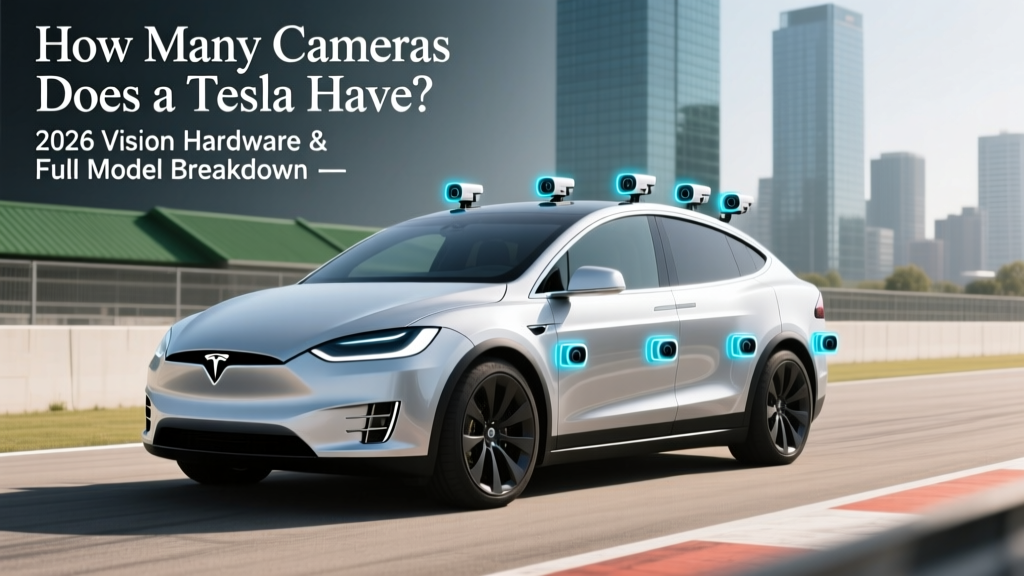
Tesla abandoned radar and ultrasonic sensors in favor of a pure vision approach branded as Tesla Vision. Every 2026 Tesla rolling off the Fremont, Shanghai, Berlin, and Austin lines ships with the same eight-camera topology:
- 3 forward-facing cameras behind the windshield (main, wide-angle, and narrow/telephoto) — the core perception stack for highway lane-keeping, traffic-light detection, and Autopilot/FSD (Supervised) path planning.
- 2 front-fender repeater cameras (one per side) — monitor cross-traffic at intersections and cover blind spots during lane changes.
- 2 pillar/rear-quarter cameras mounted in the B- or C-pillar area — track vehicles approaching from behind and adjacent lanes.
- 1 rear-view camera above the license plate — used for backup, rear cross-traffic, and as a persistent rear perception feed while driving.
A ninth, interior camera sits above the rearview mirror. It's used for cabin occupancy detection, Sentry Mode recording when triggered, and driver-monitoring in markets that require it. It is not part of the active driving-perception stack.
Hardware generation matters. Most 2026 vehicles now ship with Hardware 4 (HW4), which pairs higher-resolution sensors (up to 5 megapixels per camera versus HW3's ~1.2 MP) with a faster inference computer. The practical upshot: longer detection range (roughly 250 m versus ~150 m on HW3), better low-light performance, and crisper Sentry Mode clips.
Which 2026 Tesla Are We Talking About?
The camera count is identical across the lineup, but the vehicle wrapped around those cameras is not. Below is a spec snapshot of the four current models so you can match the hardware story to the car you're actually shopping.
| Spec | Model 3 Long Range AWD | Model Y Long Range AWD | Model S Long Range | Model X Long Range |
|---|---|---|---|---|
| External Cameras | 8 | 8 | 8 | 8 |
| Cabin Camera | 1 | 1 | 1 | 1 |
| EPA Range | 341 mi | 320 mi | 402 mi | 335 mi |
| Battery (usable) | ~75 kWh, NMC | ~75 kWh, NMC | ~95 kWh, NMC | ~95 kWh, NMC |
| Peak DC Charge | 250 kW | 250 kW | 250 kW | 250 kW |
| 10–80% DC Time | ~27 min | ~27 min | ~30 min | ~31 min |
| Level 2 Home Rate | 11.5 kW (~44 mi/hr) | 11.5 kW (~44 mi/hr) | 11.5 kW (~34 mi/hr) | 11.5 kW (~30 mi/hr) |
| 0–60 mph | 4.2 s | 4.8 s | 3.1 s | 3.8 s |
| Drivetrain | Dual-Motor AWD | Dual-Motor AWD | Dual-Motor AWD | Dual-Motor AWD |
| Horsepower | ~346 hp | ~384 hp | ~670 hp | ~670 hp |
| Efficiency | 134 MPGe / 25 kWh/100mi | 122 MPGe / 27 kWh/100mi | 124 MPGe / 27 kWh/100mi | 109 MPGe / 31 kWh/100mi |
| Base MSRP | $47,740 | $48,240 | $79,990 | $84,990 |
| Battery Warranty | 8 yr / 120,000 mi | 8 yr / 120,000 mi | 8 yr / 150,000 mi | 8 yr / 150,000 mi |
Sources: fueleconomy.gov and Tesla Owner's Manuals.
Real-World Range: What the EPA Sticker Doesn't Tell You
EPA 341 miles (Model 3 LR AWD) — expect ~275–295 miles at sustained 75 mph highway speeds in mild weather, ~230–255 miles in freezing temperatures with cabin heat, and roughly 310+ miles in stop-and-go city driving where regen recovers energy.
Tesla's efficiency remains class-leading, but physics is non-negotiable. Highway aerodynamic drag, cold-soaked battery chemistry, and cabin heating all compress range. The Model 3 Highland refresh improved thermal management with a standard heat pump across trims, which cuts cold-weather range loss from the ~30% seen on older resistive-heat cars down to roughly 18–22%. The larger Model S and X, with more mass and frontal area, shed range faster at highway speeds — plan conservatively on road trips and precondition the battery via the navigation system before every DC fast-charge stop.
Charging Speed: Peak kW Is Not Sustained kW
All 2026 Teslas peak at 250 kW on V3/V4 Superchargers using the native NACS connector — no adapter required. But peak rate only holds between roughly 10% and 35% state of charge. The charge curve then tapers: expect ~175 kW through 55%, ~100 kW through 75%, and sub-50 kW above 85%.
| Charging Level | Power (kW) | Miles Added per Hour | Typical Use Case |
|---|---|---|---|
| Level 1 (120V) | ~1.4 kW | ~3–5 mi/hr | Emergency/top-up only |
| Level 2 (240V, 48A) | 11.5 kW | ~30–44 mi/hr | Home overnight charging |
| DC Fast (Supercharger V3/V4) | Up to 250 kW | ~1,000 mi/hr peak | Road trips, 10–80% in ~27–31 min |
| CCS Adapter ( Electrify America, etc.) | Up to ~250 kW | Similar to Supercharger curve | Non-Tesla networks |
Home charging on a 60-amp circuit (48A continuous) delivers the sweet spot of speed and practicality — most owners wake up to a full battery every morning. If your panel is maxed out, a 40-amp circuit (32A continuous, ~7.7 kW) still adds ~250 miles overnight in a Model 3.
FSD, Autopilot, and What Those 8 Cameras Actually Do
The eight-camera suite is the sensory input for three tiers of driver assistance:
- Basic Autopilot (standard): Traffic-Aware Cruise Control and Autosteer on divided highways.
- Enhanced Autopilot ($6,000 option): Adds Navigate on Autopilot, Auto Lane Change, Autopark, Summon, and Smart Summon.
- Full Self-Driving (Supervised) ($8,000 option or $99/mo subscription): Adds traffic-light and stop-sign control, and city-street autosteer.
SAE Level 2 only. Despite the "Full Self-Driving" name, every Tesla feature available to consumers is SAE Level 2 — the driver must remain attentive, keep hands available, and supervise at all times. Tesla's camera system does not make the car autonomous. True Level 4 driverless service in the U.S. is currently offered only by Waymo in geofenced zones.
HW4's higher-resolution cameras improve small-object detection (curbs, debris, painted lane markings in rain) and reduce phantom-braking events compared to HW3, though owner forums still report occasional shadow-triggered deceleration. The cabin camera monitors gaze direction and will escalate warnings — then disengage Autopilot — if the driver looks away for extended periods.
Pricing, Trims, and the Federal Tax Credit Reality
| Model / Trim | Base MSRP | §30D Credit Eligible? | Effective Price (if eligible) |
|---|---|---|---|
| Model 3 RWD | $38,990 | Up to $7,500 (point-of-sale) | ~$31,490 |
| Model 3 Long Range AWD | $47,740 | Up to $7,500 | ~$40,240 |
| Model 3 Performance | $52,990 | Up to $7,500 | ~$45,490 |
| Model Y Long Range AWD | $48,240 | Up to $7,500 | ~$40,740 |
| Model Y Performance | $51,490 | Up to $7,500 | ~$43,990 |
| Model S Long Range | $79,990 | No (over MSRP cap) | $79,990 |
| Model X Long Range | $84,990 | No (over MSRP cap) | $84,990 |
Under current IRS §30D rules, the $7,500 credit for new EVs has several gates:
- MSRP caps: Sedans (Model 3) must be ≤ $55,000; SUVs and trucks (Model Y) must be ≤ $80,000. Model S and X exceed these caps.
- Buyer income caps: AGI ≤ $150,000 single / $225,000 HOH / $300,000 joint.
- Battery sourcing: The credit splits into two $3,750 halves — one tied to critical-mineral sourcing, the other to battery-component manufacturing. Sourcing requirements tighten each year; confirm the current split for your purchase month on IRS.gov.
- Point-of-sale transfer: Eligible buyers can apply the credit as a down-payment reduction at delivery rather than waiting to claim it on their tax return.
Tax rules shift, and state incentives (California, Colorado, etc.) layer on separately. Consult a tax professional before relying on a specific credit amount.
Cargo, Cabin, and Daily Practicality
The camera hardware doesn't eat interior space — packaging is the differentiator:
- Model 3: 23 cu ft trunk + ~3 cu ft frunk. Rear legroom 35.3 in. Tight for tall rear passengers on long trips.
- Model Y: 34 cu ft behind second row, 76 cu ft folded + frunk. The family default for strollers, groceries, and weekend gear.
- Model S: 28 cu ft rear hatch + frunk, 40.5 in rear legroom — genuine luxury sedan space.
- Model X: Up to 88 cu ft behind front seats; available 6- or 7-seat layout with a usable third row for kids. Towing up to 5,000 lb.
The minimalist interiors put nearly every control behind the 15.4-inch touchscreen (Model 3/Y) or 17-inch screen (Model S/X). No physical gear selector, no turn-signal stalk on refreshed models — those functions moved to the steering wheel and screen. Love it or hate it, it's the biggest adjustment for new Tesla owners.
Pros, Cons, and the Honest Ownership Picture
Pros
- Supercharger network remains the most reliable DC fast-charge ecosystem in North America
- Class-leading efficiency (kWh/100 mi) stretches range per dollar
- Over-the-air updates add features years after purchase
- Strong resale relative to most EVs (though softer than 2022 peaks)
- HW4 camera suite is genuinely more capable than HW3 in low light and at distance
Cons
- No radar or ultrasonic backup — pure vision can struggle in heavy rain, fog, or direct low-sun glare
- Phantom braking events still reported on Autopilot
- Stalkless turn signals and screen-only HVAC controls frustrate some drivers
- Model S/X no longer qualify for the §30D credit due to MSRP caps
- Insurance premiums run 15–30% above comparable ICE sedans in many states
Who Should Buy a 2026 Tesla — And Who Shouldn't
Choose a Tesla if: You want access to the Supercharger network without adapters, you value efficiency and OTA updates, and you're comfortable with a screen-centric cabin. Model 3 is the commuter default; Model Y is the family default; Model S/X serve luxury sedan and three-row SUV buyers who don't need the tax credit.
Look elsewhere if: You want physical buttons and stalks (Hyundai Ioniq 5, BMW i4), you need a true Level 4 autonomous experience (not offered by any consumer car), or you tow heavy trailers regularly (Rivian R1T, Ford F-150 Lightning).
Frequently Asked Questions
How many cameras does a Tesla Model 3 have?
Eight external cameras (3 front, 2 fender repeaters, 2 pillar, 1 rear) plus one interior cabin camera — nine total lenses.
Does Tesla still use ultrasonic sensors or radar?
No. Since late 2022, Tesla has shipped all vehicles as pure Tesla Vision — no ultrasonic parking sensors and no radar. Object distance estimation is handled by neural networks processing the camera feeds.
Is FSD actually self-driving?
No. FSD (Supervised) is SAE Level 2 driver assistance. The driver must remain engaged, hands ready, and eyes on the road. It is not autonomous.
Does the Model Y qualify for the $7,500 federal tax credit?
Yes, if the buyer meets IRS §30D income caps (≤ $150k single / $300k joint), the vehicle MSRP is ≤ $80,000 (it is), and the battery meets current-year critical-mineral and component-sourcing thresholds. Confirm specifics on IRS.gov before ordering.
What happens if a Tesla camera gets damaged?
Individual camera replacement typically runs $250–$600 per unit including calibration, depending on location. Fender-repeater and pillar cameras are more exposed to road debris than the windshield-mounted trio.
How does Tesla's camera count compare to rivals?
Comparable. Ford's BlueCruise vehicles use up to 11 sensors (cameras + radar). GM Super Cruise uses cameras, radar, and LiDAR-mapped highways. Tesla is unique in relying on cameras alone with no radar or LiDAR backup.