If you've searched how many cameras are on a Tesla, you're likely evaluating Autopilot capability, FSD (Supervised) performance, or how Tesla's vision-only approach stacks up against lidar-equipped rivals. The short answer for the 2026 lineup: eight cameras on most models, with a ninth cabin-facing camera on newer builds. But the sensor story goes deeper than a simple count — placement, resolution, processor generation, and software all shape what the car actually sees.
Below, we map every camera across the 2026 Tesla fleet, then pair that sensor data with the numbers that matter for purchase decisions: EPA range, DC fast-charge speed, pricing, and federal tax credit eligibility under IRS §30D rules.
Tesla's Camera Hardware: 8 Exterior Plus 1 Interior
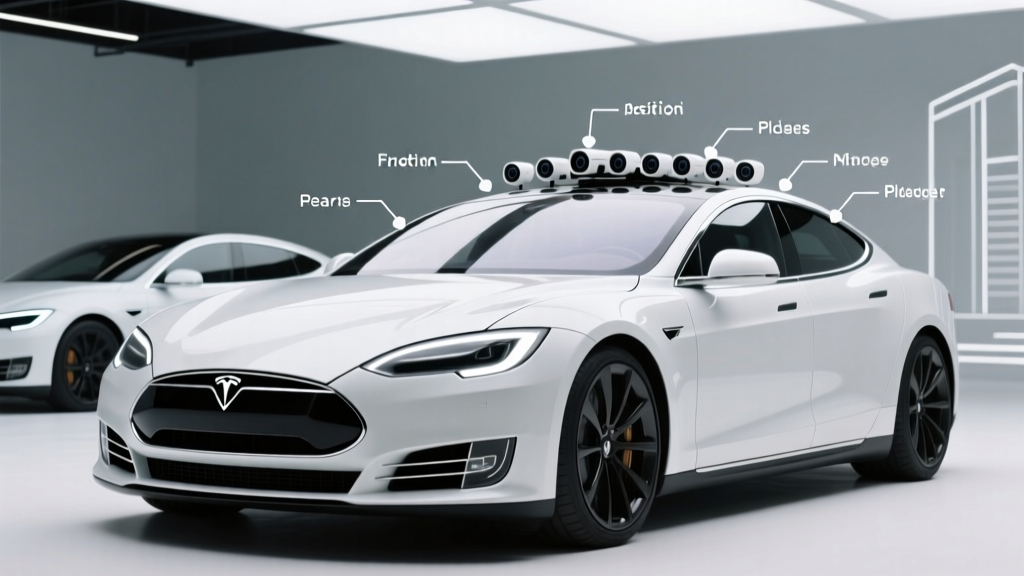
Since Tesla removed ultrasonic sensors (USS) and radar from its production vehicles starting in 2022–2023 (a strategy Tesla calls Tesla Vision), cameras carry the full perception load for Autopilot, FSD (Supervised), parking assist, and dashcam/Sentry Mode. Here's the standard layout across the 2026 Model 3, Model Y, Model S, Model X, and Cybertruck:
| Camera Position | Count | Primary Function |
|---|---|---|
| Front main (above rearview mirror housing) | 1 | Forward lane/obstacle detection, FSD primary |
| Front wide-angle (same housing) | 1 | Intersection, cut-in, close-range objects |
| Front narrow/telephoto (same housing) | 1 | High-speed distant object tracking |
| Front fender repeaters (left + right) | 2 | Blind-spot, lane-change, side-approach |
| Rear corner cameras (left + right, near C-pillar) | 2 | Rear cross-traffic, adjacent-lane merge |
| Rear backup camera | 1 | Reverse, trailer assist |
| Cabin-facing camera (above mirror) | 1 | Driver monitoring (required for FSD Supervised) |
Total: 9 cameras on current-production 2026 vehicles (8 exterior + 1 interior). Older pre-2023 builds may have 8 exterior only; the cabin camera became mandatory as FSD (Supervised) driver-monitoring requirements tightened.
Why Tesla Ditched Radar and Ultrasonics
Most competitors — Waymo, Cruise (pre-pause), Mercedes, Mobileye — combine cameras with radar, lidar, or ultrasonics for sensor redundancy. Tesla's bet is that a high-resolution camera suite paired with its HW4 (and now HW5/AI5) neural-network processor can replicate human vision using only optical data, reducing cost and simplifying the stack.
The tradeoff: pure vision systems have historically struggled in heavy rain, fog, direct sun glare, and low-contrast scenarios (white truck against a bright sky — a failure mode documented in early NHTSA investigations). Tesla has iterated heavily via over-the-air software, and its 2025–2026 FSD (Supervised) v13.x stack shows measurable improvement in disengagement frequency, per NHTSA incident data. Still, owners in snow-belt states report more phantom braking and parking-assist hesitation than those in sunnier climates.
2026 Tesla Lineup: Range, Charging, and Pricing Specs
Camera count is consistent across the fleet, but the powertrain and economics vary sharply. Here's the spec matrix buyers actually need.
| Model / Trim | EPA Range | Battery (kWh / Chem.) | Max DC kW | 10–80% Min | 0–60 mph | HP | Drivetrain | Base MSRP |
|---|---|---|---|---|---|---|---|---|
| Model 3 RWD | 363 mi | ~60 / LFP | 170 kW | ~28 | 5.8 s | 283 | RWD | $38,990 |
| Model 3 Long Range AWD | 363 mi | ~75 / NMC | 250 kW | ~22 | 4.2 s | 384 | AWD | $42,990 |
| Model Y Long Range AWD | 320 mi | ~75 / NMC | 250 kW | ~24 | 4.8 s | 384 | AWD | $44,990 |
| Model Y Performance | 298 mi | ~75 / NMC | 250 kW | ~24 | 3.5 s | 456 | AWD | $49,990 |
| Model S Long Range | 402 mi | ~100 / NMC | 250 kW | ~28 | 3.1 s | 670 | AWD | $79,990 |
| Model X Long Range | 348 mi | ~100 / NMC | 250 kW | ~30 | 3.8 s | 670 | AWD | $84,990 |
| Cybertruck AWD | 340 mi | ~123 / NMC | 250 kW | ~35 | 4.1 s | 600 | AWD | $79,990 |
Charging Speed: DC Fast, Level 2, and Supercharger Access
Tesla's NACS (North American Charging Standard) connector is now the industry default — Ford, GM, Rivian, Volvo, and others have adopted it, giving Tesla owners the largest proprietary DC network plus full third-party compatibility.
| Level | Power | Typical Speed (mi/hr added) | Use Case |
|---|---|---|---|
| Level 1 (120V household) | ~1.4 kW | 3–5 mi/hr | Overnight trickle, emergencies |
| Level 2 (240V home Wall Connector) | 11.5 kW | ~44 mi/hr | Daily home charging, 0–100% in ~7–9 hr |
| DC Fast (V3 Supercharger) | Up to 250 kW | ~1,000 mi/hr peak | Road trips; 10–80% in 22–35 min depending on pack |
| DC Fast (V4 Supercharger cabinet) | Up to 350 kW (vehicle-limited) | Similar to V3 for current Teslas | Future headroom; current cars cap at 250 kW |
Charge-curve caveat: Peak kW is sustained only between roughly 10–45% State of Charge (SoC). Above 80%, the curve tapers sharply to protect battery longevity — charging 80–100% can take as long as 10–80%. For road-trip efficiency, plan stops around 10–80% rather than topping off.
Federal EV Tax Credit: Who Qualifies in 2026?
Under IRS §30D rules, the federal clean-vehicle credit is now a point-of-sale transfer (you can apply it at the dealer to reduce your out-of-pocket cost), but eligibility hinges on three moving targets: buyer income caps, MSRP caps, and battery critical-mineral/battery-component sourcing requirements that tighten annually.
| Model | MSRP Cap Met? | Typical Credit | Notes |
|---|---|---|---|
| Model 3 RWD / LR | Yes (sedan cap: $55,000) | Up to $7,500 (if sourcing thresholds met) | Income cap: $150k single / $300k joint AGI |
| Model Y | Yes (SUV cap: $80,000) | Up to $7,500 (if sourcing thresholds met) | Classified as SUV; higher MSRP cap |
| Model S / X | Often exceeds cap | $0 for most trims | MSRP above $55k sedan / $80k SUV limit |
| Cybertruck | Borderline — trim-dependent | $0–$7,500 | Confirm classification and sourcing at purchase |
Critical sourcing caveat: The percentage of battery critical minerals and components that must be sourced from the U.S. or free-trade-agreement partners increases each year. A model that qualified in 2024 may not qualify in 2026. Always verify eligibility via the fueleconomy.gov credit lookup tool before signing a purchase agreement — never rely on a dealer's verbal assurance.
Autopilot, FSD (Supervised), and What the Cameras Actually Enable
The 8-exterior-camera array feeds Tesla's HW4 computer (and the emerging AI5 processor on newest builds), enabling:
- Basic Autopilot (standard): Traffic-aware cruise control + autosteer on marked highways.
- Enhanced Autopilot ($6,000 option): Auto lane-change, Navigate on Autopilot, Smart Summon, Autopark.
- FSD (Supervised) ($8,000 option or $99/mo): Traffic-light/stop-sign control, city-street autosteer — still requires active driver supervision. Not autonomous.
Who Should Buy a Tesla in 2026?
Choose Tesla if…
- You want the lowest-friction DC charging network (Superchargers are still the reliability benchmark)
- Over-the-air software updates matter to you
- You drive in regions with good weather and clear lane markings
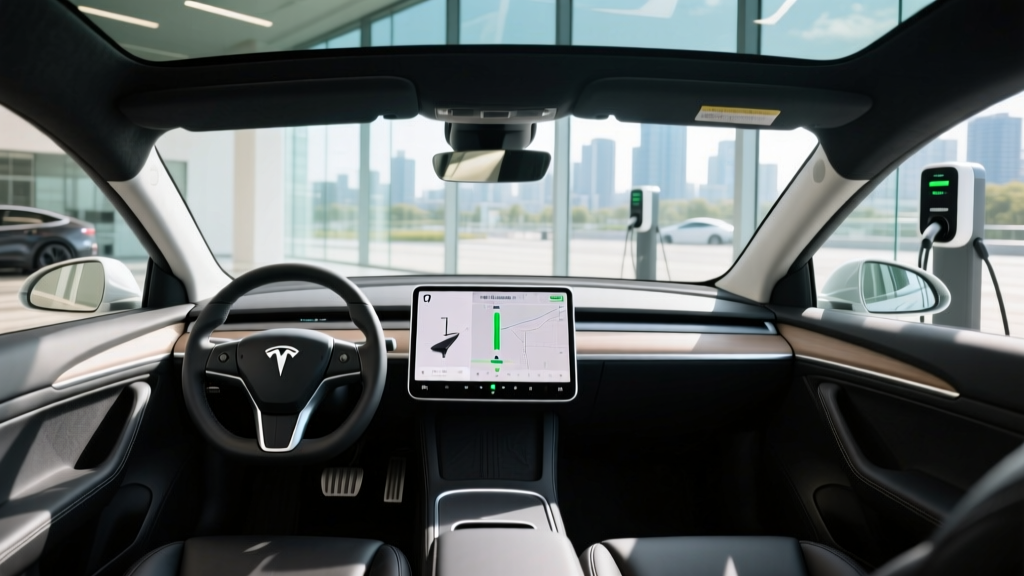
- You value minimalist interior design and strong infotainment (15.4" center screen, gaming, streaming)
Look at competitors if…
- You need lidar/radar redundancy for peace of mind (Hyundai Ioniq 5, BMW iX)
- You want a physical instrument cluster or traditional controls
- You tow heavy loads regularly (Rivian R1T, Ford F-150 Lightning)
- You live in a snow-belt state and prioritize ADAS stability in poor visibility
Warranty, Cargo, and Ownership Practicalities
All 2026 Teslas include a 4-year/50,000-mile basic warranty and an 8-year battery & drive-unit warranty (100,000 miles on Model 3/Y; 150,000 miles on Model S/X). Tesla guarantees at least 70% battery capacity retention over the warranty period — a typical industry benchmark.
Cargo volume (behind second row, where applicable):
- Model 3: 23 cu ft trunk + 3.1 cu ft frunk
- Model Y: 30 cu ft (seats up) / 72 cu ft (folded) + 4.1 cu ft frunk
- Model S: 28 cu ft + 31 cu ft folded + frunk
- Model X: 15 cu ft (seats up) + 82 cu ft folded + frunk
- Cybertruck: 34 cu ft bed (6-ft vault) + front trunk
Frequently Asked Questions
Does Tesla use lidar or radar in 2026?
No. Tesla removed radar from Model 3/Y in 2021 and from Model S/X in 2022, and ultrasonic sensors were phased out in late 2022. All 2026 models rely on the 8-exterior-camera Tesla Vision stack plus the cabin camera for driver monitoring.
Can the cabin camera see me all the time?
The cabin camera activates primarily when FSD (Supervised) or Autopilot is engaged to verify driver attention. It does not continuously record or upload footage unless you enable dashcam/Sentry Mode features. Privacy settings are user-configurable.
How does Tesla's camera count compare to competitors?
Waymo's 6th-gen robotaxi uses 29 cameras plus lidar and radar — but it's a Level 4 service, not a consumer car. Among consumer vehicles, Mobileye-based systems often use 11–12 cameras plus radar. Tesla's 8-camera count is on the lower end, but resolution and processing (HW4/AI5) compensate in most conditions.
Is FSD (Supervised) worth the $8,000 cost?
For most buyers, no — the monthly subscription ($99/mo) is more economical unless you drive 80+ months consecutively. FSD's city-street capability is impressive but still Level 2; you cannot disengage. If your commute is primarily well-marked highways, standard Autopilot is sufficient.
Will a 2026 Tesla qualify for the full $7,500 tax credit?
Model 3 and Model Y typically qualify, subject to your AGI (income cap: $150k single / $300k joint) and the annual battery-sourcing thresholds. Model S, Model X, and most Cybertruck trims exceed MSRP caps or fail sourcing rules. Verify on fueleconomy.gov before purchasing.