How Many Cameras Does Tesla Have in 2026?
Every current-production Tesla — Model 3, Model Y, Model S, Model X, and Cybertruck — ships with eight external cameras that form the backbone of the company's Tesla Vision sensor suite. There are no ultrasonic sensors and no radar on new vehicles; the camera array is the sole input for Autopilot, Enhanced Autopilot, and Full Self-Driving (Supervised). If you're shopping for a Tesla or comparing it to rivals that lean on lidar or radar fusion, understanding exactly what those eight cameras see — and what the car can and cannot do with them — is essential before you sign a purchase agreement.
This guide maps the full camera layout, explains what Tesla Vision actually delivers at SAE Level 2, and pairs that tech deep-dive with the hard numbers buyers need: EPA range, real-world efficiency, DC fast-charge speeds, pricing after federal tax credits, and cargo space. We'll use the 2026 Tesla Model 3 Long Range AWD as our primary reference vehicle, with notes where Model Y, S, X, and Cybertruck differ.
The Eight-Camera Tesla Vision Layout
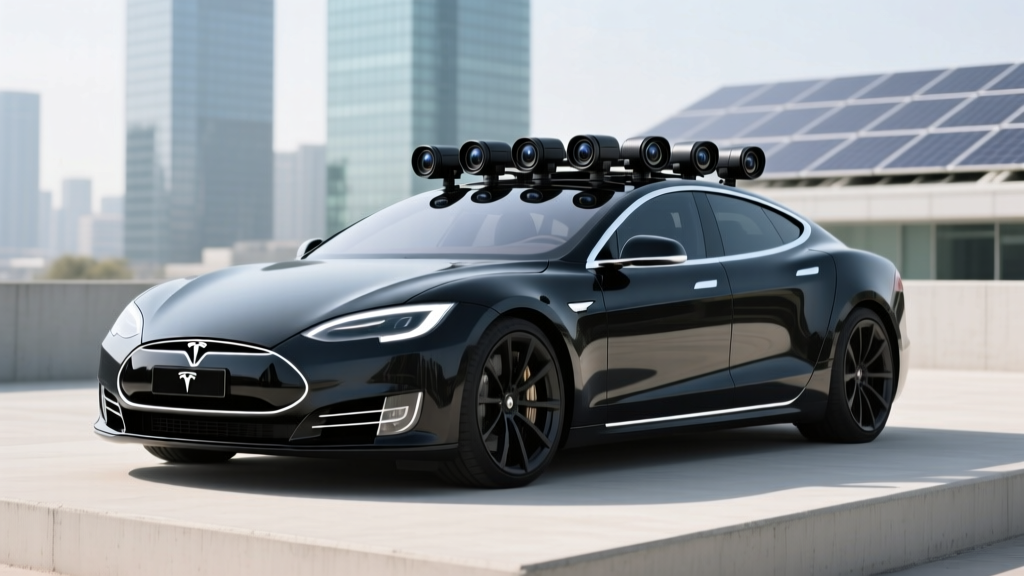
Tesla's current hardware suite (often referred to as HW4 or AI4) uses eight cameras positioned to deliver overlapping, near-360-degree coverage around the vehicle. Here is the exact placement:
- Front main (narrow): Mounted behind the windshield, top-center. Long focal length for detecting vehicles, signs, and lane markings at distance (up to ~250 meters claimed).
- Front wide-angle: Adjacent to the main camera. Short focal length for close-in intersections, cut-ins, and traffic-light detection.
- Front left fender: Driver-side front fender, aimed at the left blind spot and adjacent lane.
- Front right fender: Passenger-side front fender, mirrored coverage.
- Rear left pillar: Mounted on the left rear roof pillar, covering the left rear quarter and blind spot.
- Rear right pillar: Mirrored coverage on the right side.
- Rear-view (backup): Centered above the license plate or integrated into the rear trim, used for reversing, parking visualization, and rearward driving context.
- Cabin camera: Interior-facing, above the rearview mirror. Monitors driver attentiveness when Autopilot/FSD is engaged — a requirement Tesla added after NHTSA scrutiny of driver-monitoring practices.
The cabin camera is worth singling out: it is not part of the external perception stack, but Tesla uses it to enforce hands-on-wheel and eyes-on-road compliance. If you look away from the road for more than a few seconds while FSD (Supervised) is active, the system escalates warnings and will eventually disengage and lock you out for the remainder of the drive. This matters because, unlike GM's Super Cruise which uses an IR driver-monitoring camera that works with polarized sunglasses, Tesla's visible-light cabin camera can be finicky with certain eyewear and lighting conditions.
What Tesla Vision Actually Does (and Doesn't Do)
The eight-camera vision suite feeds Tesla's neural-net-based perception stack, which builds a real-time 3D model of the world around the car. In practice, FSD (Supervised) in 2026 handles highway lane-keeping, on-ramp/off-ramp transitions, traffic-light and stop-sign recognition, and many urban turns impressively well. It also makes occasional baffling decisions — phantom braking on empty roads, hesitating at unprotected left turns, or misclassifying roadside debris. The system is continuously improving via over-the-air updates, but "Supervised" is doing heavy lifting in that name.
- Drive without an attentive, licensed driver in the seat
- Reliably detect stationary emergency vehicles in all lighting conditions (a documented NHTSA investigation area)
- Operate in heavy fog, blinding rain, or when cameras are occluded by ice, mud, or road salt
- Replace human judgment at construction zones with non-standard lane markings
2026 Tesla Model 3 Long Range AWD: Full Spec Breakdown
With the camera stack explained, let's look at the vehicle those cameras are mounted on. The 2026 Model 3 Long Range AWD remains Tesla's volume sedan and the trim most buyers cross-shop against the Hyundai Ioniq 6, BMW i4, and Polestar 2.
| Spec | Value |
|---|---|
| EPA-estimated range | 341 miles |
| Battery (usable) | ~75 kWh, NMC (nickel manganese cobalt) |
| Drivetrain | Dual-motor AWD |
| Horsepower | ~384 hp combined |
| 0–60 mph | 4.2 seconds |
| Top speed | 125 mph (electronically limited) |
| Efficiency | 134 MPGe combined / 25 kWh/100 mi |
| Max DC fast charge | 250 kW (peak) |
| 10–80% DC charge | ~27 minutes |
| Level 2 home charge | 11.5 kW (~44 mi/hr) |
| Cargo (trunk + frunk) | 23 cu ft trunk + 3 cu ft frunk = 26 cu ft total |
| Rear legroom | 35.3 inches |
| Base MSRP | $47,740 (incl. destination) |
| Battery warranty | 8 years / 120,000 miles (min 70% retention) |
| Camera count | 8 external + 1 cabin |
Real-World Range: What the EPA Sticker Doesn't Tell You
The Model 3 Long Range's NMC battery delivers strong energy density, which is how Tesla achieves 341 miles from a relatively compact 75 kWh usable pack. If you're a high-mileage commuter or road-tripper, the efficiency story is excellent — 25 kWh/100 mi is among the best in the segment. But buyers in northern-tier states should budget for meaningful winter range compression and plan charging stops accordingly. Preconditioning the battery via the Tesla app or navigation-routed Supercharger prep is essential to recoup regenerative braking capability and charging speed in cold weather.
Charging: Supercharger Network vs. Home Level 2
Tesla's Supercharger network remains the most reliable DC fast-charging ecosystem in North America, and the Model 3 Long Range takes full advantage of it.
| Level | Power | Miles Added per Hour | Notes |
|---|---|---|---|
| Level 1 (120V) | ~1.4 kW | ~5 mi/hr | Emergency/trickle only |
| Level 2 (240V, 48A) | 11.5 kW | ~44 mi/hr | Full overnight charge in ~7 hrs |
| DC Fast (Supercharger V3) | 250 kW peak | ~170 mi in 15 min | Tapers significantly above 80% SoC |
| DC Fast (Supercharger V4) | Up to 250 kW (Model 3) | Similar to V3 | V4 cabinets support higher kW for future platforms |
The charge curve matters more than the peak number. The Model 3 Long Range hits 250 kW only at a low state of charge (roughly 10–20% SoC) and ramps down progressively. Expect the 10–80% session to average around 150–170 kW sustained, which translates to roughly 27 minutes at a V3 Supercharger. Above 80%, charging slows dramatically to protect the battery — an 80–100% top-off can take as long as the 10–80% session. For road trips, the practical play is to charge to 80% and go.
At home, a Tesla Wall Connector on a 60-amp circuit delivers the full 11.5 kW / 44 miles per hour. Most owners who plug in overnight never visit a public charger for daily driving. Installation typically runs $800–$2,000 depending on panel proximity and whether a 200-amp service upgrade is needed — a licensed electrician should assess your panel before you commit to hardware.
Pricing, Trims, and Federal Tax Credit Eligibility
| Trim | MSRP (incl. dest.) | Est. After §30D Credit* |
|---|---|---|
| Long Range AWD | $47,740 | ~$40,240 |
| Performance AWD | $54,740 | ~$47,240 |
| Model 3 RWD (base) | $38,990 | ~$31,490 |
*Federal tax credit estimates assume buyer eligibility. Actual credit depends on IRS §30D rules.
- MSRP cap: Sedans must be ≤ $55,000 (SUVs/trucks ≤ $80,000). Model 3 trims qualify; Model S does not.
- Buyer income cap: AGI ≤ $150,000 single / $300,000 joint filers.
- Battery sourcing: Critical minerals and battery components must meet escalating domestic-content thresholds. Tesla's Fremont and Austin-built vehicles have generally met these requirements, but supply chains shift — verify at IRS.gov or via the point-of-sale dealer attestation at delivery.
- Point-of-sale transfer: As of 2024+, buyers can transfer the credit to the dealer at purchase, reducing the out-of-pocket price directly rather than waiting for a tax refund.
- VIN verification: The vehicle's battery and mineral sourcing must be confirmed per-VIN. Not every unit on the lot may qualify identically.
The Model 3 RWD (base) at $38,990 before a potential $7,500 credit is one of the most affordable long-range EVs on the market. The Long Range AWD at ~$40,240 after credit is where most buyers land — you gain AWD, 60+ additional miles of range, and substantially quicker acceleration for roughly $9,000 more before incentives.
How Does It Compare to Key Competitors?
The camera-centric Tesla Vision approach is philosophically distinct from the sensor-fusion strategies used by nearly every other automaker. Here's how the competitive landscape looks in 2026:
- Hyundai Ioniq 6 (Long Range RWD): EPA 361 miles, ~$46,000. Uses radar + cameras for Hyundai SmartSense. No lidar. Less ambitious driver-assist than FSD but more conservative and predictable. Charges at up to 350 kW on 800V architecture (10–80% in ~18 min).
- BMW i4 eDrive40: EPA 307 miles, ~$57,000. Camera + radar + ultrasonic. More premium interior, less cargo space, no frunk. Driving assist is solid Level 2 but less feature-rich than FSD.
- Polestar 2 Long Range Dual Motor: EPA ~320 miles, ~$53,000. Camera + radar + ultrasonic. Google-based infotainment. More traditional switchgear than Tesla's minimalist cabin.
The Model 3 wins on efficiency (25 kWh/100 mi is best-in-class), Supercharger access (now open to other brands via NACS adoption, but Tesla still gets the best stall availability and pricing), and over-the-air feature evolution. It loses on interior material quality (improved in the 2024+ refresh but still not BMW-tier), rear-seat comfort for tall adults, and the absence of any sensor redundancy beyond cameras.
- You want the lowest cost-per-mile efficiency in the segment
- Supercharger network access is a top priority for road trips
- You're comfortable with a camera-only driver-assist system and its current limitations
- You value OTA feature updates and a minimalist cabin
- You want radar or ultrasonic redundancy for ADAS (Hyundai, BMW, Mercedes)
- Rear-seat space for adults is a daily need (Model Y or Ioniq 5 are roomier)
- You prefer physical buttons, a traditional instrument cluster, or Apple CarPlay/Android Auto (Tesla uses its own proprietary interface exclusively)
Pros, Cons, and Who Should Buy
- Class-leading efficiency (134 MPGe / 25 kWh/100mi)
- 341-mile EPA range covers most road trips with one stop
- 250 kW Supercharger access with best-in-class network reliability
- FSD (Supervised) is the most feature-rich consumer Level 2 system available
- OTA updates add real features post-purchase
- Strong resale value relative to EV segment average
- Camera-only vision: no radar/lidar/ultrasonic redundancy
- Phantom braking remains a documented complaint
- Rear seat is tight for adults over 6 feet
- No Apple CarPlay or Android Auto
- Panel gaps and paint quality improved but still inconsistent
- FSD subscription ($99/mo) or purchase ($8,000) adds significant cost for features that are still "Supervised"
Who it suits best: Tech-forward commuters and road-trippers who prioritize efficiency, charging infrastructure, and cutting-edge (if imperfect) driver assistance over traditional luxury feel. It's an excellent first EV for someone with home Level 2 access. It's a weaker choice for families who need generous rear-seat space (step up to Model Y) or buyers who want sensor redundancy in their ADAS stack.
Frequently Asked Questions
How many cameras does Tesla have across all current models?
Every current Tesla — Model 3, Model Y, Model S, Model X, and Cybertruck — uses the same eight external camera layout plus one interior cabin camera. The camera count does not vary by trim or model year for vehicles built after the HW4/AI4 transition (completed across the lineup by late 2024).
Does Tesla use radar or ultrasonic sensors anymore?
No. Tesla removed ultrasonic sensors from production vehicles starting in late 2022 and eliminated radar from most models by 2023. A brief return to radar (HD radar) appeared in some 2023 Model S/X builds, but the current 2026 production fleet is camera-only for all external perception. Tesla calls this approach "Tesla Vision."
What is the real-world range of the 2026 Model 3 Long Range?
EPA-rated at 341 miles, expect approximately 270–295 miles on highway trips at 75+ mph and 220–250 miles in sub-freezing weather. City driving with regenerative braking in mild conditions can match or slightly exceed the EPA number. See fueleconomy.gov for the official EPA data.
How fast does the Model 3 Long Range charge?
At a V3 Supercharger (250 kW peak), 10–80% takes approximately 27 minutes. At home on a Level 2 Wall Connector (11.5 kW), a full charge takes roughly 7 hours. The charge curve tapers significantly above 80%, so road-trip strategy should target 80% tops.
Does the 2026 Model 3 qualify for the federal EV tax credit?
The Model 3 Long Range AWD ($47,740) and RWD ($38,990) fall under the $55,000 MSRP cap for sedans and have historically met critical-mineral and battery-component sourcing requirements. Buyer income must not exceed $150,000 (single) or $300,000 (joint). Verify per-VIN eligibility at IRS.gov before purchase, as sourcing rules can shift mid-year.
Is Tesla FSD actually self-driving?
No. FSD (Supervised) is an SAE Level 2 driver-assistance system. You must keep your hands on the wheel, eyes on the road, and be prepared to intervene at any moment. The cabin camera monitors compliance. Only Level 4 services like Waymo operate without a driver — and only in mapped, geofenced areas.
What's the battery warranty on a 2026 Tesla Model 3?
Tesla covers the Model 3 Long Range battery and drive unit for 8 years or 120,000 miles, whichever comes first, with a minimum 70% capacity retention guarantee. If the battery degrades below 70% of its original capacity within that window, Tesla will repair or replace it at no cost.