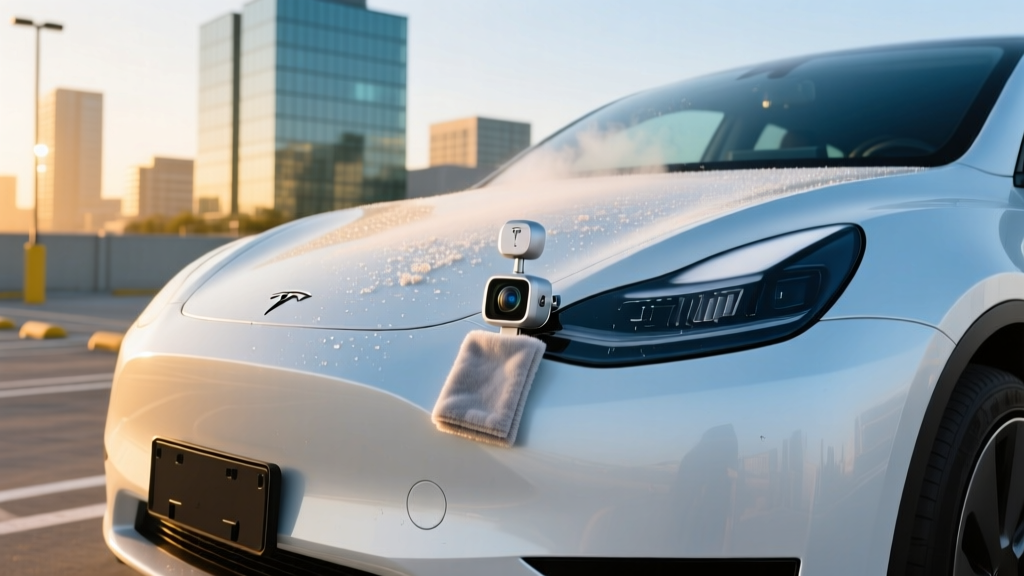
Tesla's vision-only approach to driver assistance means the cameras embedded around your Model 3, Model Y, Model S, or Model X are the single most critical sensor suite on the vehicle. Unlike competitors that supplement cameras with radar or lidar, Tesla relies entirely on eight exterior cameras to power Autopilot, Enhanced Autopilot, and Full Self-Driving (Supervised). When those lenses get dirty, degraded, or obstructed, the system's performance drops — sometimes silently. That reality has spawned an aftermarket niche: the Tesla camera cleaner. But do you actually need a dedicated product, and what does proper camera maintenance look like for a 2026 Tesla owner?
This guide examines the real-world problem of camera obstruction across the current Tesla fleet, evaluates whether aftermarket camera-cleaning kits and hydrophobic coatings deliver measurable value, and walks through the exact specs, range, and charging capabilities of the 2026 Tesla lineup so you understand what's at stake when the vision system degrades.
Why Tesla Camera Cleanliness Matters More Than You Think
Every current-production Tesla — the Model 3 Highland, Model Y Juniper, refreshed Model S, and Model X — uses the same fundamental sensor philosophy: eight cameras providing a 360-degree view, processed by the Hardware 4 (HW4) computer. There is no radar backup on new vehicles (Tesla removed ultrasonic sensors starting with late-2022 production and radar before that). The cameras handle everything from adaptive cruise control and lane-keeping to the FSD (Supervised) city-street navigation that remains an SAE Level 2 driver-assist system.
The most contamination-prone camera locations on a Tesla include:
- Front fender repeaters — directly in the wheel-spray zone, accumulating road film, salt, and brake dust rapidly
- Front pillar (B-pillar) cameras — subject to water streaking and bug accumulation at highway speeds
- Rear-view camera (above license plate) — collects road spray, especially in rain and winter conditions
- Front main camera (behind windshield) — protected from direct contamination but affected by interior fogging and exterior windshield grime
When these cameras degrade, you'll see dashboard warnings like "Camera visibility reduced" or "Autopilot temporarily unavailable." But subtler degradation — slight film buildup that doesn't trigger a warning — can reduce object-detection confidence and increase phantom braking events.
Aftermarket Tesla Camera Cleaner Products: What's Available
The "Tesla camera cleaner" market in 2026 breaks into three product categories:
1. Hydrophobic Nano-Coatings for Camera Lenses
Products like Rain-X Plastic Water Repellent, CarPro DLX, and Tesla-specific nano-coating kits (sold on Amazon and through Tesla accessory vendors for $15–$35) apply a hydrophobic layer to exterior camera housings. The idea: water beads and rolls off, reducing streaking and film buildup.
Real-world verdict: These coatings work well on the front main camera area (applied to the windshield in front of the camera cluster) and on rear-camera housings. They are less effective on fender repeaters, where high-velocity road spray and physical abrasion wear coatings off within 2–4 weeks. Reapplication is frequent.
2. Camera Lens Cleaning Kits
Microfiber-based kits with isopropyl-alcohol wipes or lens-specific cleaning solutions ($8–$20) are the simplest approach. Brands like iKlear, Zeiss lens wipes, and generic EV camera kits provide streak-free cleaning without damaging the camera housing's anti-glare coating.
Real-world verdict: This is what most Tesla owners actually need. A quick wipe of the fender repeaters and rear camera during every fuel... er, charging stop keeps visibility optimal. Keep a pack of Zeiss wipes in the center console.
3. Aftermarket Camera Washer Systems
A few vendors have prototyped pump-and-nozzle systems that spray washer fluid onto exterior cameras, similar to how Volvo and Mercedes-Benz clean their rear-view cameras. As of 2026, no production Tesla includes built-in camera washers, and aftermarket kits ($80–$200 plus installation) remain niche, requiring drilling and fluid-line routing.
Real-world verdict: Overkill for most owners. Unless you regularly drive in heavy mud, salt spray, or construction zones, manual cleaning with wipes is sufficient and far simpler.
2026 Tesla Fleet: Range, Charging, and Specs at a Glance
Understanding what you're protecting when you maintain your Tesla's cameras means understanding the vehicles themselves. Here are the current 2026 production specs across the lineup:
| Spec | Model 3 Long Range AWD | Model Y Long Range AWD | Model S Long Range | Model X Long Range |
|---|---|---|---|---|
| EPA Range | 363 mi | 320 mi | 402 mi | 335 mi |
| Battery (usable) | ~79 kWh (NMC) | ~79 kWh (NMC) | ~100 kWh (NMC) | ~100 kWh (NMC) |
| Max DC Fast Charge | 250 kW | 250 kW | 250 kW | 250 kW |
| 10–80% DCFC Time | ~25 min | ~27 min | ~30 min | ~32 min |
| Level 2 Home Charge | 11.5 kW (~44 mi/hr) | 11.5 kW (~44 mi/hr) | 11.5 kW (~44 mi/hr) | 11.5 kW (~44 mi/hr) |
| 0–60 mph | 4.2 sec | 4.8 sec | 3.1 sec | 3.8 sec |
| Horsepower | ~346 hp | ~384 hp | ~670 hp | ~670 hp |
| Drivetrain | Dual-Motor AWD | Dual-Motor AWD | Dual-Motor AWD | Dual-Motor AWD |
| Efficiency (MPGe) | 132 MPGe combined | 122 MPGe combined | 120 MPGe combined | 109 MPGe combined |
| Base MSRP | $47,740 | $48,990 | $79,990 | $84,990 |
| Cargo Volume | 23 cu ft (rear) + frunk | 30 cu ft (rear) + frunk | 28 cu ft (rear) + frunk | 88 cu ft (max, seats folded) |
| Battery Warranty | 8 yr / 120,000 mi | 8 yr / 120,000 mi | 8 yr / 150,000 mi | 8 yr / 150,000 mi |
Source: fueleconomy.gov and Tesla.com. Specs reflect 2026 model-year production. RWD trims with LFP batteries are available on Model 3 at lower MSRP but with reduced range.
Camera Contamination by Climate: Where a Tesla Camera Cleaner Earns Its Keep
Not every Tesla owner faces the same camera-maintenance burden. Your environment dictates how aggressively you need to manage lens cleanliness:
| Climate / Use Case | Camera Contamination Risk | Recommended Maintenance |
|---|---|---|
| Snow-belt states (road salt, slush) | HIGH — salt film builds on all cameras within a single drive | Wipe cameras every trip; apply hydrophobic coating monthly; consider front camera PPF |
| Rain-heavy regions (Pacific NW, Southeast) | MODERATE — water streaking on side cameras | Hydrophobic coating on B-pillar and fender cameras; reapply every 4–6 weeks |
| Dusty / desert (Arizona, SoCal inland) | MODERATE — fine dust film reduces contrast | Weekly wipe-down with microfiber; lens wipes at every Supercharger stop |
| Bug-heavy (Midwest summer, rural routes) | MODERATE-HIGH — bug splatter on front cameras | Bug-remover solution + microfiber; windshield camera area kept clean |
| Mild urban (garage-parked, fair weather) | LOW — occasional grime | Monthly wipe-down is sufficient |
Tesla's Own Camera Maintenance Guidance
Tesla's official owner's manuals recommend cleaning cameras with a soft, lint-free cloth and avoiding abrasive materials or high-pressure washers directed at camera housings. The company does not sell a branded camera-cleaning kit, though Tesla Service Centers will clean cameras during routine service visits.
Notably, Tesla's software includes a camera-calibration routine that can be triggered from the service menu. If you've cleaned your cameras and Autopilot still behaves oddly — excessive phantom braking, lane-centering drift — running a recalibration (which requires driving 20–40 miles on well-marked roads) can reset the vision system's baseline.
For the windshield-mounted front camera cluster, keeping the exterior windshield clean and ensuring the interior glass surface (behind the camera housing) is free of film and fog residue is essential. Many Tesla owners overlook the interior surface, which can develop a hazy film from off-gassing of interior plastics — especially in hot climates.
Federal Tax Credit and Pricing: What You'll Actually Pay
Tax credit eligibility for new Teslas in 2026 depends on the IRS §30D Clean Vehicle Credit rules, which include income caps, MSRP caps, and battery-component/critical-mineral sourcing requirements that have tightened significantly since the Inflation Reduction Act took effect.
| Model / Trim | Base MSRP | MSRP Cap | Max Credit | Effective Price* |
|---|---|---|---|---|
| Model 3 RWD (LFP) | $38,990 | $55,000 (sedan) | Up to $7,500 | ~$31,490 |
| Model 3 Long Range AWD | $47,740 | $55,000 (sedan) | Up to $7,500 | ~$40,240 |
| Model Y Long Range AWD | $48,990 | $80,000 (SUV) | Up to $7,500 | ~$41,490 |
| Model S Long Range | $79,990 | $55,000 (sedan) | $0 (exceeds cap) | $79,990 |
| Model X Long Range | $84,990 | $80,000 (SUV) | $0 (exceeds cap) | $84,990 |
*Effective price assumes full $7,500 credit eligibility. Buyer income caps apply: $150,000 single / $225,000 head of household / $300,000 joint (MAGI). Battery sourcing and critical-mineral requirements may reduce the credit to $3,750 or $0 depending on the specific vehicle's supply chain. Point-of-sale transfer is available at participating dealers. Always verify current eligibility on IRS.gov and consult a tax professional.
Pros, Cons, and the Bottom Line on Tesla Camera Maintenance
✅ Pros: Tesla Vision System + Camera Care
- Vision-only system eliminates radar/lidar hardware failure points
- HW4 computer provides high-resolution camera processing with redundancy
- Camera cleaning is cheap — $10–$35 in supplies covers months of maintenance
- Hydrophobic coatings measurably reduce rain streaking on side cameras
- OTA updates continuously improve vision-model performance without hardware changes
- Supercharger network reliability means fewer stranded-in-rain cleaning scenarios
❌ Cons: Camera Maintenance Realities
- No built-in camera washer system — unlike some Volvo/Mercedes competitors
- Fender repeaters get dirty fast and are awkward to reach
- System may not always warn you when camera degradation is subtle
- Hydrophobic coatings wear off in 2–4 weeks on high-spray areas
- Aftermarket washer kits require permanent modification and are unreliable
- Winter road salt can trigger "camera blocked" warnings within minutes of driving
- Vision-only approach means zero sensor redundancy if cameras are fully obscured
Who Should Worry About Tesla Camera Cleaning?
Daily commuters in snow-belt states — If you drive a Tesla in Michigan, Minnesota, Massachusetts, or anywhere road salt is standard, camera cleaning is a near-daily task in winter. Budget 30 seconds at each stop. Keep lens wipes in the car. Apply a hydrophobic coating monthly.
FSD (Supervised) subscribers — If you're paying $99/month or $8,000 for FSD, you're relying on the vision system more heavily than a basic Autopilot user. Camera clarity directly affects the system's confidence in complex urban environments. You should be the most diligent about maintenance.
Road-trippers and high-mileage drivers — Bug accumulation on long summer drives and road grime from multi-state trips can degrade cameras mid-journey. A quick wipe at every Supercharger stop (which you're doing anyway while charging for 20–30 minutes) keeps the system performing.
Garage-parked, fair-weather drivers — If your Tesla lives in a garage and you drive mostly in dry, mild conditions, camera maintenance is a once-a-month wipe-down. A dedicated camera cleaner product is unnecessary for you.
Frequently Asked Questions
Does Tesla sell an official camera cleaner?
No. Tesla does not offer a branded camera-cleaning kit. The company recommends using a soft lint-free cloth and avoiding harsh chemicals or high-pressure water on camera housings. Third-party products from brands like Zeiss, Rain-X (plastic formula), and various EV accessory vendors fill this gap.
Can I use Windex or glass cleaner on Tesla cameras?
Avoid ammonia-based glass cleaners like standard Windex on camera lenses. The exterior camera housings have optical coatings that can be degraded by harsh solvents. Use isopropyl alcohol wipes (70% or less) or lens-specific cleaning solutions designed for optics.
Will Autopilot disable itself if cameras are dirty?
Tesla's system will display a "Camera visibility reduced" or "Autopilot temporarily unavailable" warning when it detects significant obstruction. However, gradual film buildup may not trigger a warning while still reducing detection performance. Manual inspection and cleaning is the safest approach.
How often should I clean my Tesla's cameras?
It depends on your environment. In winter road-salt conditions, clean cameras every drive. In rainy climates, every few days. In mild, dry conditions, a weekly or biweekly wipe-down is sufficient. Check fender repeaters most frequently — they accumulate grime fastest.
Do hydrophobic coatings damage Tesla camera lenses?
When applied correctly using products designed for plastics and optics (not standard windshield Rain-X, which is formulated for glass), hydrophobic coatings do not damage camera housings. Use products labeled safe for polycarbonate or acrylic plastics. Reapply as the coating wears — typically every 2–6 weeks depending on conditions.
Is the Tesla camera-cleaning problem solved on newer models?
As of the 2026 model year, no Tesla includes built-in camera washers or self-cleaning camera systems. The Juniper Model Y refresh and Highland Model 3 redesign did not add this feature. It remains a manual maintenance task across the entire fleet.