The phrase Tesla California HQ conjures images of Palo Alto boardrooms and Gigafactory robots, but for EV buyers, it really means one thing: the Fremont factory where the Model Y is still engineered, refined, and shipped to driveways across North America. As of the 2026 model year, the Model Y Long Range AWD remains Tesla's best-selling vehicle and the benchmark compact electric SUV against which every rival is measured. This review dissects the numbers that matter—range, charging curve, battery chemistry, cabin space, and post-incentive price—so you can decide whether Fremont's flagship crossover still earns its spot in your garage.
Quick Verdict: Still the Default EV SUV in 2026
The 2026 Tesla Model Y Long Range AWD delivers 320 miles of EPA range, a usable 75 kWh battery (NMC chemistry), 250 kW peak DC fast charging, and a 4.8-second 0-60 mph sprint—starting at $46,630 before incentives. It is not the most luxurious, quietest, or softest-riding SUV in its class, but no competitor matches its combination of Supercharger network access, over-the-air updates, and cargo versatility. If you can install a Level 2 home charger and your commute fits inside 300 real-world miles, the Model Y remains the path-of-least-resistance EV purchase.
Range, Efficiency, and the Real-World Reality Check
Real-World Expectation: 270–290 miles on mixed highway driving at 70 mph; 220–240 miles in sub-30°F winter conditions with cabin heat; up to 310 miles in mild city/suburban duty with regen braking.
The EPA sticker is a useful starting point, but the Model Y's real efficiency story lives in its kWh per 100 miles figure: 28 kWh/100 mi combined, which translates to 122 MPGe per fueleconomy.gov. That is among the most efficient all-wheel-drive EVs in its segment, thanks to Tesla's heat pump (standard since 2021) and tightly managed thermal system.
Highway drivers should budget roughly 10–12% range loss at sustained 75–80 mph speeds compared to the EPA number. Cold-weather range loss is more dramatic: LFP batteries in the RWD trim lose up to 30% in deep freezes, while the NMC pack in the Long Range AWD typically sheds 18–22% when preconditioning is skipped. Always precondition the battery via the Tesla app before winter driving—it warms the pack and recovers up to 8% of lost range.
| Attribute | Long Range AWD | Performance | RWD (Standard) |
|---|---|---|---|
| EPA Range | 320 mi | 295 mi | 260 mi |
| Battery (usable) | 75 kWh NMC | 75 kWh NMC | 60 kWh LFP |
| Peak DC Charge | 250 kW | 250 kW | 170 kW |
| 10–80% DC Time | ~25 min | ~25 min | ~32 min |
| 0–60 mph | 4.8 sec | 3.5 sec | 6.6 sec |
| Horsepower | 384 hp | 456 hp | 295 hp |
| Drivetrain | Dual-Motor AWD | Dual-Motor AWD | RWD |
| Base MSRP | $46,630 | $52,130 | $38,630 |
Charging: Supercharger Dominance and Home Setup
Tesla's 250 kW V3 Supercharger architecture remains a segment advantage, even as rivals adopt NACS connectors. The Model Y Long Range AWD peaks at 250 kW and sustains roughly 180–200 kW through the 20–60% state-of-charge window before tapering to ~80 kW above 80%. A 10–80% session takes approximately 25 minutes under optimal battery-preconditioned conditions. Unplugging at 80% is strongly recommended; charging from 80–100% can add another 20 minutes due to the taper curve.
| Level | Power | Miles Added per Hour | Typical Use Case |
|---|---|---|---|
| Level 1 (120V) | 1.4 kW | ~4 mi/hr | Emergency / overnight trickle |
| Level 2 (240V, 48A) | 11.5 kW | ~38 mi/hr | Home Wall Connector overnight |
| Level 2 (240V, 32A) | 7.7 kW | ~26 mi/hr | Portable / destination charging |
| DC Fast (V3 Supercharger) | 250 kW peak | ~200 mi in 15 min | Road-trip stops |
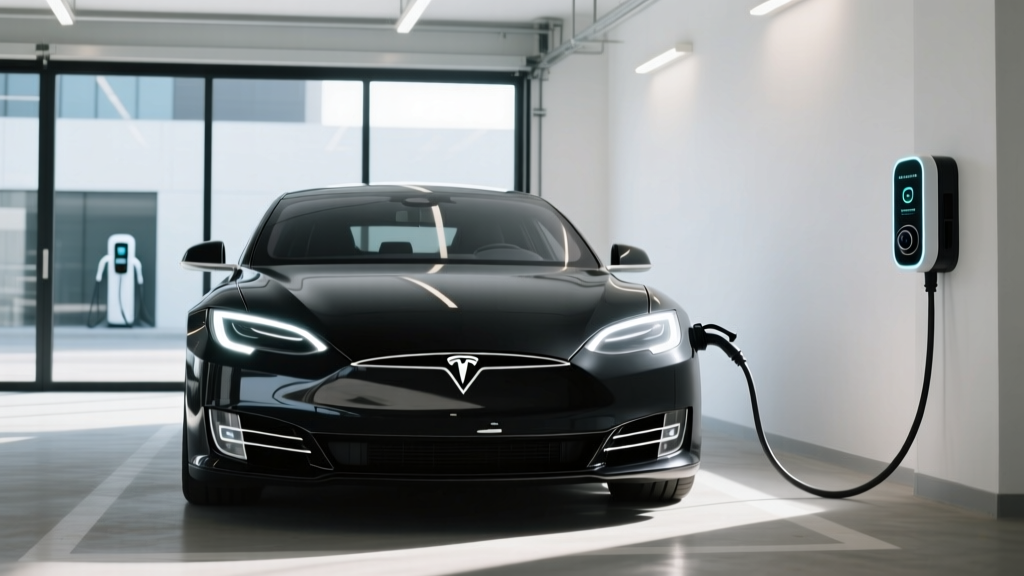
At home, the Tesla Wall Connector on a 60-amp circuit delivers 48 amps (11.5 kW), adding roughly 38 miles of range per hour of charging. A full overnight session (8 hours) replenishes ~300 miles—enough for any daily commute. Expect a licensed electrician to charge $800–$1,800 for a standard Wall Connector installation on an existing 200-amp panel; older homes may require a $2,000–$4,000 panel upgrade.
Performance, Drivetrain, and Ride Character
The dual-motor AWD powertrain in the Long Range trim pairs a front induction motor with a rear permanent-magnet synchronous motor for 384 combined horsepower. The 4.8-second 0–60 mph time is brisk but not exotic; the Performance trim's 3.5-second sprint crosses into sports-sedan territory. Regenerative braking is aggressive and effectively enables one-pedal driving in most conditions, though Tesla removed the user-adjustable regen setting in recent model years—a notable drawback for drivers who prefer coasting.
Ride quality has improved incrementally with the 2025 "Juniper" refresh, which introduced revised damper tuning and acoustic glass. However, the Model Y still transmits more road texture than a Hyundai Ioniq 5 or Ford Mustang Mach-E on rough pavement. Cabin noise at 70 mph measures around 66 dB—acceptable, but not luxury-quiet.
Interior Space, Cargo, and Daily Practicality
The Model Y's hatchback form factor is its secret weapon for families and road-trippers:
- Cargo behind 2nd row: 34.3 cu ft (26.6 cu ft with raised floor)
- Cargo with 2nd row folded: 72.1 cu ft
- Front trunk (frunk): 4.1 cu ft—ideal for charging cables or a small bag
- Rear legroom: 41.6 inches—competitive with midsize SUVs
- Optional 3rd row: Available but tight; best for children under 10
The minimalist interior centers on a single 15.4-inch touchscreen that controls virtually every function, including glovebox release and mirror adjustment. There are no physical buttons for climate or volume—a dealbreaker for some, a non-issue for others. The panoramic glass roof floods the cabin with light but offers no shade; aftermarket tint film is a common owner upgrade in hot climates.
Pricing, Trims, and Federal Tax Credit Eligibility
| Trim | Base MSRP | Est. §30D Credit | Effective Price* |
|---|---|---|---|
| RWD (Standard) | $38,630 | Up to $7,500 | ~$31,130 |
| Long Range AWD | $46,630 | Up to $7,500 | ~$39,130 |
| Performance | $52,130 | Up to $7,500 | ~$44,630 |
*Effective price assumes full §30D credit eligibility. Actual credit depends on battery-sourcing and critical-mineral requirements, buyer income caps ($150k single / $300k joint), and MSRP caps ($80,000 for SUVs). The credit can now be transferred to the dealer at point of sale, reducing your out-of-pocket cost at purchase. Verify current-year eligibility at IRS.gov and confirm sourcing compliance with your Tesla advisor before signing.
All 2026 Model Y trims fall well under the $80,000 SUV MSRP cap, so price is not the limiting factor—income thresholds and battery-mineral sourcing rules are. Tesla has progressively shifted supply chains to meet critical-mineral requirements, but the exact credit amount ($3,750 or $7,500) can change mid-year as sourcing agreements evolve.
Warranty, Battery Longevity, and Ownership Costs
Tesla covers the Model Y with:
- Basic vehicle warranty: 4 years / 50,000 miles
- Battery & drive unit: 8 years / 120,000 miles (Long Range/Performance); 8 years / 100,000 miles (RWD)
- Capacity retention threshold: 70% minimum over the warranty period
Real-world degradation data from Tesla's own fleet reports show NMC packs retaining roughly 88–90% capacity at 100,000 miles. LFP packs in the RWD trim degrade more slowly and tolerate daily 100% charging without accelerated wear—a genuine advantage for high-mileage commuters. A full battery replacement outside warranty currently runs $12,000–$16,000 at Tesla service centers, though most owners will never need one within typical ownership cycles.
Insurance premiums are a real cost factor: expect $1,800–$2,600 annually for the Long Range AWD depending on state, driving record, and coverage level—roughly 20–30% higher than a comparably priced gas SUV. Tesla Insurance is available in select states and can undercut traditional carriers for clean-record drivers.
Autopilot, FSD, and Smart Driving Features
Standard Autopilot includes Traffic-Aware Cruise Control and Autosteer (lane-centering on marked highways). The $8,000 FSD (Supervised) upgrade adds automatic lane changes, traffic-light and stop-sign recognition, and Navigate on Autopilot. As of early 2026, FSD remains a supervised driver-assist system—impressive in capability, but legally and practically the driver's responsibility. For a true Level 4 driverless experience, only Waymo's robotaxi service (available in select metros) qualifies.
Pros, Cons, and Who Should Buy
- Best-in-class Supercharger network (20,000+ stalls in North America)
- Industry-leading efficiency (28 kWh/100 mi)
- Class-leading cargo volume for a compact SUV
- Strong over-the-air update cadence adds features post-purchase
- Point-of-sale tax-credit transfer lowers upfront cost
- Ride quality still firm on rough surfaces post-Juniper
- No physical buttons—everything funnels through touchscreen
- FSD costs $8,000 and remains Level 2 supervised
- Insurance premiums 20–30% above segment average
- No adjustable regen setting
Look at competitors (Ioniq 5, Mach-E, EV6) if: You prioritize ride comfort, want physical climate controls, need 800V ultra-fast charging for frequent road trips, or prefer a more traditional dealership service experience.
Frequently Asked Questions
What is the real-world range of the 2026 Model Y Long Range AWD?
Expect 270–290 miles in mixed highway driving and up to 310 miles in mild city conditions. In sub-30°F winter weather without preconditioning, plan for 220–240 miles.
How fast does the Model Y charge at home and on the road?
On a Tesla Wall Connector (11.5 kW Level 2), you gain ~38 miles per hour, fully replenishing overnight. At a V3 Supercharger, peak 250 kW delivers a 10–80% charge in approximately 25 minutes.
Does the 2026 Model Y qualify for the $7,500 federal EV tax credit?
It can, but eligibility depends on your income (≤$300k joint / ≤$150k single), the vehicle's MSRP (under $80k cap—met), and battery critical-mineral sourcing compliance, which Tesla updates throughout the year. Confirm at IRS.gov and with your Tesla advisor at purchase.
Is the Model Y still worth buying over the Hyundai Ioniq 5 or Ford Mustang Mach-E?
If Supercharger access and cargo space are your priorities, yes. If you prefer a softer ride, 800V ultra-fast charging (Ioniq 5), or physical controls, the competitors are compelling alternatives at similar price points.
How long will the Model Y battery last?
Tesla warranties the NMC battery for 8 years/120,000 miles at 70% minimum capacity. Real-world fleet data shows ~88–90% retention at 100,000 miles. Most owners will not require a replacement within normal ownership cycles.
Is Tesla's Full Self-Driving actually self-driving?
No. FSD (Supervised) is an SAE Level 2 driver-assist system. You must remain fully engaged—hands on wheel, eyes on road—at all times. It is not autonomous driving.