The Tesla Business Model: Why Model Y Pricing Works Differently
Most automakers sell cars through franchised dealers, mark them up over MSRP, and rely on service departments for long-term revenue. Tesla's business model inverts nearly every one of those assumptions. The company sells direct-to-consumer, adjusts pricing algorithmically based on demand, and profits from software subscriptions (FSD, Premium Connectivity), Supercharger network access, and data-driven fleet insurance rather than dealer service bays.
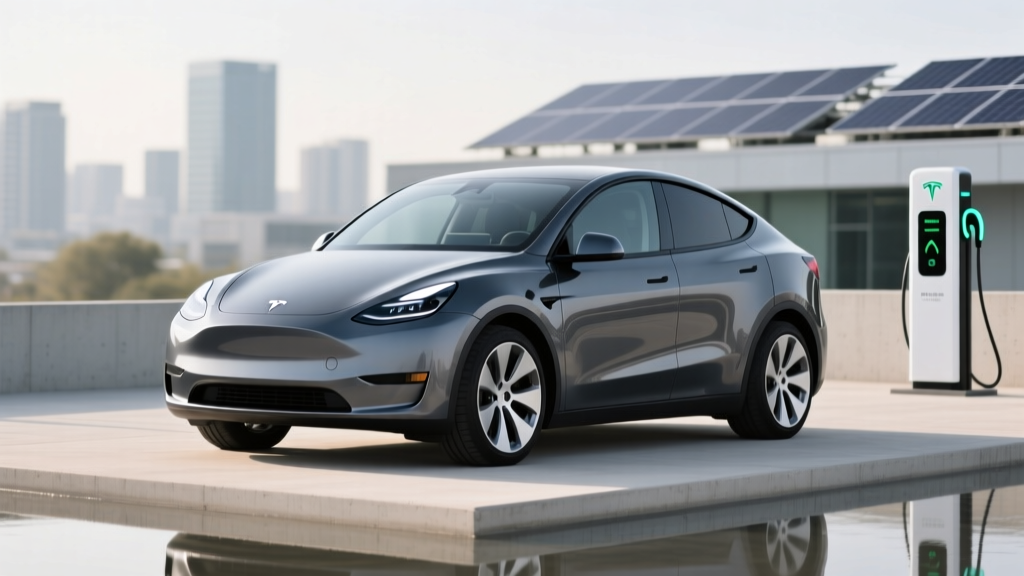
For buyers, this means the 2026 Tesla Model Y isn't just a vehicle purchase — it's an entry into a vertically integrated ecosystem. Understanding that ecosystem is essential to evaluating whether the Model Y makes financial sense compared to dealer-sold competitors like the Hyundai Ioniq 5, Ford Mustang Mach-E, or Kia EV6.
| Spec | Long Range RWD | Long Range AWD | Performance |
|---|---|---|---|
| EPA Range | 320 mi | 308 mi | 277 mi |
| Battery (usable) | ~75 kWh (NMC) | ~75 kWh (NMC) | ~75 kWh (NMC) |
| MPGe (combined) | 122 MPGe | 117 MPGe | 111 MPGe |
| Efficiency | 28 kWh/100 mi | 29 kWh/100 mi | 30 kWh/100 mi |
| 0–60 mph | 5.8 sec | 4.8 sec | 3.5 sec |
| Horsepower | 346 hp | 384 hp | 456 hp |
| Drivetrain | RWD (single motor) | AWD (dual motor) | AWD (dual motor) |
| Peak DC Charge | 250 kW | 250 kW | 250 kW |
| 10–80% DC Time | ~25 min | ~25 min | ~25 min |
| Level 2 Rate | 11.5 kW (44 mi/hr) | 11.5 kW (44 mi/hr) | 11.5 kW (44 mi/hr) |
| Base MSRP | $44,990 | $47,990 | $52,490 |
| Battery Warranty | 8 yr / 120,000 mi | 8 yr / 120,000 mi | 8 yr / 120,000 mi |
Range, Efficiency, and the Real-World Reality Check
The EPA posts the 2026 Model Y Long Range RWD at 320 miles. That number is achieved under mixed city/highway driving at moderate temperatures — a best-case composite, not a guarantee. Here's what you should actually plan for:
EPA Sticker: 320 miles (Long Range RWD)
Real-World Highway (70 mph, 65°F): ~265–280 miles
Cold Weather (30°F, highway): ~220–240 miles (30–35% reduction due to cabin heating and increased battery internal resistance)
City/Stop-and-Go: ~300–310 miles (regen braking recovers energy that highway driving wastes)
Tesla's NMC (nickel manganese cobalt) chemistry offers higher energy density than LFP, giving the Model Y its range advantage within a compact pack. However, NMC cells degrade slightly faster under sustained 100% state-of-charge storage. Tesla recommends daily charging to 80–90% and reserving 100% for trips — a habit that preserves long-term State of Health (SoH).
Efficiency is where Tesla's business model shows engineering payoff. The Model Y's heat pump, integrated into the Octovalve thermal management system, scavenges waste heat from the motors and battery to warm the cabin — reducing winter range loss by roughly 10–15% compared to resistive-heater EVs. At 28 kWh per 100 miles, the Long Range RWD is one of the most efficient electric crossovers on the market, per fueleconomy.gov.
Charging Speed: Supercharger Network as a Competitive Moat
The Tesla business model treats the Supercharger network not as a cost center but as a profit-generating asset — and a reason buyers stay within the Tesla ecosystem. With over 6,500 Supercharger stations across North America (as of early 2026), Tesla's proprietary network remains the most reliable DC fast-charging infrastructure available, with uptime exceeding 99%.
| Level | Power | Speed | Notes |
|---|---|---|---|
| Level 1 (120V) | 1.4 kW | ~5 mi/hr | Emergency/trickle only |
| Level 2 (240V, 48A) | 11.5 kW | 44 mi/hr | Full charge in ~7 hours |
| DC Fast (V3 Supercharger) | 250 kW peak | ~170 mi in 15 min | 10–80% in ~25 min; tapers above 80% |
| DC Fast (V4 Supercharger) | Up to 350 kW* | Model Y capped at 250 kW | Future OTA may unlock higher rate |
*V4 Supercharger cabinets can deliver 350 kW to compatible vehicles (Cybertruck), but the 2026 Model Y's onboard architecture caps intake at 250 kW.
The charge curve matters more than peak kW. The Model Y sustains roughly 200–250 kW from 10–45% SoC, then tapers progressively: ~150 kW at 60%, ~90 kW at 80%, and below 40 kW above 90%. This is why the 10–80% time is ~25 minutes, but 10–100% takes closer to 45 minutes. Preconditioning the battery (automatic when navigating to a Supercharger) is essential to hitting peak rate in cold weather.
Non-Tesla networks (Electrify America, EVgo) work with the Model Y via the included NACS-to-CCS adapter or Tesla's CCS adapter (sold separately for older models). However, peak speeds on third-party chargers may be limited by station output and adapter overhead.
Pricing, Tax Credits, and Tesla's Direct-Sale Advantage
Because Tesla sells directly — no dealer markups, no negotiated haggling — the listed price is the price you pay. This is a core pillar of the Tesla business model and a significant differentiator in a market where EV markups of $3,000–$8,000 above MSRP were common as recently as 2023.
| Trim | MSRP | §30D Credit | Effective Price |
|---|---|---|---|
| Long Range RWD | $44,990 | Up to $7,500 | ~$37,490 |
| Long Range AWD | $47,990 | Up to $7,500 | ~$40,490 |
| Performance | $52,490 | Up to $7,500 | ~$44,990 |
Eligibility caveats (IRS §30D, 2026 rules):
- MSRP cap: SUVs/crossovers must be under $80,000 — all Model Y trims qualify.
- Income cap: Modified AGI ≤ $150,000 (single), $225,000 (head of household), $300,000 (joint).
- Battery sourcing: Critical minerals and battery components must meet phased-in domestic/free-trade sourcing thresholds. Tesla's North American supply chain has historically met these requirements, but verify current-year compliance on irs.gov before purchase.
- Point-of-sale transfer: You can transfer the credit to Tesla at purchase, reducing your out-of-pocket cost immediately rather than waiting for tax filing.
Tesla's frequent price adjustments — sometimes weekly — mean the effective cost can shift without notice. Monitoring Tesla's configurator page and third-party trackers is advisable if timing matters.
Interior, Cargo, and Daily Livability
The 2026 Model Y "Juniper" refresh brought meaningful interior improvements: ventilated front seats, ambient lighting, a rear-seat touchscreen, power-folding second row, and improved sound insulation. The minimalist cabin remains polarizing — no physical buttons, no instrument cluster, all controls routed through the 15.4-inch center display — but build quality has measurably improved over pre-2025 models.
Dimensions:
- Cargo (behind 2nd row): 30.2 cu ft
- Cargo (2nd row folded): 72.1 cu ft
- Front trunk (frunk): 4.1 cu ft
- Rear legroom: 40.5 inches
- Front headroom: 41.0 inches
The flat floor and absence of a transmission tunnel give the Model Y a spacious feel relative to its exterior footprint. The frunk is useful for charging cables or a small bag, though smaller than the Ford Mach-E's 4.7 cu ft front trunk.
Infotainment runs Tesla's proprietary Linux-based OS with built-in navigation, streaming (Netflix, YouTube, Spotify while parked), and a built-in dashcam/sentry mode that records surroundings using the vehicle's external cameras — a feature no competitor matches without aftermarket hardware.
Autopilot, FSD, and the Software Revenue Layer
Tesla's driver-assistance suite is central to its business model because it generates recurring software revenue — a margin stream traditional automakers cannot easily replicate.
SAE Automation Level: Level 2 (partial automation). The driver must remain fully attentive, hands on or near the wheel, at all times. Neither Autopilot nor FSD (Supervised) is "self-driving." Only Level 4 robotaxi services (Waymo, Zoox) operate without a human driver in geofenced areas.
What's included (standard): Autopilot — adaptive cruise control, lane centering, automatic emergency braking, blind-spot monitoring, lane departure warning.
Optional: FSD (Supervised) — $8,000 one-time or $99/month: Adds automatic lane changes, Navigate on Autopilot (highway on/off-ramp routing), Autopark, Summon, traffic light/stop sign recognition, and city-street steering assistance. As of 2026, FSD remains a supervised system requiring continuous driver oversight. Tesla's safety data, published quarterly, shows FSD-equipped vehicles in supervised mode averaging fewer crashes per million miles than the US fleet average — but this data is self-reported and not independently audited by NHTSA.
Whether FSD is "worth it" depends on your commute profile. For a daily 40-mile highway commute with congestion, the lane-centering and auto-lane-change features reduce fatigue meaningfully. For occasional drivers, the $99/month subscription is more rational than the $8,000 purchase.
Warranty and Long-Term Battery Outlook
Tesla's battery and drive unit warranty covers 8 years or 120,000 miles (whichever comes first) with a minimum 70% capacity retention threshold. The basic vehicle limited warranty is 4 years / 50,000 miles — shorter than Hyundai's 5/60 or Kia's 5/60 bumper-to-bumper coverage.
Real-world degradation data from fleet analytics (Tessie, Recurrent Auto) shows the Model Y's NMC pack losing approximately 8–12% capacity over the first 100,000 miles, with the steepest drop occurring in the first 15,000 miles before stabilizing. This is consistent with NMC chemistry behavior across the industry.
Battery replacement cost out of warranty: $12,000–$16,000 (estimated, based on 2025 service data). Drive unit replacements run $5,000–$8,000. These figures are comparable to the Hyundai Ioniq 5 and lower than the Ford Mach-E GT's estimated pack replacement cost.
Pros, Cons, and the Verdict
Pros
- Best-in-class Supercharger network reliability and coverage
- Direct-sale model eliminates dealer markups
- Class-leading efficiency (28 kWh/100 mi)
- Strong software ecosystem (OTA updates, Sentry Mode, app integration)
- Competitive cargo space and practical crossover layout
- Heat pump standard — superior cold-weather efficiency
Cons
- Minimalist interior not for everyone; no physical controls
- Shorter basic warranty than Korean competitors
- FSD remains Level 2 despite premium pricing
- Service center wait times can be 2–4 weeks in some metro areas
- No Apple CarPlay / Android Auto integration
- Ride quality firm on larger wheel options (20"/21")
Who Should Buy the 2026 Model Y?
Choose the Model Y if: You value charging-network reliability above all else, want a direct-purchase experience with no dealer negotiation, drive 15,000+ miles/year (where efficiency savings compound), and are comfortable with touchscreen-only vehicle controls.
Look elsewhere if: You need physical buttons and a traditional instrument cluster (Hyundai Ioniq 5), want the longest basic warranty (Kia EV6 at 5yr/60k mi), prefer Apple CarPlay (nearly every competitor), or live in an area with sparse Tesla Service coverage.
Frequently Asked Questions
What is the real-world range of the 2026 Model Y?
EPA-estimated 320 miles for the Long Range RWD. Expect 265–280 miles on sustained highway driving and 220–240 miles in freezing temperatures. City driving with regenerative braking can approach 300+ miles.
How fast does the Model Y charge?
Peak 250 kW on V3/V4 Superchargers, achieving 10–80% in approximately 25 minutes. Home Level 2 charging at 11.5 kW adds roughly 44 miles per hour, fully replenishing the battery in about 7 hours.
How much does the Model Y cost after tax credits?
The Long Range RWD starts at $44,990. If you qualify for the full $7,500 federal §30D credit (income and sourcing requirements met), the effective price drops to approximately $37,490. Point-of-sale transfer is available.
Is the Model Y worth buying vs. the Hyundai Ioniq 5 or Kia EV6?
It depends on priorities. The Model Y wins on charging network access, efficiency, and software. The Ioniq 5 and EV6 win on interior design, physical controls, CarPlay support, and basic warranty length. All three are strong choices; none is objectively "best" for every buyer.
Does the 2026 Model Y qualify for the federal EV tax credit?
All trims fall under the $80,000 SUV MSRP cap. Eligibility depends on your income (≤$150k single / $300k joint) and current-year battery sourcing compliance. Verify on irs.gov before purchasing.
Is Tesla's FSD actually self-driving?
No. FSD (Supervised) is an SAE Level 2 driver-assist system. You must remain fully attentive and prepared to take over at any moment. It is not autonomous driving.