Quick Verdict: Tesla's Braking System Is a Range Multiplier
If you've searched "tesla braking system" wondering what makes it different from a conventional car's brakes, the short answer is integration. Tesla pairs a traditional hydraulic friction-brake setup with aggressive regenerative braking that recovers kinetic energy back into the battery. The result is a system that doesn't just stop the car — it extends EPA range by 10-30% in stop-and-go driving, slashes brake-pad wear to near-zero, and enables one-pedal driving in most conditions.
But the braking system's behavior also shapes real-world range, cold-weather efficiency, and how you'll drive day-to-day. This profile breaks down the engineering behind Tesla's braking — and applies it to the current 2026 Model 3 and Model Y lineup with the exact specs buyers need.
How Tesla's Braking System Actually Works
Tesla uses a blended braking architecture with three layers:
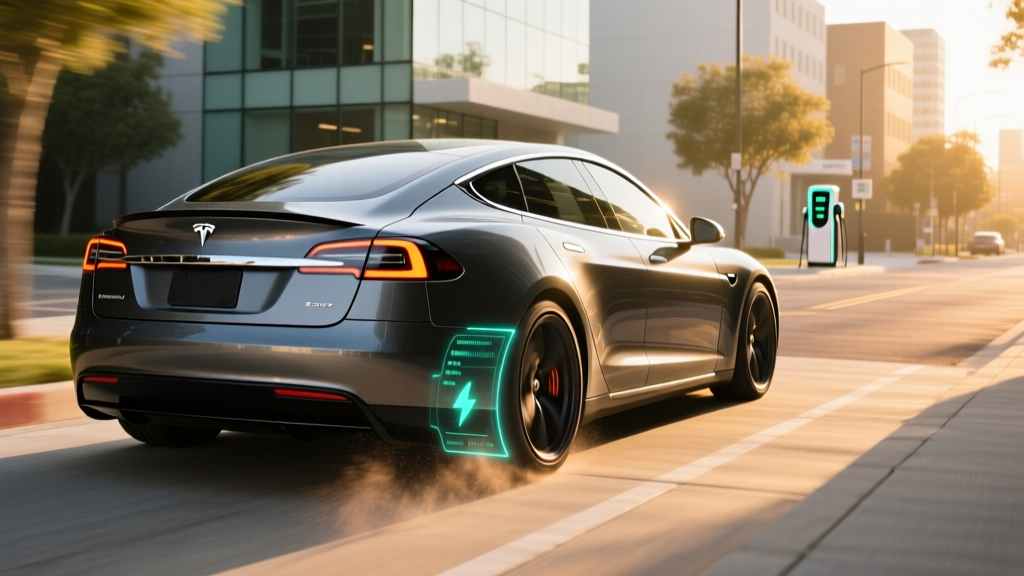
- Regenerative braking (primary): When you lift off the accelerator, the drive motor reverses into a generator, converting kinetic energy into electricity that flows back into the battery pack. Tesla's regen can decelerate the car at up to ~0.3g — enough to handle most daily stops without touching the brake pedal.
- Hydraulic friction brakes (secondary): Conventional disc brakes (vented front, solid rear on most trims) engage when you press the brake pedal, when regen is insufficient (hard stops, near 0 mph), or when the battery is full/cold and can't accept charge.
- Blended pedal logic: The brake pedal modulates regen first, then progressively adds friction braking as pedal pressure increases — a strategy shared with most modern EVs but tuned more aggressively by Tesla.
One-Pedal Driving: Still Available, But Changed
Until 2020, Tesla offered adjustable regen levels. Today, Tesla uses a fixed high-regen "Hold" mode that brings the car to a complete stop and holds it without you pressing the brake — effectively enabling one-pedal driving. The controversial 2023 NHTSA recall (affecting 2012-2023 models) added driver-monitoring alerts and the option to select regen behavior in some markets, but the default remains strong regen that rewards anticipatory driving.
2026 Tesla Lineup: Specs, Range & Efficiency
The braking system's regen recovery directly feeds into EPA range and MPGe ratings. Here's how the current 2026 lineup stacks up, with real-world caveats:
| Spec | Model 3 RWD | Model 3 Long Range AWD | Model Y Long Range AWD | Model Y Performance |
|---|---|---|---|---|
| EPA Range | 272 mi | 341 mi | 320 mi | 285 mi |
| Battery (usable) | ~60 kWh LFP | ~75 kWh NMC | ~75 kWh NMC | ~75 kWh NMC |
| Drivetrain | RWD single motor | AWD dual motor | AWD dual motor | AWD dual motor |
| Horsepower | 271 hp | 384 hp | 384 hp | 456 hp |
| 0-60 mph | 5.8 sec | 4.2 sec | 4.8 sec | 3.5 sec |
| MPGe (combined) | 132 MPGe | 131 MPGe | 122 MPGe | 111 MPGe |
| kWh/100 mi | 25 | 26 | 28 | 30 |
| Base MSRP | $38,990 | $45,740 | $46,630 | $52,130 |
| Battery Warranty | 8 yr/100k mi | 8 yr/120k mi | 8 yr/120k mi | 8 yr/120k mi |
Source: fueleconomy.gov and Tesla's 2026 spec sheets.
- City stop-and-go: Expect to match or beat EPA (regen maximizes recovery). A Model 3 LR can deliver 350+ miles in warm urban driving.
- Highway (70-80 mph): Subtract 10-15%. Aerodynamic drag dominates and regen rarely engages. Model 3 LR: ~290-305 miles.
- Cold weather (below 32°F): Subtract 20-30% due to battery resistance, cabin heating, and reduced regen acceptance. Model 3 RWD LFP: ~190-215 miles in winter city driving.
Charging Speeds: DC Fast, Level 2 & Battery Chemistry Impact
Braking regen puts energy back into the pack, but grid charging refills it. Tesla's Supercharger network remains the benchmark for DC fast charging, though speeds vary by chemistry.
| Charge Level | Power / Rate | Model 3 RWD (LFP) | Model 3 LR (NMC) | Model Y LR (NMC) |
|---|---|---|---|---|
| DC Fast (peak) | ~170-250 kW | 170 kW peak | 250 kW peak | 250 kW peak |
| 10-80% time | — | ~28 min | ~25 min | ~27 min |
| Level 2 (240V, 48A) | 11.5 kW | ~44 mi/hr | ~44 mi/hr | ~44 mi/hr |
| Level 1 (120V) | ~1.4 kW | ~4 mi/hr | ~4 mi/hr | ~4 mi/hr |
LFP vs. NMC: How Battery Chemistry Shapes Charging & Braking
The Model 3 RWD uses LFP (lithium iron phosphate) chemistry, while Long Range and Performance trims use NMC (nickel manganese cobalt). This matters for braking and charging:
- LFP can be charged to 100% daily without degradation concerns (Tesla recommends it). But LFP has lower charge acceptance above ~90% SoC and a lower peak kW, so fast-charging curves taper earlier.
- NMC delivers higher peak kW and sustains it longer, but Tesla recommends daily charges to 80% to preserve longevity — use 100% only for road trips.
- Both chemistries reduce regen acceptance when cold; preconditioning the battery (via navigation to a Supercharger) mitigates this by warming the pack before arrival.
Pricing, Tax Credits & Total Cost
Tesla's pricing has stabilized after years of volatility. Federal tax credit eligibility under IRS §30D is the biggest variable — and it's not a guaranteed $7,500 for every buyer.
| Trim | Base MSRP | §30D Credit Eligibility | Effective Price (if eligible) |
|---|---|---|---|
| Model 3 RWD | $38,990 | Eligible (under $55k cap) | ~$31,490 |
| Model 3 LR AWD | $45,740 | Eligible (under $55k cap) | ~$38,240 |
| Model Y LR AWD | $46,630 | Eligible (under $80k SUV cap) | ~$39,130 |
| Model Y Perf. | $52,130 | Eligible (under $80k SUV cap) | ~$44,630 |
- MSRP caps: $55,000 for sedans (Model 3), $80,000 for SUVs/trucks (Model Y)
- Buyer income caps: $150k single / $225k head of household / $300k joint (MAGI)
- Battery sourcing: Critical minerals and components must meet phased-in domestic/FTEA thresholds — Tesla's Fremont/Austin packs generally qualify, but verify at purchase
- Point-of-sale transfer available — apply the credit at the dealer rather than waiting for tax filing
- Official rules: IRS.gov clean vehicle credits
Interior, Cargo & Daily Livability
The braking system is invisible in daily use, but cabin space is where you live. Tesla's minimalist interiors prioritize screen-based controls over physical buttons — a love-or-hate tradeoff.
Model 3 (2026 Refresh)
- Front legroom: 42.3 in / Rear legroom: 35.3 in
- Cargo: 23 cu ft trunk + rear-seat fold (60/40)
- Frunk: ~3.1 cu ft (small, useful for charging cables)
- 15.4-inch center touchscreen handles HVAC, mirrors, wipers, and glovebox — no physical stalks (turn signals are on the steering wheel rim)
Model Y (2026 Juniper Refresh)
- Front legroom: 41.8 in / Rear legroom: 37.0 in (best-in-class for compact SUVs)
- Cargo: 30 cu ft behind rear seats / 72 cu ft folded
- Frunk: ~4.1 cu ft
- Ventilated front seats, ambient lighting, and rear touchscreen added with Juniper
Driver Assistance: Autopilot & FSD (Supervised)
Autopilot (standard) includes adaptive cruise, lane centering, and automatic emergency braking. FSD (Supervised), a $8,000 option or $99/month subscription, adds automated lane changes, intersection handling, and parking assist. The braking system integrates with these features: AEB uses the same blended regen/friction logic, and FSD's predictive driving maximizes regen by anticipating stops earlier than most human drivers.
Safety ratings are strong: the Model 3 and Model Y both hold IIHS Top Safety Pick+ awards and 5-star NHTSA ratings across all categories.
Who the Tesla Braking System — and These Cars — Suit Best
Tesla's braking philosophy rewards specific driving patterns:
- Urban commuters: Maximum regen recovery, minimal friction-brake wear, and lowest cost per mile. The Model 3 RWD at ~$31.5k after credit is one of the cheapest-to-own EVs available.
- Tech-forward buyers: OTA updates, Supercharger access, and the app ecosystem remain best-in-class.
- Road trippers: Supercharger network coverage is unmatched, though CCS/NACS adoption by competitors is closing the gap by 2026.
- NOT ideal for: Buyers who want physical buttons, luxury interior materials, or a traditional dealer service experience. Panel gaps and service-center wait times remain common complaints.
Pros
- Best-in-class regen tuning extends real-world city range beyond EPA
- Supercharger network reliability (99%+ uptime historically)
- Friction brake pads often last 100k+ miles due to regen dominance
- OTA updates continually improve braking, range, and safety features
- Strong §30D eligibility across the lineup
Cons
- No adjustable regen level — fixed "Hold" mode frustrates some new EV drivers
- Regen drops significantly when battery is cold or near-full
- Turn signals on steering wheel rim (not stalk) are controversial
- Service-center capacity still lags sales volume in many metros
- FSD (Supervised) remains Level 2 despite the "Full Self-Driving" name
Tesla Braking System FAQ
What is the real-world range of a Tesla?
Expect EPA numbers in city driving (where regen shines), 10-15% less on the highway, and 20-30% less in freezing weather. A Model 3 Long Range AWD delivers ~340 miles in warm city driving, ~295 highway, and ~240 in winter conditions.
How fast does a Tesla charge at home and on the road?
At home on a 48A Level 2 wall connector: ~44 miles of range per hour (11.5 kW), fully recharging overnight. On DC fast charging, Model 3 LR and Model Y peak at 250 kW, adding 10-80% in ~25-27 minutes. The LFP Model 3 RWD peaks at 170 kW with a ~28-minute 10-80% session.
How much does a Tesla cost after tax credits?
If you meet IRS §30D income caps and the vehicle's battery sourcing qualifies, the Model 3 RWD drops to ~$31,490, Model 3 LR to ~$38,240, and Model Y LR to ~$39,130. Verify eligibility at purchase — rules phase in through 2032.
Is Tesla worth buying vs. Hyundai Ioniq 6, BMW i4, or Ford Mustang Mach-E?
Tesla wins on Supercharger network reliability, OTA updates, and price-to-range value (especially the Model 3 RWD). Competitors beat it on interior materials (BMW i4), 800V charging architecture (Ioniq 6), and physical controls. If you road-trip often and lack home charging, Tesla's network is still the tiebreaker.
Do Teslas qualify for the $7,500 federal EV tax credit?
Most 2026 Model 3 and Model Y trims qualify, subject to MSRP caps ($55k sedans, $80k SUVs), buyer income limits, and battery-sourcing rules. The credit can be transferred at point of sale. Always confirm with your tax professional and the dealer's §30D documentation.
How long do Tesla brake pads last?
Because regen handles ~80-90% of daily deceleration, Tesla friction brake pads routinely last 100,000+ miles. Some owners report original pads at 150k. The tradeoff: rarely-used friction brakes can develop surface rust, so Tesla recommends occasional firm brake applications to keep rotors clean.
Why does my Tesla brake feel different when it's cold or fully charged?
When the battery is cold (below ~50°F) or near 100% SoC, it cannot accept regen energy efficiently. The car compensates by using more friction braking, which feels like a firmer pedal with more travel. Preconditioning the battery (via scheduled departure or navigating to a Supercharger) warms the pack and restores normal regen behavior.