The Tesla Box Truck: Separating Rumor from Reality
Search forums, Reddit threads, or commercial fleet blogs and you'll find persistent speculation about a "Tesla box truck" — a fully enclosed, step-van-style electric commercial vehicle. As of 2026, Tesla has not officially announced, unveiled, or listed a box truck or step van in its product lineup. What exists is the Tesla Semi (Class 8 tractor), the Cybertruck (pickup), and a growing ecosystem of third-party upfitters building box bodies on electric chassis from competitors.
This article breaks down what a Tesla box truck would need to deliver based on Tesla's existing commercial platform, what the real-world specs would likely look like, and which electric box trucks fleet buyers can actually order today.
| Spec | Estimated / Projected | Notes |
|---|---|---|
| Status | Unannounced | Not in Tesla's 2026 product lineup |
| EPA Range | 150–250 mi (projected) | Based on Semi 300/500 mi scaled to box-van aero/drag |
| Battery Capacity | ~500–900 kWh (estimated) | Multi-pack NMC configuration likely |
| Battery Chemistry | NMC (projected) | High energy density needed for commercial payload |
| Max DC Fast Charge | ~900 kW (Megacharger) | Tesla Semi Megacharger architecture |
| 10–80% Charge Time | ~30 min (projected at Megacharger) | Depends on pack size and thermal management |
| Level 2 Home/Depot Charge | ~48 kW (projected) | Requires commercial-grade depot charging |
| 0–60 mph | ~20 sec (loaded, projected) | Tesla Semi achieves 20 sec at 80,000 lb GCW |
| Horsepower | ~1,000+ hp (estimated) | Tri-motor or quad-motor configuration |
| Drivetrain | AWD (multi-motor) | Independent motor-per-axle likely |
| Base MSRP | Not announced | Semi starts ~$250,000; box truck would likely be $180,000–$300,000+ |
| Federal Tax Credit (§30D) | Commercial vehicles use §45W | Up to $40,000 for commercial EVs over 14,000 lb GVWR |
| Warranty | Projected 8 yr / 1,000,000 mi | Matching Tesla Semi battery warranty |
What a Tesla Box Truck Would Actually Be
A "box truck" in commercial fleet terminology refers to a straight truck or step van with an enclosed cargo body — the kind used for last-mile delivery, moving services, food distribution, and parcel logistics. Think UPS brown trucks, Amazon Rivian EDVs, or FedEx step vans. This is distinct from the Tesla Semi, which is a Class 8 day-cab tractor designed to pull a separate trailer.
For Tesla to enter this segment, the company would need to develop a dedicated medium-duty chassis (Class 4–6, roughly 15,000–26,000 lb GVWR) with an integrated or upfitter-compatible box body. Alternatively, Tesla could offer the Semi chassis in a straight-truck configuration, though the Semi's 80,000 lb GCW design is overkill for most box-truck routes.
Tesla CEO Elon Musk has occasionally referenced expanding Tesla's commercial vehicle lineup beyond the Semi, but as of early 2026, no formal box truck program has been confirmed in Tesla's earnings calls, investor presentations, or product pages.
Projected Range and Efficiency: What Physics Tells Us
Real-World Expectation: A box truck body creates significantly more aerodynamic drag than the Tesla Semi's streamlined tractor design. Expect 15–25% range reduction vs. the Semi's EPA rating in equivalent conditions. In cold weather (below 32°F), add another 20–30% loss due to cabin heating, battery thermal management, and reduced regenerative braking efficiency. A 250-mile projected EPA range could realistically deliver 140–175 miles on a cold winter highway route with a full payload.
The Tesla Semi achieves its EPA-rated 500 miles (loaded, 80,000 lb GCW) partly through exceptional aerodynamics (drag coefficient reportedly under 0.36) and a massive battery pack estimated at 900+ kWh. A box truck's flat-front, slab-sided body produces a drag coefficient closer to 0.50–0.60, dramatically increasing energy consumption at highway speeds.
For context, the closest real-world comparison is the BrightDrop Zevo 600 (now part of GM's commercial EV fleet), which achieves an EPA-estimated 250 miles with a 165 kWh battery in a step-van configuration. A Tesla box truck would likely need 300+ kWh for similar range, or accept lower range with a smaller pack to control cost and weight.
Projected efficiency: 2.5–3.5 kWh/mile depending on payload, route profile, and speed. This translates to roughly 1,000–1,400 MPGe equivalent — competitive with diesel box trucks that average 6–8 mpg when converted to energy-equivalent cost per mile.
Charging: Megacharger, Depot, and the Infrastructure Problem
| Charging Level | Power (kW) | Miles Added per Hour | Notes |
|---|---|---|---|
| Level 1 (120V) | ~1.4 kW | <1 mi/hr | Impractical for commercial use |
| Level 2 / Depot (480V commercial) | ~48 kW | ~15–20 mi/hr | Overnight depot charging; 8–10 hr for full charge |
| DC Fast (CCS commercial) | ~150–350 kW | ~60–120 mi/hr | Public truck-stop chargers; 10–80% in 60–90 min |
| Tesla Megacharger | ~900 kW (peak) | ~300+ mi/hr | 10–80% in ~30 min; limited Megacharger network |
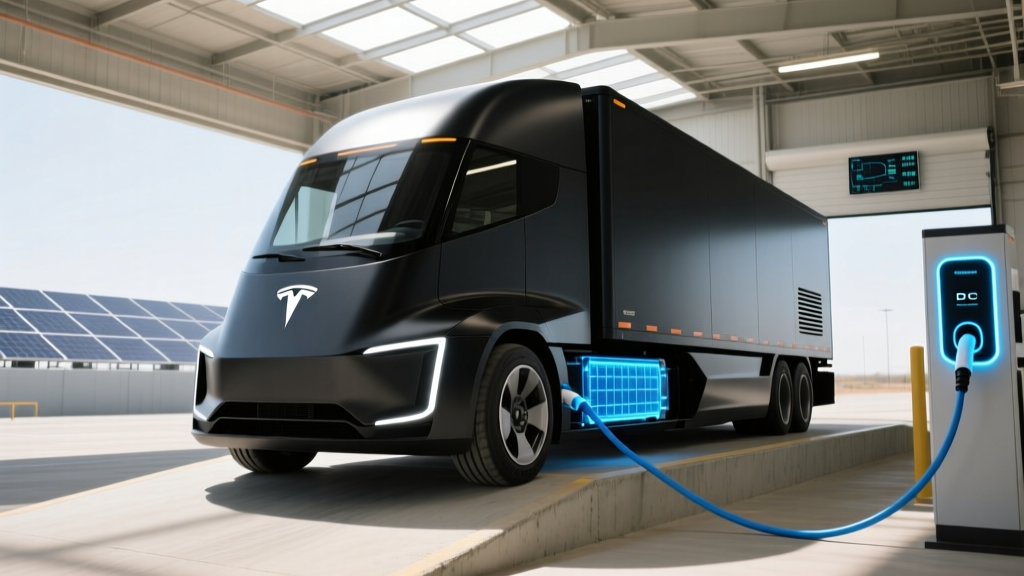
The Tesla Semi uses Tesla's proprietary Megacharger network, delivering up to 900 kW via the Tesla charging connector (now aligned with NACS for light-duty vehicles, but the Semi uses a higher-current commercial variant). Megachargers remain extremely limited in deployment — mostly concentrated along specific freight corridors in California and Nevada.
For a hypothetical Tesla box truck, depot charging would be the primary strategy. Most last-mile delivery routes return to a central facility nightly, making 48 kW Level 2 depot chargers practical for overnight replenishment. The challenge: a 500 kWh pack charging at 48 kW takes roughly 10 hours for a full charge, which works for single-shift operations but not double-shift or 24/7 logistics.
DC fast charging on public CCS networks (Electrify America, EVgo commercial) would provide mid-day top-ups, but most public DC chargers max out at 150–350 kW for commercial vehicles, meaning a 10–80% session could take 60–90 minutes for a large pack. Tesla's Megacharger would dramatically reduce this to ~30 minutes — but only if the fleet operates near an installed Megacharger station.
Key charging reality: Peak kW is not sustained kW. Any large battery pack will see charging speed taper significantly above 80% State of Charge to protect cell longevity. Fleet operators typically charge to 80–90% for daily operations and only charge to 100% when maximum range is required.
Performance and Powertrain
Tesla's multi-motor architecture gives its commercial vehicles exceptional performance. The Tesla Semi uses three independent motors (one on the steer axle, two on the drive axle) producing over 1,000 combined horsepower. A box truck variant would likely use a similar or simplified dual/tri-motor setup.
Projected performance figures:
- 0–60 mph: ~20 seconds (loaded to 26,000 lb GVWR) / ~8–12 seconds (empty or light load)
- Horsepower: 800–1,000+ hp combined
- Drivetrain: AWD with independent rear motors; possible front motor for traction
- Gradeability: Sustained 6.5% grade at GVWR (matching Semi capability)
While 0–60 times seem academic for a delivery truck, instant electric torque provides significant advantages in stop-and-go urban routes — faster merge acceleration, regenerative braking that reduces brake wear by an estimated 50–70%, and no turbo lag or transmission shift delays.
Pricing, Tax Credits, and Total Cost of Ownership
| Vehicle | Base MSRP | Federal Credit | Effective Price |
|---|---|---|---|
| Tesla Box Truck (projected) | $180,000–$300,000 | Up to $40,000 (§45W commercial) | $140,000–$260,000 |
| BrightDrop Zevo 600 | ~$120,000–$150,000 | Up to $40,000 (§45W) | ~$80,000–$110,000 |
| Ford E-Transit (cutaway/box) | ~$55,000–$70,000 | Up to $7,500 (§30D) or $40,000 (§45W) | ~$47,500–$62,500 |
| Rivian EDV (Amazon exclusive) | Not publicly sold | N/A | N/A |
| Diesel box truck (Class 5) | ~$90,000–$120,000 | None | $90,000–$120,000 |
Tax credit note for commercial buyers: Vehicles over 14,000 lb GVWR do not qualify for the consumer §30D credit (which caps at $7,500 and has MSRP and income limits). Instead, commercial fleets use IRC §45W (Commercial Clean Vehicle Credit), which provides up to $40,000 for qualifying commercial EVs. Eligibility requires the vehicle to be used in a trade or business, meet battery sourcing requirements, and be placed in service in the United States. Consult IRS.gov guidance on §45W and a qualified tax professional before making purchase decisions.
Total cost of ownership advantage: Electric box trucks typically save $0.15–$0.25 per mile on fuel vs. diesel (electricity at $0.12–$0.18/kWh vs. diesel at $4.00+/gallon at 7 mpg). Over a 150,000-mile lifecycle, that's $22,500–$37,500 in fuel savings alone. Add reduced brake maintenance and no oil/filter/transmission fluid changes, and the TCO breakeven vs. diesel typically arrives within 3–5 years for high-utilization routes.
Cargo Space and Body Configuration
Since no Tesla box truck exists, exact cargo dimensions are unknown. For reference, competitive electric box trucks and step vans in the Class 4–6 segment offer:
- BrightDrop Zevo 600: 615 cu ft cargo volume, 28 ft body length, 4,500 lb payload capacity
- Ford E-Transit cutaway (upfitted box): 150–300 cu ft depending on box length (10–16 ft bodies), 3,500–4,500 lb payload
- Lightning Electric Class 4: Up to 24 ft box body, ~500 cu ft, 10,000+ lb payload
A Tesla box truck would likely offer configurable body lengths from 14 to 26 feet, with cargo volumes from 250 to 700+ cubic feet. The flat skateboard-style battery platform (as used in the Semi) would allow a low load floor and maximum interior height — a significant advantage for walk-in delivery applications.
Tech, Driver Assistance, and the Autopilot Question
Tesla's commercial vehicles would inherit the company's software-first approach. Expect:
- 15-inch or larger touchscreen with fleet management integration
- Over-the-air updates for performance, efficiency, and feature improvements
- Tesla Autopilot (adaptive cruise, lane centering, automatic emergency braking)
- FSD (Supervised) — if offered, this remains a SAE Level 2 driver-assistance system requiring full driver engagement at all times
- Sentry Mode and fleet telematics for security and route optimization
- Regenerative braking with configurable levels for one-pedal driving in stop-and-go routes
Notable drawbacks of the Tesla approach for commercial fleets: Tesla's direct-to-consumer sales model lacks the dedicated commercial dealer network and service infrastructure that fleet managers rely on. Downtime is expensive in commercial operations, and Tesla's service wait times for body and collision repair have been a persistent complaint among Semi early adopters.
Pros (If Released)
- Tesla Supercharger/Megacharger network access (most reliable DC network)
- Class-leading performance and acceleration
- OTA updates and continuous software improvement
- Lowest energy consumption per mile (projected, based on Semi efficiency)
- Strong brand cachet for fleet marketing
Cons (Based on Tesla's Commercial Track Record)
- Does not exist — cannot be ordered or tested
- Limited commercial service infrastructure vs. legacy OEMs
- Megacharger network still very limited geographically
- Likely premium pricing vs. purpose-built competitors
- No upfitter ecosystem established for box bodies
- Tesla's history of delayed commercial product timelines (Semi announced 2017, deliveries began late 2022)
Who Should Wait — and Who Should Buy Now
Wait for a Tesla box truck if: Your fleet operates on Tesla Megacharger corridors, you prioritize software integration and OTA capability, your routes are under 200 miles daily, and you can absorb a 2–5 year wait with no guaranteed product timeline.
Buy an available electric box truck now if: You need vehicles in production within 6–12 months, you require established commercial service and parts networks, your routes demand proven payload and range figures, or you need to meet ESG or regulatory electrification mandates on a specific timeline.
Choose BrightDrop Zevo 600 if: You need a purpose-built step van for last-mile parcel or food delivery with 250+ miles of range and GM's commercial backing.
Choose Lightning Electric or Xos Trucks if: You need a Class 5–6 medium-duty electric box truck with established fleet deployments and proven uptime data.
Choose Tesla Semi (tractor) if: Your operation involves highway freight hauling with a separate trailer, not an integrated box body.
Warranty and Longevity Projections
The Tesla Semi carries an 8-year / 1,000,000-mile battery and drive unit warranty — the most generous in commercial trucking. A box truck variant would likely carry similar coverage. For context:
- Tesla Semi: 8 yr / 1,000,000 mi battery & drive unit
- Ford E-Transit: 8 yr / 100,000 mi battery (per Ford commercial specs)
- BrightDrop Zevo 600: 8 yr / 100,000 mi battery
Tesla's million-mile warranty reflects the company's confidence in its NMC cell chemistry and thermal management. For fleet operators running 50,000+ miles per year, this warranty effectively covers the vehicle's entire first-owner lifecycle.
Frequently Asked Questions
Does Tesla actually make a box truck in 2026?
No. As of 2026, Tesla has not announced a box truck, step van, or straight truck product. Tesla's commercial vehicle is the Semi (Class 8 tractor). Companies like BrightDrop, Ford Pro, Lightning Electric, and Xos Trucks offer electric box trucks that can be ordered today.
What is the real-world range of a Tesla box truck?
Since the vehicle does not exist, there is no EPA rating or real-world data. Based on the Tesla Semi's platform scaled to a box-van body with higher aerodynamic drag, a reasonable projection is 150–250 miles EPA, with real-world highway range 15–25% lower and cold-weather range 20–30% below that. For verified range data, see the BrightDrop Zevo 600 (250 mi EPA) or Ford E-Transit (126 mi EPA for the cargo van).
How fast would a Tesla box truck charge?
Projected: ~900 kW peak at a Tesla Megacharger (10–80% in ~30 minutes), ~48 kW at a commercial depot Level 2 charger (~15–20 miles per hour), and ~150–350 kW at public CCS DC fast chargers (10–80% in 60–90 minutes). These are estimates based on Semi platform architecture.
How much would a Tesla box truck cost after tax credits?
Projected base price: $180,000–$300,000 depending on battery size and body configuration. The federal §45W commercial clean vehicle credit provides up to $40,000 for qualifying commercial EVs over 14,000 lb GVWR, bringing the effective price to approximately $140,000–$260,000. Exact credit eligibility depends on battery sourcing requirements and business-use qualification — consult IRS.gov and a tax professional.
Does a Tesla box truck qualify for the $7,500 federal EV tax credit?
The §30D consumer credit (up to $7,500) applies to vehicles under 14,000 lb GVWR with MSRP caps ($80,000 for vans/pickups, $55,000 for sedans) and buyer income limits. A Tesla box truck would almost certainly exceed 14,000 lb GVWR and the MSRP cap, making it ineligible for §30D. Instead, commercial buyers would use the §45W credit (up to $40,000), which has different eligibility rules focused on business use and battery sourcing.
Is it worth waiting for a Tesla box truck vs. buying a competitor now?
For most fleets, no. Tesla has a history of multi-year delays on commercial products (the Semi was announced in 2017 and began limited deliveries in late 2022). Purpose-built competitors like BrightDrop, Ford E-Transit, and Xos are in production today with established service networks, verified range data, and available federal incentives. Unless your operation specifically requires Tesla's Megacharger network or software ecosystem, available options present lower risk and faster deployment timelines.
What are the biggest pros and cons of a Tesla box truck?
Pros (projected): Industry-leading energy efficiency, Megacharger network access, million-mile battery warranty, OTA software updates, strong performance. Cons: Vehicle does not exist, no commercial service infrastructure comparable to legacy OEMs, limited Megacharger coverage, likely premium pricing, no established box-body upfitter partnerships, uncertain timeline.
Sources: Tesla Semi product page, fueleconomy.gov (EPA), IRS §45W Commercial Clean Vehicle Credit.