If you've been searching for "Tesla Boombox" online, you've likely encountered a mix of confusing results — some pointing to Tesla's vehicle audio systems, others to the discontinued Boombox portable speaker, and still others to the Boombox feature buried in Tesla's Toybox entertainment menu. This guide clears up exactly what the Tesla Boombox is in 2026, which vehicles offer it, and delivers a full spec-driven review of the models that carry it so you can make an informed purchase decision.
What Is the Tesla Boombox Feature?
The Tesla Boombox is an external audio feature available through the vehicle's Toybox entertainment suite. It allows owners to play music, custom sound clips, or preset audio effects through the car's exterior speaker — the same Pedestrian Warning System (PWS) speaker mandated on all EVs for low-speed audible alerts. Originally introduced around 2020–2021, Boombox let drivers broadcast custom audio outside the vehicle, which quickly became both a beloved party trick and a public nuisance.
Following NHTSA scrutiny over safety concerns — specifically, that custom external audio could mask the required pedestrian warning tones — Tesla restricted Boombox functionality. As of the 2026 model year, Boombox is disabled while the vehicle is in Drive. It functions only when the car is in Park, making it a stationary entertainment feature rather than a rolling sound system. This restriction applies across all Tesla models via over-the-air updates.
2026 Tesla Model Lineup: Boombox-Equipped Vehicles Compared
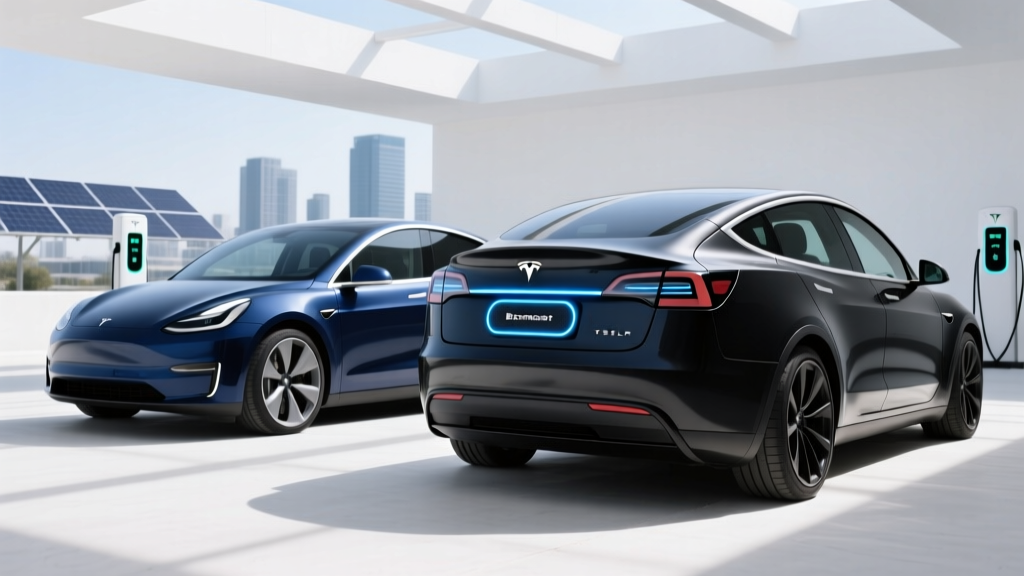
Every current-production Tesla includes the Boombox feature. The real question for buyers is which model fits your driving needs. Below is a side-by-side spec table covering the four core 2026 models.
| Spec | Model 3 Long Range AWD | Model Y Long Range AWD | Model S Long Range | Model X Long Range |
|---|---|---|---|---|
| EPA Range | 363 mi | 320 mi | 402 mi | 348 mi |
| Battery (usable) | ~75 kWh (NMC) | ~75 kWh (NMC) | ~95 kWh (NMC) | ~95 kWh (NMC) |
| Peak DC Charge | 250 kW | 250 kW | 250 kW | 250 kW |
| 10–80% DC Time | ~25 min | ~27 min | ~30 min | ~32 min |
| Level 2 Rate | 11.5 kW (~44 mi/hr) | 11.5 kW (~44 mi/hr) | 11.5 kW (~34 mi/hr) | 11.5 kW (~34 mi/hr) |
| 0–60 mph | 4.2 sec | 4.8 sec | 3.1 sec | 3.8 sec |
| Horsepower | ~346 hp | ~384 hp | ~670 hp | ~670 hp |
| Drivetrain | Dual-Motor AWD | Dual-Motor AWD | Dual-Motor AWD | Dual-Motor AWD |
| MPGe (combined) | 132 MPGe | 117 MPGe | 120 MPGe | 105 MPGe |
| Cargo Volume | 23 cu ft | 76 cu ft (rear seats folded) | 28 cu ft | 88 cu ft (rear seats folded) |
| Base MSRP | $47,740 | $48,990 | $79,990 | $84,990 |
| Battery Warranty | 8 yr / 120,000 mi | 8 yr / 120,000 mi | 8 yr / 150,000 mi | 8 yr / 150,000 mi |
Source: fueleconomy.gov and Tesla's official 2026 specifications. Prices exclude destination fee. Real-world range and charging times vary by conditions.
Real-World Range: What the EPA Sticker Doesn't Tell You
Model 3 LR: EPA 363 mi → expect ~300–320 mi highway (75 mph), ~250–280 mi in cold weather (below 32°F)
Model Y LR: EPA 320 mi → expect ~260–285 mi highway, ~220–245 mi in cold weather
Model S LR: EPA 402 mi → expect ~340–365 mi highway, ~290–320 mi in cold weather
Model X LR: EPA 348 mi → expect ~285–310 mi highway, ~240–270 mi in cold weather
Tesla's EPA range estimates remain among the most achievable in the industry — particularly for the Model 3 and Model S — but physics doesn't bend for marketing. Highway driving at 75+ mph reduces range by roughly 12–18% versus the combined EPA cycle. Cold weather compounds this: lithium-ion cells lose efficiency below freezing, and cabin heating draws significant energy. Tesla's heat pump (standard on all 2026 models) mitigates this compared to resistive heating, but expect a 20–30% range reduction in sustained sub-freezing conditions.
For road-trip planning, use the lower real-world figures. The Model 3 Long Range remains the efficiency champion of the lineup at 132 MPGe combined (EPA data), translating to roughly 25–27 kWh per 100 miles depending on driving style.
Charging Speed: DC Fast Charge and Home Level 2
Tesla's Supercharger network remains the gold standard for public DC fast charging, and all 2026 Tesla models peak at 250 kW on V3 Superchargers. However, peak rate is not sustained rate — the charging curve tapers significantly above 60% State of Charge (SoC) to protect battery health.
| Charging Method | Power / Rate | Miles Added per Hour | Notes |
|---|---|---|---|
| Level 1 (120V household) | ~1.4 kW | ~3–5 mi/hr | Emergency/trickle only |
| Level 2 (240V, 48A Wall Connector) | 11.5 kW | ~34–44 mi/hr | Full overnight charge in 7–9 hrs |
| DC Fast Charge (V3 Supercharger) | Peak 250 kW | ~1,000 mi/hr at peak | 10–80% in ~25–32 min; tapers above 60% |
| DC Fast Charge (V4 Supercharger) | Up to 250 kW (current Tesla vehicles) | Similar to V3 | V4 cabinet supports higher rates for future architectures |
Preconditioning matters. Tesla's navigation system automatically warms the battery when you route to a Supercharger, enabling faster charge acceptance on arrival. Without preconditioning — for example, pulling into a charger without using navigation — your initial charge rate can be 30–50% lower for the first several minutes, especially in cold weather. Always navigate to your charger via the Tesla app or in-car navigation.
All 2026 Teslas use the NACS (North American Charging Standard) connector natively. With the broader industry adopting NACS through 2025–2026, Tesla owners now have access to an expanding network of non-Tesla chargers equipped with NACS cables — including select Electrify America and ChargePoint stations.
Pricing, Trims, and Federal Tax Credit Eligibility
Tesla's pricing has shifted frequently, but as of early 2026, here's where the lineup stands and how the IRS §30D federal tax credit applies.
| Model / Trim | Base MSRP | MSRP Cap (§30D) | Est. Credit | Effective Price |
|---|---|---|---|---|
| Model 3 Long Range AWD | $47,740 | $55,000 (sedan) | Up to $7,500 | ~$40,240 |
| Model Y Long Range AWD | $48,990 | $80,000 (SUV) | Up to $7,500 | ~$41,490 |
| Model S Long Range | $79,990 | $55,000 (sedan) | $0 (exceeds cap) | $79,990 |
| Model X Long Range | $84,990 | $80,000 (SUV) | $0 (exceeds cap) | $84,990 |
- MSRP cap: Sedans/wagons ≤ $55,000; SUVs/pickups/vans ≤ $80,000
- Buyer income cap: Modified AGI ≤ $150,000 (single), $225,000 (head of household), $300,000 (joint)
- Battery sourcing: Critical minerals and battery components must meet phased-in domestic/free-trade-agreement thresholds — percentages increase annually through 2029
- Point-of-sale transfer: Eligible buyers can transfer the credit to the dealer at purchase, reducing the upfront price directly
- Assembly: Vehicle must undergo final assembly in North America (all US-market Teslas qualify)
Tax credit rules change frequently and battery-sourcing requirements tighten each year. Consult IRS.gov and a tax professional before relying on credit eligibility.
The Model 3 and Model Y remain the value plays — both fall under their respective MSRP caps and have historically qualified for the full $7,500 credit, though battery-sourcing compliance should be verified at the time of purchase. The Model S and Model X exceed the sedan and SUV caps respectively, making them ineligible for the federal credit regardless of buyer income.
Tech, Interior, and the Boombox Experience
All 2026 Teslas share the same core software platform, meaning the Boombox feature, Toybox entertainment suite, and driver-assistance stack are consistent across models. Key tech highlights include:
- 15.4-inch center touchscreen (Model 3/Y) or 17-inch touchscreen (Model S/X) with Netflix, YouTube, and gaming
- Tesla Premium Audio — 14 to 22 speakers depending on model, with immersive sound tuning
- Boombox external speaker — accessible in Park via Toybox; play presets or custom audio clips externally
- Autopilot (standard) — SAE Level 2 adaptive cruise + lane centering; requires continuous driver supervision
- Full Self-Driving (Supervised) — optional $8,000 upgrade; still SAE Level 2 despite the name
- Over-the-air updates — Tesla continuously adds features; Boombox itself has evolved through multiple OTA revisions
- Sentry Mode / Dashcam — integrated camera recording with USB storage
Interior quality has improved markedly in the refreshed Model 3 (Highland) and Model Y (Juniper), with ventilated front seats, ambient lighting, acoustic glass, and a rear passenger touchscreen on Model 3. However, the minimalist interior still polarizes — no physical stalks (turn signals are on the steering wheel), no instrument cluster, and all climate/seat controls route through the touchscreen.
Pros and Cons: The Honest Verdict
✅ Pros
- Class-leading Supercharger network access
- Best-in-class efficiency (Model 3: 132 MPGe)
- Strong real-world range achievability
- OTA updates continuously add features
- Low operating cost — ~$0.04–0.06/mile on home charging
- Boombox + Toybox entertainment suite standard
- Excellent safety ratings (NHTSA 5-star across models)
❌ Cons
- Model S/X ineligible for federal tax credit (MSRP cap)
- 250 kW peak DC rate trails Hyundai/Kia's 350 kW E-GMP platform
- No physical controls — everything via touchscreen
- Boombox disabled in Drive (Park only)
- FSD (Supervised) is expensive and still Level 2
- Insurance premiums run 15–30% above comparable gas vehicles
- Build quality inconsistency — panel gaps still reported
Who Should Buy a Tesla in 2026?
Choose the Model 3 Long Range if:
You prioritize maximum efficiency and range per dollar, commute solo or with one passenger, and want the lowest effective price after the $7,500 credit (~$40,240). The best all-around value in Tesla's lineup.
Choose the Model Y Long Range if:
You need crossover cargo space (76 cu ft with seats folded), have a family, and still want tax-credit eligibility. The default choice for most American EV buyers.
Choose the Model S or Model X if:
Performance (3.1-second 0–60), premium positioning, and maximum range (402 mi for Model S) matter more than tax credits. You accept the $80K+ price and higher running costs for a flagship experience.
Look at competitors if:
You need faster DC charging (Hyundai Ioniq 5/6 at 350 kW), physical controls (BMW i4, Hyundai), or a more traditional interior layout. Also consider if you're ineligible for the tax credit and want to maximize value — the Hyundai Ioniq 5 or Chevrolet Equinox EV may offer better dollar-per-mile economics.
Frequently Asked Questions
What is the real-world range of a 2026 Tesla?
Real-world range depends on the model and conditions. The Model 3 Long Range achieves 363 miles EPA but expect ~300–320 miles at highway speeds and ~250–280 miles in freezing weather. The Model Y Long Range delivers 320 miles EPA with similar proportional reductions. Tesla's efficiency is among the best in the industry, so real-world achievability is higher than many competitors.
How fast does a Tesla charge at home and on the road?
At home on a 240V/48A Tesla Wall Connector, all models charge at 11.5 kW, adding roughly 34–44 miles of range per hour — a full charge takes 7–9 hours overnight. On DC fast chargers, Tesla's V3 Superchargers deliver a peak of 250 kW, reaching 10–80% in approximately 25–32 minutes depending on the model. The charge curve tapers above 60% SoC to protect the battery.
How much does a Tesla cost after federal tax credits?
The Model 3 Long Range starts at $47,740 and can drop to ~$40,240 with the full $7,500 §30D credit (subject to income and battery-sourcing eligibility). The Model Y Long Range starts at $48,990, reaching ~$41,490 with the credit. The Model S ($79,990) and Model X ($84,990) exceed their respective MSRP caps and do not qualify for the federal credit.
Is a Tesla worth buying versus competitors in 2026?
Tesla still leads in charging infrastructure (Supercharger network), software integration, and efficiency. However, competitors like the Hyundai Ioniq 5 offer faster DC charging (350 kW peak), the BMW i4 provides a more traditional luxury interior, and the Chevrolet Equinox EV undercuts on price. If Supercharger access and software experience are priorities, Tesla remains the default. If you value faster charging stops or physical controls, cross-shop aggressively.
Does the Tesla Boombox work while driving?
No. As of current NHTSA compliance requirements, Boombox is restricted to Park mode only. It cannot play external audio while the vehicle is in Drive, Reverse, or Neutral. This restriction was implemented to ensure the Pedestrian Warning System remains audible and unmasked at low speeds.
Does a 2026 Tesla qualify for the federal EV tax credit?
The Model 3 and Model Y qualify for up to $7,500 under IRS §30D, provided the buyer meets income caps ($150K single / $300K joint) and the vehicle's battery components satisfy current-year critical-mineral and domestic-sourcing thresholds. The Model S and Model X do not qualify due to MSRP cap exceedance. Always verify eligibility on IRS.gov at time of purchase.