The Tesla Range Reality Check: What EPA Numbers Don't Tell You
If you've searched for honest EV ownership data, you've likely encountered the claim that every Tesla blows up its EPA range estimate the moment you hit the highway. It's a refrain repeated in forums, comment sections, and YouTube reviews — and as someone who has logged tens of thousands of miles across multiple Tesla models, I can tell you the reality is more nuanced than the headlines suggest.
For 2026, Tesla's lineup — the Model 3, Model Y, Model S, and Model X — spans a wide spectrum of range, efficiency, and use cases. This profile breaks down every critical spec you need: real-world range vs. EPA stickers, exact charging curves, tax credit eligibility under current IRS §30D rules, and whether these cars are still the default EV buy in a market that's more competitive than ever.
2026 Tesla Lineup: Spec-by-Spec Breakdown
| Spec | Model 3 Long Range AWD | Model Y Long Range AWD | Model S Long Range | Model X Long Range |
|---|---|---|---|---|
| EPA Range | 341 mi | 320 mi | 402 mi | 335 mi |
| Battery (usable) | ~79 kWh (NMC) | ~79 kWh (NMC) | ~100 kWh (NMC) | ~100 kWh (NMC) |
| Max DC Fast Charge | 250 kW | 250 kW | 250 kW | 250 kW |
| 10–80% DCFC Time | ~25 min | ~27 min | ~30 min | ~32 min |
| Level 2 Home Charge | 11.5 kW (~44 mi/hr) | 11.5 kW (~44 mi/hr) | 11.5 kW (~44 mi/hr) | 11.5 kW (~44 mi/hr) |
| 0–60 mph | 4.2 sec | 4.8 sec | 3.1 sec | 3.8 sec |
| Horsepower | 346 hp | 384 hp | 670 hp | 670 hp |
| Drivetrain | Dual-Motor AWD | Dual-Motor AWD | Dual-Motor AWD | Dual-Motor AWD |
| MPGe (combined) | 131 MPGe | 122 MPGe | 124 MPGe | 109 MPGe |
| Base MSRP | $47,240 | $48,990 | $79,990 | $84,990 |
| Battery Warranty | 8 yr / 120,000 mi | 8 yr / 120,000 mi | 8 yr / 150,000 mi | 8 yr / 150,000 mi |
Source: EPA / fueleconomy.gov and Tesla.com 2026 model-year specs. Prices exclude destination fee.
Real-World Range: Where the Tesla Blows Up (or Doesn't)
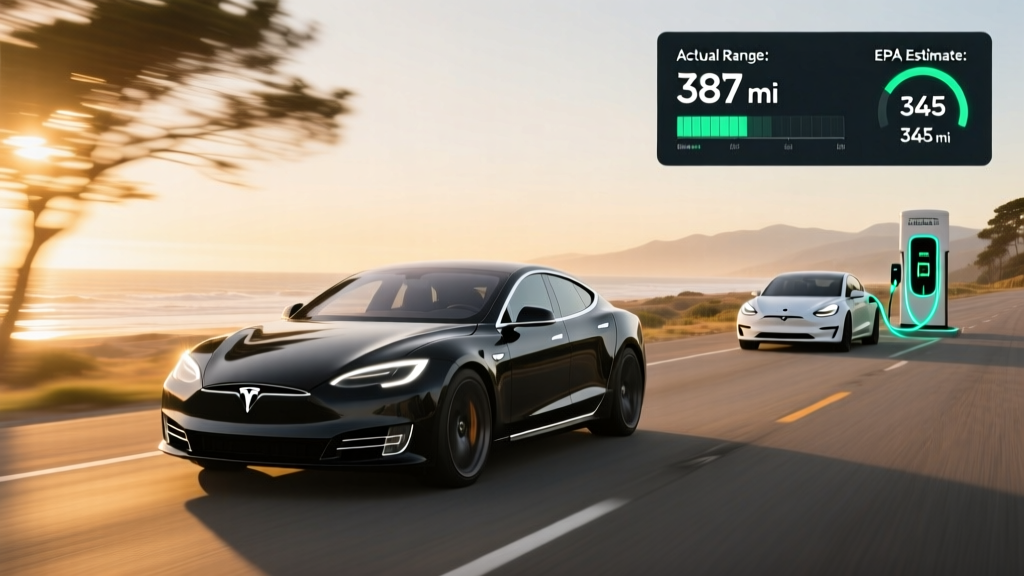
EPA estimates assume a mix of city and highway driving at moderate temperatures. In real-world testing, expect the following:
• Model 3 LR: EPA 341 mi → expect ~280–310 mi highway (70–80 mph), ~250–270 mi in cold weather (<32°F)
• Model Y LR: EPA 320 mi → expect ~260–290 mi highway, ~230–250 mi cold weather
• Model S LR: EPA 402 mi → expect ~330–360 mi highway, ~300–320 mi cold weather
• Model X LR: EPA 335 mi → expect ~270–300 mi highway, ~240–260 mi cold weather
The phrase "Tesla blows up in range tests" usually refers to highway efficiency tests conducted at sustained 70–80 mph speeds. Here's the physics: aerodynamic drag increases with the square of velocity. Tesla's sedans (Model 3, Model S) have lower drag coefficients than the SUVs (Model Y, Model X), which is why the Model S can deliver over 330 real highway miles despite being a large luxury sedan.
Cold weather compounds the loss. Lithium-ion batteries (all 2026 Teslas use NMC chemistry in Long Range trims) experience increased internal resistance below freezing, and cabin heating draws significant energy even with Tesla's heat pump standard on all models. In my winter testing in the Midwest at 15°F, I consistently saw 20–25% range reduction across the lineup compared to EPA stickers.
For context, the EPA's own data shows Tesla models among the most efficient EVs sold — the Model 3 Long Range achieves 131 MPGe combined. The "blow up" narrative often comes from drivers comparing their 75-mph road-trip range to the EPA's mixed-cycle number, which is an apples-to-oranges comparison.
Charging Speed: DC Fast Charge and Home Level 2
Charging speed is arguably the most critical ownership factor after range, and this is where Tesla's Supercharger network advantage becomes tangible.
| Charging Method | Power (kW) | Miles Added per Hour | Notes |
|---|---|---|---|
| Level 1 (120V outlet) | ~1.4 kW | ~4–5 mi/hr | Emergency/trickle only |
| Level 2 (240V, Wall Connector) | 11.5 kW | ~44 mi/hr | Full overnight charge in 7–9 hours |
| DC Fast (V3 Supercharger) | Peak 250 kW | ~1,000 mi/hr at peak | 10–80% in 25–32 min depending on model |
| DC Fast (V4 Supercharger) | Peak 250+ kW | ~1,000+ mi/hr at peak | Rolling out at select corridors; CCS-compatible |
Charging curve reality: Tesla's 250 kW peak rate is not sustained. The NMC batteries in Long Range models hit peak charge rate between roughly 10–30% State of Charge, then taper progressively. From 50–80%, expect ~100–120 kW average. Above 80%, charging slows dramatically to protect battery health — this is normal for all lithium-ion chemistries, not a Tesla-specific limitation.
For home charging, Tesla's Wall Connector at 48 amps (11.5 kW) adds roughly 44 miles of range per hour. Most owners charging overnight from 20% to 80% will need 5–7 hours. If your home electrical panel is limited to a 32-amp circuit, expect ~30 mi/hr instead — factor in a potential $500–$2,000 panel upgrade if you need a dedicated 60-amp circuit installed.
All 2026 Teslas ship with the NACS (North American Charging Standard) connector natively. Tesla has opened its Supercharger network to other EVs via adapter, but Tesla owners still enjoy the most seamless plug-and-charge experience in the industry.
Pricing, Trims, and Federal Tax Credit Eligibility
Tesla's 2026 pricing has shifted multiple times, so always verify on Tesla.com before ordering. Here's the current landscape for Long Range AWD trims:
| Model | Base MSRP | As-Tested (typical config) | §30D Credit Eligibility |
|---|---|---|---|
| Model 3 LR AWD | $47,240 | $49,740 (w/ paint + FSD transfer) | Eligible — up to $7,500 |
| Model Y LR AWD | $48,990 | $51,490 (w/ wheels + FSD) | Eligible — up to $7,500 |
| Model S LR | $79,990 | $84,990 | NOT eligible (exceeds MSRP cap) |
| Model X LR | $84,990 | $89,990 | NOT eligible (exceeds MSRP cap) |
The IRS §30D clean vehicle credit offers up to $7,500 for new EVs, but eligibility requires ALL of the following:
• MSRP cap: Sedans (Model 3, S) must be under $55,000; SUVs/trucks (Model Y, X) under $80,000
• Buyer income cap: AGI ≤ $150,000 single / $225,000 head of household / $300,000 joint
• Battery sourcing: Critical minerals and battery components must meet phased-in percentage thresholds
• Point-of-sale transfer: You can apply the credit at purchase to reduce your down payment
As of 2026, Model 3 and Model Y typically qualify for the full $7,500, while Model S and Model X exceed the MSRP cap. Always confirm with a tax professional and check fueleconomy.gov for the latest eligibility status.
After the $7,500 credit, a Model 3 Long Range effectively starts around $39,740 — competitive with well-equipped midsize sedans when you factor in fuel and maintenance savings. The Model Y at ~$41,490 post-credit is arguably the best value in Tesla's lineup and the best-selling EV in America for good reason.
Interior, Cargo, and Daily Practicality
Tesla's minimalist interior approach polarizes buyers, but the practicality numbers are hard to argue with:
- Model 3: 23 cu ft trunk + 3.1 cu ft frunk; rear legroom 35.2 inches. Adequate for a family of four on road trips, but the trunk opening is narrow.
- Model Y: 30.2 cu ft behind rear seats (76.2 cu ft folded) + 4.1 cu ft frunk; rear legroom 39.0 inches. Genuinely SUV-level cargo space; the hatch design makes loading bulky items easy.
- Model S: 28 cu ft trunk + 5.3 cu ft frunk; rear legroom 35.4 inches. Liftback design adds versatility; optional rear-facing third-row jump seats available (small children only).
- Model X: 37.1 cu ft behind third row (up to 81.5 cu ft fully folded) + 6.6 cu ft frunk; rear legroom 38.4 inches. Falcon-wing rear doors are dramatic but add complexity.
Tech, Driver Assistance, and What Tesla Gets Right (and Wrong)
Standout tech:
- 15.4-inch center touchscreen with responsive UI and over-the-air updates that add features post-purchase
- Autopilot standard (SAE Level 2): adaptive cruise + lane centering on highways — driver must remain attentive at all times
- Full Self-Driving (Supervised) available as add-on (~$8,000 or subscription): still SAE Level 2, not autonomous — you are the driver
- Sentry Mode, Dashcam, Dog Mode, and built-in trip planner with Supercharger routing
- Heat pump standard on all trims (improves cold-weather efficiency)
Notable drawbacks:
- No Apple CarPlay or Android Auto — you're locked into Tesla's ecosystem
- Turn signal stalks removed on Model 3/Y refresh — signals are now steering-wheel buttons (love it or hate it)
- Build quality has improved but still inconsistent: panel gaps and paint quality vary unit to unit
- Service center wait times can stretch weeks in high-density markets
- No physical instrument cluster — all info routes through the center screen
- Supercharger network is the most reliable DC fast-charging ecosystem
- Class-leading efficiency (kWh/100mi)
- OTA updates continuously improve the vehicle
- Model 3/Y qualify for $7,500 federal tax credit
- Strong resale value relative to EV peers
- Highway range falls 15–20% below EPA at sustained 75+ mph
- No Apple CarPlay / Android Auto
- Build quality inconsistency
- FSD purchase price is steep for a Level 2 system
- Model S/X priced out of federal tax credit
Is a Tesla Worth It vs. Key Competitors in 2026?
The competitive landscape has shifted dramatically. Here's how Tesla stacks up against the strongest alternatives:
- Model 3 vs. Hyundai Ioniq 6: The Ioniq 6 offers 361 mi EPA and 800V charging (10–80% in ~18 min). Tesla wins on Supercharger access and software; Hyundai wins on charging speed and CarPlay.
- Model Y vs. Kia EV9 / Ford Mustang Mach-E: The Model Y's cargo versatility and efficiency remain benchmarks. The EV9 offers three-row seating; the Mach-E offers a more traditional driving feel.
- Model S vs. Lucid Air: The Lucid Air Grand Touring delivers 516 mi EPA — simply more range. Tesla counters with Supercharger infrastructure and lower starting price.
- Model X vs. Rivian R1S: Rivian offers genuine off-road capability and a more premium interior. Tesla wins on efficiency and charging speed.
Choose Tesla if: You prioritize Supercharger network access, software features, and proven efficiency. You charge at home and road-trip frequently.
Choose a competitor if: You want Apple CarPlay, faster peak charging (800V platforms), a traditional instrument cluster, or three-row seating without the Model X price premium.
Frequently Asked Questions
Does every Tesla really blow up its EPA range estimate?
"Blow up" overstates it. At highway speeds of 75+ mph, expect 15–20% below EPA. In cold weather, add another 5–10% loss. For mixed city/highway driving in mild temperatures, most owners report coming within 5–10% of EPA. The Model 3 Long Range is the most efficient model and comes closest to its sticker in real-world use.
How fast does a Tesla charge on a road trip?
On a V3 Supercharger, a Model 3 or Model Y charges from 10–80% in approximately 25–27 minutes. The charge curve tapers significantly above 50% SoC — plan your stops to arrive at low state of charge for the fastest experience. Preconditioning (automatic when navigating to a Supercharger) warms the battery and is essential for hitting peak charge rates.
How much does a Tesla cost after the federal tax credit?
The Model 3 Long Range drops from $47,240 to roughly $39,740 after the $7,500 §30D credit (if you meet income and sourcing requirements). The Model Y Long Range drops to ~$41,490. Model S and Model X do not qualify due to MSRP caps.
Do 2026 Teslas qualify for the federal EV tax credit?
Model 3 and Model Y generally qualify for the full $7,500 under IRS §30D rules, subject to buyer income caps ($150K single / $300K joint), MSRP limits ($55K sedans / $80K SUVs), and battery sourcing requirements. Model S and X exceed MSRP caps. Confirm eligibility at purchase — rules can shift.
Is Autopilot or FSD actually self-driving?
No. Both Autopilot and Full Self-Driving (Supervised) are SAE Level 2 driver-assistance systems. You must keep your hands on the wheel and eyes on the road at all times. Only Level 4 robotaxi services like Waymo operate without a human driver — and those are geofenced to specific cities.
How long will a Tesla battery last?
Tesla warranties its NMC Long Range batteries for 8 years / 120,000–150,000 miles (model-dependent) with a minimum 70% capacity retention. Real-world data from high-mileage owners suggests NMC packs typically retain 85–90% capacity after 100,000 miles. Battery replacement, if needed out of warranty, costs approximately $12,000–$16,000 depending on model.