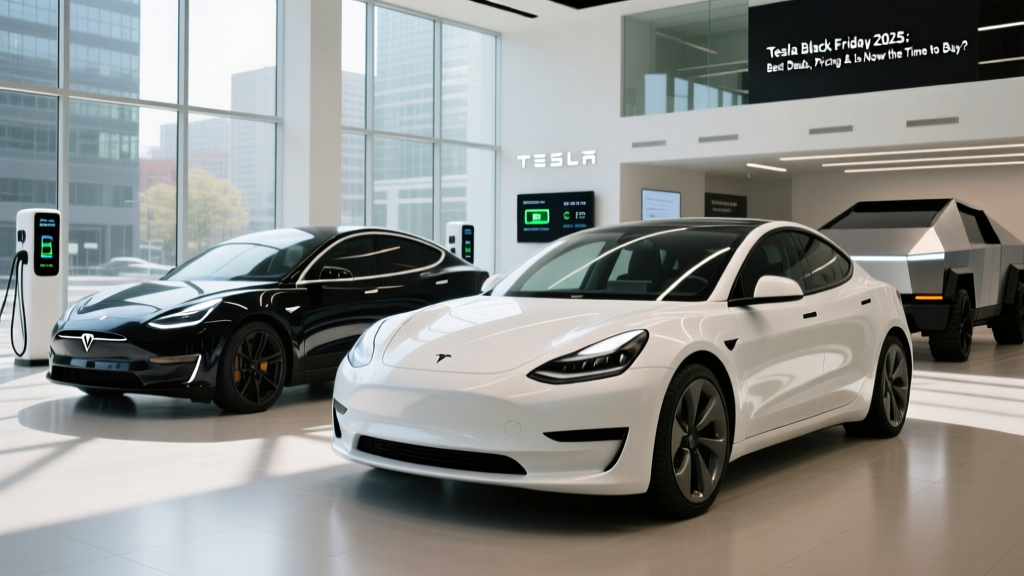
Tesla doesn't do traditional dealer lot negotiations, and it certainly doesn't hang banners from showroom ceilings. But as Q4 2025 closes and the 2026 model year transition looms, the phrase Tesla Black Friday 2025 has taken on real meaning for EV shoppers. Between end-of-year inventory clearance on 2025 models, shifting federal tax credit rules, Tesla's own referral and inventory discount programs, and aggressive competitor pricing, the holiday season has become one of the most consequential windows to buy a Tesla in years.
This guide breaks down exactly what Tesla is offering as of late 2025, which models carry the best value, how real-world range and charging stack up against the EPA sticker, and whether the math works after federal and state incentives. We'll focus on the two volume sellers — the Model Y and Model 3 — since those are the vehicles most shoppers are researching when they search for Tesla holiday deals.
What "Tesla Black Friday 2025" Actually Means for Buyers
Unlike Ford, Hyundai, or BMW dealerships that run advertised Black Friday events, Tesla sells direct-to-consumer with a fixed-price model. There are no haggling sessions and no "holiday sale event" banners. Instead, Tesla uses a combination of mechanisms that tend to converge in November and December:
- Inventory vehicle discounts: Tesla reduces prices on existing inventory units — especially outgoing model-year vehicles — to clear stock before the new year. In late 2025, discounts of $1,000–$3,000 off MSRP on in-stock 2025 Model Y and Model 3 units have been documented on Tesla's inventory pages.
- Referral program incentives: Tesla periodically reactivates its referral program, offering buyers $500–$1,000 in discounts when purchasing through an existing owner's referral link, along with free Supercharging miles or FSD trial periods.
- Free Supercharging promotions: Historically, Tesla has offered limited-time free Supercharging (typically 10,000 miles or 1–3 months) on end-of-quarter deliveries to pull forward demand.
- Federal tax credit urgency: With IRS §30D rules subject to legislative change and battery-sourcing requirements tightening, many buyers are accelerating purchases to lock in the current credit structure before potential 2026 rule changes.
The bottom line: if you're shopping a Tesla in late 2025, you're looking at a combination of price cuts on inventory cars, potential referral savings, and tax credit eligibility that may not look the same in 2026.
2025 Tesla Model Y: Pricing, Range & Specs Breakdown
The Model Y remains Tesla's global best-seller and the vehicle most likely to appear in Tesla's end-of-year inventory deals. Here's the complete spec picture for the 2025 model year as it stands heading into Black Friday.
| Spec | Long Range RWD | Long Range AWD | Performance |
|---|---|---|---|
| EPA Range | 320 miles | 308 miles | 277 miles |
| Battery (usable) | ~75 kWh (NMC) | ~75 kWh (NMC) | ~75 kWh (NMC) |
| MPGe (combined) | 122 MPGe | 117 MPGe | 111 MPGe |
| Efficiency | 27 kWh/100 mi | 29 kWh/100 mi | 30 kWh/100 mi |
| 0-60 mph | 5.8 sec | 4.8 sec | 3.5 sec |
| Horsepower | 346 hp | 384 hp | 456 hp |
| Drivetrain | RWD (single motor) | AWD (dual motor) | AWD (dual motor) |
| Max DC Fast Charge | 250 kW | 250 kW | 250 kW |
| 10-80% DC Time | ~27 min | ~27 min | ~27 min |
| Level 2 Home Charge | 11.5 kW (~44 mi/hr) | 11.5 kW (~44 mi/hr) | 11.5 kW (~44 mi/hr) |
| Base MSRP | $44,990 | $47,990 | $52,490 |
| Cargo (rear seats up) | 30.2 cu ft | 30.2 cu ft | 30.2 cu ft |
| Cargo (rear seats folded) | 72.1 cu ft | 72.1 cu ft | 72.1 cu ft |
| Rear Legroom | 41.6 in | 41.6 in | 41.6 in |
2025 Tesla Model 3: The Refreshed Sedan's Numbers
The "Highland" refresh brought meaningful improvements to the Model 3 for the 2024-2025 model years: a quieter cabin, ventilated front seats, rear touchscreen, ambient lighting, and a slightly larger battery. For buyers considering a sedan over an SUV, the Model 3 offers better efficiency and a lower entry price.
| Spec | Long Range RWD | Long Range AWD | Performance |
|---|---|---|---|
| EPA Range | 363 miles | 341 miles | 315 miles |
| Battery (usable) | ~79 kWh (NMC) | ~79 kWh (NMC) | ~79 kWh (NMC) |
| MPGe (combined) | 132 MPGe | 125 MPGe | 119 MPGe |
| 0-60 mph | 5.8 sec | 4.2 sec | 2.9 sec |
| Horsepower | 271 hp | 346 hp | 510 hp |
| Max DC Fast Charge | 250 kW | 250 kW | 250 kW |
| 10-80% DC Time | ~25 min | ~25 min | ~25 min |
| Level 2 Home Charge | 11.5 kW (~48 mi/hr) | 11.5 kW (~48 mi/hr) | 11.5 kW (~48 mi/hr) |
| Base MSRP | $42,490 | $47,490 | $54,990 |
| Cargo (trunk + frunk) | 23.0 cu ft | 23.0 cu ft | 23.0 cu ft |
| Rear Legroom | 35.2 in | 35.2 in | 35.2 in |
The Model 3 Long Range RWD at 363 miles EPA is among the longest-range EVs on the market at any price point. On real-world highway drives at 70 mph in 60-70°F weather, expect around 300–320 miles before needing to stop. In winter conditions, plan for 250–275 miles of usable range.
Charging Speed: What Tesla Owners Actually Experience
Tesla's Supercharger network remains the gold standard for DC fast charging reliability in the U.S. — a significant competitive moat, especially as other networks like Electrify America continue to face uptime complaints. Here's the charging picture across all three charging levels:
| Charging Level | Power | Speed (Model Y LR) | Typical Use Case |
|---|---|---|---|
| Level 1 (120V outlet) | ~1.4 kW | ~3-5 mi/hr | Emergency/overnight trickle |
| Level 2 (240V home) | 11.5 kW (48A) | ~44 mi/hr | Daily home charging |
| DC Fast (V3 Supercharger) | 250 kW peak | ~175 mi in 15 min | Road trips |
| DC Fast (V4 Supercharger) | Up to 350 kW* | Model Y capped at 250 kW | Future vehicles |
*V4 Supercharger cabinets support higher power, but current Model Y/3 architecture peaks at 250 kW. The Cybertruck and future platforms may leverage higher rates.
Charging curve reality: The 250 kW peak rate applies only between roughly 10-30% State of Charge. Above 50%, the rate tapers significantly — dropping to around 100 kW by 70% and below 50 kW above 85%. The published 10-80% time of ~27 minutes reflects this taper. For road trip planning, plan stops around the 15-20 minute mark to stay in the fast part of the curve.
Home charging setup: Installing a Tesla Wall Connector on a 60-amp circuit (requiring a NEMA 14-50 or hardwired connection) delivers the full 11.5 kW / 48 amps. Most Tesla owners report installing a Level 2 home charger costs between $500–$2,000 depending on panel proximity and whether a panel upgrade (to 200A service) is needed. Budget $500 for the Wall Connector unit itself and $500-$1,500 for licensed electrician labor.
Federal Tax Credit: Does a Tesla Still Qualify in Late 2025?
This is where timing matters most. Under current IRS §30D rules, Tesla vehicles may qualify for up to $7,500 in federal clean vehicle credits — but eligibility depends on several factors that can change:
- MSRP cap: SUVs/vans/pickups (Model Y) must be under $80,000; sedans (Model 3) under $55,000. All current Model Y and Model 3 trims clear this cap.
- Buyer income cap: Modified AGI must not exceed $300,000 (joint), $225,000 (head of household), or $150,000 (single).
- Battery sourcing: Critical minerals and battery components must meet escalating North American/free-trade-partner thresholds. Tesla's U.S.-built vehicles with CATL/Panasonic cells have navigated these requirements, but specific trim eligibility can shift.
- Point-of-sale transfer: Buyers can transfer the credit to the dealer (Tesla) at purchase, reducing the purchase price directly rather than waiting for a tax return.
- Final assembly: Must be in North America. All U.S.-market Model Y (Fremont/Austin) and Model 3 (Fremont) qualify.
| Model | Base MSRP | Est. §30D Credit | Effective Price* |
|---|---|---|---|
| Model 3 LR RWD | $42,490 | $7,500 | ~$34,990 |
| Model Y LR RWD | $44,990 | $7,500 | ~$37,490 |
| Model Y LR AWD | $47,990 | $7,500 | ~$40,490 |
| Model Y Performance | $52,490 | $7,500 | ~$44,990 |
*Effective price assumes full $7,500 credit eligibility. Actual credit may be $3,750 or $0 depending on battery component and critical mineral sourcing at time of delivery. Always verify eligibility on fueleconomy.gov before purchasing. Consult a tax professional for your specific situation.
The urgency for late-2025 buyers: proposed legislative changes could modify or sunset §30D provisions for 2026 and beyond. If you qualify now, locking in the credit via a 2025 delivery may be financially prudent.
Tesla Autopilot & FSD: What You're Getting (and What You're Not)
Tesla Autopilot and Full Self-Driving (Supervised) are Level 2 driver-assistance systems. The driver must remain fully engaged, hands on or near the wheel, eyes on the road, and ready to take over at any moment. These systems are not self-driving. Only Level 4 robotaxi services like Waymo operate without a human driver in defined service areas.
Every 2025 Tesla ships with Basic Autopilot (Traffic-Aware Cruise Control and Autosteer) at no extra cost. The optional Full Self-Driving (Supervised) package — currently priced at $8,000 outright or $99/month — adds Navigate on Autopilot, Auto Lane Change, Autopark, Summon, Smart Summon, and Traffic Light/Stop Sign Control.
FSD (Supervised) has improved substantially in 2025 with Tesla's end-to-end neural network approach (v13.x), showing smoother urban driving behavior. However, it still requires constant supervision and can make unexpected decisions in construction zones, complex intersections, or poor weather. Budget for the subscription rather than the outright purchase unless you're certain you'll keep the vehicle long-term — FSD does not transfer to a new owner and does not proportionally increase resale value.
Warranty, Reliability & Ownership Costs
Tesla's warranty coverage is competitive but not class-leading:
- Basic Vehicle Warranty: 4 years / 50,000 miles
- Battery & Drive Unit Warranty: 8 years / 120,000 miles (Long Range & Performance) with a minimum 70% capacity retention guarantee
- RWD Model Y Battery Warranty: 8 years / 100,000 miles (LFP-equipped RWD variants where applicable)
Tesla's NMC batteries have demonstrated strong longevity in real-world data. Most Model 3/Y packs show approximately 10-12% degradation at 100,000 miles, well within the 70% retention warranty threshold. Battery replacement outside warranty — should it ever be needed — runs approximately $12,000–$16,000 at current Tesla service pricing, though this is rare within the first decade.
Insurance costs remain a consideration: Tesla owners typically pay 15-30% more for insurance compared to equivalent gas-powered crossovers due to higher repair costs and parts pricing. Tesla Insurance is available in many states and can be competitive, but shop multiple quotes.
Tesla Model Y vs. Key Competitors: The Late-2025 Landscape
The Tesla Black Friday 2025 conversation doesn't happen in a vacuum. Here's how the Model Y Long Range AWD stacks up against its most relevant competitors at end-of-2025 pricing:
| Spec | Tesla Model Y LR AWD | Hyundai Ioniq 5 Limited AWD | Ford Mustang Mach-E Premium AWD |
|---|---|---|---|
| EPA Range | 308 mi | 290 mi | 290 mi |
| Max DC Charge | 250 kW | 235 kW | 150 kW |
| 10-80% Time | ~27 min | ~26 min | ~37 min |
| 0-60 mph | 4.8 sec | 5.0 sec | 5.1 sec |
| Cargo Volume | 72.1 cu ft | 59.3 cu ft | 59.7 cu ft |
| Charging Network | Native NACS / Supercharger | NACS (2025+) / Supercharger access | NACS adapter / Supercharger access |
| Base MSRP (AWD) | $47,990 | $54,950 | $48,995 |
The Model Y's advantages remain clear: Supercharger network access without adapters, the most cargo space in the segment, strong efficiency, and Tesla's OTA software update cadence. The Ioniq 5 counters with faster 800V architecture (slightly better sustained charge rates), a more conventional interior with physical controls, and a smoother ride. The Mach-E offers a more traditional driving feel and Ford dealer service access.
- Best-in-class cargo volume (72.1 cu ft)
- Native Supercharger access — no adapters needed
- Strong efficiency (29 kWh/100 mi for AWD)
- OTA updates continuously add features
- Extensive Supercharger network reliability
- Strong resale value relative to EV peers
- Firm ride quality on rough roads
- No Apple CarPlay or Android Auto
- Panel gaps and paint quality inconsistent
- No physical buttons — all controls via touchscreen
- Insurance costs above segment average
- FSD ($8,000) adds cost without Level 4 capability
Who Should Buy a Tesla During the 2025 Holiday Window?
- You qualify for the full $7,500 federal tax credit and want to lock it in before potential 2026 rule changes
- You find an inventory vehicle with $1,500-$3,000 in Tesla discounts
- You need a family crossover with strong range, cargo space, and road-trip charging infrastructure today
- You have reliable Level 2 home charging access
- You're interested in the refreshed Model Y (rumored "Juniper" update) expected in 2026 with potential 800V architecture and interior upgrades
- Your income exceeds §30D caps and you don't benefit from the tax credit
- You primarily drive in areas with limited Supercharger coverage and prefer a vehicle with CCS access to Electrify America or other networks
- You want Apple CarPlay/Android Auto as a non-negotiable feature
Frequently Asked Questions
Does Tesla actually have Black Friday sales?
Tesla doesn't run traditional Black Friday sales events. However, Tesla typically offers end-of-year inventory discounts, referral incentives, and occasional free Supercharging promotions in November and December to meet annual delivery targets. In 2025, inventory discounts of $1,000–$3,000 on in-stock vehicles have been available.
What is the real-world range of the 2025 Tesla Model Y?
The EPA rates the Model Y Long Range RWD at 320 miles and the AWD at 308 miles. In real-world highway driving at 70-75 mph in moderate temperatures, expect 260-280 miles. In cold weather (below 32°F), plan for 220-250 miles due to battery efficiency loss and cabin heating demands.
How fast does a Tesla Model Y charge at home and on road trips?
On a Level 2 home charger (11.5 kW / 48A), the Model Y gains approximately 44 miles of range per hour — a full overnight charge from 20% to 100% takes about 7-8 hours. On a V3 Supercharger (250 kW peak), a 10-80% charge takes approximately 27 minutes, adding roughly 175 miles in 15 minutes.
How much does a Tesla Model Y cost after the federal tax credit?
The 2025 Model Y Long Range RWD starts at $44,990 MSRP. With the maximum $7,500 §30D federal tax credit (if eligible), the effective price drops to approximately $37,490. Eligibility depends on buyer income (under $300,000 joint AGI for SUVs), battery component sourcing, and MSRP caps. Always verify on fueleconomy.gov before purchasing.
Is the Tesla Model Y worth buying over the Hyundai Ioniq 5 or Ford Mach-E?
The Model Y wins on cargo space (72.1 vs ~59 cu ft), native Supercharger access, and efficiency. The Ioniq 5 offers a more refined ride, physical controls, and competitive charging speed. The Mach-E provides a more traditional driving feel. If Supercharger reliability and cargo volume are priorities, the Model Y remains the strongest choice. If ride comfort and CarPlay matter more, consider the Ioniq 5.
Does the 2025 Tesla Model 3 or Model Y qualify for the $7,500 federal EV tax credit?
Both the Model 3 and Model Y can qualify for up to $7,500 under IRS §30D, subject to buyer income caps ($150K single / $300K joint for SUVs), MSRP caps (all trims qualify), and battery critical-mineral and component sourcing requirements. Point-of-sale transfer is available, reducing the purchase price at delivery. Check fueleconomy.gov for the latest eligibility by specific VIN and delivery date.
Should I buy FSD (Full Self-Driving) with my Tesla?
FSD (Supervised) is a Level 2 driver-assist system — not self-driving. At $99/month, it's worth trying for the features you'll use (Navigate on Autopilot, Auto Lane Change). At $8,000 outright, it's harder to justify since it doesn't transfer at resale and doesn't add proportional resale value. The monthly subscription is the smarter financial choice for most buyers.
Will Tesla release a refreshed Model Y in 2026?
Tesla has not officially announced a "Juniper" refresh for the Model Y, but industry reporting suggests an updated Model Y with potential interior, exterior, and powertrain changes could arrive in 2026. If you don't need a vehicle immediately, waiting could yield a more refined product — though you may sacrifice current tax credit terms and end-of-year inventory discounts.
Sources: EPA fuel economy data from fueleconomy.gov, Tesla official specifications, IRS §30D guidance from irs.gov.