If you've browsed Tesla's options page or watched a smoke-filled demo video, you've likely asked: what is Tesla Bioweapon Defense Mode, and does it actually matter for daily driving? The short answer is that it's a hospital-grade HEPA cabin air filtration system paired with positive cabin pressurization — and it's one of the most underrated features in the EV market. But air quality is only part of the ownership story. In this review, we break down the 2026 Tesla Model S with the same rigor we apply to every EV: real-world range, charging speed, pricing, tax credit eligibility, and how it stacks up against the Lucid Air and Mercedes EQS.
What Is Tesla Bioweapon Defense Mode, Exactly?
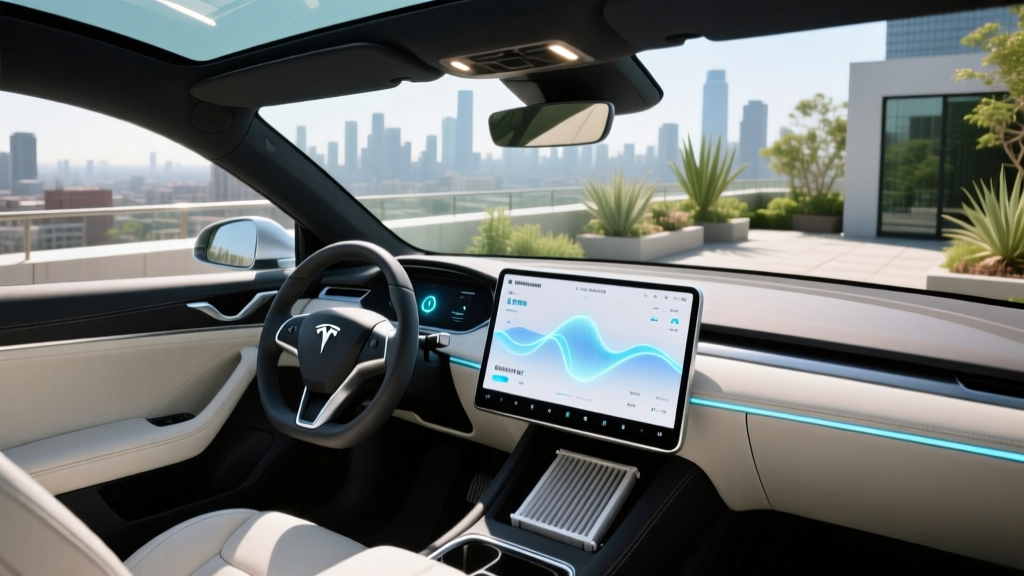
Bioweapon Defense Mode is Tesla's branded name for an advanced cabin air filtration system first introduced on the Model X in 2016 and later added to the Model S and select other Tesla vehicles. It centers on a true HEPA (High-Efficiency Particulate Air) filter — significantly larger and denser than a standard cabin air filter — combined with a secondary activated-carbon layer designed to adsorb gases, odors, and volatile organic compounds (VOCs).
When activated from the climate control screen, the system does three things simultaneously:
- Maximizes recirculation through the HEPA filter, trapping particulates down to 0.3 microns at 99.97% efficiency (the HEPA standard).
- Pressurizes the cabin by pushing filtered air inward, creating a positive-pressure seal that prevents unfiltered outside air from seeping in through door gaps and ventilation seams.
- Ramps the blower to high, cycling cabin air through the filter more rapidly to clear contaminants already inside.
For most owners, the practical use case is far more mundane than the name suggests: commuting through wildfire smoke seasons in California and the Pacific Northwest, reducing allergy-triggering pollen in spring, and keeping diesel exhaust out of the cabin in stop-and-go traffic. In Tesla's own published smoke-chamber test, the company demonstrated the system clearing a heavily contaminated cabin in under two minutes — a claim broadly consistent with independent reviewer tests using particle counters.
2026 Model S Specs: Range, Battery, and Efficiency
| Spec | Model S Long Range | Model S Plaid |
|---|---|---|
| EPA Range | 402 miles | 396 miles |
| Battery (usable) | ~95 kWh (NMC) | ~95 kWh (NMC) |
| Drivetrain | Dual-Motor AWD | Tri-Motor AWD |
| Horsepower | 670 hp | 1,020 hp |
| 0–60 mph | 3.1 seconds | 1.99 seconds |
| Efficiency | 120 MPGe / 28 kWh/100mi | 116 MPGe / 29 kWh/100mi |
| Top Speed | 155 mph | 200 mph |
The Model S uses an NMC (nickel manganese cobalt) lithium-ion pack — chosen for its high energy density, which is essential to hitting 400+ miles in a sedan form factor. The trade-off versus LFP chemistry is that NMC benefits from daily charging to 80–90% rather than 100%, reserving full charges for road trips to minimize long-term degradation.
Charging Speed: DC Fast Charge and Home Level 2
| Level | Power | Speed / Time | Notes |
|---|---|---|---|
| Level 1 (120V) | ~1.4 kW | ~3–4 miles/hour | Emergency/trickle only |
| Level 2 (240V, 48A) | 11.5 kW | ~34 miles/hour | Tesla Wall Connector at home |
| DC Fast Charge | Peak 250 kW | 10–80% in ~27 min | Supercharger V3/V4; tapers above 80% |
The Model S peaks at 250 kW on V3 Superchargers, though it does not sustain that rate for the full session. The charge curve is aggressive between 10–50% SoC (State of Charge), pulling close to peak power, then tapers progressively — by 80% you're typically at 50–70 kW. This means the 10–80% time of roughly 27 minutes is realistic, but 10–100% will take closer to 45–50 minutes. For road trips, the practical strategy is to charge in short, frequent bursts (15–20 minutes per stop) rather than waiting for a full charge.
At home, the Tesla Wall Connector on a 60-amp circuit delivers 48 amps (11.5 kW), adding about 34 miles of range per hour — enough to fully replenish the pack overnight. If your home has a 200-amp electrical panel with spare capacity, installation typically runs $500–$1,500 depending on run length. Homes needing a panel upgrade should budget $2,000–$4,000 additional. Always get a quote from a licensed electrician before committing.
Pricing, Trims, and Federal Tax Credit Eligibility
| Trim | Base MSRP | Federal §30D Credit | Effective Price |
|---|---|---|---|
| Model S Long Range | $74,990 | Eligible (up to $7,500) | ~$67,490* |
| Model S Plaid | $89,990 | Eligible (up to $7,500) | ~$82,490* |
*Effective price assumes full $7,500 credit eligibility. Actual credit depends on buyer income, battery sourcing, and point-of-sale transfer rules.
The 2026 Model S qualifies for the IRS §30D Clean Vehicle Credit because its base MSRP falls under the $55,000 sedan cap — wait, it doesn't. This is where precision matters. The §30D sedan cap is $55,000, and the Model S Long Range at $74,990 exceeds that cap, meaning it is not eligible for the new-vehicle federal tax credit. This is a critical point often missed in casual reviews.
- Vehicle MSRP cap: $55,000 for sedans, $80,000 for SUVs/trucks/vans
- Buyer AGI cap: $150K single / $225K head of household / $300K joint
- Battery critical minerals and component sourcing thresholds (phasing in annually)
- Vehicle must be assembled in North America (Model S: Fremont, CA — qualifies)
- Credit is transferable to dealer at point of sale for an upfront discount
Because the Model S is a sedan priced above $55,000, it does not qualify for the new-vehicle §30D credit. See IRS.gov §30D rules for full details. Consult a tax professional for your specific situation.
However, if you're considering a used Model S (model year 2024 or earlier, purchased from a dealer for $25,000 or less), the §25E used clean vehicle credit of up to $4,000 may apply, subject to lower income caps ($75K single / $150K joint).
Interior, Cargo, and Standout Technology
The 2026 Model S interior is minimalist by design — a 17-inch center touchscreen handles nearly all vehicle controls, a second screen serves rear passengers, and a yoke-style steering wheel (with a round wheel available as a no-cost option) completes the cockpit. Build quality has improved meaningfully since the 2021 refresh, with better panel gaps, ventilated front seats, and a redesigned center console.
Cargo space: 28 cubic feet behind the rear seats (including the rear trunk and front trunk/frunk), expanding to approximately 79 cubic feet with the rear seats folded. Rear legroom measures 35.4 inches — adequate for adults on shorter trips, though the sloping roofline limits headroom for passengers over 6 feet tall.
Standout tech:
- Bioweapon Defense Mode — HEPA filtration with positive pressurization (detailed above)
- Autopilot / FSD (Supervised) — SAE Level 2 driver-assist with lane centering, adaptive cruise, and optional Full Self-Driving capability ($8,000 add-on or $99/month subscription). Requires active driver supervision at all times.
- Over-the-air updates — continuous feature additions and performance improvements
- 1,020-watt, 22-speaker audio system with immersive sound
- Wireless phone charging for front and rear passengers
- Gaming-capable hardware (up to 10 teraflops) for in-car entertainment while parked or charging
Notable drawbacks: The yoke steering wheel requires an adjustment period and can frustrate during low-speed parking maneuvers. The lack of physical buttons for climate and media means more screen tapping than some drivers prefer. Rear-seat visibility is compromised by the fastback roofline. And at $75K–$90K+, the Model S is firmly a luxury-tier purchase with luxury-tier insurance premiums — expect $2,500–$4,000/year depending on your state and driving record.
How the Model S Compares: Lucid Air and Mercedes EQS
| Spec | Tesla Model S LR | Lucid Air Pure | Mercedes EQS 450+ |
|---|---|---|---|
| EPA Range | 402 mi | 419 mi | 390 mi |
| Base MSRP | $74,990 | $69,900 | $104,400 |
| 0–60 mph | 3.1 sec | 5.0 sec | 5.9 sec |
| Peak DC Charge | 250 kW | 200 kW | 200 kW |
| 10–80% Time | ~27 min | ~33 min | ~31 min |
| HEPA Filtration | Yes (Bioweapon Mode) | No (standard cabin filter) | Yes (Energized Air with HEPA option) |
| Supercharger Access | Native (NACS) | Adapter required (NACS) | Adapter required (NACS) |
The Model S occupies a specific niche: it's the performance-and-infrastructure pick. The Lucid Air Pure beats it on range (419 mi) and price ($69,900), and the Lucid Air Grand Touring pushes range to 516 miles — but Lucid's Supercharger access still requires an adapter, and its service center network is far smaller. The Mercedes EQS offers superior interior luxury and a more traditional driving feel but at a significant price premium and with lower efficiency.
Pros, Cons, and Who Should Buy the Model S
- 402-mile EPA range — among the longest of any production EV
- Native Tesla Supercharger network access (17,000+ US stalls)
- Bioweapon Defense Mode — best-in-class cabin air filtration
- Class-leading acceleration, even in Long Range trim
- Continuous OTA updates add features post-purchase
- Spacious frunk + trunk combo (28 cu ft cargo)
- Exceeds $55K sedan cap — no federal new-vehicle tax credit
- Yoke steering is polarizing; round wheel should be default
- High insurance costs ($2,500–$4,000/year)
- Minimalist interior isn't for everyone — no physical buttons
- Plaid's range drops to 396 mi; real-world highway closer to 300
- Service center wait times can be long in some metro areas
- Choose the Model S if you want maximum range with native Supercharger access, value cabin air quality (wildfire/pollen regions), and enjoy rapid acceleration without stepping into supercar pricing.
- Choose the Lucid Air if range-per-dollar is your top priority and you don't mind adapter-based Supercharger access for now.
- Choose the Mercedes EQS if traditional luxury, dealer service, and a quieter, more insulated ride matter more than outright performance or charging speed.
- Look at the Model 3 or Model Y if you want Tesla's tech and Supercharger network but need to stay under the $55K MSRP cap for the $7,500 federal tax credit.
Warranty and Long-Term Ownership
Tesla covers the 2026 Model S with:
- Basic Vehicle Warranty: 4 years / 50,000 miles
- Battery & Drive Unit Warranty: 8 years / 150,000 miles (whichever comes first), with a guaranteed minimum 70% battery capacity retention over that period
The 150,000-mile battery warranty on the Model S is more generous than the 120,000-mile coverage on the Model 3/Y Long Range, reflecting Tesla's confidence in the larger pack's longevity. Real-world data from high-mileage Model S owners shows typical degradation of 10–15% over 100,000 miles, with the steepest drop occurring in the first 20,000 miles before leveling off. Charging habits matter: frequent DC fast charging and routinely charging to 100% accelerate degradation. For daily use, set your charge limit to 80–90% and use Superchargers primarily for road trips.
Frequently Asked Questions
Does Bioweapon Defense Mode work against wildfire smoke?
Yes. The HEPA filter captures fine particulate matter (PM2.5) from wildfire smoke at 99.97% efficiency. Combined with cabin pressurization, it keeps the interior air quality significantly cleaner than outside air. It's one of the most effective factory-installed filtration systems in any passenger vehicle.
Does the 2026 Model S qualify for the $7,500 federal tax credit?
No. Under IRS §30D rules, new sedans must have an MSRP at or below $55,000 to qualify. The Model S starts at $74,990, exceeding the cap. Buyers seeking a Tesla with federal credit eligibility should look at the Model 3 (starting around $38,990) or Model Y (starting around $44,990, classified as an SUV under the $80,000 cap).
What is the real-world highway range of the Model S?
The EPA rates the Long Range at 402 miles. Real-world highway driving at 70–75 mph typically yields 320–350 miles. In cold weather (below freezing), expect 280–320 miles. Aggressive driving or sustained speeds above 80 mph will push range toward 270–300 miles.
How fast does the Model S charge at home?
On a Tesla Wall Connector (48 amps / 11.5 kW on a 60-amp circuit), the Model S adds approximately 34 miles of range per hour, fully charging from empty overnight in about 10–12 hours.
Is the Model S worth it versus the Lucid Air?
It depends on your priorities. The Lucid Air Pure offers more range (419 mi) at a lower price ($69,900) but requires an adapter for Supercharger access and has a smaller service network. The Model S wins on native charging infrastructure, performance, and cabin air filtration. Test-drive both before deciding.
Can I get Bioweapon Defense Mode on other Tesla models?
Bioweapon Defense Mode is available on the Model S and Model X. The Model 3 and Model Y use a smaller, standard cabin air filter without the HEPA-grade media or positive pressurization system, though aftermarket HEPA-style filter upgrades are available from third-party suppliers.