What Is Tesla's Bioweapon Defense Mode?
Bioweapon Defense Mode is Tesla's proprietary cabin air filtration system built around a hospital-grade HEPA (High-Efficiency Particulate Air) filter and a secondary activated-carbon layer. When activated, it pressurizes the cabin to prevent outside air infiltration while scrubbing particulates down to 0.3 microns at 99.97% efficiency, along with gases, odors, and volatile organic compounds (VOCs).
Originally introduced on the Model X in 2016 and later added to the Model S and Model Y, the system remains one of the most advanced HVAC setups in any production vehicle. For 2026, Tesla continues to offer Bioweapon Defense Mode on the Model S, Model X, and Model Y (Long Range and Performance trims). The refreshed Model 3 (Highland and subsequent revisions) uses an improved but differently named filtration system with a smaller HEPA-style filter.
This review examines the filtration technology in detail, then profiles the three Tesla models that carry it — with full specs on range, charging, performance, pricing, and federal tax credit eligibility under current IRS §30D rules.
How the HEPA Filtration System Works
Standard automotive cabin filters capture pollen and larger dust particles. Tesla's Bioweapon Defense Mode goes significantly further:
- HEPA filter media: Approximately 10x the surface area of a typical cabin filter, rated to capture 99.97% of particles at 0.3 microns — including fine particulate matter (PM2.5), bacteria, and allergens.
- Activated carbon layer: Adsorbs gases, exhaust hydrocarbons, ozone, and VOCs that a particle-only filter cannot stop.
- Positive cabin pressure: The system ramps blower speed to maximum and seals recirculation paths, creating a slight positive pressure that prevents unfiltered air from leaking in through door seals and vents.
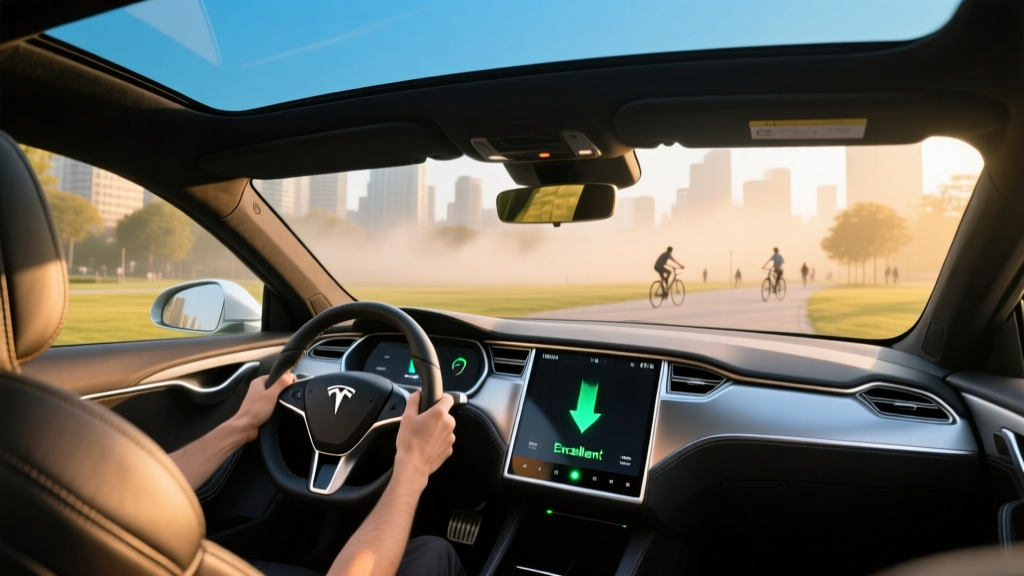
- Real-time AQI display: The touchscreen shows an outside-vs-inside air quality index (AQI) reading, letting you watch indoor AQI drop from hazardous levels to single digits within minutes.
In independent testing by Tesla and third-party reviewers, the system reduced cabin PM2.5 from extreme levels (500+ AQI, simulating wildfire smoke) to near-zero within 2 to 5 minutes depending on cabin volume. For buyers in wildfire-prone regions (California, Oregon, British Columbia) or dense urban corridors, this is not a gimmick — it is a daily-use health feature.
- It does not filter carbon monoxide (CO) — no consumer HEPA system does. Do not rely on it in enclosed garage or tunnel scenarios.
- It does not make the vehicle airtight or submersible.
- It does not replace cabin filter maintenance. Tesla recommends HEPA filter replacement every 2–3 years (or sooner in high-pollution areas), at a service cost of roughly $150–$250.
- Running it at maximum blower speed increases parasitic energy draw, which can reduce range by 1–3% in sustained use.
2026 Tesla Models With Bioweapon Defense Mode: Spec Comparison
| Spec | 2026 Model Y Long Range AWD | 2026 Model S Long Range | 2026 Model X Long Range |
|---|---|---|---|
| EPA Range | 320 mi | 402 mi | 348 mi |
| Battery (usable) | ~75 kWh, NMC | ~95 kWh, NMC | ~95 kWh, NMC |
| Efficiency | 122 MPGe / 27 kWh/100mi | 124 MPGe / 27 kWh/100mi | 109 MPGe / 31 kWh/100mi |
| Drivetrain | Dual-Motor AWD | Dual-Motor AWD | Dual-Motor AWD |
| Horsepower | 384 hp | 670 hp | 670 hp |
| 0–60 mph | 4.8 sec | 3.1 sec | 3.8 sec |
| Max DC Fast Charge | 250 kW (peak) | 250 kW (peak) | 250 kW (peak) |
| 10–80% DC Time | ~27 min | ~30 min | ~31 min |
| Level 2 Home Charge | 11.5 kW (~44 mi/hr) | 11.5 kW (~34 mi/hr) | 11.5 kW (~30 mi/hr) |
| Cargo Volume | 76 cu ft (rear seats folded) | 28 cu ft (trunk + frunk) | 91 cu ft (rear seats folded) |
| Rear Legroom | 41.6 in | 41.7 in | 41.9 in |
| Battery Warranty | 8 yr / 120,000 mi | 8 yr / 150,000 mi | 8 yr / 150,000 mi |
| Base MSRP | $48,990 | $79,990 | $84,990 |
Sources: EPA fueleconomy.gov, Tesla Model Y specs, Tesla Model S specs, Tesla Model X specs. Specs reflect 2026 model year as published; verify at time of purchase.
Real-World Range: What to Actually Expect
- Model Y LR (EPA 320 mi): Expect ~275–290 mi on mixed driving; ~250–265 mi sustained highway at 75 mph; ~220–240 mi in freezing temps with cabin heat.
- Model S LR (EPA 402 mi): Expect ~350–370 mi mixed; ~320–340 mi highway; ~280–310 mi in cold weather.
- Model X LR (EPA 348 mi): Expect ~300–315 mi mixed; ~270–285 mi highway; ~235–255 mi cold weather.
Running Bioweapon Defense Mode continuously at max blower adds roughly 0.5–1.5 kW of parasitic load — noticeable on long wildfire-smoke days but minimal on short commutes.
Tesla's NMC (nickel-manganese-cobalt) battery chemistry in all three models provides high energy density but is more sensitive to sustained 100% state-of-charge storage. Tesla recommends daily charging to 80–90% for NMC packs, reserving 100% for road trips. Long-term degradation data from fleet studies shows approximately 10–12% capacity loss at 150,000 miles under typical use patterns.
Charging Speed: DC Fast, Level 2, and the Supercharger Advantage
| Charging Level | Power / Speed | Practical Notes |
|---|---|---|
| Level 1 (120V) | ~1.4 kW / 3–5 mi/hr | Emergency/top-up only; full charge takes 3+ days |
| Level 2 (240V home) | 11.5 kW / 30–44 mi/hr | Full overnight charge in 8–10 hours; requires 60A circuit |
| DC Fast (Supercharger V3) | 250 kW peak / 10–80% in ~27–31 min | Peak rate only below ~50% SoC; tapers significantly above 80% |
| DC Fast (V4 Supercharger) | Up to 250 kW (vehicle-limited) | Current Teslas cap at 250 kW; future architectures may go higher |
Charging curve reality check: Tesla's 250 kW peak rate applies only when the battery is warm (preconditioned via navigation to a Supercharger) and at low state-of-charge. In practice, the Model Y sustains roughly 150–170 kW from 20–60%, then tapers to ~80 kW by 75%, and drops below 40 kW past 85%. The larger Model S/X batteries sustain higher absolute power longer, but the taper pattern is similar. Always precondition by entering a Supercharger as your navigation destination — this warms the battery and can shave 5–8 minutes off your charge stop.
All three models use the NACS (North American Charging Standard) connector natively, giving access to Tesla's Supercharger network — over 25,000 stalls in North America as of 2026. With a CCS adapter (sold separately by Tesla for ~$175), you can also use Electrify America, EVgo, and other CCS networks, though at reduced peak rates on some stations.
Pricing, Trims, and Federal Tax Credit Eligibility
| Model / Trim | Base MSRP | Est. §30D Credit | Effective Price |
|---|---|---|---|
| Model Y Long Range AWD | $48,990 | $3,750–$7,500* | $41,490–$45,240 |
| Model Y Performance | $52,490 | $3,750–$7,500* | $44,990–$48,740 |
| Model S Long Range | $79,990 | $0† | $79,990 |
| Model X Long Range | $84,990 | $0† | $84,990 |
* Model Y credit amount depends on battery-sourcing and critical-minerals compliance for the specific production batch. Verify current eligibility on IRS.gov §30D guidelines or via the point-of-sale transfer tool at the dealer. Amount may be $3,750 (critical minerals only) or $7,500 (both requirements met).
† Model S and Model X exceed the §30D MSRP cap for SUVs ($80,000) and sedans ($55,000). The Model X at $84,990 exceeds the $80,000 SUV cap; the Model S at $79,990 exceeds the $55,000 sedan cap. Neither qualifies for the new-vehicle federal credit. Income caps also apply: modified AGI must not exceed $150,000 (single), $225,000 (head of household), or $300,000 (joint).
- Vehicle MSRP must be ≤ $55,000 (sedans) or ≤ $80,000 (SUVs/trucks) — Model Y qualifies; Model S/X do not
- Buyer modified AGI must be within IRS income caps
- Battery components must meet North American manufacturing thresholds (phasing in annually)
- Critical minerals must meet sourcing requirements (phasing in annually)
- Credit can be transferred to the dealer at point of sale as an immediate price reduction
- Vehicle must be new, purchased for personal use, and predominantly used in the US
Performance, Tech, and Daily Livability
All three models deliver dual-motor all-wheel drive with excellent traction in rain and light snow. The Model S remains the performance benchmark — its 3.1-second 0–60 time outpaces most sports cars, and its 402-mile EPA range is among the highest of any production EV sold in the US. The Model Y trades some range and power for a far more accessible price and crossover practicality. The Model X adds falcon-wing rear doors, standard third-row seating (6- or 7-seat configs), and the most cargo volume of the three.
Infotainment and Driver Assistance
Tesla's 15.4-inch center touchscreen (17-inch in Model S/X, tilt-capable) handles all vehicle controls, navigation, media, and climate. The instrument cluster is minimal — a small driver display in Model S/X, and no cluster at all in the Model Y (information shown on the main screen). Apple CarPlay and Android Auto are not supported; Tesla's native interface handles CarPlay-equivalent functions through its own apps.
Every Tesla ships with Basic Autopilot (SAE Level 2), which includes adaptive cruise control and lane-centering on highways. The optional Full Self-Driving (Supervised) package ($8,000 one-time or $99/month as of early 2026) adds automatic lane changes, traffic-light/stop-sign recognition, and city-street navigation-assisted driving.
Both Autopilot and FSD (Supervised) are SAE Level 2 systems. The driver must remain fully attentive, keep hands on the wheel, and be prepared to take over at any moment. These are not self-driving systems. Level 4 (true driverless operation in defined areas) is currently offered only by commercial robotaxi services like Waymo — not in any consumer Tesla.
Cargo and Passenger Space
The Model Y offers 76 cubic feet of cargo space with the second row folded — competitive with midsize gas SUVs and enough for camping gear, Costco runs, or a family road trip. Rear legroom of 41.6 inches is generous. The Model X provides up to 91 cu ft and an available third row, though the third row is best suited for children. The Model S, as a sedan, offers 28 cu ft total (trunk + frunk) — adequate for luggage but not bulky items.
Pros, Cons, and the Verdict
Pros
- Best-in-class cabin air filtration; genuinely valuable in wildfire/smog regions
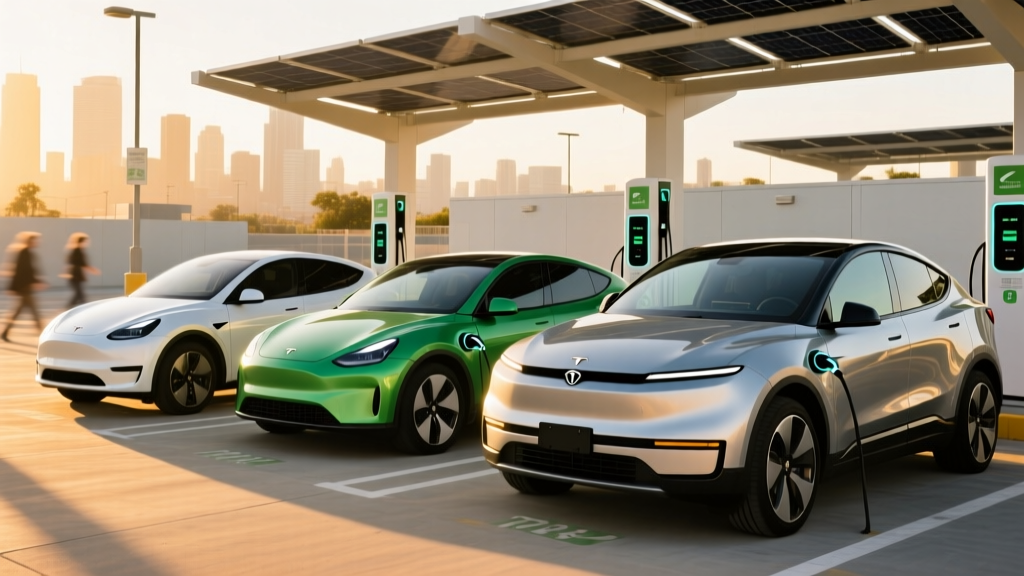
- Supercharger network access — the most reliable DC fast-charging ecosystem in North America
- Class-leading efficiency (kWh/100mi) across all three models
- Strong acceleration and standard AWD
- Over-the-air updates continuously add features
- Model Y qualifies for partial or full §30D federal tax credit
Cons
- No Apple CarPlay or Android Auto
- Model S and Model X do not qualify for the federal EV tax credit (MSRP cap)
- HEPA filter replacement cost ($150–$250 every 2–3 years)
- Build quality and panel gaps remain inconsistent vs. legacy luxury brands
- Insurance premiums tend to run 15–30% higher than comparable non-Tesla EVs
- Model Y 250 kW peak charge rate trails Hyundai Ioniq 5/Kia EV6 at 350 kW on 800V chargers
Who Should Buy?
- Choose the Model Y LR if you want the best value: crossover space, 320 mi range, tax credit eligibility, and Bioweapon Defense Mode under $50K.
- Choose the Model S LR if you need 400+ mi range, sedan refinement, and blistering acceleration — and don't need the federal credit.
- Choose the Model X LR if you need three rows of seating, maximum cargo volume, and falcon-wing doors for tight parking-access — and accept the premium price without a tax credit.
- Look elsewhere if you prioritize Apple CarPlay, the fastest possible DC charging (800V competitors), or a traditional luxury interior (BMW iX, Mercedes EQS SUV).
Frequently Asked Questions
Does the Tesla Model 3 have Bioweapon Defense Mode?
The refreshed Model 3 (Highland generation and later) uses an upgraded HEPA-style cabin filter with improved particulate capture, but Tesla does not brand it as "Bioweapon Defense Mode" and it lacks the larger filter housing and positive-pressure system of the Model Y/S/X. It is a meaningful improvement over the pre-2024 Model 3 filter but does not match the full BDM system's capacity.
How often does the HEPA filter need replacement?
Tesla recommends replacing the HEPA filter every 2–3 years under normal conditions. In areas with heavy wildfire smoke, industrial pollution, or frequent dust storms, annual replacement may be warranted. The cabin air filter (standard, non-HEPA) should be replaced every 2 years. Service costs range from $150–$250 depending on model and location.
Does running Bioweapon Defense Mode reduce range?
Yes, but modestly. The high-speed blower motor and recirculation system draw approximately 0.5–1.5 kW of additional power. Over an hour of driving, that translates to roughly 1–3% range reduction. On a 300-mile trip, expect to lose 3–9 miles of range — a small trade-off for clean cabin air during smoke events.
Can Bioweapon Defense Mode protect against wildfire smoke?
Yes — this is one of its strongest real-world use cases. The HEPA filter captures PM2.5 particulates (the primary health hazard in wildfire smoke) at 99.97% efficiency, and the positive-pressure seal prevents smoke infiltration. Multiple independent tests have demonstrated cabin AQI dropping from 300+ to under 10 within 3–5 minutes of activation. It does not eliminate all VOCs from smoke, but the activated carbon layer significantly reduces them.
Does the Tesla Model Y qualify for the $7,500 federal tax credit?
The Model Y may qualify for either $3,750 or the full $7,500 under IRS §30D, depending on whether the specific vehicle meets both the critical-minerals and battery-component sourcing requirements. These thresholds change annually. The buyer must also meet income caps ($150K single / $300K joint). Always verify eligibility on IRS.gov before purchase, and confirm the specific VIN's eligibility with Tesla at the point of sale. The credit can be applied as a point-of-sale price reduction.
Is Bioweapon Defense Mode worth it over a regular cabin filter?
If you live in or frequently travel through areas affected by wildfire smoke, urban smog, dust storms, or high pollen counts, the system provides measurable health benefits that a standard cabin filter cannot match. For buyers in clean-air rural areas who rarely encounter pollution events, the benefit is less pronounced — though it still provides superior filtration on highway drives behind diesel trucks and in construction zones.