The 2026 Tesla BEV Lineup: What Buyers Actually Need to Know
Tesla remains the default reference point for battery-electric vehicles in the United States. Whether you're cross-shopping a Tesla BEV against a Hyundai Ioniq 5, Ford Mustang Mach-E, or Rivian R1S, the decision hinges on hard numbers: real-world range versus the EPA sticker, actual sustained DC fast-charging speeds (not just peak kW), total cost after the federal §30D tax credit, and whether the Supercharger network advantage still matters in 2026 now that NACS has become the industry standard.
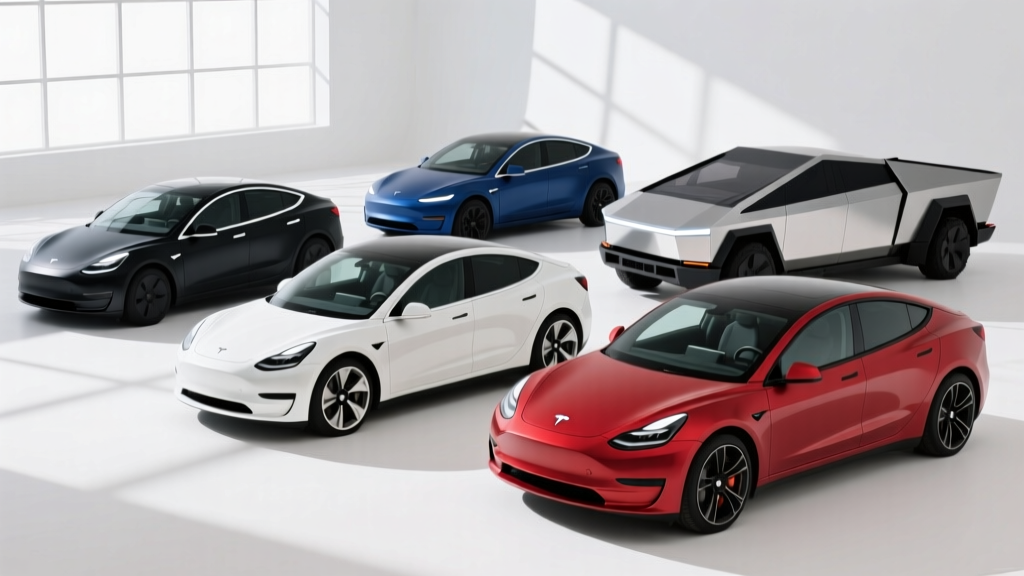
This review covers every current-production Tesla BEV sold in the US for the 2026 model year — the refreshed Model 3, the new-generation Model Y, the Model S and Model X luxury flagships, and the Cybertruck. We'll give you the exact figures that matter, flag where real-world ownership diverges from marketing claims, and help you decide which Tesla BEV (if any) fits your driving pattern and budget.
Side-by-Side Spec Table: Every 2026 Tesla BEV at a Glance
| Spec | Model 3 LR AWD | Model Y LR AWD | Model S LR | Model X LR | Cybertruck AWD |
|---|---|---|---|---|---|
| EPA Range | 363 mi | 320 mi | 402 mi | 335 mi | 340 mi |
| Battery (usable, est.) | ~75 kWh (NMC) | ~75 kWh (NMC) | ~95 kWh (NMC) | ~95 kWh (NMC) | ~123 kWh (NMC) |
| Drivetrain | Dual-motor AWD | Dual-motor AWD | Dual-motor AWD | Dual-motor AWD | Dual-motor AWD |
| 0-60 mph | 4.2 sec | 4.8 sec | 3.1 sec | 3.8 sec | 3.9 sec |
| Horsepower | ~346 hp | ~384 hp | ~670 hp | ~670 hp | ~600 hp |
| Peak DC Charge | 250 kW | 250 kW | 250 kW | 250 kW | 250 kW |
| 10-80% DCFC Time | ~27 min | ~27 min | ~30 min | ~30 min | ~35 min |
| Level 2 Rate | 11.5 kW (~44 mi/hr) | 11.5 kW (~44 mi/hr) | 11.5 kW (~36 mi/hr) | 11.5 kW (~30 mi/hr) | 11.5 kW (~30 mi/hr) |
| EPA Efficiency | 132 MPGe (25 kWh/100mi) | 122 MPGe (28 kWh/100mi) | 124 MPGe (27 kWh/100mi) | 112 MPGe (30 kWh/100mi) | 78 MPGe (43 kWh/100mi) |
| Cargo (rear seats up) | 23 cu ft | 30 cu ft (+12 frunk) | 28 cu ft (+3 frunk) | 37 cu ft (+7 frunk) | 34 cu ft (+7 frunk) |
| Base MSRP | $47,740 | $49,990 | $79,990 | $84,990 | $79,990 |
| Battery Warranty | 8 yr / 120,000 mi | 8 yr / 120,000 mi | 8 yr / 150,000 mi | 8 yr / 150,000 mi | 8 yr / 120,000 mi |
Sources: fueleconomy.gov (EPA data), Tesla.com 2026 order configurator. Prices exclude destination fee unless noted. Specs reflect Long Range AWD trims where applicable.
Real-World Range: What the EPA Sticker Doesn't Tell You
EPA estimates assume a mix of city and highway driving at moderate temperatures. In practice:
• Highway-only at 75 mph: Expect 10-15% less than EPA (e.g., Model 3 LR: ~310 mi instead of 363 mi)
• Cold weather (below 32°F): Expect 20-30% range reduction due to battery heating demands and cabin climate load
• Best-case city driving: Regen-heavy stop-and-go can match or slightly exceed EPA numbers
• Towing (Cybertruck): Range drops 40-50% when towing near max capacity
Tesla's trip planner and in-car energy graph are among the best in the industry for predicting arrival State of Charge (SoC), but the physics remain unchanged: aerodynamic drag dominates at highway speed, and lithium-ion cells lose effective capacity in freezing temperatures regardless of the chemistry. Tesla uses NMC (nickel manganese cobalt) chemistry across its 2026 lineup in the US, which offers higher energy density than LFP but is more sensitive to extreme cold.
For the Model 3 Long Range, owners consistently report 290-320 miles on summer road trips at 70-75 mph and 240-270 miles in sub-freezing winter highway driving. The Model Y, with its taller, less aerodynamic crossover profile, typically delivers 270-295 real-world highway miles in fair weather. The Model S benefits from its larger battery pack and sleek sedan shape, yielding 340-370 real-world highway miles — still the longest-range Tesla BEV you can buy.
Charging Speed: Peak kW vs. Sustained Reality
This is where Tesla BEVs draw the most scrutiny in 2026. While competitors like the Hyundai Ioniq 5 and Kia EV6 offer 800V architectures enabling 350 kW peak charging, Tesla's fleet tops out at 250 kW on V3 Superchargers. Here's what that means in practice:
| Charging Level | Power (kW) | Typical Miles Added per Hour | Use Case |
|---|---|---|---|
| Level 1 (120V outlet) | ~1.4 kW | 3-5 mi/hr | Emergency / overnight trickle |
| Level 2 (240V home Wall Connector) | 11.5 kW | 30-44 mi/hr (varies by model) | Daily home charging — full overnight refill |
| DC Fast Charge (V3 Supercharger) | Up to 250 kW peak | ~170 mi in 15 min (Model 3) | Road trips; tapers significantly above 80% SoC |
| DC Fast Charge (V4 Supercharger) | Up to 250 kW (current Tesla vehicles) | Same as V3 for current fleet | Newer stations with CCS/NACS cable management; higher-power vehicles expected in future |
Charge curve reality check: No Tesla BEV sustains 250 kW for the entire 10-80% session. Peak rate is typically reached between 10-30% SoC when the battery is preconditioned (navigate to a Supercharger in the car and it warms the pack automatically). Above 50% SoC, the rate drops to roughly 150 kW; above 80%, it falls below 75 kW. This is why Tesla and EPA data quote 10-80% times rather than 0-100%.
For home charging, Tesla's Wall Connector on a 60-amp circuit delivers 11.5 kW (48 amps continuous). That adds roughly 44 miles of range per hour in a Model 3 — meaning a depleted pack reaches full in about 8-9 hours overnight. Most owners charging nightly from 30-80% SoC need only 4-5 hours on Level 2, well within off-peak electricity windows.
Pricing, Trims, and Federal Tax Credit Eligibility
Tesla pricing fluctuates more than legacy automakers — sometimes weekly. As of early 2026, here's where the lineup stands before destination charges and options:
| Model / Trim | Base MSRP | Under §30D MSRP Cap? | Max Federal Credit | Est. Price After Credit |
|---|---|---|---|---|
| Model 3 RWD | $42,490 | Yes (sedan cap: $55,000) | Up to $7,500 | ~$34,990 |
| Model 3 Long Range AWD | $47,740 | Yes | Up to $7,500 | ~$40,240 |
| Model 3 Performance | $54,990 | Yes (close to cap) | Up to $7,500 | ~$47,490 |
| Model Y Long Range AWD | $49,990 | Yes (SUV cap: $80,000) | Up to $7,500 | ~$42,490 |
| Model Y Performance | $53,490 | Yes | Up to $7,500 | ~$45,990 |
| Model S Long Range | $79,990 | Yes (sedan cap: $55,000 — NO) | $0 | $79,990 |
| Model X Long Range | $84,990 | Yes (SUV cap: $80,000 — NO) | $0 | $84,990 |
| Cybertruck AWD | $79,990 | Yes (truck cap: $80,000) | Up to $7,500* | ~$72,490* |
Critical tax credit caveats (IRS §30D, 2026 rules):
- Income caps: Modified AGI must not exceed $150,000 (single), $225,000 (head of household), or $300,000 (married filing jointly).
- MSRP caps: $55,000 for sedans; $80,000 for SUVs, vans, and trucks. The Model S and Model X exceed these caps and do NOT qualify.
- Battery sourcing: The full $7,500 requires meeting both critical-minerals and battery-component requirements set by the IRS. Partial credit ($3,750) applies if only one requirement is met. Tesla's supply chain has progressively shifted to compliant sourcing, but verify current eligibility at the point of sale — rules tighten annually.
- Point-of-sale transfer: As of 2024, buyers can transfer the credit to the dealer at purchase, reducing the upfront price rather than waiting for a tax refund. Tesla supports this at delivery.
*Cybertruck credit eligibility depends on IRS classification as a truck and current battery-sourcing compliance. Confirm at purchase.
Performance, Efficiency, and Daily Practicality
Every Tesla BEV in 2026 delivers brisk acceleration that outpaces most gas-powered equivalents. The Model S Plaid (not reviewed in depth here; $89,990, 1,020 hp, 1.99-sec 0-60) remains a hypercar-slayer, but even the base Model 3 RWD hits 60 mph in 5.8 seconds — quicker than a Toyota Camry V6 of a decade ago.
Efficiency leadership: Tesla's heat pump (standard across the fleet) and integrated powertrain give it an edge in energy consumption. The Model 3 LR achieves 25 kWh per 100 miles (132 MPGe combined per fueleconomy.gov), meaning a full charge costs roughly $9-14 at the national average residential electricity rate of $0.16/kWh. Compare that to a 30 MPG gas sedan at $3.50/gallon: $11.67 per 350 miles. The EV wins on cost in most states, and the gap widens if you have access to off-peak utility rates or free workplace charging.
Cargo and passenger space: The Model Y's 30 cu ft rear cargo area (76 cu ft with seats folded) plus a 4.1 cu ft front trunk makes it the most practical Tesla BEV for families. The Model 3 sedan offers 23 cu ft — adequate for groceries and luggage but tight for bulky items. The Model X's falcon-wing doors and available third row (seating up to 7) cater to larger families, though the third row is best suited for children. The Cybertruck's 6-foot bed and 11,000-lb towing capacity serve truck-buyer needs, but its stainless-steel exoskeleton and polarizing design limit its appeal.
Tech, Autopilot, and FSD (Supervised): What You're Actually Getting
Tesla Autopilot and Full Self-Driving (Supervised) are SAE Level 2 driver-assistance systems. The driver must remain fully attentive, keep hands available for steering input, and be prepared to take over at any moment. These are NOT Level 4 autonomous systems like Waymo's driverless robotaxis. Misuse of these systems — treating them as self-driving — has been a factor in NHTSA-investigated crashes.
Tesla's infotainment remains a differentiator: a single 15.4-inch touchscreen handles navigation, climate, media, vehicle settings, and even gaming (the car can run Cyberpunk 2077 while parked). There is no Apple CarPlay or Android Auto — Tesla insists on its proprietary software stack, which integrates navigation with Supercharger routing, battery preconditioning, and energy prediction.
Autopilot (included) provides adaptive cruise control and lane-centering on highways. FSD (Supervised), available as an $8,000 one-time purchase or $99/month subscription in 2026, adds automated lane changes, traffic-light and stop-sign recognition, and city-street navigation. Real-world FSD performance varies enormously by geography and road complexity — it handles well-mapped suburban arterials competently but still requires vigilant supervision in construction zones, unmapped roads, and adverse weather.
Notable drawbacks: Tesla's minimalist interior means everything routes through the touchscreen — including glovebox release, mirror adjustment, and windshield wiper speed. Some buyers love the simplicity; others find it distracting. Build quality has improved substantially since the Fremont-era panel-gap reputation, but it still doesn't match the fit and finish of a Mercedes EQS or BMW iX at the luxury end.
Pros and Cons: The Honest Summary
- Class-leading energy efficiency (kWh/100mi)
- Supercharger network: most reliable DC fast-charging ecosystem in North America
- Over-the-air updates continuously add features
- Strong resale value relative to most EVs
- Excellent real-world range prediction and trip planning
- Heat pump standard — better cold-weather range retention
- 250 kW peak DC charging lags 800V competitors (350 kW capable)
- No Apple CarPlay / Android Auto
- FSD (Supervised) costs extra and remains Level 2 — not autonomous
- Minimalist interior frustrates some drivers; touchscreen dependency
- Model S/X priced out of federal tax credit eligibility
- Insurance premiums run 15-30% higher than comparable gas vehicles in many states
Who Should Buy a Tesla BEV — And Who Shouldn't?
- Choose a Tesla BEV if: You want access to the Supercharger network, value OTA software updates, prioritize efficiency and range per dollar, and are comfortable with a touchscreen-centric interface. The Model 3 and Model Y are the strongest value propositions, especially after the §30D credit.
- Look elsewhere if: You need 350 kW DC fast-charging for frequent long road trips (consider Hyundai Ioniq 5 or Kia EV6 with 800V architecture), you want Apple CarPlay, you need a luxury interior at the $80K+ level (BMW iX, Mercedes EQS), or you want a true Level 4 autonomous experience (Waymo in available cities).
- Consider a PHEV instead if: You lack reliable home charging access, frequently drive in extreme cold with no garage, or regularly exceed 400 miles between stops in rural areas with sparse charging infrastructure.
Frequently Asked Questions
What is the real-world range of a Tesla BEV?
Real-world range depends on model, speed, and temperature. For the best-selling Model 3 Long Range (EPA 363 mi), expect 290-320 miles on a summer highway trip at 70-75 mph and 240-270 miles in freezing winter conditions. The Model S Long Range (EPA 402 mi) delivers 340-370 real-world highway miles in fair weather — the longest of any current Tesla.
How fast does a Tesla BEV charge at home and on the road?
At home on a Level 2 Tesla Wall Connector (11.5 kW / 48A), the Model 3 adds about 44 miles of range per hour, fully recharging overnight in 8-9 hours. On a V3 or V4 Supercharger, peak rate is 250 kW, delivering roughly 170 miles in 15 minutes. However, the charge curve tapers: 10-80% takes approximately 27 minutes for Model 3/Y and 30-35 minutes for Model S/X and Cybertruck. Charging from 80-100% adds another 20+ minutes and is rarely worth the wait on road trips.
How much does a Tesla BEV cost after the federal tax credit?
The Model 3 RWD starts at $42,490 and can drop to approximately $34,990 after the full $7,500 §30D credit — if you meet income caps ($150K single / $300K joint), the vehicle meets battery-sourcing requirements, and you transfer the credit at point of sale. The Model Y LR drops from $49,990 to ~$42,490. The Model S ($79,990) and Model X ($84,990) exceed MSRP caps and do not qualify for the federal credit. Always verify current eligibility via the IRS clean vehicle credit page.
Is a Tesla BEV worth buying versus competitors in 2026?
For the Model 3 and Model Y segments: yes, if Supercharger access and efficiency are priorities. The Hyundai Ioniq 5 charges faster (350 kW peak on 800V), the BMW i4 offers a more traditional luxury interior, and the Ford Mustang Mach-E provides CarPlay. But Tesla's combination of range, efficiency, software integration, and charging infrastructure remains hard to beat at the $40-50K price point after credits. For luxury buyers spending $80K+, the BMW iX, Mercedes EQS, and Lucid Air offer superior interiors and, in Lucid's case, longer range.
Does every Tesla BEV qualify for the $7,500 federal EV tax credit?
No. Only models under the MSRP cap qualify: $55,000 for sedans (Model 3) and $80,000 for SUVs/trucks (Model Y, Cybertruck base). The Model S and Model X exceed these limits. Additionally, buyers must meet income caps, and the vehicle must satisfy IRS battery-sourcing and critical-minerals requirements, which tighten each year. The credit can be $3,750 (partial) or $7,500 (full) depending on compliance. Confirm eligibility at the time of purchase.
What is Tesla's battery warranty and how long do the batteries last?
Tesla warranties its battery packs and drive units for 8 years / 120,000 miles (Model 3, Model Y, Cybertruck) or 8 years / 150,000 miles (Model S, Model X), whichever comes first, with a minimum 70% capacity retention guarantee. Real-world degradation data from fleet studies shows Tesla NMC packs typically retain 85-90% capacity at 100,000 miles, with the steepest drop occurring in the first 10,000-20,000 miles before leveling off. Full battery replacement outside warranty currently costs between $12,000 and $20,000 depending on the model.