Why the Tesla vs BYD Sales Race Matters for Buyers
The global battle for EV supremacy reached a pivotal moment in early 2026. While BYD dominated total electrified vehicle deliveries (including plug-in hybrids), pure battery-electric sales told a different story: Tesla reclaimed the global BEV crown, outselling BYD's battery-only lineup in Q1 2026 by a narrow but significant margin. For US buyers, this macro trend distills into a micro decision — is the Tesla Model Y still the EV to beat, especially as BYD eyes international expansion and competitors close the gap?
This review dissects the 2026 Tesla Model Y across every metric that matters: real-world range, charging speed, pricing after federal incentives, interior practicality, and whether the sales leader actually deserves your money. We'll also benchmark it against the BYD Sealion 6 and other rivals reshaping the midsize electric SUV segment.
Range and Efficiency: EPA Numbers vs Highway Reality
The 2026 Tesla Model Y Long Range AWD carries an EPA-estimated range of 320 miles on its 78.1 kWh (usable) battery pack. The base Rear-Wheel Drive variant, equipped with a 60 kWh LFP (lithium iron phosphate) battery, is rated at 260 miles. These figures place the Model Y squarely in the competitive sweet spot for the midsize electric SUV class.
Model Y Long Range AWD: EPA 320 mi | Expect 275–295 mi on mixed highway driving at 70 mph. In cold weather (below 30°F), plan for 230–260 mi due to cabin heating loads and reduced battery chemistry efficiency.
Model Y RWD (LFP): EPA 260 mi | Expect 220–240 mi highway; 180–210 mi in freezing conditions. LFP chemistry suffers slightly more cold-weather range loss than NMC, but offers superior longevity and 100% SoC daily charging tolerance.
Efficiency remains a Tesla strong point. The Long Range AWD achieves 122 MPGe combined (28 kWh/100 mi) per fueleconomy.gov, which is class-leading for an AWD crossover of this size. The heat pump — standard on all 2026 trims — recovers waste heat from the drivetrain to warm the cabin, partially offsetting winter range penalties.
| Spec | RWD (Base) | Long Range AWD | Performance |
|---|---|---|---|
| EPA Range | 260 mi | 320 mi | 295 mi |
| Battery (usable) | 60 kWh (LFP) | 78.1 kWh (NMC) | 78.1 kWh (NMC) |
| Drivetrain | RWD single motor | AWD dual motor | AWD dual motor |
| Horsepower | 295 hp | 384 hp | 456 hp |
| 0–60 mph | 6.6 sec | 4.8 sec | 3.5 sec |
| MPGe (combined) | 128 MPGe | 122 MPGe | 111 MPGe |
| Max DC Charge | 170 kW | 250 kW | 250 kW |
| Base MSRP | $44,990 | $48,990 | $53,490 |
Charging Speed: Supercharger Network Advantage
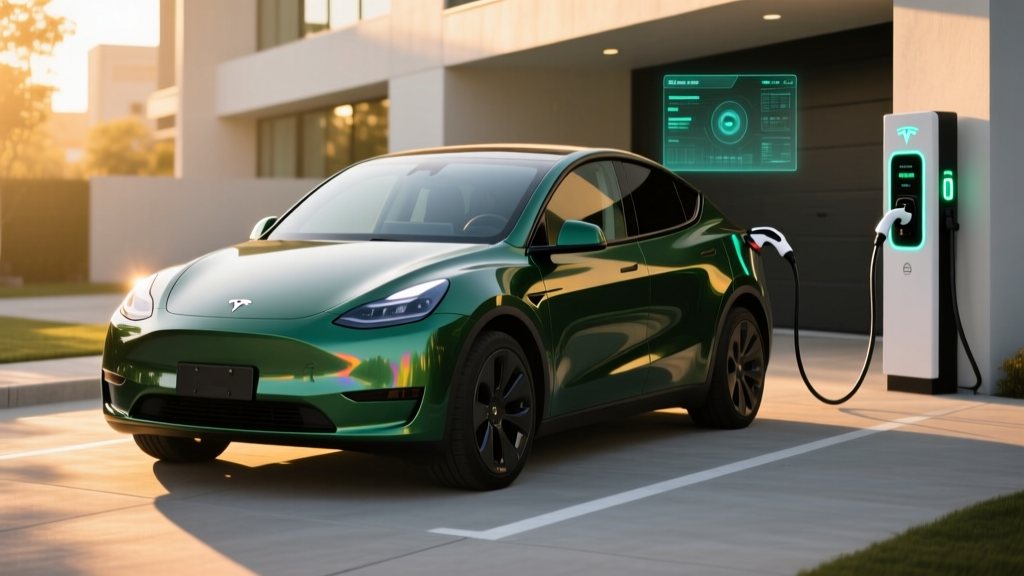
Charging infrastructure remains Tesla's most defensible moat, even as the North American Charging Standard (NACS) opens Supercharger stalls to Ford, Rivian, and GM EVs. The 2026 Model Y Long Range and Performance trims peak at 250 kW on V3 and V4 Superchargers, while the RWD model tops out at 170 kW due to its LFP pack's lower charge-rate tolerance.
| Charge Level | Power / Rate | 10–80% Time | Miles Added per Hour |
|---|---|---|---|
| Level 1 (120V) | 1.4 kW | N/A (days) | ~4 mi/hr |
| Level 2 (240V / 48A) | 11.5 kW | ~7.5 hrs (0–100%) | ~37 mi/hr |
| DC Fast (V3 Supercharger) | Up to 250 kW peak | ~22 min (LR AWD) | ~200+ mi in 15 min |
| DC Fast (V4 Supercharger) | Up to 250 kW peak | ~22 min (LR AWD) | ~200+ mi in 15 min |
The charging curve matters more than peak numbers. The Long Range sustains roughly 200+ kW up to about 40% SoC before tapering to ~150 kW through 60%, then drops progressively to ~60 kW by 80%. That 10–80% sprint in roughly 22 minutes is competitive with Hyundai's E-GMP platform (Ioniq 5 at 350 kW peak, ~18 min) but still among the fastest in the segment for real-world network availability — Supercharger reliability vastly outpaces Electrify America's uptime record.
For home charging, a 48-amp Level 2 wall connector on a 60-amp circuit adds about 37 miles of range per hour. Most owners who charge overnight will wake up to a full battery regardless of trim. Installation typically runs $800–$2,000 depending on panel proximity; a 200-amp panel upgrade adds $1,500–$3,000 if your home needs it.
Pricing, Tax Credits, and Total Cost
Tesla's pricing strategy has stabilized after years of volatility. The 2026 Model Y lineup starts at $44,990 for the RWD and climbs to $53,490 for the Performance — all figures including the $1,390 destination fee. The Long Range AWD at $48,990 is the volume seller and the trim most buyers should target for its range and dual-motor traction.
| Trim | Base MSRP | §30D Credit | Effective Price |
|---|---|---|---|
| RWD | $44,990 | Up to $7,500* | ~$37,490 |
| Long Range AWD | $48,990 | Up to $7,500* | ~$41,490 |
| Performance | $53,490 | Up to $7,500* | ~$45,990 |
*Federal §30D credit eligibility requires: buyer AGI ≤ $150K (single) / $300K (joint), vehicle MSRP ≤ $80K (SUVs), and compliant battery critical-mineral and component sourcing. The Model Y qualifies for the full $7,500 as of early 2026 due to Tesla's North American battery supply chain, but IRS rules evolve — verify at irs.gov before purchase. The credit is now transferable at point of sale, meaning you can apply it as an immediate discount at the dealership rather than waiting for tax filing.
On total cost of ownership, the Model Y Long Range driven 15,000 miles annually costs roughly $550–$700 per year in electricity (at $0.14/kWh national average) versus $1,800+ for a comparable gas SUV at 25 MPG and $3.20/gallon. Over five years, fuel savings alone approach $6,000–$7,000, partially offsetting the higher insurance premiums EVs typically carry (plan for 15–25% above gas equivalents per industry data).
Interior, Cargo, and Daily Practicality
The 2026 Model Y's "Juniper" refresh brought meaningful interior upgrades: ventilated front seats, ambient lighting, a rear-seat touchscreen, and improved acoustic glass that drops cabin noise by roughly 3 dB at highway speed. The minimalist single-screen layout remains polarizing — there are no physical buttons for climate or mirrors, and everything routes through the 15.4-inch center display.
Cargo volume is genuinely class-leading: 30.2 cubic feet behind the second row and 72.1 cubic feet with the rear seats folded. The front trunk (frunk) adds 4.1 cubic feet for charging cables or a small bag. Rear legroom measures 41.6 inches — enough for six-foot passengers to sit behind a similarly sized driver without knee contact.
The 7-seat option remains available on the Long Range but is best suited for children; third-row legroom is 26.8 inches, which no adult will tolerate beyond a short school run. For families needing genuine three-row space, the Kia EV9 or Rivian RWS remains a better fit.
Technology and Driver Assistance
Tesla's infotainment system is arguably the most responsive in the industry, with a custom AMD Ryzen processor handling navigation, streaming (Netflix/YouTube while parked), and gaming. Over-the-air updates continue to add features post-purchase — recent additions include adaptive high beams, improved trip planner routing, and Dashcam Sentry enhancements.
Tesla Autopilot (standard) and Full Self-Driving Supervised ($8,000 option) are SAE Level 2 driver-assistance systems. They do NOT make the Model Y self-driving. The driver must remain attentive, keep hands on the wheel (or demonstrate engagement via camera monitoring), and be prepared to intervene at any moment. True Level 4 autonomy — no driver required — currently exists only in geofenced robotaxi services like Waymo.
Autopilot's highway lane-keeping and adaptive cruise remain among the smoothest in the segment, but FSD Supervised still exhibits hesitation at complex unprotected left turns and construction-zone lane merges. For most buyers, the included Basic Autopilot is sufficient for highway commuting. The $8,000 FSD upgrade is difficult to recommend unless you anticipate future unsupervised capability — which Tesla has projected but not yet delivered or received regulatory approval for.
Notable drawbacks: the lack of Apple CarPlay/Android Auto frustrates smartphone-integration loyalists, and Tesla's reliance on camera-only vision (no radar or ultrasonic sensors since 2022) occasionally produces phantom braking events and less reliable parking-assist proximity detection compared to ultrasonic-equipped rivals.
Warranty Coverage and Battery Longevity
Tesla's warranty structure is competitive but not class-leading:
- Basic Vehicle: 4 years / 50,000 miles
- Battery & Drive Unit: 8 years / 120,000 miles (Long Range/Performance) or 8 years / 100,000 miles (RWD)
- Capacity Retention Threshold: 70% minimum over the warranty period
The 70% retention floor is standard for the industry — Hyundai offers 70% over 10 years/100,000 miles, which is more generous on duration. Real-world degradation data from Tesla's fleet shows the average Model Y battery retains approximately 88–92% capacity at 100,000 miles, well above the warranty threshold. LFP packs in the RWD model typically degrade more slowly in the first few years but may show steeper loss after 150,000+ miles; NMC packs in the Long Range follow a more linear degradation curve.
Out-of-warranty battery replacement currently costs between $12,000 and $16,000 depending on pack size and labor — a figure that has decreased roughly 20% since 2023 as Tesla's remanufacturing program scales. For most owners who plan to sell or trade within 8 years, battery replacement cost is a theoretical rather than practical concern.
Tesla Beats BYD EV Sales: What It Means for the Model Y
The headline — Tesla beats BYD EV sales in pure BEV volume through early 2026 — reflects two dynamics. First, BYD's massive domestic Chinese market is increasingly saturated, and its international expansion faces tariff barriers (the EU imposed up to 38% duties on Chinese EVs, and the US maintains a 100% tariff). Second, the Model Y's refresh and Tesla's aggressive pricing have kept it competitive even as the Hyundai Ioniq 5, Ford Mustang Mach-E, and Chevrolet Equinox EV chip away at market share.
For US buyers, the BYD question is largely moot: BYD does not sell passenger vehicles in the United States, and near-term entry faces significant political and tariff headwinds. The real competitive set for the Model Y is domestic and Korean:
| Spec | Tesla Model Y LR | Hyundai Ioniq 5 LR AWD | Ford Mach-E ER AWD |
|---|---|---|---|
| EPA Range | 320 mi | 290 mi | 305 mi |
| Battery | 78.1 kWh NMC | 84 kWh NMC | 91 kWh NMC |
| Max DC Charge | 250 kW | 350 kW | 150 kW |
| 10–80% Time | ~22 min | ~18 min | ~38 min |
| 0–60 mph | 4.8 sec | 5.1 sec | 5.2 sec |
| Cargo (behind 2nd row) | 30.2 cu ft | 27.2 cu ft | 29.7 cu ft |
| Base MSRP (AWD) | $48,990 | $52,150 | $50,995 |
| §30D Credit | $7,500 | $7,500 | $3,750 |
The Model Y wins on range, cargo space, and price-after-credit. The Ioniq 5 wins on charging speed (its 800V architecture enables 350 kW peaks on compatible chargers). The Mach-E offers a more traditional interior layout with physical controls but trails on charging speed and credit eligibility (the Mach-E's credit was reduced to $3,750 in late 2025 due to battery sourcing changes).
Pros, Cons, and the Verdict
- Class-leading 320-mi EPA range (Long Range AWD) with strong real-world efficiency
- Supercharger network — still the most reliable DC fast-charging ecosystem in North America
- Best-in-class cargo volume (30.2 cu ft) with practical frunk
- Lowest price in the segment after $7,500 federal credit (~$41,490 effective for LR AWD)
- Continuous OTA updates and strong resale value relative to most EVs
- Excellent heat-pump efficiency in cold weather
- Camera-only vision system causes occasional phantom braking and weak parking sensors
- No Apple CarPlay or Android Auto — Tesla's UI is all-or-nothing
- FSD Supervised ($8,000) remains SAE Level 2 with no timeline for true autonomy
- Ride quality is firm; road imperfections transmit more than in the Ioniq 5 or Mach-E
- 7-seat third row is impractical for adults
- Service center wait times remain long in many metro areas
- Choose the Model Y Long Range AWD if: You want the best range-per-dollar in a midsize SUV, rely on road-trip charging infrastructure, and value cargo space. It's the default pick for commuters and small families.
- Choose the RWD if: You live in a mild climate, drive under 30 miles daily, and want the lowest entry price with LFP battery longevity.
- Look elsewhere if: You need physical climate controls, CarPlay integration, a plush ride, or genuine three-row seating.
Frequently Asked Questions
What is the real-world range of the 2026 Tesla Model Y?
The Long Range AWD delivers 275–295 miles in mixed highway driving and 230–260 miles in freezing weather. The RWD model achieves 220–240 miles highway, dropping to 180–210 miles in cold conditions. Both fall short of their EPA stickers on sustained highway runs above 70 mph, which is typical for all EVs.
How fast does the Model Y charge at home and on DC fast chargers?
On a 48-amp Level 2 home charger, the Model Y adds about 37 miles of range per hour, reaching a full charge overnight in roughly 7.5 hours. On a V3/V4 Supercharger, the Long Range peaks at 250 kW and charges from 10–80% in approximately 22 minutes. The RWD model peaks at 170 kW and takes about 28 minutes for the same 10–80% session.
Does the 2026 Model Y qualify for the $7,500 federal EV tax credit?
Yes — as of early 2026, all Model Y trims qualify for the full $7,500 under IRS §30D rules, provided the buyer meets income caps ($150K single / $300K joint AGI). The credit is transferable at point of sale, so you can take it as an immediate price reduction. Verify current eligibility at irs.gov before purchasing, as battery-sourcing rules are subject to change.
Is the Model Y worth buying vs the Hyundai Ioniq 5 or Ford Mach-E?
The Model Y wins on range (320 vs 290/305 mi), cargo space (30.2 vs 27.2/29.7 cu ft), and price after credit. The Ioniq 5 charges faster (350 kW peak, 18-min 10–80%) and has a more comfortable ride. The Mach-E offers physical controls and a familiar crossover feel but trails on charging speed and credit amount. If Supercharger access and range are your priorities, the Model Y remains the segment benchmark.
How long will the Model Y battery last before needing replacement?
Tesla's fleet data shows average Model Y batteries retain 88–92% capacity at 100,000 miles. The battery warranty guarantees at least 70% retention over 8 years / 120,000 miles (Long Range) or 8 years / 100,000 miles (RWD). Most owners will sell or trade the vehicle before approaching the replacement threshold. Out-of-warranty replacement runs $12,000–$16,000 if needed.
Is Tesla's Full Self-Driving worth the $8,000 upgrade?
For most buyers, no. FSD Supervised is an SAE Level 2 system that requires constant driver attention — it does not make the car self-driving. The included Basic Autopilot handles highway lane-keeping and adaptive cruise competently. FSD's city-street capabilities have improved but still struggle with construction zones and complex intersections. Purchase FSD only if you value the current convenience features at that price or are speculating on future capabilities that have no confirmed timeline or regulatory approval.