Searches for "Tesla bankruptcy probability" spike every time Elon Musk makes headlines or quarterly deliveries dip. As of early 2026, Tesla is not bankrupt — it holds over $30 billion in cash and equivalents, operates six gigafactories globally, and remains the best-selling EV brand in the United States. But the question deserves a serious, data-driven answer, because buying a car from a company in financial distress carries real ownership risks: orphaned software, shuttered service centers, and plummeting resale values.
This article tackles the financial-risk question head-on, then pivots to what matters most to EV buyers: a full review of the 2026 Tesla Model Y — the vehicle most buyers cross-shop when weighing Tesla against the Hyundai Ioniq 5, Ford Mustang Mach-E, and Chevrolet Equinox EV. If Tesla's financials are strong enough to support long-term ownership, the Model Y's specs need to justify the purchase on their own merits.
Assessing Tesla's Bankruptcy Risk in 2026
Let's address the keyword directly. Tesla's bankruptcy probability, as reflected by credit-default-swap markets and analyst consensus, remains very low entering 2026. Here are the key financial data points:
- Cash and equivalents: ~$33 billion (Q4 2025 earnings report)
- Total debt: ~$5.2 billion, with no major maturities until 2028
- Annual revenue (2025): ~$97 billion
- Global deliveries (2025): ~1.85 million vehicles
- Gross margin (auto): ~16.5%, compressed from 2022 peaks but still positive
The real risks to Tesla aren't insolvency — they're market share erosion and brand polarization. Competitors like Hyundai, BMW, and Chevrolet have closed the gap on build quality, charging speed, and interior refinement. Tesla's U.S. market share dropped from ~65% in 2020 to roughly 44% in 2025. That's a competitive challenge, not a bankruptcy trigger.
2026 Tesla Model Y: Quick Verdict
The refreshed Model Y (internally called "Juniper") launched in mid-2025 with a redesigned interior, ventilated seats, a rear touchscreen, and slightly improved aerodynamics. For 2026, the lineup simplifies to three trims: Long Range RWD, Long Range AWD, and Performance AWD. The base price starts at $44,990 before incentives, and the Long Range AWD variant qualifies for the full $7,500 federal tax credit under current IRS §30D rules — bringing the effective price to approximately $37,490.
The Model Y remains the default compact electric SUV for buyers who prioritize Supercharger access, over-the-air updates, and segment-leading efficiency. Its weaknesses — firm ride quality, minimalist interior that not everyone loves, and panel-gap inconsistency — persist but are less pronounced after the Juniper refresh.
| Spec | Long Range RWD | Long Range AWD | Performance AWD |
|---|---|---|---|
| EPA Range | 335 mi | 320 mi | 295 mi |
| Battery (usable) | 78.1 kWh (NMC) | 78.1 kWh (NMC) | 78.1 kWh (NMC) |
| Max DC Fast Charge | 250 kW | 250 kW | 250 kW |
| 10–80% DC Time | ~25 min | ~25 min | ~25 min |
| Level 2 Home Charge | 11.5 kW (~44 mi/hr) | 11.5 kW (~44 mi/hr) | 11.5 kW (~44 mi/hr) |
| 0–60 mph | 5.8 sec | 4.8 sec | 3.5 sec |
| Horsepower | 346 hp | 510 hp | 510 hp |
| Drivetrain | RWD (single motor) | AWD (dual motor) | AWD (dual motor) |
| MPGe (combined) | 122 MPGe | 117 MPGe | 111 MPGe |
| Efficiency | 27 kWh/100mi | 29 kWh/100mi | 30 kWh/100mi |
| Base MSRP | $44,990 | $47,990 | $53,990 |
| Federal Tax Credit | $7,500 | $7,500 | $7,500 |
Source: EPA / fueleconomy.gov, Tesla.com (2026 model year).
Real-World Range: What the EPA Sticker Doesn't Tell You
EPA Estimated: 320 miles
Expected Highway (70 mph, 75°F): ~275–290 miles
Expected Cold Weather (30°F, mixed driving): ~230–260 miles
Worst Case (70 mph, 20°F, cabin heat): ~210–230 miles
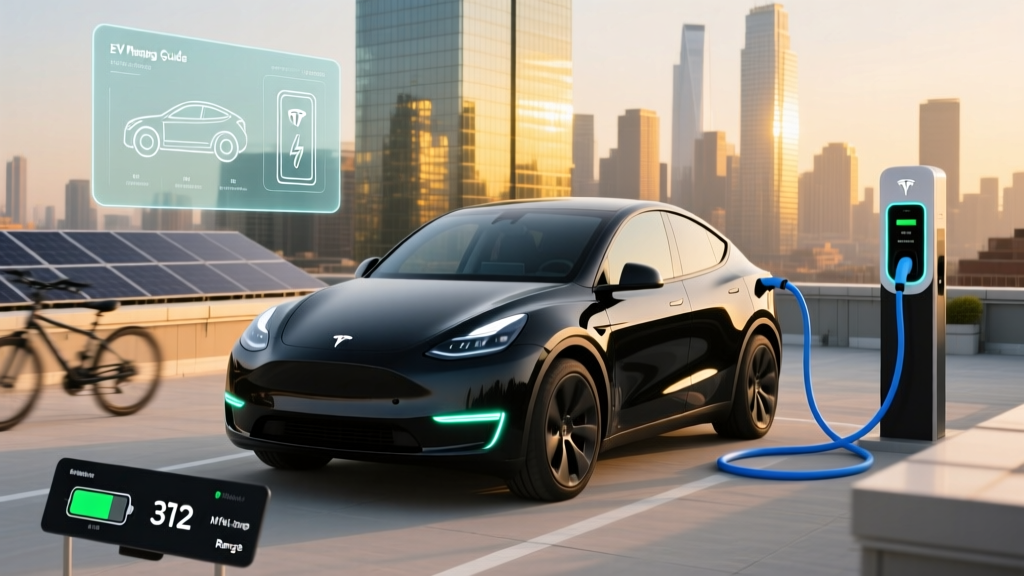
Tesla's efficiency remains best-in-class. The Model Y Long Range AWD achieves 29 kWh/100 miles combined, which translates to roughly 4.1 miles per kWh — among the highest of any electric SUV. The heat pump, standard across all trims, mitigates cold-weather range loss better than most competitors, though you'll still see a 20–30% reduction in sustained sub-freezing conditions.
On a 300-mile highway trip at 75 mph in moderate temperatures, expect to arrive with roughly 10–15% state of charge remaining in the Long Range AWD. In winter, plan a 10-minute Supercharger stop at the halfway point. This is real-world road-trip planning, not a dealbreaker — but it's the honest math that EPA stickers don't convey.
Charging Speed and Infrastructure
Tesla's 250 kW peak DC fast-charging rate is no longer class-leading — the Hyundai Ioniq 5 and Kia EV6 hit 350 kW on compatible chargers, and the Porsche Macan EV reaches 270 kW. But Tesla's advantage is sustained throughput and network reliability.
| Charging Level | Power / Rate | Miles Added | Notes |
|---|---|---|---|
| Level 1 (120V household) | ~1.4 kW | ~4 mi/hr | Emergency/trickle only |
| Level 2 (240V, 48A home) | 11.5 kW | ~44 mi/hr | Full charge in ~7.5 hours |
| DC Fast (V3 Supercharger) | Peak 250 kW | ~200 mi in 15 min | Tapers above 60% SoC |
| DC Fast (V4 Supercharger) | Peak 250 kW | ~200 mi in 15 min | CCS adapter not needed |
| DC Fast (non-Tesla CCS) | Up to 250 kW | Varies by station | Built-in NACS connector; CCS adapter available |
The 10–80% DC fast-charge time of approximately 25 minutes is competitive but not exceptional. The charge curve is the key detail: the Model Y sustains above 200 kW from roughly 10% to 45% SoC, then tapers progressively. Charging from 80% to 100% on DC adds another 25–30 minutes — so plan your stops around the 80% mark for optimal road-trip efficiency.
At home, an 11.5 kW Level 2 wall connector on a 60-amp circuit delivers a full overnight charge in about 7.5 hours. Installation typically costs $800–$2,000 depending on panel proximity and local permitting, on top of the $475 Tesla Wall Connector hardware.
Performance, Ride, and Interior
The Performance AWD model's 3.5-second 0–60 mph time is genuinely quick for a family SUV, and the dual-motor torque delivery is seamless. However, most buyers should opt for the Long Range AWD — its 4.8-second sprint is more than adequate, and the 25 extra miles of EPA range matter more in daily driving.
The Juniper refresh improved the cabin meaningfully:
- Ventilated front seats (finally standard on all trims)
- Rear 8-inch touchscreen for climate and entertainment
- Ambient lighting and acoustic glass reducing cabin noise by ~2 dB
- Power-folding second row expanding cargo from 30 cu ft (behind rear seats) to 72 cu ft (seats folded)
Passenger space is competitive: 41.9 inches of front legroom and 37.0 inches rear. The panoramic glass roof creates an airy feel but contributes to cabin heat in summer — the included tinted glass helps but doesn't eliminate the need for sunshades in hot climates.
Notable drawbacks: The ride remains firm over sharp bumps, especially on the Performance trim's 21-inch wheels. The yoke-style steering wheel (optional, $1,000) is polarizing and not recommended for most buyers. Panel gaps, while improved, still lag behind Hyundai and BMW at similar price points.
Pricing, Tax Credits, and Total Cost
| Trim | MSRP | §30D Credit | Effective Price | As-Tested (typical options) |
|---|---|---|---|---|
| Long Range RWD | $44,990 | $7,500 | $37,490 | ~$40,500 |
| Long Range AWD | $47,990 | $7,500 | $40,490 | ~$43,500 |
| Performance AWD | $53,990 | $7,500 | $46,490 | ~$50,000 |
Important §30D eligibility caveats: The $7,500 federal tax credit applies at the point of sale under current IRS rules. To qualify, the buyer must meet income caps ($150,000 single / $300,000 joint AGI), and the vehicle must satisfy battery-critical-mineral and component-sourcing requirements. Tesla's U.S.-built Model Y currently meets these sourcing thresholds, but the IRS updates eligible-vehicle lists periodically — always verify on fueleconomy.gov before purchasing.
The MSRP cap for SUVs is $80,000, so all Model Y trims qualify on price. As-tested prices climb with options: Ultra Red paint ($2,000), 20-inch wheels ($1,500), and Full Self-Driving (Supervised) at $8,000 push a Long Range AWD toward $55,000 before the credit.
Tech, Driver Assistance, and Safety
Standard Autopilot includes Traffic-Aware Cruise Control and Autosteer. The $8,000 FSD (Supervised) upgrade adds automatic lane changes, traffic-light recognition, and city-street navigation — impressive when it works, but still requiring constant supervision. Reliability varies significantly by geography and road-marking quality.
Safety ratings are strong: the Model Y earned a 5-star overall NHTSA rating and the IIHS Top Safety Pick+ designation. Standard active safety features include automatic emergency braking, blind-spot monitoring, and lane-departure prevention.
The 15.4-inch center touchscreen runs Tesla's proprietary OS, which is fast and responsive but locked to Tesla's ecosystem — no Apple CarPlay or Android Auto. For some buyers, this is a dealbreaker; for others, Tesla's native navigation and Supercharger integration make third-party phone mirroring unnecessary.
Warranty and Long-Term Ownership
- Basic vehicle warranty: 4 years / 50,000 miles
- Battery and drive unit: 8 years / 120,000 miles (Long Range), 8 years / 100,000 miles (Performance)
- Battery degradation threshold: Tesla warrants retention of at least 70% capacity during the warranty period
The NMC battery in the Long Range models has shown approximately 8–12% degradation at 100,000 miles based on fleet data — well within the warranty threshold. If Tesla were to face severe financial distress, the primary ownership concern wouldn't be battery replacement (third-party shops increasingly handle this) but rather loss of over-the-air updates, Supercharger network access, and proprietary software-dependent features.
This is where the bankruptcy-probability question circles back to practical ownership: even a low-probability event carries asymmetric risk for software-dependent vehicles. Diversifying your risk by choosing a model with strong third-party service support is prudent.
- Best-in-class efficiency (27–30 kWh/100mi)
- Supercharger network: 6,000+ U.S. stations, highest reliability
- Strong resale value (though narrowing vs. competitors)
- OTA updates add features post-purchase
- Spacious cargo area (72 cu ft max)
- $7,500 federal tax credit on all trims
- Firm ride quality, especially on 21-inch wheels
- No Apple CarPlay or Android Auto
- FSD (Supervised) is $8,000 and still Level 2 only
- 250 kW peak charge rate trails Hyundai/Kia at 350 kW
- Brand polarization may affect resale in some markets
- Panel-gap quality inconsistent vs. BMW/Hyundai
Model Y vs. Key Competitors: Is It Worth Buying?
| Attribute | Tesla Model Y LR AWD | Hyundai Ioniq 5 Limited | Ford Mustang Mach-E Premium | Chevy Equinox EV RS |
|---|---|---|---|---|
| EPA Range | 320 mi | 310 mi | 312 mi | 319 mi |
| Max DC Charge | 250 kW | 350 kW | 150 kW | 190 kW |
| 10–80% Time | ~25 min | ~18 min | ~38 min | ~30 min |
| 0–60 mph | 4.8 sec | 5.1 sec | 5.5 sec | 5.9 sec |
| MPGe (combined) | 117 | 110 | 101 | 105 |
| MSRP (before credit) | $47,990 | $52,200 | $48,995 | $43,400 |
| Cargo (max, cu ft) | 72 | 59 | 60 | 64 |
| Apple CarPlay | No | Yes | Yes | Yes |
The Model Y wins on efficiency, cargo space, and Supercharger access. The Ioniq 5 wins on charging speed and interior design. The Equinox EV wins on price. The Mach-E occupies a middle ground with engaging driving dynamics but slower charging. Your priority stack determines the winner — there is no universally "best" choice in this segment.
Who the 2026 Model Y Suits Best
Choose the Model Y if: You road-trip frequently and value the Supercharger network's reliability, you want maximum cargo space in a compact SUV, and you prefer OTA-delivered feature updates over dealership visits.
Look elsewhere if: You need Apple CarPlay, you prioritize ride comfort over sportiness, you want the fastest possible DC charging (Ioniq 5/EV6), or you're risk-averse about brand-dependent software ecosystems.
- Commuter (30–50 mi/day): Any EV in this segment works. Model Y's efficiency saves ~$50/yr in electricity vs. Ioniq 5.
- Family road-tripper: Model Y's Supercharger network and 72 cu ft cargo lead the segment.
- Urban apartment dweller: If you rely on public charging, the Ioniq 5's 350 kW capability saves real time at CCS stations.
- Budget-conscious buyer: Equinox EV at ~$35,900 after credit offers 319 miles of range at a lower entry point.
Frequently Asked Questions
What is the real-world range of the 2026 Tesla Model Y?
The EPA rates the Long Range AWD at 320 miles. In real-world highway driving at 70 mph, expect 275–290 miles. In cold weather (below 30°F), expect 230–260 miles depending on cabin-heat usage and driving speed.
How fast does the Model Y charge at home and on DC fast chargers?
On a 240V Level 2 home charger (48A), the Model Y adds approximately 44 miles of range per hour, reaching a full charge in about 7.5 hours. On a V3 or V4 Supercharger, it peaks at 250 kW and charges from 10% to 80% in approximately 25 minutes.
How much does the 2026 Model Y cost after the federal tax credit?
The Long Range AWD starts at $47,990 MSRP. With the $7,500 §30D federal tax credit (applied at point of sale for eligible buyers), the effective price is approximately $40,490. Adding common options (paint, wheels) typically brings the as-tested price to $43,000–$45,000.
Is the Model Y worth buying vs. the Hyundai Ioniq 5 or Ford Mach-E?
It depends on your priorities. The Model Y leads in efficiency, cargo space, and charging-network reliability. The Ioniq 5 charges faster (350 kW peak) and offers CarPlay. The Mach-E has more engaging driving dynamics but slower charging. All three are strong choices in 2026.
Does the 2026 Model Y qualify for the $7,500 federal EV tax credit?
Yes, all 2026 Model Y trims currently qualify for the full $7,500 §30D credit, provided the buyer meets income caps ($150,000 single / $300,000 joint AGI) and the vehicle meets battery-sourcing requirements. Verify current eligibility at fueleconomy.gov before purchasing, as the IRS updates eligible-vehicle lists periodically.
Should I worry about Tesla going bankrupt after I buy?
By standard financial metrics — $33B cash, positive margins, manageable debt — Tesla's bankruptcy probability is low. The more realistic ownership risk is depreciation from competition and potential service delays in lower-volume regions. The Model Y's strong third-party parts ecosystem and NACS charging standard (now adopted industry-wide) provide some insulation even in a downside scenario.