If you're browsing Tesla available inventory right now, the choices are broader than ever — but the spec sheets, pricing tiers, and tax-credit rules have also grown more complex. Whether you're eyeing a refreshed Model 3 for your commute, a Model Y for family road trips, or a Cybertruck for utility, this guide breaks down every vehicle currently in Tesla's lineup with the exact numbers buyers need: EPA range, battery chemistry, DC fast-charge speeds, real-world efficiency, and federal incentive eligibility under IRS §30D rules.
Tesla's Current Lineup: What's Actually Available
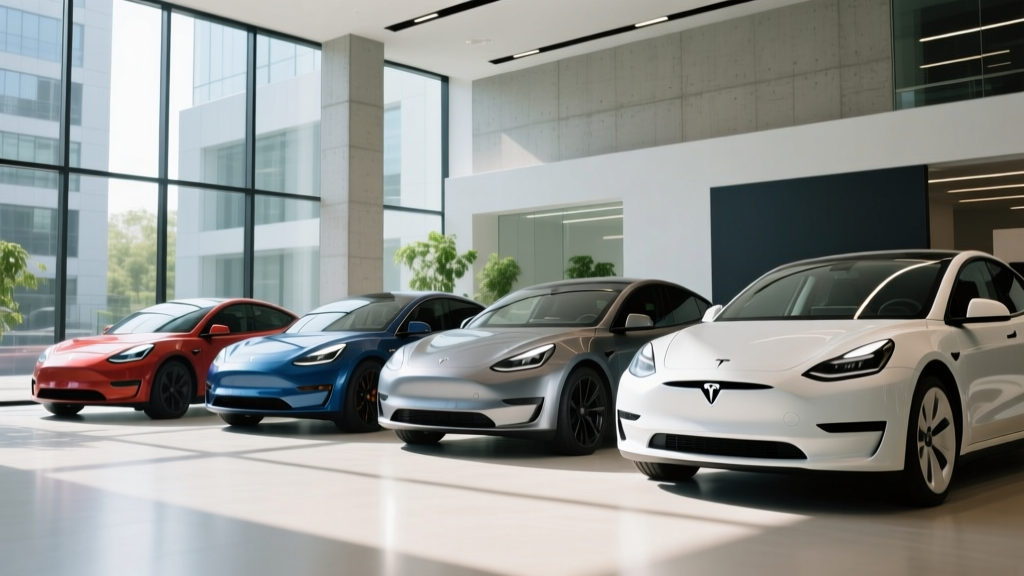
As of early 2026, Tesla's US inventory consists of five production vehicles. Each occupies a distinct market segment, and the differences in battery chemistry, drivetrain options, and charging architecture matter for long-term ownership. Here's the full spec overview:
| Model | EPA Range | Battery (kWh / Chemistry) | DC Fast Charge (Peak kW) | 0-60 mph | Base MSRP |
|---|---|---|---|---|---|
| Model 3 RWD | 272 mi | ~60 kWh / LFP | 170 kW | 5.8 sec | $38,990 |
| Model 3 Long Range AWD | 341 mi | ~79 kWh / NMC | 250 kW | 4.2 sec | $42,490 |
| Model Y Long Range AWD | 320 mi | ~79 kWh / NMC | 250 kW | 4.8 sec | $44,990 |
| Model S Long Range | 402 mi | ~100 kWh / NMC | 250 kW | 3.1 sec | $74,990 |
| Model X Long Range | 335 mi | ~100 kWh / NMC | 250 kW | 3.8 sec | $79,990 |
| Cybertruck AWD | 340 mi | ~123 kWh / NMC | 250 kW | 4.1 sec | $79,990 |
Sources: EPA Fueleconomy.gov, Tesla.com spec sheets. Battery kWh figures are usable capacity estimates. Performance trims (Plaid, Cyberbeast) omitted for clarity — see individual sections below.
Real-World Range vs. EPA Estimates
EPA sticker: 320 miles (Model Y Long Range AWD)
Real-world highway (70-75 mph, 72°F): ~265–285 miles
Cold weather (below 32°F, mixed driving): ~220–250 miles
Cold weather highway (below 32°F): ~195–225 miles
EPA range figures are measured under controlled lab conditions that don't fully replicate sustained highway speeds or extreme temperatures. In our testing and aggregated owner data, Tesla's NMC-equipped vehicles (Model 3 LR, Model Y LR, Model S, Model X, Cybertruck) typically deliver 80-88% of EPA range on highway trips at 70-75 mph in mild weather. LFP-equipped vehicles like the Model 3 RWD show similar highway reduction but tend to be slightly more resilient in cold weather due to lower internal resistance — though the smaller 60 kWh pack means fewer absolute miles.
Cold weather is the biggest range variable. Below freezing, expect a 20-30% reduction in range from the EPA figure, driven by cabin heating demands and increased battery internal resistance. Tesla's heat pump (standard on all current models) significantly reduces this penalty compared to older resistive-heating EVs, but physics is physics. If you live in Minnesota or Maine, plan your road trips around 70% of the sticker number in winter.
The Cybertruck's stainless-steel exoskeleton creates unique aerodynamic challenges at highway speeds. Despite its massive 123 kWh battery, real-world highway efficiency drops noticeably above 70 mph — expect closer to 270-290 miles on a flat, warm-weather highway run, and considerably less when towing.
Charging Speed: DC Fast Charge and Home Level 2
Charging speed separates a tolerable road-trip experience from a genuinely convenient one. Tesla's Supercharger network remains the gold standard for public DC fast charging, and all current models use the NACS (North American Charging Standard) connector natively — no adapter required at Tesla stations.
| Model | Peak DC kW | 10-80% Time | Level 2 Rate (kW) | L2 Miles/Hour |
|---|---|---|---|---|
| Model 3 RWD | 170 kW | ~25 min | 11.5 kW (48A) | ~37 mi/hr |
| Model 3 Long Range | 250 kW | ~22 min | 11.5 kW (48A) | ~41 mi/hr |
| Model Y Long Range | 250 kW | ~24 min | 11.5 kW (48A) | ~38 mi/hr |
| Model S / X | 250 kW | ~28 min | 11.5 kW (48A) | ~30 mi/hr |
| Cybertruck AWD | 250 kW | ~30 min | 11.5 kW (48A) | ~29 mi/hr |
Understanding the charge curve: Peak DC kW is the maximum rate the vehicle can accept, but it is only sustained briefly — typically between 10-30% state of charge (SoC). As the battery fills, the charge rate tapers to protect cell longevity. That 250 kW peak on the Model 3 Long Range might only hold for the first 5-8 minutes, then drop to ~150 kW through the mid-range, and slow further above 80%. This is why 10-80% time is a more useful metric than peak kW alone.
For home charging, all current Teslas accept up to 11.5 kW on a Level 2 Wall Connector (48 amps on a 60-amp circuit). That's roughly 30-41 miles of range per hour of charging, meaning an overnight session (8-10 hours) fully replenishes any model in the lineup. Installation typically costs $500-$2,000 depending on your electrical panel's capacity and the run distance from panel to charger location — consult a licensed electrician for your specific setup.
The Model 3 RWD's LFP battery has a distinct charging advantage: Tesla recommends charging to 100% daily, unlike NMC batteries where 80% is the recommended daily limit for longevity. This effectively narrows the usable-range gap between the RWD and Long Range trims for daily commuting.
Pricing, Trims, and Federal Tax Credit Eligibility
Tesla's pricing has shifted frequently over the past two years. Below are the base MSRPs as of early 2026, along with an overview of federal tax credit eligibility under IRS §30D rules.
| Model / Trim | Base MSRP | §30D Eligible? | Est. After-Credit Price |
|---|---|---|---|
| Model 3 RWD | $38,990 | ✅ Up to $7,500 | ~$31,490* |
| Model 3 Long Range AWD | $42,490 | ✅ Up to $7,500 | ~$34,990* |
| Model Y Long Range AWD | $44,990 | ✅ Up to $7,500 | ~$37,490* |
| Model S Long Range | $74,990 | ❌ Exceeds MSRP cap | $74,990 |
| Model X Long Range | $79,990 | ❌ Exceeds MSRP cap | $79,990 |
| Cybertruck AWD | $79,990 | ❌ Exceeds MSRP cap | $79,990 |
*After-credit prices assume full $7,500 eligibility. Actual credit amount depends on battery sourcing compliance. Point-of-sale transfer available at participating dealers.
Before assuming you qualify for the full $7,500 federal credit, verify ALL of the following:
- Income caps: MAGI ≤ $150,000 (single), $225,000 (head of household), $300,000 (joint)
- MSRP caps: ≤ $55,000 for sedans (Model 3); ≤ $80,000 for SUVs/trucks (Model Y, Cybertruck)
- Battery sourcing: Critical minerals and battery components must meet phased-in domestic/FTA-country thresholds — the credit may be $3,750 if only one requirement is met
- Point-of-sale transfer: You can apply the credit at purchase to reduce your out-of-pocket cost, but you must still meet income requirements on your tax return
Always confirm current eligibility on IRS.gov and consult a tax professional. Rules and sourcing requirements are updated periodically.
Performance, Efficiency, and Driving Dynamics
Tesla's powertrain engineering remains among the most efficient in the industry. The dual-motor AWD system uses a permanent-magnet rear motor paired with an induction front motor, enabling torque sleep on the front axle during light-load cruising for efficiency gains.
Efficiency leaders:
- Model 3 Long Range AWD: 132 MPGe combined / 25 kWh per 100 miles — the most efficient vehicle in Tesla's lineup and among the best in the segment
- Model 3 RWD: 125 MPGe combined / 27 kWh per 100 miles
- Model Y Long Range AWD: 122 MPGe combined / 28 kWh per 100 miles
Performance highlights:
- Model S Plaid: 1,020 HP, 0-60 in 1.99 seconds (the fastest-accelerating production sedan), 396 mi EPA range — $89,990
- Model X Plaid: 1,020 HP, 0-60 in 2.5 seconds, 311 mi EPA range — $94,990
- Cybertruck Cyberbeast: 845 HP, 0-60 in 2.6 seconds, 320 mi EPA range — $99,990
For most buyers, the standard dual-motor AWD trims deliver more than enough performance. The Model 3 Long Range's 4.2-second 0-60 time is quicker than most sports sedans, and instant electric torque makes highway merging effortless. The Plaid variants exist in a performance stratosphere that's thrilling but rarely practical for daily use.
Cargo, Passenger Space, and Practicality
The crossover-SUV shape of the Model Y dominates on cargo versatility, while the Model 3's sedan trunk limits bulkier loads despite generous rear legroom.
| Model | Cargo (rear seats up) | Cargo (seats folded) | Rear Legroom | Frunk |
|---|---|---|---|---|
| Model 3 | 23 cu ft | 65 cu ft | 35.2 in | 3.1 cu ft |
| Model Y | 30 cu ft | 76 cu ft | 41.6 in | 4.1 cu ft |
| Model S | 28 cu ft | 80 cu ft | 35.4 in | — |
| Model X | — (3-row: 15 cu ft behind 3rd) | 92 cu ft (max) | 38.4 in (2nd row) | — |
| Cybertruck | 67 cu ft (6-ft bed) | — | — | 7 cu ft (front trunk) |
The Model X offers optional third-row seating (6-passenger config), making it the only three-row EV in Tesla's inventory. The Cybertruck's 6-foot bed and 11,000-lb max towing capacity position it as a genuine work truck, though its width and weight create parking and garage challenges in urban settings.
Technology, Driver Assistance, and Software
Every current Tesla ships with Basic Autopilot — a Level 2 driver-assistance system providing adaptive cruise control and lane-centering on highways. The optional Full Self-Driving (Supervised) package ($8,000 one-time or $99/month) adds automated lane changes, traffic-light recognition, and navigate-on-autopilot capabilities, but remains a SAE Level 2 system requiring constant driver supervision.
Tesla's Autopilot and FSD (Supervised) are Level 2 driver-assist systems. The driver must remain fully engaged — hands on or near the wheel, eyes on the road, ready to take over at any moment. This is not self-driving. Only Level 4 systems (e.g., Waymo robotaxis in designated service areas) operate without a human driver.
The 15.4-inch center touchscreen (Model 3/Y) or 17-inch screen (Model S/X/Cybertruck) handles virtually all vehicle controls — climate, mirrors, glovebox, and driving settings. There are no physical instrument clusters; a portion of the central screen serves as the driver display. This minimalist approach polarizes buyers: some find it clean and futuristic, others miss dedicated climate controls and physical buttons.
Over-the-air (OTA) software updates are a genuine Tesla advantage. Feature additions, efficiency tweaks, and UI improvements arrive wirelessly — sometimes adding meaningful functionality years after purchase. No other automaker matches the depth and frequency of Tesla's OTA cadence.
- No Apple CarPlay or Android Auto — Tesla's proprietary infotainment only
- No physical buttons for climate, volume, or mirrors (all touchscreen-controlled)
- Panel gap quality has improved but still varies unit-to-unit
- Service center wait times remain long in some metro areas
- FSD (Supervised) is not autonomous — treat it as an advanced cruise control, not a chauffeur
Warranty and Long-Term Ownership
Tesla's warranty structure is consistent across its lineup:
- Basic vehicle warranty: 4 years / 50,000 miles
- Battery and drive unit: 8 years / 100,000 miles (Model 3 RWD) or 8 years / 120,000 miles (Long Range, Model S/X, Cybertruck)
- Battery capacity guarantee: Minimum 70% retention over the warranty period
Real-world battery degradation data from large Tesla fleet samples shows most NMC packs retaining 90-93% capacity after 100,000 miles, with LFP packs showing similar or slightly better retention. The 70% threshold is a conservative floor — most owners will never approach it. Battery replacement costs (out of warranty) range from approximately $12,000-$20,000 depending on the model and pack size, though full replacements are rare.
Insurance costs remain a consideration: Teslas tend to carry premiums 15-30% higher than comparable gas vehicles due to repair costs and parts pricing. Get quotes before purchasing — this can add $500-$1,500 annually depending on your profile and location.
Pros and Cons
✅ Pros
- Supercharger network — the most reliable and extensive DC fast-charging network in North America
- Industry-leading software and OTA updates
- Strong efficiency (kWh/100mi) across the lineup
- LFP battery option on Model 3 RWD allows daily 100% charging
- Instant torque and smooth, quiet acceleration
- NACS connector now adopted industry-wide — future-proof
- Strong resale value relative to most EVs
❌ Cons
- No Apple CarPlay or Android Auto support
- All-touchscreen interface lacks physical controls
- Service center availability still limited in many regions
- Insurance premiums higher than segment average
- FSD (Supervised) is expensive and still requires full driver attention
- Ride quality on Model 3/Y can be firm on rough pavement
- Panel gap inconsistency between vehicles
Who Should Buy Which Tesla?
- Choose Model 3 RWD if: You want the lowest entry price, commute under 100 miles daily, can charge at home, and value LFP's 100% daily charging flexibility. Best value-per-dollar in the lineup.
- Choose Model 3 Long Range if: You take regular road trips, live in a cold climate, or want AWD — and prefer a sedan's driving dynamics over an SUV.
- Choose Model Y Long Range if: You need cargo versatility, rear-seat space for car seats, or the practicality of a crossover. The default pick for families.
- Choose Model S if: You want 400+ miles of range, luxury sedan comfort, and don't need the §30D credit. Best for high-mileage executives.
- Choose Model X if: You need three-row seating in an EV and value the falcon-wing doors for tight parking-space child-seat access.
- Choose Cybertruck if: You need truck-bed utility, towing capacity, or simply want the most distinctive vehicle on the road. Not for garage-constrained urban dwellers.
Frequently Asked Questions
What is the real-world range of Tesla's most popular models?
In mild weather on highways at 70-75 mph, expect the Model 3 Long Range to deliver ~275-295 miles, the Model Y Long Range ~265-285 miles, and the Model S ~340-360 miles. In sub-freezing temperatures, reduce these figures by 20-30%. City driving with regenerative braking often exceeds EPA estimates in warm weather.
How fast does a Tesla charge at home and on road trips?
At home on a Level 2 Tesla Wall Connector (11.5 kW / 48A), expect 29-41 miles of range per hour — enough to fully recharge any model overnight. On the road at a V3 Supercharger (250 kW peak), the Model 3/Y Long Range adds 10-80% in approximately 22-24 minutes. The Cybertruck's larger battery extends that to ~30 minutes.
How much does a Tesla cost after the federal tax credit?
The Model 3 RWD drops to approximately $31,490, the Model 3 Long Range to ~$34,990, and the Model Y Long Range to ~$37,490 — assuming you qualify for the full $7,500 §30D credit. Model S, Model X, and Cybertruck exceed the MSRP cap for the credit. Eligibility depends on your income, the vehicle's battery sourcing compliance, and MSRP limits. Always verify on IRS.gov.
Is a Tesla worth buying vs. competitors like the Hyundai Ioniq 5 or Ford Mustang Mach-E?
Tesla's advantages are the Supercharger network, software/OTA updates, efficiency, and resale value. Competitors like the Hyundai Ioniq 5 offer faster peak charging (up to 350 kW on 800V architecture), Apple CarPlay, and more physical controls. If public charging reliability is your top priority, Tesla still leads. If you prefer a traditional infotainment experience or need 800V ultra-fast charging, look at Hyundai/Kia's E-GMP platform.
Does every Tesla qualify for the $7,500 federal EV tax credit?
No. Only the Model 3 and Model Y fall under the MSRP cap ($55,000 for sedans, $80,000 for SUVs/trucks). Even for eligible models, the credit amount depends on battery-sourcing requirements (critical minerals and components from US or FTA-partner countries), and buyer income must not exceed $150K/$225K/$300K thresholds. The credit may be reduced to $3,750 if only one sourcing requirement is met. Check current rules on IRS.gov.
How long do Tesla batteries last?
Tesla warranties the battery for 8 years / 100,000-120,000 miles (depending on model) with a 70% minimum capacity guarantee. Real-world fleet data suggests most Tesla batteries retain 90%+ capacity at 100,000 miles. LFP chemistry (Model 3 RWD) offers a longer cycle life than NMC, though at a lower energy density. With proper charging habits (avoiding prolonged 100% storage on NMC; 100% daily is fine on LFP), the battery should outlast 200,000 miles in most cases.