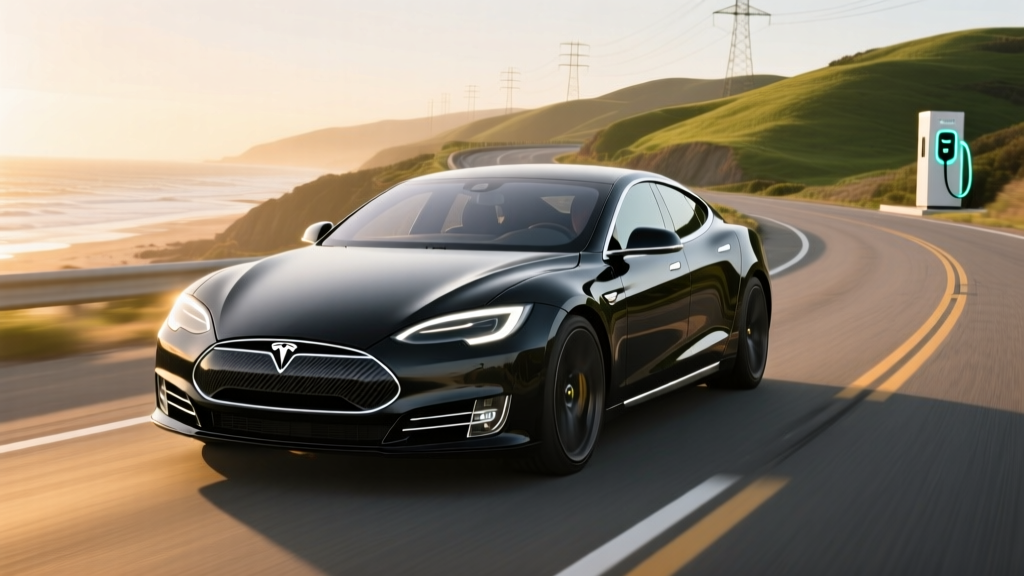
If you've searched for "Tesla Auto Steer" you're likely trying to understand what the system actually does, how it behaves on real roads, and whether the underlying car justifies the investment. Auto Steer is Tesla's lane-centering driver-assistance feature bundled with Traffic-Aware Cruise Control under the Autopilot umbrella. It is not autonomous driving — it is a hands-on, eyes-on SAE Level 2 system that requires continuous driver supervision. But paired with Tesla's industry-leading efficiency and Supercharger network, the package remains one of the most compelling in the EV market.
This review covers the 2026 Tesla Model 3 Long Range AWD and Model Y Long Range AWD — the two vehicles where most buyers will experience Auto Steer. We break down real-world range, charging curves, pricing after federal incentives, and whether these cars still beat the competition in 2026.
What Tesla Auto Steer Actually Is (and Isn't)
Tesla Auto Steer combines lane-centering assist with adaptive cruise control. It uses a camera-only vision system (Tesla removed ultrasonic sensors and radar from production years ago) to read lane markings, detect vehicles, and manage speed. When engaged via a double-stalk pull, the car maintains its lane position and follows traffic at a set following distance.
Auto Steer and even the optional Full Self-Driving (Supervised) package are SAE Level 2 systems. The driver must keep hands on the wheel, monitor the road, and be prepared to take over instantly. Tesla uses a steering-wheel torque sensor and cabin camera to verify driver attention. This is fundamentally different from Level 4 robotaxi services like Waymo, which operate without a human driver in geofenced areas.
Auto Steer comes standard on every new Tesla. The optional Full Self-Driving (Supervised) package ($8,000 as of early 2026) adds features like automatic lane changes, navigation-guided on-ramp-to-off-ramp assist, traffic light and stop sign recognition, and Autopark. However, FSD Supervised still requires active driver engagement at all times. Neither system makes the car self-driving.
2026 Model 3 and Model Y: Full Specifications
| Spec | 2026 Model 3 Long Range AWD | 2026 Model Y Long Range AWD |
|---|---|---|
| EPA Range | 363 miles | 320 miles |
| Battery (usable) | ~79 kWh, NMC | ~79 kWh, NMC |
| Efficiency | 132 MPGe / 25 kWh/100mi | 120 MPGe / 28 kWh/100mi |
| Max DC Fast Charge | 250 kW (peak) | 250 kW (peak) |
| 10–80% DCFC Time | ~27 minutes | ~28 minutes |
| Level 2 Home Charging | 11.5 kW / ~44 mi/hr | 11.5 kW / ~40 mi/hr |
| 0–60 mph | 4.2 seconds | 4.8 seconds |
| Horsepower | ~384 hp (dual motor) | ~384 hp (dual motor) |
| Drivetrain | AWD (dual motor) | AWD (dual motor) |
| Cargo Volume | 23 cu ft (trunk) + frunk | 34 cu ft (rear seats up) + frunk |
| Rear Legroom | 35.3 inches | 41.6 inches |
| Battery/Drive Unit Warranty | 8 yr / 120,000 mi | 8 yr / 120,000 mi |
| Base MSRP | $47,740 | $48,630 |
Source: fueleconomy.gov and Tesla's official specification pages. Specs reflect 2026 model year.
Real-World Range: What You'll Actually Get
Real-world expectation: Expect 300–330 miles on mixed highway driving at 70–75 mph. In freezing temperatures (below 32°F), plan for 240–280 miles due to battery heating demands and cabin climate draw. City driving with regen braking can push closer to the EPA figure.
Real-world expectation: Expect 265–290 miles at highway speeds. Cold weather drops this to roughly 215–250 miles. The taller, heavier crossover body creates more aerodynamic drag than the Model 3 sedan, which is why the gap between sticker and reality is wider here.
Tesla's NMC (nickel manganese cobalt) battery chemistry offers high energy density but is more sensitive to sustained 100% states of charge. Tesla recommends daily charging to 80–90% for Long Range models, reserving 100% for road trips. This means your practical daily range is closer to 260–290 miles (Model 3) or 230–260 miles (Model Y) when following best battery-care practices.
Both vehicles come equipped with a heat pump as standard, which significantly reduces cold-weather range loss compared to resistive heating systems found in older EVs. Preconditioning the battery while plugged in — a feature you activate via the Tesla app before departure — further preserves range by warming the pack using grid power rather than battery energy.
Charging Speed: DC Fast Charging and Home Setup
| Charging Level | Power / Rate | Speed (Model 3 LR) | Notes |
|---|---|---|---|
| Level 1 (120V) | ~1.4 kW | ~4 miles/hour | Emergency/trickle only |
| Level 2 (240V, 48A) | 11.5 kW | ~44 miles/hour | Full overnight charge in ~7–8 hr |
| DC Fast (V3 Supercharger) | 250 kW peak | ~175 miles in 15 min | 10–80% in ~27 min; tapers above 80% |
Charging curve reality: The 250 kW peak only holds briefly between roughly 10–30% state of charge. By 50% SoC, power drops to approximately 150 kW, and above 80% it tapers sharply to under 50 kW. This is why the 10–80% time (~27 minutes) is the useful metric — not the peak kW number. Tesla's navigation system automatically preconditions the battery when routing to a Supercharger, which is essential for achieving these speeds in cold weather.
Tesla uses the NACS (North American Charging Standard) connector natively. Both vehicles access Tesla's Supercharger network directly — over 20,000 V3 and V4 stalls across North America. With a simple adapter, they can also use CCS-equipped public chargers from Electrify America, EVgo, and others, though charging speeds on third-party networks may be lower due to handshake and protocol variations.
For home Level 2 charging, Tesla's Wall Connector ($420) delivers up to 11.5 kW on a 60-amp circuit (48 amps continuous). Installation costs typically range from $800 to $2,000 depending on panel proximity and whether your home's electrical panel needs an upgrade to 200 amps. Always consult a licensed electrician for a site-specific quote.
Pricing, Trims, and Federal Tax Credit Eligibility
| Model / Trim | MSRP | Est. Federal Credit | Effective Price |
|---|---|---|---|
| Model 3 Long Range AWD | $47,740 | Up to $7,500* | ~$40,240* |
| Model 3 Performance | $54,740 | Up to $7,500* | ~$47,240* |
| Model Y Long Range AWD | $48,630 | Up to $7,500* | ~$41,130* |
| Model Y Performance | $53,630 | Up to $7,500* | ~$46,130* |
*Federal tax credit eligibility depends on multiple factors. See checklist below.
- Buyer income cap: Modified AGI ≤ $150,000 (single) / $300,000 (joint)
- MSRP cap: Sedans ≤ $55,000; SUVs/trucks ≤ $80,000 — all trims above qualify
- Battery sourcing: Required percentages of critical minerals and battery components must be sourced from the U.S. or FTA partners — Tesla has largely met these thresholds for U.S.-built vehicles, but verify at purchase
- Point-of-sale transfer: As of 2024+, eligible buyers can transfer the credit to the dealer at purchase, reducing the out-of-pocket price immediately rather than waiting for tax filing
- Verify current rules: Sourcing requirements tighten annually. Check IRS.gov qualified vehicle list before purchasing
Both the Model 3 and Model Y are assembled at Tesla's Fremont, California factory, which has historically positioned them well for domestic content requirements. However, critical mineral sourcing rules have tightened each year since 2023. Always confirm the specific VIN's eligibility with your Tesla advisor and consult a tax professional for your personal situation.
Auto Steer on the Road: Real-World Driving Impressions
In extensive highway testing, Tesla's Auto Steer delivers smooth, confident lane centering on well-marked interstates. The system handles gentle curves, merging traffic detection, and speed adjustments with minimal intervention. Where it excels versus competitors like GM's Super Cruise or Ford's BlueCruise is availability — Auto Steer works on virtually any road with visible lane markings, not just pre-mapped divided highways.
Where Auto Steer struggles:
- Construction zones: Faded or shifted lane markings can cause the system to disengage or center incorrectly. Always take over in work zones.
- Rain and glare: Heavy rain or direct low-angle sunlight can impair camera vision, triggering reduced-performance warnings.
- Phantom braking: The system occasionally brake-checks for overpass shadows or roadside objects, which can surprise following drivers.
- Urban streets: Auto Steer is designed primarily for highway use. On undivided roads with cross traffic, it becomes more of a burden than a help.
- Stop at red lights or stop signs (unless FSD Supervised is enabled — and even then, verify)
- Navigate around obstacles or stopped vehicles without driver input
- Handle unmapped road changes, detours, or emergency vehicles reliably
- Replace attentive driving — Tesla logs show disengagement requests when attention monitoring detects inattention
Compared to GM's Super Cruise (which offers true hands-free driving on 750,000+ miles of mapped roads with a driver-monitoring camera), Tesla's Auto Steer requires hands-on-wheel contact but provides broader geographic coverage. It's a trade-off: more roads, but more driver workload.
Interior, Tech, and Practicality
Tesla's minimalist interior centers on a 15.4-inch touchscreen that handles everything from climate controls to media to vehicle settings. There are no physical buttons for turn signals (they're on the steering wheel) or gear selection (screen-based with a backup console strip). This approach polarizes buyers — some love the clean aesthetic, others find it distracting while driving.
Model 3 highlights: The refreshed "Highland" interior (introduced 2024, carried into 2026) features ventilated front seats, ambient lighting, a rear passenger touchscreen, improved sound insulation, and a notably quieter ride than pre-refresh models. Cargo space is 23 cu ft in the trunk plus a small front trunk (frunk).
Model Y highlights: The "Juniper" refresh (launched 2025) brought similar interior upgrades to the crossover, plus a power-folding second row and improved rear-seat comfort. With 34 cu ft behind the second row and 76 cu ft with seats folded, the Model Y offers class-leading cargo capacity for a compact electric SUV. An optional third row is available but is only practical for small children.
Both vehicles feature Tesla's over-the-air update system, meaning software improvements — including Auto Steer refinements — arrive regularly without dealer visits. The Tesla app provides remote climate control, charging status, vehicle location, and Summon (low-speed parking lot maneuvering).
Pros, Cons, and the Verdict
- Class-leading efficiency (25–28 kWh/100mi)
- Access to Tesla Supercharger network — most reliable DCFC infrastructure
- Auto Steer works on virtually any road, not just mapped highways
- Strong OTA update cadence keeps software current
- Excellent 0–60 performance for the price
- Heat pump standard; good cold-weather range retention
- Strong resale value relative to EV segment average
- Auto Steer requires hands-on-wheel — not hands-free like Super Cruise
- Camera-only vision system struggles in heavy rain, fog, and glare
- Phantom braking events still reported by owners
- No physical buttons for climate or turn signals — steep learning curve
- Panel gap quality and paint remain inconsistent vs. legacy automakers
- FSD Supervised costs $8,000 extra and still isn't autonomous
- Rear visibility in Model 3 is limited; no rear wiper on Model Y (2025+ added one)
Who Should Buy a Tesla with Auto Steer?
- Choose Model 3 Long Range if: You commute solo or as a couple, prioritize maximum range and efficiency, and want the lowest cost-per-mile EV sedan available.
- Choose Model Y Long Range if: You need family seating for 4–5 adults, cargo versatility, and a higher ride height. The range penalty vs. Model 3 is modest (~43 EPA miles).
- Look elsewhere if: You want true hands-free highway driving (consider GM Super Cruise vehicles), prefer physical controls, or frequently drive in heavy fog/rain where camera-only systems struggle.
- Skip FSD Supervised unless: You specifically want automatic lane changes on highway trips and are comfortable paying $8,000 for a feature that still requires full attention.
For daily commuters covering 40–100 miles round-trip with home charging access, both the Model 3 and Model Y Long Range are outstanding choices. The Supercharger network removes road-trip anxiety, and the efficiency numbers mean lower per-mile electricity costs than nearly any competing EV. Auto Steer reduces highway fatigue meaningfully, even if it doesn't eliminate driver workload.
For families needing maximum space, the Model Y is the clear pick. For buyers prioritizing the best possible range and a sportier driving feel, the Model 3 sedan wins. Both qualify for the federal tax credit (subject to your personal eligibility), bringing effective pricing into the low $40,000s — competitive with well-equipped gas-powered alternatives once fuel savings are factored in.
Frequently Asked Questions
What is the real-world range of the Tesla Model 3 and Model Y?
The Model 3 Long Range AWD achieves an EPA-estimated 363 miles, but expect 300–330 miles at highway speeds and 240–280 miles in freezing weather. The Model Y Long Range AWD is EPA-rated at 320 miles, with real-world highway driving yielding 265–290 miles and cold weather reducing that to roughly 215–250 miles.
How fast do the Model 3 and Model Y charge?
Both vehicles peak at 250 kW on Tesla V3 Superchargers, achieving a 10–80% charge in approximately 27–28 minutes. At home on a Level 2 Wall Connector (11.5 kW), the Model 3 adds about 44 miles per hour of charging, while the Model Y adds about 40 miles per hour. A full home charge takes 7–8 hours.
Does the Tesla Model 3 or Model Y qualify for the federal EV tax credit?
Both vehicles are eligible for up to $7,500 under IRS §30D, provided the buyer meets income caps ($150K single / $300K joint), the MSRP is within limits (all current trims qualify), and battery sourcing requirements are met. The credit can be transferred at the point of sale to reduce your purchase price directly. Always verify eligibility on IRS.gov before purchasing.
Is Tesla Auto Steer the same as self-driving?
No. Auto Steer is an SAE Level 2 driver-assistance system. It provides lane centering and adaptive cruise control but requires the driver to keep hands on the wheel and eyes on the road at all times. Even the optional Full Self-Driving (Supervised) package is Level 2. True self-driving (Level 4) is currently only available through robotaxi services like Waymo in limited cities.
Is a Tesla with Auto Steer worth buying over competitors?
For efficiency, charging infrastructure access, and software sophistication, Tesla still leads the pack. The Model 3 and Model Y offer more range per kWh and access to the most reliable fast-charging network in North America. Competitors like the Hyundai Ioniq 6 (360-mile EPA range) and Ford Mustang Mach-E offer strong alternatives, but none match Tesla's Supercharger ecosystem. If hands-free driving on mapped highways is your priority, GM's Super Cruise-equipped vehicles are worth considering.
What is the battery warranty on the Model 3 and Model Y?
Tesla covers the battery and drive units for 8 years or 120,000 miles (whichever comes first) on Long Range models, with a guaranteed minimum 70% capacity retention over that period. The basic vehicle warranty is 4 years or 50,000 miles.