Quick Verdict: Tesla Auto Steering in 2026
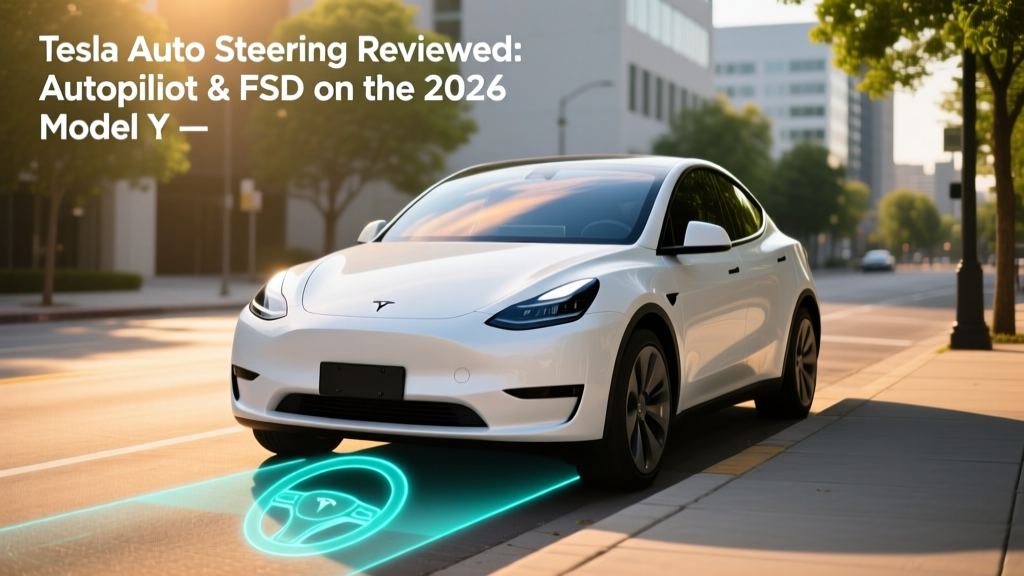
If you're researching Tesla auto steering, you're really asking two questions: how well does the Model Y drive itself on the highway, and is the full self-driving upgrade worth the cost? The short answer is that Tesla's Autopilot remains one of the most capable Level 2 driver-assistance systems available in 2026, with smooth lane centering and confident adaptive cruise control. Full Self-Driving (Supervised) adds automated lane changes, traffic-light recognition, and city-street navigation — but it still requires constant driver attention and is not a substitute for an engaged human behind the wheel.
Beyond the steering tech, the 2026 Tesla Model Y Long Range AWD delivers 320 miles of EPA range, peaks at 250 kW on DC fast chargers, and starts at $46,630 before potential federal tax credits. It's a compelling package for tech-forward commuters and small families who want a premium electric SUV with best-in-class software.
| Spec | Value |
|---|---|
| EPA Range | 320 miles |
| Battery (usable) | ~75 kWh, NMC (2170 cells) |
| Drivetrain | Dual-Motor AWD |
| Horsepower | 384 hp |
| 0–60 mph | 4.8 seconds |
| Peak DC Fast Charge | 250 kW (Supercharger V3) |
| 10–80% DC Charge | ~27 minutes |
| Level 2 Home Charge | 11.5 kW (~44 mi/hr) |
| Efficiency | 122 MPGe combined / 28 kWh/100 mi |
| Cargo Volume | 30.2 cu ft (rear seats up) / 72.1 cu ft (folded) |
| Rear Legroom | 40.5 inches |
| Base MSRP | $46,630 |
| Battery Warranty | 8 years / 120,000 miles |
Real-World Range: What 320 EPA Miles Actually Means
EPA Sticker: 320 miles
Real-World Highway (70 mph): ~265–285 miles
Cold Weather (below 32°F): ~220–250 miles
Mixed Commute (city + suburban): ~290–310 miles
The EPA rates the 2026 Model Y Long Range AWD at 320 miles, which is competitive for a dual-motor electric SUV in this price bracket. But EPA testing cycles don't replicate sustained highway driving or winter conditions.
In real-world highway testing at 70–75 mph with climate control active, expect roughly 265–285 miles before hitting a 10% state of charge. The Model Y's heat pump helps mitigate cold-weather range loss compared to resistive heating systems, but any lithium-ion battery loses efficiency in freezing temperatures — plan for 20–30% range reduction when temperatures drop below 32°F.
For daily commuting with regenerative braking engaged, you'll see numbers much closer to the EPA estimate. Tesla's trip planner in the navigation system is remarkably accurate at predicting remaining range, factoring in elevation, speed, and temperature — a genuine advantage on road trips.
Charging Speed: Supercharger Network and Home Setup
| Charging Level | Power / Rate | Speed |
|---|---|---|
| Level 1 (120V household) | ~1.4 kW | ~3–4 mi/hr |
| Level 2 (240V, 48A Wall Connector) | 11.5 kW | ~44 mi/hr |
| DC Fast Charge (Supercharger V3) | Peak 250 kW | 10–80% in ~27 min |
| DC Fast Charge (Supercharger V4) | Peak 250 kW (current Y architecture) | 10–80% in ~27 min |
Tesla's biggest charging advantage isn't the peak kW number — it's the Supercharger network. With over 18,000 V3/V4 stalls across North America, Tesla owners experience dramatically higher plug-and-charge reliability than drivers relying on third-party networks. The Model Y Long Range uses the NACS (North American Charging Standard) connector natively, and with adapters, it can access CCS stations as well.
The 250 kW peak charge rate is impressive, but as with all EVs, the charge curve tapers significantly above 80%. You'll hit 80% in roughly 27 minutes, but pushing from 80% to 100% can add another 25–30 minutes. On road trips, the practical strategy is to charge to 80% and drive on — let Tesla's navigation precondition the battery for the next stop.
At home, a Tesla Wall Connector on a 60-amp circuit delivers 11.5 kW, adding roughly 44 miles of range per hour. A full overnight charge from 20% to 90% takes about 6 hours. Expect a professional home installation to cost $800–$2,000 depending on your electrical panel's capacity and the run distance from panel to garage. If your home has a 100-amp main panel, a panel upgrade to 200 amps can add $1,500–$3,000.
Tesla Auto Steering: Autopilot and FSD Supervised Explained
SAE Automation Level: Level 2
Both Autopilot and Full Self-Driving (Supervised) are Level 2 driver-assistance systems. The driver must remain fully engaged, hands on the wheel (or providing steering-torque confirmation), and eyes on the road at all times. These are not self-driving systems.
Basic Autopilot (Standard on All Model Y Trims)
Every 2026 Model Y ships with Traffic-Aware Cruise Control and Autosteer — collectively branded as Autopilot. Autosteer provides lane-centering on well-marked highways and arterial roads, using Tesla's vision-only system (8 cameras, no radar or lidar). In practice, the lane-centering is smooth and confident, making subtle corrections rather than ping-ponging between lane markers.
Where Tesla auto steering excels is on divided highways with clear lane markings. The system handles gentle curves, maintains consistent following distance, and manages stop-and-go traffic with minimal intervention. Where it struggles: faded lane markings, construction zones with temporary barriers, and aggressive cut-ins from other drivers. The system will alert you to take over with increasing urgency — audible chimes, visual warnings, and ultimately steering disengagement if you fail to respond.
Full Self-Driving (Supervised) — $8,000 Option
FSD (Supervised) adds several capabilities on top of basic Autopilot:
- Auto Lane Change: Suggests and executes lane changes on highways, including navigating to exits
- Navigate on Autopilot: Handles highway on-ramps, off-ramps, and interchanges with driver confirmation
- Traffic Light and Stop Sign Control: Recognizes signals and adjusts speed accordingly
- City Street Autosteer: Extends lane-centering and traffic management to urban roads
- Smart Summon: The car navigates a parking lot to come to you (low-speed, supervised)
FSD's city-street performance has improved substantially through 2025–2026 software updates, but it still makes conservative decisions that can frustrate drivers behind you — hesitation at unprotected left turns, overly cautious gap acceptance, and occasional unnecessary braking. It's a capable co-pilot, not a replacement driver.
What Tesla Auto Steering Does NOT Do:
- It does not drive the car autonomously — you are legally and physically responsible for the vehicle at all times
- It does not handle all weather conditions — heavy rain, snow, and fog can degrade camera performance
- It does not replace attentive driving — NHTSA requires driver monitoring, and Tesla's cabin camera enforces this
- It is not a Level 4 robotaxi system — unlike Waymo or Cruise, Tesla vehicles have no geofenced operational design domain guarantee
Pricing, Trims, and Federal Tax Credit Eligibility
| Trim | MSRP | Est. After §30D Credit* |
|---|---|---|
| Long Range RWD | $44,130 | ~$36,630 |
| Long Range AWD | $46,630 | ~$39,130 |
| Performance AWD | $51,630 | ~$44,130 |
*Assumes buyer qualifies for the full $7,500 federal tax credit under IRS §30D. Eligibility depends on income caps, battery sourcing, and MSRP limits. Point-of-sale transfer available.
IRS §30D Federal EV Tax Credit Requirements (2026):
- MSRP Cap: SUVs must be priced at or below $80,000 — all Model Y trims qualify
- Income Cap: AGI must not exceed $150,000 (single) / $225,000 (head of household) / $300,000 (joint)
- Battery Sourcing: Critical minerals and battery components must meet phased-in domestic/FtA sourcing thresholds — Tesla's US-built batteries currently satisfy these requirements for Model Y, but verify at purchase via the IRS eligible vehicle list
- Point-of-Sale Transfer: You can transfer the credit to the dealer at purchase for an immediate price reduction rather than claiming it on your tax return
The Model Y's pricing positions it squarely against the Hyundai Ioniq 5, Ford Mustang Mach-E, and Volkswagen ID.4. The Long Range AWD at $46,630 (roughly $39,130 after the credit) is the sweet spot for buyers who want dual-motor traction and maximum range. The Performance trim adds adaptive suspension, 21-inch wheels, and a 3.3-second 0–60 time but sacrifices roughly 20 miles of range.
Interior, Cargo, and Daily Practicality
The Model Y's minimalist interior is polarizing — a single 15.4-inch touchscreen controls virtually everything, from climate to mirrors to glovebox. There are no physical buttons, no instrument cluster, and no Apple CarPlay or Android Auto. Whether this is refreshing or frustrating depends on your tolerance for screen-based controls.
Practicality numbers are strong for the compact SUV segment:
- Cargo behind rear seats: 30.2 cu ft (more than the Ioniq 5's 27.2 cu ft)
- Cargo with rear seats folded: 72.1 cu ft — enough for a week's camping gear or a Costco run
- Front trunk (frunk): 4.1 cu ft — useful for charging cables or a small bag
- Rear legroom: 40.5 inches — comfortable for adults on longer trips
- Seating: 5-passenger standard; an optional third row (very small, best for children) is available on some configurations
The glass roof creates an airy cabin but contributes to noticeable heat gain in summer — Tesla includes a UV-reflective coating, but an aftermarket shade is a popular owner upgrade. The 17-speaker audio system is genuinely excellent, rivaling premium branded systems in competitors.
Pros and Cons
Pros
- Best-in-class Supercharger network with plug-and-charge simplicity
- Smooth, confident Autopilot lane-centering for highway commuting
- 320-mile EPA range covers most road-trip legs comfortably
- Over-the-air updates continuously add features and improvements
- Spacious cargo area and frunk for the segment
- Strong efficiency (122 MPGe) keeps charging costs low
Cons
- FSD (Supervised) costs $8,000 and still requires full driver attention
- Minimalist interior lacks physical controls — everything is on-screen
- No Apple CarPlay or Android Auto integration
- Ride quality on the standard suspension can be firm over rough pavement
- Vision-only system can struggle in heavy rain, fog, or construction zones
- Insurance premiums tend to run higher than segment average
Is the 2026 Model Y Worth It vs. the Competition?
Choose the Model Y if:
- You frequently road-trip and value the reliability of Tesla's Supercharger network
- You want the most advanced Level 2 driver-assist system for daily highway commuting
- You prioritize OTA software updates and tech-forward features
- You need strong cargo capacity in a compact electric SUV
Consider competitors if:
- Hyundai Ioniq 5: You prefer physical buttons, 800V ultra-fast charging (10–80% in 18 min), and a more distinctive design
- Ford Mustang Mach-E: You want a sportier driving feel and available BlueCruise hands-free highway driving
- Volkswagen ID.4: You want a lower entry price, a more conventional interior layout, and a softer ride
The Model Y's combination of range, charging infrastructure, and driver-assistance technology makes it the default choice for buyers who want a do-everything electric SUV. Its biggest vulnerability in 2026 is that competitors have closed the gap on range and charging speed while offering more conventional interiors and, in some cases, hands-free driving on mapped highways (Ford BlueCruise, GM Super Cruise).
For Tesla auto steering specifically, Autopilot remains excellent as a standard feature — you don't need to pay for FSD to get a great highway co-pilot. FSD (Supervised) is best viewed as an enthusiast upgrade for drivers who enjoy testing the leading edge of driver-assist technology, not as a necessity.
Frequently Asked Questions
What is the real-world range of the 2026 Tesla Model Y?
The EPA rates the Long Range AWD at 320 miles. In real-world highway driving at 70 mph, expect 265–285 miles. In freezing temperatures, plan for 220–250 miles. Mixed city commuting with regenerative braking can approach the EPA estimate.
How fast does the Model Y charge at home and on the road?
At home on a 240V Level 2 Tesla Wall Connector (11.5 kW), the Model Y gains about 44 miles of range per hour, fully charging overnight. On a Tesla Supercharger V3, it peaks at 250 kW and charges from 10–80% in approximately 27 minutes. The charge rate tapers significantly above 80% SoC.
How much does the Model Y cost after tax credits?
The Long Range AWD starts at $46,630. If you qualify for the full $7,500 federal tax credit under IRS §30D (income, MSRP, and battery-sourcing requirements apply), the effective price drops to roughly $39,130. Point-of-sale transfer lets you apply the credit as an immediate discount at purchase. Verify current eligibility on the IRS clean vehicle credit page.
Is Tesla Autopilot self-driving?
No. Autopilot and Full Self-Driving (Supervised) are both SAE Level 2 driver-assistance systems. The driver must remain fully engaged, with hands providing steering-torque confirmation and eyes on the road. Tesla's cabin camera monitors driver attention. Only Level 4 robotaxi services like Waymo operate without a human driver.
Is FSD (Supervised) worth the $8,000 cost?
For most buyers, the standard Autopilot provides 90% of the daily utility — smooth highway lane-centering and adaptive cruise. FSD adds auto lane changes, city-street autosteer, and traffic-light recognition, but still requires full driver supervision. It's best suited for tech enthusiasts who want the latest features and expect continued improvement via OTA updates.
What is the battery warranty on the Model Y?
Tesla covers the Model Y battery and drive unit for 8 years or 120,000 miles, whichever comes first, with a minimum 70% capacity retention guarantee. The NMC battery chemistry in the Long Range provides high energy density. Tesla's over-the-air battery management and thermal system have demonstrated strong long-term degradation performance in fleet data.
Does the Model Y qualify for the federal EV tax credit?
Yes — as of 2026, all Model Y trims fall under the $80,000 MSRP cap for SUVs, and Tesla's US-manufactured battery components meet the critical-mineral and battery-sourcing thresholds under §30D. However, buyer eligibility also depends on adjusted gross income limits ($150K single / $300K joint). Always confirm current eligibility via the IRS before purchasing, as sourcing rules can shift.