The Viral Question: What Happens When a Tesla Driver Falls Asleep?
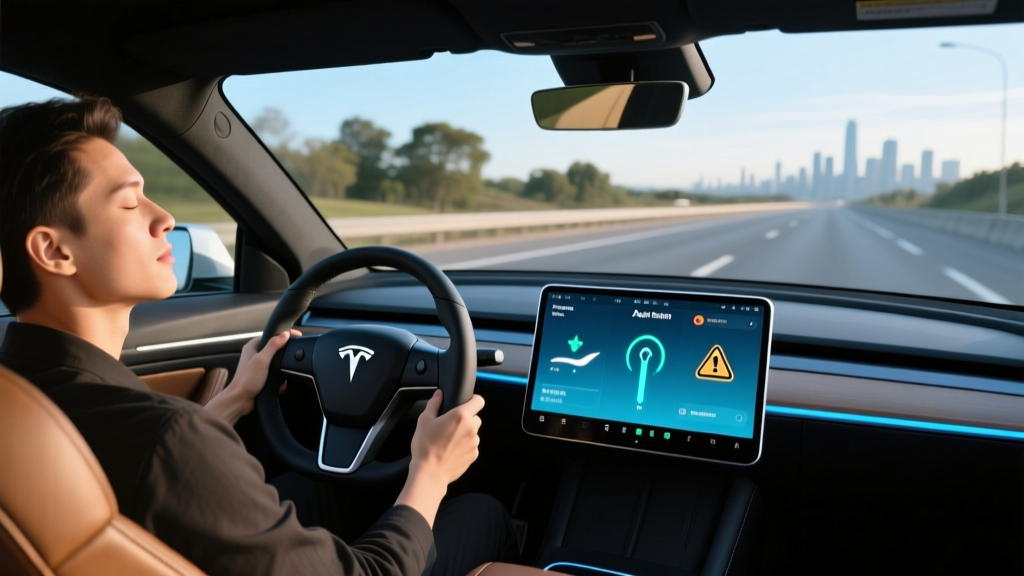
Search "tesla driver asleep" on any video platform and you'll find hundreds of clips: hands off the wheel, eyes closed, sometimes feet propped on the dash. These videos generate millions of views and fuel a persistent myth — that Tesla vehicles are self-driving cars where napping behind the wheel is safe or acceptable. It isn't.
As of the 2026 model year, every Tesla sold in the United States operates at SAE Level 2 automation. That means the driver must remain fully engaged, hands on or near the wheel, eyes on the road, and ready to take over at any moment. Tesla's Autopilot and Full Self-Driving (Supervised) systems are advanced driver-assistance features — not autonomous driving platforms. When a Tesla driver falls asleep at the wheel, they are violating both the law and the fundamental operating requirements of the vehicle.
This review examines what Tesla's current driver-monitoring systems actually do, how the 2026 Model 3 and Model Y perform in the real world, and what the data says about drowsy driving with driver-assist technology engaged. We'll also cover the full ownership picture: range, charging, pricing, and whether a Tesla still makes sense in an increasingly competitive EV market.
Tesla's Driver Monitoring: How the Car Tries to Keep You Awake
Tesla has progressively tightened its driver-monitoring protocols in response to regulatory pressure from the National Highway Traffic Safety Administration (NHTSA) and real-world incident data. Here's how the 2026 system works:
- Cabin camera monitoring: A camera mounted above the rearview mirror tracks eye gaze and head position. If your eyes drift downward or close for more than a few seconds, the system issues an escalating series of alerts.
- Steering wheel torque detection: The system requires periodic torque input on the steering wheel. If no input is detected, visual and audible warnings trigger.
- Escalating warnings: First a visual chime, then repeated audible alerts, then the system begins to slow the vehicle with hazard lights activated.
- Autopilot lockout: If the driver fails to respond through all warning stages, Tesla will bring the vehicle to a controlled stop, disable Autopilot for the remainder of the drive, and in repeated cases, may restrict Autopilot access for future trips.
- FSD (Supervised) strictness: FSD mode enforces more aggressive monitoring with shorter warning intervals than basic Autopilot.
In practice, these systems will catch a drowsy driver before a full sleep episode in most cases — but they are not foolproof. Sunglasses, certain head angles, and deliberate evasion (like the weighted steering-wheel accessories sold online, which Tesla and NHTSA have warned against) can delay detection. The bottom line: the car's safeguards are a last-resort backstop, not a permission structure for napping.
2026 Tesla Model 3: Range, Charging, and Real-World Efficiency
The refreshed Model 3 (internally called "Highland" and further refined for 2026) remains Tesla's volume sedan and the most relevant model to evaluate for daily-driver EV shoppers. Here are the hard numbers:
| Specification | Model 3 RWD | Model 3 Long Range AWD | Model 3 Performance |
|---|---|---|---|
| EPA Range | 272 mi | 363 mi | 315 mi |
| Battery (usable) | ~57.5 kWh (LFP) | ~75 kWh (NMC) | ~75 kWh (NMC) |
| Max DC Fast Charge | 170 kW | 250 kW | 250 kW |
| 10–80% DCFC Time | ~28 min | ~25 min | ~25 min |
| Level 2 Home Charge | 11.5 kW (~44 mi/hr) | 11.5 kW (~44 mi/hr) | 11.5 kW (~44 mi/hr) |
| 0–60 mph | 5.8 sec | 4.2 sec | 2.9 sec |
| Horsepower | 271 hp | 346 hp | 510 hp |
| MPGe (combined) | 132 MPGe | 132 MPGe | 119 MPGe |
| Drivetrain | RWD | Dual-Motor AWD | Dual-Motor AWD |
Charging Speed and Infrastructure: Tesla's Biggest Moat
Tesla's Supercharger network remains the most reliable DC fast-charging infrastructure in North America, with over 6,500 stations and 60,000+ individual chargers as of early 2026. The opening of Superchargers to non-Tesla EVs (via NACS or Magic Dock adapters) has increased station utilization at some corridors, but Tesla owners still benefit from seamless plug-and-charge integration, automatic battery preconditioning when navigating to a Supercharger, and generally superior uptime compared to Electrify America or EVgo.
| Charging Level | Power (kW) | Miles Added per Hour | Typical Use Case |
|---|---|---|---|
| Level 1 (120V outlet) | ~1.4 kW | 3–5 mi/hr | Emergency trickle |
| Level 2 (240V home) | 11.5 kW | ~44 mi/hr | Daily overnight charging |
| DC Fast (Supercharger V3) | Up to 250 kW | ~1,000+ mi/hr (peak) | Road trips, 10–80% in ~25 min |
| DC Fast (Supercharger V4) | Up to 350 kW (future capable) | Faster taper curve | Next-gen stations rolling out |
Charging curve reality: The 250 kW peak rate on Long Range and Performance trims is not sustained. The charge curve peaks around 250 kW between 10–30% State of Charge, then tapers progressively. From 50–80%, you'll see rates closer to 100–140 kW. This is why the 10–80% time of ~25 minutes is the more useful metric than the peak kW number. The LFP battery in the RWD model has a flatter charge curve and can tolerate regular 100% charging (unlike NMC, which Tesla recommends keeping at 80% for daily use).
Pricing, Tax Credits, and the True Cost of a 2026 Tesla
Tesla has adjusted pricing aggressively over the past two years to remain competitive. Here's where the 2026 lineup stands:
| Trim | Base MSRP | Est. §30D Credit | Effective Price* |
|---|---|---|---|
| Model 3 RWD | $38,990 | Up to $7,500 | ~$31,490 |
| Model 3 Long Range AWD | $45,990 | Up to $7,500 | ~$38,490 |
| Model 3 Performance | $52,990 | Up to $7,500 | ~$45,490 |
| Model Y Long Range AWD | $46,990 | Up to $7,500 | ~$39,490 |
| Model Y Performance | $51,990 | Up to $7,500 | ~$44,490 |
*Effective price assumes full §30D credit eligibility. Your actual credit depends on multiple factors.
- Income caps: Modified adjusted gross income must not exceed $150,000 (single), $225,000 (head of household), or $300,000 (joint filers).
- MSRP caps: Sedans (Model 3) must be under $55,000; SUVs/trucks/vans (Model Y) under $80,000. All current Tesla trims qualify.
- Battery sourcing: The credit is split into two $3,750 halves — one for critical minerals sourcing and one for battery component manufacturing. Tesla's shifting supply chain means eligibility can change month to month. Always verify current eligibility on IRS.gov before purchasing.
- Point-of-sale transfer: As of 2024, buyers can transfer the credit to the dealer at purchase, reducing the upfront price rather than waiting for a tax refund. This applies in 2026.
Interior, Cargo, Tech, and Daily Livability
The 2026 Model 3 interior carries forward the minimalist redesign introduced with the Highland refresh: ventilated front seats, ambient lighting, rear-seat touchscreen, improved sound insulation, and a slightly softer ride thanks to retuned suspension. The Model Y, redesigned for 2025 ("Juniper"), offers substantially more cargo room and remains the top-selling vehicle in the world by unit volume.
| Dimension | Model 3 | Model Y |
|---|---|---|
| Cargo (rear seats up) | 23 cu ft | 34 cu ft |
| Cargo (rear seats folded) | ~50 cu ft | ~72 cu ft |
| Front legroom | 42.7 in | 41.8 in |
| Rear legroom | 35.2 in | 39.5 in |
| Frunk | 3.1 cu ft | 4.1 cu ft |
Standout tech: Tesla's 15.4-inch center touchscreen runs a proprietary OS with native navigation, streaming (Netflix/YouTube while parked), a robust mobile app with remote climate and Sentry Mode cameras, and over-the-air updates that can add features post-purchase. The optional FSD (Supervised) package ($8,000 or $99/month) adds automated lane changes, traffic-light recognition, and city-street navigation — but remains a Level 2 system requiring full driver attention.
Notable drawbacks: No Apple CarPlay or Android Auto. Turn-signal stalks were removed in favor of steering-wheel buttons (polarizing). No heads-up display. Rear visibility is limited in the Model 3 sedan. Insurance costs run 20–40% higher than comparable non-Tesla EVs, according to industry data.
Warranty and Long-Term Battery Confidence
Tesla's warranty structure is competitive but not class-leading:
- Basic vehicle: 4 years / 50,000 miles
- Battery & drive unit (RWD): 8 years / 100,000 miles
- Battery & drive unit (Long Range/Performance): 8 years / 120,000 miles
- Capacity retention threshold: Tesla warrants that the battery will retain at least 70% of original capacity during the warranty period.
Real-world degradation data from Tesla's fleet suggests most NMC batteries retain 85–90% capacity at 100,000 miles, while LFP batteries in the RWD model show even slower degradation curves — often above 92% at equivalent mileage. LFP chemistry also allows routine 100% charging without the long-term health concerns associated with NMC at full state of charge, making the RWD model surprisingly practical for high-mileage commuters despite its lower range.
Is a 2026 Tesla Worth It vs. the Competition?
- Supercharger network reliability is unmatched
- Class-leading efficiency (kWh/mile)
- OTA updates continuously improve the car
- Strong resale value relative to most EVs
- LFP option for buyers who want 100% daily charging
- Extensive Sentry Mode and app ecosystem
- No CarPlay/Android Auto
- Higher insurance premiums
- Turn-signal buttons on wheel (no stalk)
- FSD remains Level 2 despite the name and price
- Increasingly strong competition (Hyundai, BMW, Chevrolet)
- Build quality improving but still inconsistent
The Hyundai Ioniq 6 (360-mile range, 800V charging, CarPlay) and BMW i4 (premium build, CarPlay, 307-mile range) both challenge the Model 3 on execution, though neither matches Tesla's Supercharger ecosystem. The Chevrolet Equus EQ (formerly Bolt successor) undercuts on price but trails on range and charging speed. For buyers who prioritize charging infrastructure and software above all else, Tesla still wins. For those who want traditional automotive refinement and phone integration, the alternatives have closed the gap significantly.
Frequently Asked Questions
Is it illegal to fall asleep while using Tesla Autopilot?
Yes. Every U.S. state requires a licensed, alert driver to be in control of the vehicle. Tesla Autopilot and FSD (Supervised) are SAE Level 2 driver-assistance systems — not autonomous driving. A driver who falls asleep can be charged with reckless driving, DUI-equivalent offenses (in some jurisdictions), or worse if a crash occurs. NHTSA has opened multiple investigations into crashes involving inattentive drivers on Autopilot.
Will the Tesla stop itself if the driver passes out?
Tesla's driver-monitoring system will issue escalating warnings and, if no response is detected, will activate hazard lights, slow the vehicle, and attempt to pull over. However, this is an emergency backstop — not a reliable safety net. The system cannot guarantee a safe stop in all traffic or road conditions. Relying on it is extremely dangerous.
Does the 2026 Tesla Model 3 qualify for the $7,500 federal tax credit?
It can, but eligibility depends on your income, the vehicle's battery-sourcing compliance at the time of purchase, and MSRP caps. All Model 3 trims fall under the $55,000 sedan cap. Verify current sourcing compliance on IRS.gov and consult a tax professional before relying on the credit.
What is the real-world highway range of a Tesla Model 3 Long Range?
Expect approximately 290–320 miles at highway speeds (70–75 mph) in moderate temperatures. In cold weather (below 30°F), that drops to roughly 240–275 miles. The EPA sticker of 363 miles reflects a mixed city/highway cycle that most road-trip driving won't match.
How does Tesla's FSD (Supervised) differ from Waymo's self-driving?
Tesla FSD is Level 2 — the driver must remain fully engaged and responsible at all times. Waymo operates Level 4 robotaxis in geofenced urban areas (Phoenix, San Francisco, Los Angeles) with no driver present. These are fundamentally different technologies. Consumer Tesla vehicles cannot drive themselves without human supervision.
Who is the Tesla Model 3 best suited for?
The Model 3 excels for tech-forward commuters and road-trippers who value the Supercharger network, over-the-air updates, and strong efficiency. The RWD trim with LFP battery is ideal for high-mileage daily drivers who can charge at home. The Long Range AWD suits those who need all-weather capability and maximum range. Families needing more cargo space should look at the Model Y.