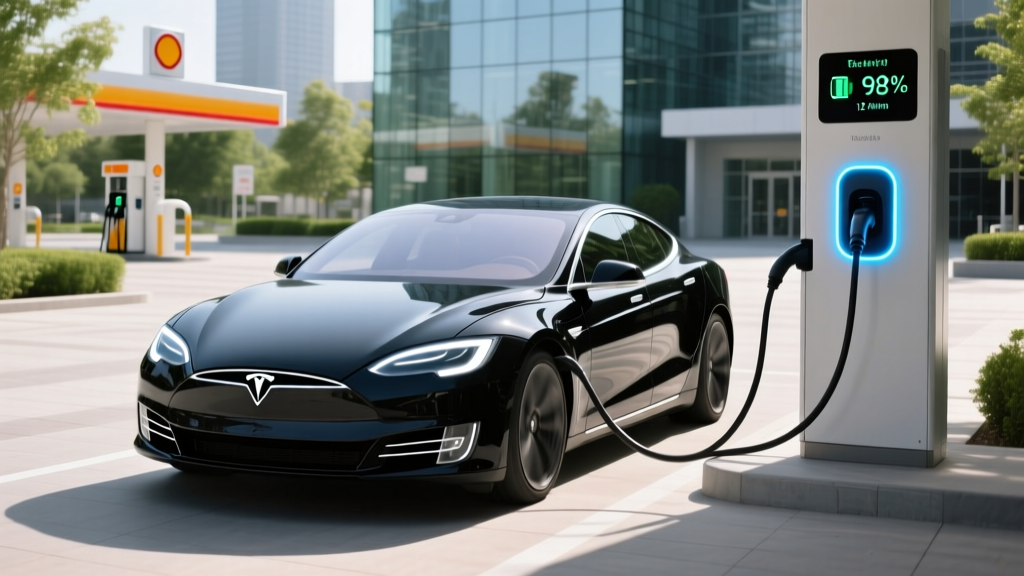
If you've ever searched "Tesla at gas station" on YouTube, you've seen the genre: EV owners pulling up to pumps they'll never use, smugly filming the $4-per-gallon prices while they plug in at home for a fraction of the cost. It's meme material, sure — but it also highlights a real question for 2026 EV shoppers: Does owning a Tesla actually eliminate the gas station from your life, and what does the math look like today?
This guide uses the 2026 Tesla Model Y — the brand's best-selling vehicle and the one most cross-shoppers compare against gas-powered SUVs like the Toyota RAV4 or Honda CR-V — to answer that question with hard numbers. We'll cover real-world range, charging costs, home setup, tax credits, and where the Tesla ownership experience genuinely diverges from the gas-car routine.
2026 Tesla Model Y: The Quick Verdict
The 2026 Model Y remains the default electric crossover for buyers who want proven Supercharger access, strong efficiency, and a starting price that undercuts many rivals after the federal tax credit. It's not the most luxurious EV in its class, nor the fastest-charging, but its ecosystem advantages — especially the Supercharger network's reliability — make the "no gas station" lifestyle more achievable than with most competitors.
| Spec | Value |
|---|---|
| EPA Range | 320 miles |
| Battery | 78 kWh usable (NMC) |
| Efficiency | 119 MPGe / 28 kWh/100 mi |
| 0-60 mph | 4.8 seconds |
| Horsepower | 384 hp (dual motor AWD) |
| Max DC Fast Charge | 250 kW peak |
| 10-80% DC Time | ~22 minutes |
| Level 2 Home Charge | 11.5 kW (~44 mi/hr) |
| Cargo Volume | 30.2 cu ft (rear seats up) / 72.0 cu ft (folded) |
| Base MSRP | $46,630 (Long Range AWD) |
| As-Tested (typical) | $49,130 with FSD transfer + paint |
| Battery Warranty | 8 years / 120,000 miles (70% retention) |
Real-World Range: What 320 EPA Miles Actually Means
Real-World Highway (70-75 mph, 65°F): ~265-280 miles
Cold Weather (below 32°F, highway): ~220-245 miles
City/Commuter (moderate climate): ~290-310 miles
The EPA's 320-mile estimate for the Long Range AWD is achievable in mixed suburban driving at moderate speeds with mild climate control. But highway travel — the scenario that actually matters for road-trip planning — typically yields 265 to 280 miles in temperate conditions. That's because EVs, unlike gas cars, lose efficiency at sustained high speeds (no regenerative braking to recapture energy, and aerodynamic drag scales with the square of velocity).
In freezing temperatures, expect a 20-30% range reduction due to battery chemistry limitations and cabin heating demands. The Model Y uses a heat pump (standard since 2021), which mitigates this compared to older resistance-heater EVs, but cold weather still meaningfully compresses range. If your typical road trip is 250 miles one-way in winter, you'll want to plan one Supercharger stop — which, on the Tesla network, is usually a 15-20 minute affair.
For context, a gas-powered RAV4 AWD with 28 MPG combined and a 14.5-gallon tank delivers roughly 400 miles per fill-up. The Model Y doesn't match that, but the cost-per-mile advantage is substantial (more on that below).
Charging Speed & Infrastructure: The Supercharger Advantage
This is where the "Tesla at gas station" comparison becomes most relevant. You won't visit a gas station, but you will visit chargers — and the experience varies enormously by network.
| Charge Type | Power | Speed | Typical Use Case |
|---|---|---|---|
| Level 1 (120V) | 1.4 kW | ~5 mi/hr | Emergency/top-up only |
| Level 2 (240V home) | 11.5 kW | ~44 mi/hr | Daily overnight charging |
| DC Fast (Supercharger V3) | 250 kW peak | 10-80% in ~22 min | Road trips |
| DC Fast (non-Tesla CCS) | 150-350 kW | Varies (adapter needed) | Backup network |
Home Level 2 charging is the foundation of the gas-station-free lifestyle. With a Tesla Wall Connector ($475) installed on a 60-amp circuit, you'll add roughly 44 miles of range per hour. A typical overnight session (8-10 hours) fully replenishes the battery from near-empty. Installation costs range from $800 to $2,500 depending on panel capacity and conduit run — budget $1,500 average for a straightforward garage install.
DC fast charging on Tesla's Supercharger V3 stalls peaks at 250 kW but tapers significantly above 50% state of charge. The 10-80% time of roughly 22 minutes is competitive but not class-leading — the Hyundai Ioniq 5 and Kia EV6, with 800V architectures, can hit 10-80% in 18 minutes at 350 kW chargers. However, Tesla's network reliability (typically 95%+ uptime at most corridors) often beats third-party networks where broken chargers or payment failures are common frustrations.
Since 2024, Tesla has opened Superchargers to non-Tesla EVs (with NACS ports or adapters), but Tesla owners still benefit from seamless plug-and-charge integration with no app or RFID card needed.
Cost of Ownership: Tesla vs. Gas SUV (5-Year Math)
Here's where the gas station truly leaves the picture. We compared a 2026 Model Y Long Range AWD against a 2026 Toyota RAV4 AWD (28 MPG combined) over 5 years and 75,000 miles, using national averages for electricity ($0.16/kWh) and gas ($3.40/gallon as of early 2026).
| Vehicle | Energy Cost | Total (75k mi) | Per-Mile Cost |
|---|---|---|---|
| Tesla Model Y (home charging) | $0.045/mi | $3,375 | $0.045 |
| Tesla Model Y (50% Supercharger) | $0.065/mi | $4,875 | $0.065 |
| Toyota RAV4 AWD (gas) | $0.121/mi | $9,075 | $0.121 |
Even splitting charging 50/50 between home and Superchargers (the latter costing roughly $0.28-$0.35/kWh in 2026), the Model Y saves $4,000-$5,700 in energy costs over five years. Add in eliminated oil changes (typically $300-$500 over 75k miles for the RAV4) and reduced brake wear from regenerative braking, and the total operating-cost advantage widens further.
Insurance, however, is a real offset: Model Y premiums average 15-25% higher than the RAV4 due to repair-cost data. Get quotes before purchase — this varies heavily by state, age, and driving record.
Federal Tax Credit: Does the 2026 Model Y Qualify?
As of 2026, the Tesla Model Y Long Range qualifies for the full $7,500 federal tax credit under IRS §30D, available as a point-of-sale rebate (transferred to the dealer at purchase) or as a tax credit on your return. However, eligibility has strings:
- MSRP cap: SUVs must be under $80,000 — Model Y qualifies at $46,630 base.
- Buyer income cap: Modified AGI ≤ $300,000 (joint filers), $225,000 (head of household), $150,000 (single).
- Battery sourcing: Critical minerals and battery components must meet phased-in domestic/free-trade requirements. Tesla's US-built LFP and NMC packs currently satisfy 2026 thresholds.
- Transfer option: You can assign the credit to Tesla at purchase, reducing the out-of-pocket price by $7,500 immediately (no need to wait for tax filing).
IRS clean vehicle credit page — verify current-year sourcing rules before purchase, as these tighten annually.
After the $7,500 credit, the effective price of a base Long Range AWD drops to roughly $39,130 — competitive with mid-trim RAV4 Hybrids once you factor in the fuel savings above.
Performance, Tech & Daily Livability
The Model Y's 4.8-second 0-60 time (Long Range AWD) is quick by any SUV standard and decisively faster than the RAV4 Hybrid's 7.4 seconds. Dual-motor AWD provides confident traction in rain and light snow, though the 285-mile Performance variant (4.8s → 3.5s 0-60) exists for buyers prioritizing acceleration over range.
Tech highlights:
- 15.4-inch center touchscreen with Tesla's native infotainment (no CarPlay/Android Auto — a polarizing choice)
- Over-the-air updates that add features post-purchase (recent: improved battery preconditioning, UI refinements)
- Autopilot standard (SAE Level 2): adaptive cruise + lane centering, requires hands-on-wheel supervision
- FSD Supervised ($8,000 option or $99/month): city-street capability, still Level 2 — not autonomous
- Sentry Mode dashcam, phone-as-key, app-based climate preconditioning
Notable drawbacks: The minimalist interior lacks physical buttons for climate, mirrors, and glovebox (all screen-controlled), which frustrates some drivers. Rear-seat legroom (41.6 inches) is adequate but trails the Hyundai Ioniq 5's 41.7 inches and the Kia EV6's 42.4 inches. Ride quality on the 2025-refresh Model Y improved significantly over earlier models, but it's still firmer than the RAV4's comfort-oriented tuning.
Who Should Buy the 2026 Model Y?
- You can install Level 2 home charging (garage or driveway with panel capacity)
- You take 2-4 road trips per year and want reliable Supercharger corridor coverage
- You value low operating costs and are comfortable with screen-dominant controls
- You want strong acceleration and AWD without a performance-SUV price tag
- You lack home charging access and rely entirely on public infrastructure
- You need third-row seating (look at the Model X, Kia EV9, or Rivian R1S)
- You prefer physical controls and Apple CarPlay/Android Auto integration
- You tow frequently (Model Y's 3,500-lb capacity trails the F-150 Lightning's 7,700 lbs)
Pros & Cons: The Honest Summary
- Class-leading Supercharger network reliability
- Strong efficiency (119 MPGe) keeps charging costs low
- $7,500 federal tax credit eligibility (2026)
- Quick acceleration and capable AWD
- Over-the-air updates add post-purchase value
- Spacious cargo area (72 cu ft with seats folded)
- No Apple CarPlay or Android Auto
- Screen-only controls for basic functions
- Insurance premiums above segment average
- DC fast-charge speed trails 800V rivals (250 kW vs. 350 kW)
- FSD option expensive and not truly autonomous
- Rear-seat comfort good but not class-leading
FAQ: Tesla at Gas Station Questions Answered
Can I charge a Tesla at a gas station?
Not directly. Most gas stations don't have EV chargers, though some chains (Sheetz, Wawa, Maverik) have added DC fast chargers on-site. You'll primarily charge at home, dedicated EV stations, or Superchargers (often located near shopping centers, not gas stations).
How much does it cost to "fill up" a Tesla vs. a gas car?
A full home charge (78 kWh at $0.16/kWh) costs roughly $12.50 for 320 miles of range. A gas SUV with 28 MPG needs $39 of fuel (at $3.40/gallon) for the same distance. Even Supercharger charging at $0.32/kWh costs ~$25 for a full charge — still 35% cheaper than gas.
What if I live in an apartment and can't charge at home?
This is the biggest barrier to the gas-station-free lifestyle. Without home charging, you'll rely on public Level 2 (workplace, shopping) or DC fast chargers, which costs more and requires time planning. Consider a PHEV like the RAV4 Prime if home charging isn't feasible.
Does the Model Y qualify for the $7,500 tax credit in 2026?
Yes, the Long Range AWD qualifies for the full $7,500 under §30D, subject to income caps ($150k single / $300k joint) and point-of-sale transfer rules. Verify battery-sourcing compliance at purchase, as rules tighten annually.
Is the Tesla Model Y still worth buying vs. Hyundai Ioniq 5 or Kia EV6?
For Supercharger network access and proven reliability, yes. The Ioniq 5 and EV6 charge faster (800V architecture) and offer CarPlay, but their public-charging experience depends on third-party networks with more downtime. If you road-trip frequently, Tesla's ecosystem advantage remains meaningful in 2026.
What's the real-world range in winter?
Expect 220-245 miles in sub-freezing highway driving (vs. 320 EPA). Preconditioning the battery while plugged in mitigates this somewhat and improves regenerative braking performance.
The "Tesla at gas station" meme endures because it captures a genuine ownership shift: with home charging and a 320-mile range, most Model Y owners genuinely stop visiting gas stations. The math — $3,375 in electricity vs. $9,075 in gas over five years — makes the switch economically rational, not just environmentally motivated. The 2026 Model Y isn't perfect, but it remains the lowest-friction path to an EV lifestyle for buyers with home-charging access.