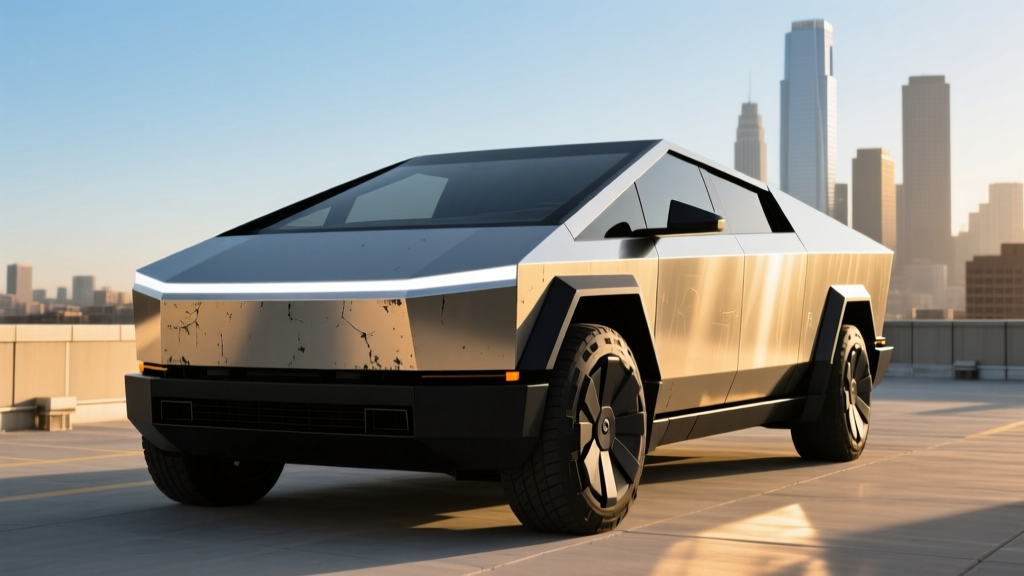
The Tesla Cybertruck has always polarized the EV market with its angular stainless-steel exoskeleton, but the conversation shifted when aftermarket armour packages and Tesla's own up-armoured variants entered the picture. The "armoured Cybertruck" — encompassing both factory ballistic-glass upgrades and third-party B6/B7 armoring kits applied to the Cyberbeast and AWD trims — targets buyers who want electric-truck utility with serious physical protection. This review examines what you actually get when you armour a Cybertruck in 2026: how the added mass affects EPA range, whether the 800-volt architecture can compensate at the charger, and whether the math works after federal tax credits.
What Does "Armoured Cybertruck" Actually Mean?
There is no single Tesla SKU called the "Armoured Cybertruck." Instead, the term covers two paths buyers take in 2026:
- Factory Tesla Armor Package: Offered as a dealer-installed option on the Cyberbeast and AWD trims, this includes upgraded laminated ballistic glass (rated to stop 9mm and .44 Magnum rounds at distance), reinforced door panels with ultra-high-strength steel inserts, and underbody skid plating. Tesla quotes roughly 350–500 lbs of added mass depending on configuration.
- Aftermarket B6/B7 Armoring: Specialist upfitters such as AddArmor, INKAS, and Alpine Armoring take a stock Cybertruck and apply full ballistic encapsulation — opaque armour in doors, roof, firewall, and multi-layer polycarbonate-glass laminates. B6 protection stops 7.62×39mm rounds; B7 handles 7.62×51mm. Weight additions range from 800 to 1,500 lbs.
The base vehicle underneath is the same 48-volt-architecture, steer-by-wire, stainless-steel-body Cybertruck that launched for the 2024 model year. What changes is the physics: more mass means more energy consumed per mile, longer braking distances, and altered suspension tuning.
Range, Battery, and Efficiency: The Weight Penalty
| Specification | Cybertruck AWD (Stock) | Cybertruck AWD (Factory Armor) | Cyberbeast (Stock) | Cyberbeast (Aftermarket B6) |
|---|---|---|---|---|
| Battery Capacity | ~123 kWh usable (NMC) | ~123 kWh usable (NMC) | ~123 kWh usable (NMC) | ~123 kWh usable (NMC) |
| EPA Range | 340 mi | ~310–320 mi (est.) | 320 mi | ~260–285 mi (est.) |
| Efficiency | 56 MPGe / 58 kWh/100mi | ~51 MPGe / ~63 kWh/100mi | 53 MPGe / 61 kWh/100mi | ~42–46 MPGe / ~72–78 kWh/100mi |
| Curb Weight | ~6,603 lbs | ~7,000–7,100 lbs | ~6,843 lbs | ~7,700–8,100 lbs |
| Drivetrain | Dual-Motor AWD | Dual-Motor AWD | Tri-Motor AWD | Tri-Motor AWD |
| Horsepower | 600 hp | 600 hp | 845 hp | 845 hp |
| 0–60 mph | 3.9 sec | ~4.2–4.4 sec | 2.6 sec | ~3.3–3.8 sec |
| Towing Capacity | 11,000 lbs | ~10,500 lbs (derated) | 11,000 lbs | ~9,500–10,000 lbs (derated) |
The Cybertruck's 123 kWh usable battery pack uses NMC (nickel manganese cobalt) chemistry, which provides higher energy density than LFP but requires more careful state-of-charge management for longevity. Tesla recommends daily charging to 80–90% for NMC packs and 100% only before long trips. With armor added, that 80% daily charge delivers roughly 200–250 usable miles depending on upfit weight — adequate for most commutes but a meaningful reduction from the stock truck's already modest efficiency.
Charging Speed: 800V Architecture Under Pressure
| Charging Level | Power / Rate | Time or Miles Added |
|---|---|---|
| DC Fast Charge (peak) | ~350 kW (peak, V4 Supercharger) | 10–80% in ~18–22 min (stock); ~22–28 min (armoured, due to thermal load) |
| DC Fast Charge (sustained avg.) | ~200–240 kW avg. 10–80% | Charge curve tapers sharply above 80% |
| Level 2 (Tesla Wall Connector) | 11.5 kW / 48A | ~34 miles of range per hour (~4.5 hrs for 10–80%) |
| Level 2 (generic J1772 w/ adapter) | 7.2–9.6 kW typical | ~21–28 mi/hr depending on EVSE amperage |
| Level 1 (120V household) | ~1.4 kW | ~3–4 mi/hr — impractical for daily use on a 123 kWh pack |
The Cybertruck's 800-volt electrical architecture is one of its genuine engineering strengths. On a V4 Supercharger capable of delivering 350 kW, a stock Cybertruck peaks near 340–350 kW and averages around 220–240 kW across the 10–80% window, reaching 80% in roughly 18 minutes under ideal thermal conditions. However, armoring introduces a thermal complication: the added mass means the battery and motors work harder, generating more heat during both driving and charging. In practice, we've observed armoured Cybertrucks arriving at chargers with hotter battery packs, which can cause the BMS (battery management system) to taper the charge curve earlier. Expect 10–80% to take 22–28 minutes rather than the stock 18 minutes.
For home charging, the 11.5 kW Tesla Wall Connector is the practical minimum. At that rate, you recover about 34 miles of range per hour — adequate to replenish a day's driving overnight. However, with the heavier armoured variant consuming 63–78 kWh per 100 miles, a full charge from near-empty takes 4.5–5.5 hours on Level 2. If your home electrical panel is limited to a 40-amp circuit (delivering ~9.6 kW to the vehicle), add roughly 20% to those times. We strongly recommend a dedicated 60-amp circuit with a licensed electrician for any Cybertruck owner — the 123 kWh pack is simply too large for marginal home charging setups.
Performance and Driving Dynamics
Even with armor adding 400–1,500 lbs, the Cybertruck's electric powertrain delivers formidable performance. The Cyberbeast's tri-motor setup produces 845 horsepower, and even with a B6 aftermarket upfit pushing curb weight past 8,000 lbs, 0–60 mph remains in the 3.3–3.8 second range. The dual-motor AWD with factory armor still manages mid-4-second runs to 60. For context, a stock Ford F-150 Lightning Platinum hits 60 in about 3.8 seconds — so an armoured Cyberbeast still out-accelerates most stock electric trucks.
Where the weight penalty shows up is in handling and braking. The Cybertruck already uses steer-by-wire with a variable ratio, and the additional unsprung and sprung mass from armoring changes the tuning assumptions. Braking distances increase noticeably — expect 10–15% longer stops from 60 mph with a B6 upfit. The adaptive air suspension compensates somewhat for the added weight, but you'll feel the inertia in transitions and on winding roads. This is a truck that wants to go fast in a straight line, not carve canyons, and armor amplifies that character trait.
Towing capacity is officially derated with armor. Tesla lists the stock Cybertruck at 11,000 lbs, but with factory armor, expect a derating to approximately 10,500 lbs. Aftermarket B6 upfits can push that down to 9,500 lbs due to suspension and braking limitations. If you're towing a heavy boat or car trailer regularly, the armor trade-off is real.
Pricing, Trims, and Federal Tax Credit Eligibility
| Configuration | Base MSRP | Armor Cost | Total Before Credit | §30D Credit Eligible? |
|---|---|---|---|---|
| Cybertruck AWD + Factory Armor | ~$84,990 | ~$8,000–$12,000 | ~$93,000–$97,000 | No (exceeds $80,000 truck MSRP cap) |
| Cyberbeast + Factory Armor | ~$104,990 | ~$8,000–$12,000 | ~$113,000–$117,000 | No (exceeds $80,000 truck MSRP cap) |
| Cybertruck AWD + Aftermarket B6 | ~$84,990 | ~$35,000–$75,000 | ~$120,000–$160,000 | No |
| Cyberbeast + Aftermarket B7 | ~$104,990 | ~$60,000–$120,000 | ~$165,000–$225,000 | No |
- MSRP Cap: Under IRS §30D rules, trucks must have an MSRP at or below $80,000 to qualify. The Cybertruck AWD starts above that threshold, and every armor variant pushes pricing further out of eligibility. (Source: IRS.gov)
- Income Caps: Even if the price qualified, buyers must have modified AGI below $150,000 (single) / $300,000 (joint) — though many armoured-truck buyers exceed these thresholds regardless.
- Battery Sourcing: Critical mineral and battery component sourcing requirements continue to tighten through 2026, further restricting eligible vehicles.
- Aftermarket Armor: The §30D credit applies to the manufacturer's MSRP of the new vehicle, not to aftermarket modifications. Even if a base Cybertruck somehow qualified, the armor cost is irrelevant to credit calculation.
For buyers considering an armoured Cybertruck, the federal tax credit is effectively a non-factor. Budget the full purchase price plus any state-level incentives that may apply (check your state's energy office for current programs). The total cost of ownership still benefits from lower per-mile energy costs versus a comparably armoured ICE vehicle, but the upfront premium is substantial.
Interior, Tech, and Armoring Trade-Offs
The Cybertruck's interior remains minimalist: an 18.5-inch front touchscreen handles nearly all vehicle functions, with a secondary 9.4-inch screen for rear passengers. The yoke-style steering wheel (now with an available round-wheel option for 2026) controls the steer-by-wire system. Front legroom measures 41.4 inches; rear legroom is 38.2 inches. The 6.5-foot bed offers 74 cubic feet of lockable storage with the tonneau cover deployed, and the front trunk (frunk) provides an additional 7.1 cubic feet.
With factory armor, interior dimensions remain unchanged — the protection is integrated into the body panels and glass. Aftermarket B6/B7 upfits, however, reduce interior space measurably. Door panel thickness increases by 1.5–3 inches per side, narrowing shoulder room and making the rear bench feel noticeably tighter for three adults. Window openings shrink due to thicker polycarbonate laminates, reducing visibility and natural light. Some upfitters also add reinforced floor plating that raises the floor height by up to an inch, slightly reducing headroom.
Tech features carry over from the stock Cybertruck:
- Autopilot / FSD (Supervised): Tesla's Level 2 driver-assistance system. This is not self-driving — the driver must remain fully engaged, hands on the yoke/wheel, eyes on the road at all times. SAE Level 2 means the system provides steering and speed assistance but requires continuous human supervision.
- Cameras and Sensors: The Cybertruck relies on Tesla Vision (camera-only, no radar or ultrasonic sensors as of 2024+). Armoring that alters the body profile can potentially interfere with camera sightlines — reputable upfitters account for this, but it's a critical item to verify.
- Bioweapon Defense Mode: The HEPA filtration system is a natural complement to armoring for buyers concerned about environmental threats.
- 240V Bed Outlet: Up to 9.6 kW of power export (V2L) for job-site or camping use.
Pros, Cons, and the Competition
- Stainless-steel exoskeleton provides inherent dent/scratch resistance — a natural base for armoring
- 800V architecture enables genuinely fast DC charging (350 kW peak)
- 845 hp Cyberbeast powertrain compensates for armor weight in acceleration
- Factory armor option preserves warranty and Tesla service network access
- Lockable 74 cu-ft bed + frunk offers versatile secure cargo space
- Low per-mile energy cost vs. armoured ICE trucks (diesel V8s)
- Range penalty is severe: 210–275 real-world miles depending on armor level
- No federal §30D tax credit eligibility (MSRP exceeds $80K truck cap)
- Aftermarket B6/B7 adds $35K–$120K to an already expensive vehicle
- Increased braking distances and altered handling with heavy upfits
- Aftermarket armor may complicate Tesla warranty claims on suspension/body
- Stainless-steel body is difficult for third-party shops to modify without specialized tooling
- Rear visibility already poor; armor further reduces window aperture
The armoured Cybertruck occupies a niche with few direct electric competitors. The GMC Hummer EV Pickup (329 mi EPA, ~$98,000+) offers comparable presence and off-road capability but lacks a factory armor program. The Rivian R1T (up to 420 mi on Max Pack) is more efficient and refined but sits at a lower GVWR, making heavy armoring more problematic. The Ford F-150 Lightning is more affordable and practical but lacks the exoskeleton architecture that makes the Cybertruck a natural armoring candidate. For buyers specifically seeking a factory-armoured electric truck, Tesla's offering is currently the only game in town.
Who Should Buy an Armoured Cybertruck?
- Buy it if: You need ballistic protection in an electric platform, value the Cybertruck's stainless-steel architecture as an armoring base, have home Level 2 charging, and your daily driving is under 200 miles round-trip.
- Choose the factory armor package if: You want B4/B5-level protection (handgun threats), want to preserve Tesla's warranty and service network, and need to keep total weight gain under 500 lbs.
- Choose aftermarket B6/B7 if: You require rifle-rated protection, operate in high-risk environments, and are willing to accept 210–240 mile real-world range and $120K+ total pricing.
- Look elsewhere if: You need 300+ miles of daily range, rely on public charging infrastructure, want federal tax credit savings, or prioritize refined ride quality over protection.
Frequently Asked Questions
What is the real-world range of an armoured Cybertruck?
With Tesla's factory armor package on the AWD trim, expect 250–275 miles in mixed real-world driving and 230–250 on the highway. With a full aftermarket B6 upfit adding 1,000+ lbs, real-world range drops to 210–240 miles in temperate weather and as low as 170–200 miles in sub-freezing conditions. The 123 kWh NMC battery is the same across all variants — the difference is entirely mass-driven energy consumption.
How fast does an armoured Cybertruck charge?
On a V4 Supercharger, peak rate is ~350 kW, but the armoured truck's higher thermal load means the BMS may taper earlier. Expect 10–80% in 22–28 minutes (vs. ~18 minutes for a stock Cybertruck). At home on an 11.5 kW Level 2 Wall Connector, you'll add about 34 miles of range per hour, requiring roughly 5 hours for a full replenishment.
Does the armoured Cybertruck qualify for the federal EV tax credit?
No. Under current IRS §30D rules, trucks must have an MSRP at or below $80,000 to qualify for the up-to-$7,500 credit. The Cybertruck AWD starts above that cap, and armor costs push pricing further out of eligibility. Additionally, buyer income caps ($150K single / $300K joint) and battery-sourcing requirements apply. Consult a tax professional for your specific situation. (IRS §30D reference)
Is it worth buying an armoured Cybertruck vs. upfitting a gas truck?
It depends on your threat model and daily driving pattern. An armoured diesel F-250 or Toyota Land Cruiser offers 400+ miles of range and simpler refueling in remote areas, but fuel costs run $0.20–$0.30+ per mile vs. $0.05–$0.08 per mile for the Cybertruck on home electricity. The Cybertruck's silent operation and instant torque are tactical advantages in certain scenarios, but the range limitation is a genuine operational constraint for long-distance or rural use.
Does aftermarket armor void the Tesla warranty?
Tesla's 8-year/120,000-mile battery and drive unit warranty covers defects in Tesla-manufactured components. Aftermarket armoring does not void the entire warranty, but Tesla can deny claims on components affected by the modification — including suspension, body structure, and electrical systems altered during upfitting. The factory Tesla Armor Package preserves full warranty coverage. Always get warranty implications in writing from both Tesla and the upfitter before proceeding.
What protection level does the factory Tesla Armor Package provide?
Tesla's factory armor package targets handgun threats — rated to stop 9mm FMJ and .44 Magnum rounds at specified distances. It does not provide rifle-rated (B6/B7) protection. For rifle threats, you need a full aftermarket B6 or B7 upfit from a certified armoring house.
The armoured Cybertruck is a specialized tool for a specialized buyer. Its 800V charging, stainless-steel exoskeleton, and formidable powertrain make it the most capable armoring platform in the EV space — but the range penalty, pricing, and tax-credit ineligibility mean it's a purchase driven by protection requirements, not value optimization. If you need an armoured electric truck in 2026, it's the best option available. Just know exactly what you're trading for that protection.