The Short Answer: Tesla and Apple CarPlay in 2026
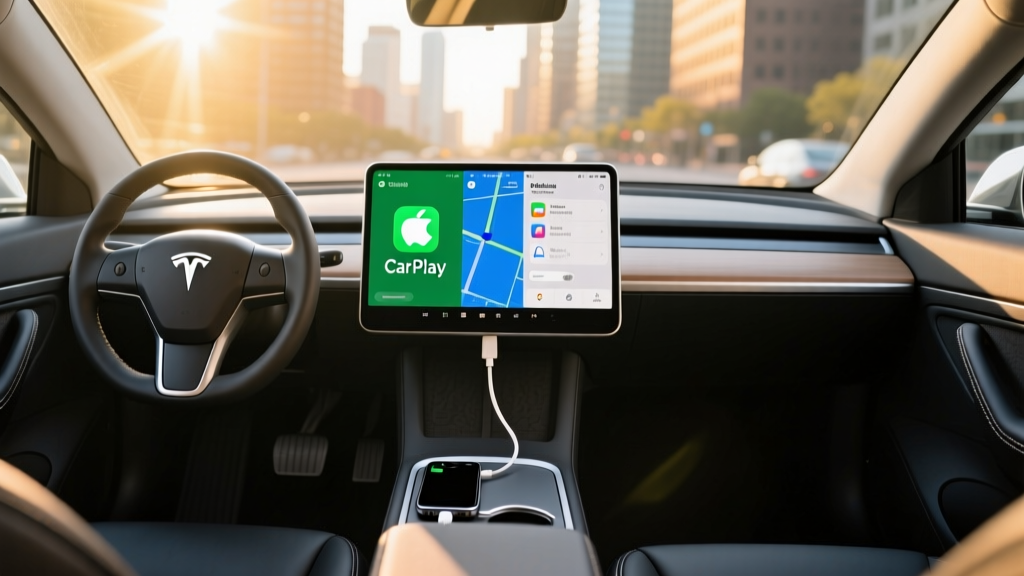
No, Tesla does not support Apple CarPlay — not in any current 2026 model, and the company has shown no indication of adding it. Whether you're looking at the Model 3, Model Y, Model S, Model X, or the Cybertruck, Tesla's proprietary infotainment system remains a walled garden. There is no wired or wireless CarPlay integration, no Android Auto support either, and no aftermarket workaround that preserves Tesla's native functionality without significant compromise.
This is one of the most-searched questions among prospective Tesla buyers, and it matters for good reason. CarPlay has become the default expectation for smartphone integration across the auto industry. Tesla's refusal to adopt it is both a philosophical stance and a competitive differentiator — their vertically integrated software stack powers everything from navigation and media to vehicle controls and over-the-air updates.
Below, we break down what Tesla offers instead, how the 2026 lineup stacks up on range, charging, performance, and pricing, and whether the absence of CarPlay should factor into your buying decision.
What Tesla Offers Instead of CarPlay
Tesla's infotainment system runs on a custom Linux-based OS displayed on a 15.4-inch center touchscreen (Model 3/Model Y) or a 17-inch screen (Model S/Model X). The system includes:
- Native navigation with real-time traffic, Supercharger routing, and battery-aware trip planning
- Spotify, Apple Music, Tidal, and TuneIn built directly into the media player (login with your account)
- Bluetooth audio streaming for any app on your phone — podcasts, audiobooks, YouTube Music, etc.
- Phone integration via Bluetooth for calls and contacts sync
- Tesla Theater (Netflix, YouTube, Disney+, Twitch) available while parked
- Arcade gaming with support for Bluetooth controllers
- Sentry Mode and Dashcam integrated into the same display
The key tradeoff: you can't mirror your iPhone's interface onto the Tesla screen. Navigation must use Tesla Maps (not Apple Maps or Google Maps directly), and while Bluetooth audio works, you lose CarPlay's unified interface for messaging, Siri integration, and app switching. Many owners adapt within weeks; others consider it a dealbreaker.
2026 Tesla Lineup: Range, Battery, and Charging Specs
| Model | EPA Range | Battery (kWh) | Chemistry | Max DC Charge (kW) | 10–80% Time | Level 2 Rate |
|---|---|---|---|---|---|---|
| Model 3 RWD | 272 mi | ~60 kWh usable | LFP | 170 kW | ~25 min | 11.5 kW / ~44 mi/hr |
| Model 3 Long Range AWD | 363 mi | ~82 kWh usable | NMC | 250 kW | ~18 min | 11.5 kW / ~44 mi/hr |
| Model 3 Performance | 315 mi | ~82 kWh usable | NMC | 250 kW | ~18 min | 11.5 kW / ~44 mi/hr |
| Model Y Long Range AWD | 320 mi | ~82 kWh usable | NMC | 250 kW | ~20 min | 11.5 kW / ~40 mi/hr |
| Model Y Performance | 285 mi | ~82 kWh usable | NMC | 250 kW | ~20 min | 11.5 kW / ~40 mi/hr |
| Model S Long Range | 402 mi | ~100 kWh usable | NMC | 250 kW | ~24 min | 11.5 kW / ~48 mi/hr |
| Model X Long Range | 348 mi | ~100 kWh usable | NMC | 250 kW | ~26 min | 11.5 kW / ~42 mi/hr |
| Cybertruck AWD | 340 mi | ~123 kWh usable | NMC | 250 kW | ~30 min | 11.5 kW / ~38 mi/hr |
Sources: EPA fueleconomy.gov, Tesla Owner's Manuals
Charging Curve Reality
Tesla's peak DC fast-charge rates are impressive but not sustained. On a V3 Supercharger (250 kW), a Model 3 Long Range will peak near 250 kW only between roughly 10-30% state of charge, then taper progressively. The 10-80% time of ~18 minutes reflects this curve. Charging from 80-100% can take an additional 20+ minutes — plan your road trips around the 80% mark for optimal efficiency. Tesla's navigation system automatically preconditions the battery when routing to a Supercharger, which is essential for achieving peak charge rates.
Performance and Drivetrain Breakdown
| Model | Drivetrain | Horsepower | 0–60 mph | Top Speed |
|---|---|---|---|---|
| Model 3 RWD | RWD (single motor) | 283 hp | 5.8 sec | 125 mph |
| Model 3 Long Range AWD | Dual-motor AWD | 384 hp | 4.2 sec | 125 mph |
| Model 3 Performance | Dual-motor AWD | 510 hp | 2.9 sec | 163 mph |
| Model Y Long Range AWD | Dual-motor AWD | 384 hp | 4.8 sec | 125 mph |
| Model Y Performance | Dual-motor AWD | 510 hp | 3.5 sec | 155 mph |
| Model S Long Range | Dual-motor AWD | 670 hp | 3.1 sec | 155 mph |
| Model X Long Range | Dual-motor AWD | 670 hp | 3.8 sec | 155 mph |
| Cybertruck AWD | Dual-motor AWD | 600 hp | 4.1 sec | 112 mph |
All Tesla models feature regenerative braking with a one-pedal driving experience. The Model 3 Performance and Model S Plaid (not shown, 1,020 hp, 0-60 in 1.99 sec) remain benchmarks for electric acceleration.
Pricing, Tax Credits, and Total Cost
| Model | Base MSRP | §30D Credit Eligible? | Est. Net Price |
|---|---|---|---|
| Model 3 RWD | $38,990 | Yes (up to $7,500) | ~$31,490 |
| Model 3 Long Range AWD | $45,490 | Yes (up to $7,500) | ~$37,990 |
| Model 3 Performance | $53,990 | Yes (up to $7,500) | ~$46,490 |
| Model Y Long Range AWD | $44,990 | Yes (up to $7,500) | ~$37,490 |
| Model Y Performance | $48,990 | Yes (up to $7,500) | ~$41,490 |
| Model S Long Range | $79,990 | No (MSRP cap exceeded) | $79,990 |
| Model X Long Range | $84,990 | No (MSRP cap exceeded) | $84,990 |
| Cybertruck AWD | $79,990 | No (MSRP cap exceeded) | $79,990 |
- MSRP Cap: Sedans must be ≤$55,000; SUVs/pickups/vans ≤$80,000 (source: IRS.gov)
- Buyer Income Cap: Modified AGI ≤$150,000 single / ≤$300,000 joint
- Battery Sourcing: Critical minerals and battery components must meet phased-in domestic/FSA-country sourcing thresholds — Tesla's US-built batteries currently qualify for the full $7,500 on eligible trims
- Point-of-Sale Transfer: As of 2024+, the credit can be transferred to the dealer at purchase, reducing your out-of-pocket cost immediately (not just at tax filing)
Efficiency
The Model 3 Long Range AWD achieves an EPA-rated 132 MPGe combined, or approximately 25 kWh per 100 miles — among the most efficient vehicles in its class. The Model Y Long Range returns 122 MPGe combined (~27 kWh/100mi). These figures translate to roughly $0.04-$0.06 per mile when charging at home on average US electricity rates ($0.16/kWh), compared to $0.12-$0.15 per mile for a comparable gasoline sedan at $3.50/gallon.
Cargo Space, Interior Dimensions, and Practicality
| Model | Cargo (rear seats up) | Cargo (seats folded) | Frunk | Rear Legroom |
|---|---|---|---|---|
| Model 3 | 23 cu ft (trunk) | — | 3.1 cu ft | 35.2 in |
| Model Y | 30 cu ft | 72 cu ft | 4.1 cu ft | 40.5 in |
| Model S | 28 cu ft (hatchback) | — | 3.1 cu ft | 35.4 in |
| Model X | 15 cu ft (behind 3rd row) | 88 cu ft (max) | 6.6 cu ft | 38.4 in |
| Cybertruck | 34 cu ft (bed) | — | 7.2 cu ft (frunk) | 36.0 in |
The Model Y remains the practicality sweet spot in the Tesla lineup: crossover cargo volume with sedan-like efficiency. The Model X offers falcon-wing rear doors and optional third-row seating (up to 7 passengers), though the third row is best suited for children.
Driver Assistance: Autopilot and FSD (Supervised)
Every 2026 Tesla ships with Basic Autopilot (Traffic-Aware Cruise Control and Autosteer on highways) at no extra cost. Enhanced Autopilot ($6,000 upgrade) adds Navigate on Autopilot, Auto Lane Change, Autopark, and Summon. Full Self-Driving (Supervised) ($8,000 upgrade) adds traffic light/stop sign recognition and city-street autosteer.
All Tesla driver-assistance features, including FSD (Supervised), are classified as SAE Level 2. The driver must remain fully attentive, keep hands on the steering wheel (or demonstrate engagement via Tesla's camera-based monitoring), and be prepared to take over at any moment. These systems are not "self-driving." Only Level 4 services like Waymo One operate without a human driver in defined geographic areas.
- Drive without human supervision or legal responsibility
- Handle all road conditions (construction zones, unmapped roads, severe weather)
- Replace the need for insurance or driver's license
- Guarantee hands-free operation — Tesla's cabin camera monitors driver attention
Warranty Coverage
| Coverage | Model 3 / Model Y | Model S / Model X |
|---|---|---|
| Basic Vehicle | 4 years / 50,000 miles | 4 years / 50,000 miles |
| Battery & Drive Unit | 8 years / 100,000 mi (RWD) or 120,000 mi (AWD) | 8 years / 150,000 miles |
| Battery Retention Threshold | 70% minimum capacity over warranty period | 70% minimum capacity over warranty period |
Tesla's battery warranty guarantees that the pack will retain at least 70% of its original capacity during the warranty term. Real-world data from Tesla's fleet suggests average degradation of roughly 10-12% after 100,000 miles for NMC packs. LFP packs (Model 3 RWD) tend to degrade more slowly and can be charged to 100% regularly without the same longevity concerns as NMC chemistry.
Pros and Cons of the 2026 Tesla Lineup
- Class-leading Supercharger network — 60,000+ global fast chargers with near-perfect uptime
- Over-the-air updates continuously add features (new UI, efficiency improvements, entertainment)
- Best-in-class energy efficiency (kWh/100mi) across Model 3 and Model Y
- LFP option on Model 3 RWD offers lower degradation and 100% daily charging
- Integrated trip planning with battery preconditioning for Supercharger stops
- Strong resale value relative to most EV competitors
- Point-of-sale tax credit transfer reduces upfront cost on eligible trims
- No Apple CarPlay or Android Auto — the most requested missing feature
- Tesla Maps navigation, while improved, lacks the POI depth of Google Maps or Apple Maps
- Service center wait times can extend to weeks in lower-density markets
- Model 3 cabin is minimalist to a fault — no instrument cluster, no physical controls
- Model S/X pricing exceeds the §30D MSRP cap, forfeiting the $7,500 credit
- FSD (Supervised) remains a paid beta experience, not a true autonomous system
- Cybertruck build quality inconsistency reported by early owners
Who Should Buy a Tesla in 2026?
- You rely on frequent road trips and need the most reliable DC fast-charging network available
- You want OTA software updates that meaningfully improve the vehicle over time
- You can charge at home and want the lowest per-mile energy cost in the segment
- You're comfortable with a phone-centric infotainment approach (Bluetooth streaming replaces CarPlay)
- Maximum efficiency (kWh/100mi) matters more than traditional luxury materials
- Apple CarPlay is a non-negotiable feature — look at the Hyundai Ioniq 5, BMW i4, or Ford Mustang Mach-E
- You want a traditional instrument cluster and physical button controls
- You live in an area with limited Tesla Service Center access
- You prefer dealership-based purchase and service experiences
Is Tesla Worth It vs. Key Competitors?
The Tesla Model 3 Long Range ($45,490 before credit) competes directly with the Hyundai Ioniq 6 Long Range (~$47,000), BMW i4 eDrive40 (~$57,000), and Polestar 2 Long Range (~$53,000). The Model 3 wins on efficiency, Supercharger access, and price-after-credit. Competitors win on CarPlay support, interior material quality, and service infrastructure.
The Model Y Long Range ($44,990 before credit) faces the Ford Mustang Mach-E Extended Range (~$48,000), Hyundai Ioniq 5 (~$47,000), and Kia EV6 (~$48,000). Again, Tesla's charging network and efficiency are decisive advantages; CarPlay, interior design variety, and dealer service favor the competition.
Frequently Asked Questions
Can I use my iPhone's navigation on a Tesla screen?
No. You cannot mirror Apple Maps, Google Maps, or Waze onto the Tesla display. You must use Tesla's built-in navigation. However, you can send destinations from the Tesla mobile app on your phone to the car's navigation remotely.
Is there any aftermarket way to add CarPlay to a Tesla?
Third-party hardware solutions exist (e.g., CarPlay AI boxes that inject a CarPlay interface via the Tesla browser or HDMI), but they are not endorsed by Tesla, may void portions of your warranty, and often introduce latency or reliability issues. Most owners who try them abandon the setup within months.
Does Bluetooth audio work well in Teslas?
Yes. Bluetooth audio streaming from any iPhone or Android app works reliably, including Apple Music, Spotify, podcast apps, and audiobook platforms. The audio quality through Tesla's premium sound system (14 speakers in Model 3/Y, 22 in Model S/X) is excellent. The limitation is control — you change tracks and playlists on your phone, not the car's screen.
What is the real-world range of the Model 3 Long Range?
The EPA rates it at 363 miles. In real-world highway driving at 70-75 mph in moderate temperatures, expect roughly 300-320 miles. In winter conditions (below freezing), plan for 250-280 miles. City driving with regenerative braking can match or slightly exceed the EPA estimate.
How fast does a Tesla charge at home?
Using a Tesla Wall Connector on a 48-amp circuit (60-amp breaker), all 2026 Tesla models charge at up to 11.5 kW, adding approximately 38-48 miles of range per hour depending on the model. A full charge from 10% to 100% takes roughly 7-9 hours overnight. Installation costs typically range from $500-$2,000 depending on panel proximity and local electrical code.
Does the Tesla Model Y qualify for the $7,500 federal tax credit?
Yes, the Model Y Long Range and Performance qualify for up to $7,500 under IRS §30D, provided the buyer's modified AGI is within limits ($150,000 single / $300,000 joint) and the vehicle is delivered with qualifying battery components. As of 2024, this credit can be applied as a point-of-sale discount, reducing your drive-off price immediately. Verify current eligibility at IRS.gov.
How long do Tesla batteries last?
Tesla's battery warranty covers 8 years / 100,000-150,000 miles (depending on model and drivetrain) with a minimum 70% capacity retention guarantee. Fleet data suggests most Tesla batteries retain 88-90% capacity at 100,000 miles. LFP chemistry (Model 3 RWD) shows even slower degradation. Full battery replacement outside warranty currently costs $12,000-$16,000 depending on the model.
Is Tesla's Autopilot self-driving?
No. Autopilot and FSD (Supervised) are SAE Level 2 driver-assistance systems. You must remain fully attentive and in control. Tesla's cabin camera monitors your engagement. The system can handle many highway and some city driving scenarios, but it is not autonomous and you are legally responsible for the vehicle at all times.