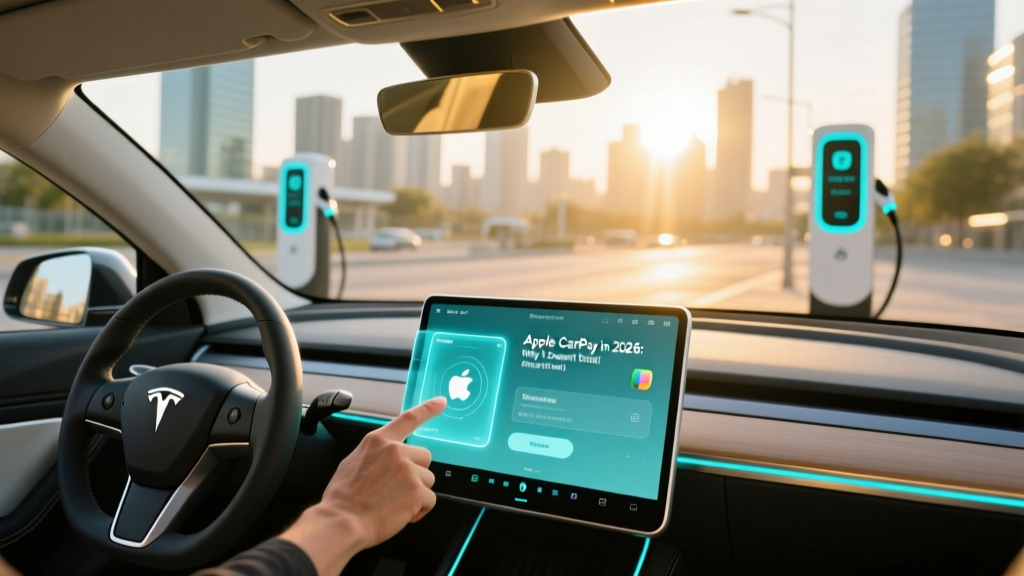
If you have searched for Tesla Apple CarPlay, you already suspect the answer: it does not exist. Tesla has never offered CarPlay or Android Auto in any production vehicle, and the 2026 Model 3, Model Y, Model S, and Model X lineup continues that tradition. Instead, Tesla insists its proprietary infotainment platform is superior to phone-mirroring — and for many owners, that argument holds up. For others, the absence of CarPlay remains the single biggest barrier to purchase.
This review examines the 2026 Tesla lineup through the lens of what CarPlay seekers actually want: seamless navigation, music, messaging, and app integration. We will also cover the real numbers buyers need — EPA range, charging speeds, pricing, and federal tax credit eligibility — so you can decide whether Tesla's walled garden is a dealbreaker or a non-issue.
Why Tesla Refuses to Support Apple CarPlay
Most automakers treat CarPlay as a low-cost way to offload infotainment development to Apple. Tesla takes the opposite approach: it builds the entire software stack in-house, from the navigation engine to the media player to the vehicle settings menus. The 15.4-inch center touchscreen in the Model 3 and Model Y is not just a display — it controls climate, mirrors, glovebox, and driving modes. Integrating CarPlay would mean ceding control of that screen to Apple, something Tesla has never been willing to do.
The practical result is a system that is deeply integrated with vehicle hardware but locked to Tesla's ecosystem. You cannot sideload apps, you cannot change the default navigation provider, and you cannot mirror your iPhone's interface. What you get instead is a native platform that Tesla updates over-the-air (OTA) regularly, adding features like theater mode, improved voice commands, and expanded streaming apps without requiring a dealership visit.
Aftermarket CarPlay adapters (like Carlinkit) that plug into the OBD-II port or USB do not enable CarPlay on Tesla vehicles. These devices rely on protocols Tesla does not expose. Browser-based screen-mirroring solutions exist but suffer from severe latency and are unsafe while driving. As of 2026, there is no reliable method to run Apple CarPlay on any Tesla model.
2026 Tesla Lineup: Core Specs at a Glance
Rather than reviewing a single model, here is how the current 2026 Tesla lineup stacks up across the metrics that matter most to EV buyers. All figures reflect the latest EPA data and Tesla's published specifications.
| Spec | Model 3 RWD | Model 3 Long Range AWD | Model Y Long Range AWD | Model S Plaid |
|---|---|---|---|---|
| EPA Range | 363 mi | 363 mi | 320 mi | 396 mi |
| Battery (usable kWh) | ~60 kWh (LFP) | ~75 kWh (NMC) | ~75 kWh (NMC) | ~95 kWh (NMC) |
| Efficiency (MPGe) | 132 MPGe | 134 MPGe | 122 MPGe | 124 MPGe |
| 0-60 mph | 5.8 sec | 4.2 sec | 4.8 sec | 1.99 sec |
| Horsepower | 271 hp | 346 hp | 384 hp | 1,020 hp |
| Peak DC Charge Rate | 170 kW | 250 kW | 250 kW | 250 kW |
| 10-80% DC Time | ~25 min | ~22 min | ~22 min | ~25 min |
| Base MSRP | $38,990 | $44,990 | $44,990 | $89,990 |
Source: fueleconomy.gov and Tesla's 2026 order page. Specs subject to change by model year and production batch.
Real-World Range: What the EPA Number Does Not Tell You
EPA Sticker: 363 miles (Model 3 Long Range AWD)
Real-World Highway (70-75 mph): Expect 280-310 miles. Tesla's efficiency is excellent, but sustained highway speeds consume significantly more energy than the EPA mixed-cycle test assumes.
Cold Weather (below 32°F / 0°C): Expect a 20-30% reduction, bringing usable range to roughly 250-290 miles. LFP-equipped Model 3 RWD variants can see up to 35% loss in extreme cold due to the chemistry's lower tolerance for low-temperature charging without preconditioning.
Tip: Always use Tesla's navigation-based trip planner for road trips — it accounts for elevation, temperature, and wind, and routes you through Superchargers with accurate arrival SoC estimates.
The Model 3 RWD's LFP (lithium iron phosphate) battery deserves special mention. LFP chemistry offers superior cycle life and can be charged to 100% daily without accelerated degradation — a significant ownership advantage. However, LFP cells are heavier, less energy-dense, and more susceptible to cold-weather range loss. If you live in a northern climate and cannot charge at home, the NMC-equipped Long Range variant is the better choice despite its higher price.
Charging Speeds: Supercharger Network vs. Public Alternatives
Tesla's biggest competitive moat in 2026 is not any single vehicle spec — it is the Supercharger network. With over 20,000 stalls across North America, it remains the most reliable DC fast-charging infrastructure available. Here is how charging breaks down across levels:
| Charging Level | Power (kW) | Miles Added per Hour | Notes |
|---|---|---|---|
| Level 1 (120V household) | ~1.4 kW | 3-5 mi/hr | Emergency/trickle only |
| Level 2 (240V home, 48A) | 11.5 kW | 35-44 mi/hr | Full charge overnight (~8-9 hrs) |
| DC Fast (V3 Supercharger) | Up to 250 kW | ~1,000 mi/hr (peak) | 10-80% in ~22 min (LR models) |
| DC Fast (V4 Supercharger) | Up to 350 kW | Faster taper curve | Limited to newer deployments; Tesla vehicles currently cap at 250 kW |
Charging curve reality: Peak 250 kW is sustained only between approximately 10-30% State of Charge (SoC). Above 50%, the rate tapers progressively, and above 80% it drops sharply to protect battery health. A 10-80% session takes roughly 22 minutes on Long Range models, but a 10-95% session can take 45-50 minutes. Plan road-trip stops accordingly — charging to 80% and driving on is almost always faster than waiting for a full battery.
With the adoption of the NACS (North American Charging Standard) connector across the industry, non-Tesla EVs now access Superchargers via adapter or native NACS ports. This has increased stall competition at popular corridors, though Tesla has been adding V4 stalls at high-traffic locations to compensate.
Tesla's Infotainment: A CarPlay Replacement or a Compromise?
Here is where the Tesla-versus-CarPlay debate gets nuanced. Tesla's native system excels in several areas where CarPlay falls short:
- Navigation: Tesla's built-in nav is EV-aware. It routes through Superchargers, preconditions the battery before arrival at a DC charger (critical for achieving peak charge rates), and estimates arrival SoC with impressive accuracy. Apple Maps via CarPlay cannot do any of this.
- Vehicle integration: Climate controls, seat heaters, steering wheel position, regenerative braking settings, and Sentry Mode all live on the touchscreen. CarPlay could never replicate this depth.
- OTA updates: Tesla regularly adds features — theater mode, improved voice recognition, new games, UI refinements — without dealer visits.
- Streaming: Spotify, Apple Music (via Bluetooth), YouTube, Netflix, and Twitch (while parked) are natively supported.
Where CarPlay loyalists feel the pain:
- Siri integration: Tesla's voice assistant has improved but still lags behind Siri's natural-language understanding for messaging, reminders, and smart-home control.
- App flexibility: You cannot install arbitrary apps. If Tesla does not support a podcast app or messaging platform you prefer, there is no workaround.
- Familiarity: iPhone users who have spent years curating CarPlay layouts, shortcuts, and Siri routines lose all of that muscle memory in a Tesla.
- Calendar/contacts sync: Tesla syncs contacts via Bluetooth but the integration is basic compared to CarPlay's deep phone-book and calendar access.
Pricing, Tax Credits, and Total Cost
| Model | Base MSRP | §30D Credit Eligibility | Effective Price (est.) |
|---|---|---|---|
| Model 3 RWD | $38,990 | Eligible (partial — up to $3,750-$7,500 depending on sourcing) | ~$31,490-$35,240 |
| Model 3 Long Range AWD | $44,990 | Eligible (partial — up to $3,750-$7,500) | ~$37,490-$41,240 |
| Model Y Long Range AWD | $44,990 | Eligible (partial — up to $3,750-$7,500) | ~$37,490-$41,240 |
| Model S / Model X | $79,990+ | Not eligible (exceeds MSRP cap) | Full MSRP |
Federal tax credit caveats (IRS §30D, 2026 rules):
- MSRP caps: Sedans (Model 3) must be under $55,000; SUVs/trucks/vans (Model Y) must be under $80,000.
- Buyer income caps: AGI must not exceed $150,000 (single), $225,000 (head of household), or $300,000 (joint).
- Battery sourcing: The credit is split into two halves ($3,750 each) — one for critical minerals sourcing and one for battery component manufacturing. Eligibility depends on current-year thresholds for North American content, which tighten annually. Check IRS.gov §30D guidance and Tesla's order page for the exact credit amount at time of purchase.
- Point-of-sale transfer: Eligible buyers can transfer the credit to the dealer at purchase, reducing the out-of-pocket price immediately rather than waiting for tax filing.
Pros, Cons, and the Verdict for CarPlay Holdouts
Pros
- Best-in-class Supercharger network access
- Class-leading efficiency (122-134 MPGe across lineup)
- OTA updates continuously add features
- LFP battery option allows daily 100% charging
- Native EV-aware navigation with battery preconditioning
- Strong resale value relative to most EV competitors
- Excellent 0-60 performance across all trims
Cons
- No Apple CarPlay or Android Auto — period
- Limited app ecosystem compared to phone-mirroring
- Voice assistant lags behind Siri/Google Assistant
- Model 3 RWD (LFP) significant cold-weather range loss
- Increasing Supercharger congestion from non-Tesla EVs
- Minimalist interior not to all tastes (no instrument cluster)
- Insurance costs above segment average
Warranty, Ownership, and Who Should Buy
Tesla's warranty coverage for the 2026 model year:
- Basic vehicle: 4 years / 50,000 miles
- Battery & drive unit (Model 3 RWD): 8 years / 100,000 miles (70% minimum capacity retention)
- Battery & drive unit (Long Range / Model S/X): 8 years / 120,000 miles (70% minimum capacity retention)
The 70% retention threshold is standard across the industry but worth noting: it means Tesla is only obligated to replace or repair a battery that has lost more than 30% of its original capacity within the warranty window. Real-world degradation data from Tesla fleet reports suggests most packs retain 88-92% capacity at 100,000 miles under normal use.
Who this EV suits best:
- Commuters with home charging: Ideal. Plug in nightly, wake up to a full battery, and never visit a gas station. The absence of CarPlay matters least on predictable routes.
- Road-trip families: The Model Y offers 76 cu ft of cargo space (rear seats folded), Supercharger access, and trip planning that works. But后排 entertainment relies on Tesla's native apps — no CarPlay means no familiar kids' apps mirrored to the screen.
- Tech-forward buyers who prefer integrated systems: If you value a single, cohesive software experience over phone-mirroring, Tesla's platform is the most advanced in production.
- CarPlay die-hards: Look at the Hyundai Ioniq 5, Ford Mustang Mach-E, or BMW i4 instead. All offer wireless CarPlay with competitive range and charging.
Frequently Asked Questions
Will Tesla ever add Apple CarPlay support?
There is no indication Tesla plans to support CarPlay. The company views its proprietary software as a core differentiator and has invested heavily in native app development, voice control, and OTA updates. Third-party hardware hacks are unreliable and unsafe. If CarPlay is a hard requirement, Tesla is not the right vehicle for you.
Can I use Apple Music and Apple Maps in a Tesla?
Apple Music is available as a native app on Tesla's infotainment system (requires an Apple Music subscription). Apple Maps is not supported — Tesla uses its own map data with Google Maps satellite imagery as a base layer. You can also use Spotify, Tidal, and other services natively.
How does Tesla's navigation compare to Apple Maps via CarPlay?
For EV-specific routing, Tesla's navigation is superior. It accounts for battery state, elevation changes, Supercharger availability, and weather — none of which Apple Maps handles in a CarPlay context. For general points of interest, restaurant reviews, and real-time traffic from non-Tesla sources, Apple Maps has a broader data ecosystem.
Does the 2026 Tesla Model Y qualify for the full $7,500 federal tax credit?
It depends on battery sourcing requirements at the time of purchase. The credit is split into two $3,750 halves based on critical minerals and battery component sourcing thresholds, which tighten each year. Always verify current eligibility on fueleconomy.gov and consult a tax professional before relying on the credit in your purchase decision.
What is the real cost of ownership compared to a gas car?
Based on national average electricity rates ($0.16/kWh) and gas prices ($3.40/gallon), a Model 3 Long Range driven 12,000 miles annually costs roughly $480/year in electricity versus $1,360/year in gasoline for a comparable 30 MPG sedan. Over five years, fuel savings of approximately $4,400 partially offset Tesla's higher insurance premiums (typically 15-25% above segment average).