The Apple CarPlay Gap in Tesla's Ecosystem
If you've searched for Tesla Apple CarPlay integration, you already know the frustrating answer: Tesla does not offer native CarPlay or Android Auto in any of its vehicles. While every major legacy automaker — from Ford to Hyundai to BMW — has embraced smartphone projection as a baseline infotainment feature, Tesla continues to rely exclusively on its proprietary touchscreen interface. For iPhone users accustomed to CarPlay's familiar maps, music queues, and Siri integration, this omission is one of the most-cited pain points in EV ownership surveys.
But the story doesn't end there. A growing ecosystem of third-party hardware adapters, software bridges, and workflow hacks now lets Tesla owners approximate the CarPlay experience — with varying degrees of success. Below, we break down exactly what's possible in 2026, what compromises you'll accept, and whether the Tesla infotainment system is good enough on its own to make you stop caring.
We'll also provide a complete 2026 Tesla Model Y Long Range AWD profile — the vehicle most buyers are cross-shopping — so you can evaluate the full ownership picture beyond the infotainment debate.
Why Tesla Refuses to Support Apple CarPlay
Tesla's resistance to CarPlay isn't an oversight; it's a deliberate product strategy. Tesla treats its 15.4-inch center touchscreen as the core of a vertically integrated software experience. The navigation system feeds directly into the vehicle's thermal management and battery preconditioning algorithms. When you enter a Supercharger as your destination, the car automatically heats or cools the battery pack to optimize charge speed — a feature that would be impossible if turn-by-turn directions ran through Apple Maps on a CarPlay window.
Similarly, Tesla's media player integrates with its cabin over-the-air update pipeline, and its phone-as-key system uses Bluetooth Low Energy in ways that would conflict with CarPlay's connection protocols. From Tesla's perspective, ceding the screen to Apple would sacrifice vehicle-level optimization for UI familiarity.
The counter-argument, of course, is that CarPlay has become an expectation. A 2025 J.D. Power survey found that 68% of EV shoppers rank smartphone projection as "very important" — and Tesla consistently scores below industry average in infotainment satisfaction specifically because of this gap.
Third-Party CarPlay Adapters for Tesla: What Actually Works
Several hardware solutions have emerged to bridge the gap. Here's how the major categories stack up in 2026:
HDMI-Input Adapter Boxes (e.g., Carlinkit T2C Plus, Hansshow)
These devices connect to the Tesla's hidden diagnostic port or a tapped CAN-bus line and inject a CarPlay signal that the Tesla browser or a custom app can display. Expect to pay $180–$320. The experience is functional but imperfect: there's typically 200–400ms of input lag, the resolution is capped at the adapter's output (often 1280×720 even on Tesla's higher-res screen), and you lose access to Tesla's native navigation while CarPlay is active — meaning no automatic battery preconditioning for Superchargers.
Tesla Browser-Based Streaming (CarPlay via Screen Mirroring)
Some adapters create a local Wi-Fi hotspot that streams a CarPlay-like interface to Tesla's built-in web browser. Latency is higher (400–800ms), and the browser may time out or fail to render certain CarPlay widgets correctly. This is the least reliable method but requires no hardware installation.
Phone Mounting + Bluetooth Audio (The Zero-Cost Compromise)
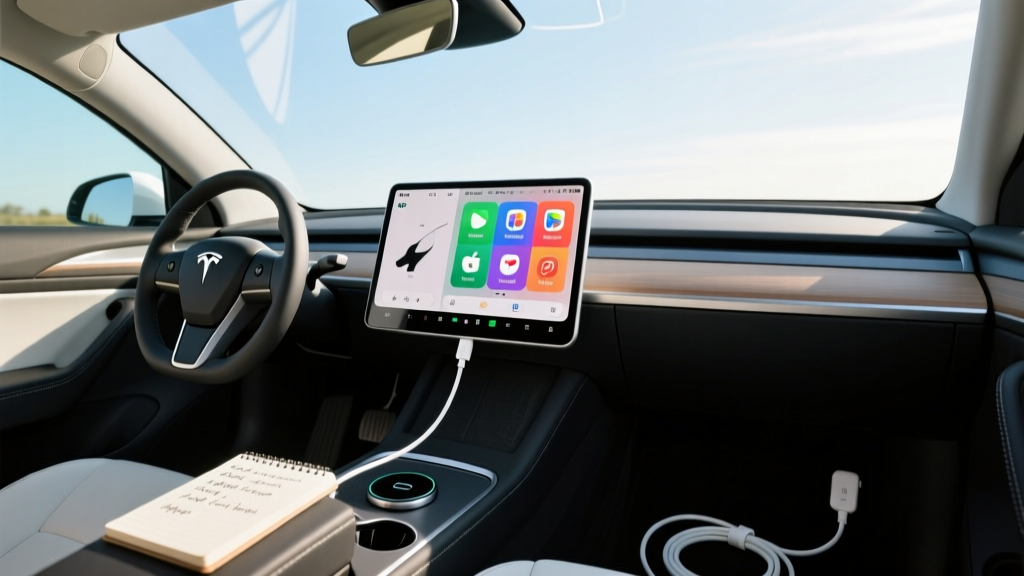
The simplest approach: mount your iPhone on the dashboard, run Apple Maps or Spotify on the phone screen, and pair audio via Bluetooth. You lose the integrated look, but you gain full CarPlay functionality on the phone itself with zero latency and zero compatibility headaches. Most Tesla owners who try adapters eventually revert to this method.
- None enable CarPlay on Tesla's instrument cluster (there isn't one in Model Y/3)
- Voice commands route through Siri on the phone, not Tesla's voice system
- Adapter firmware updates may break after Tesla OTA software updates
- Warranty implications are unclear — Tesla service centers have not issued official guidance
Is Tesla's Native Infotainment Good Enough Without CarPlay?
Here's where honest assessment matters. Tesla's 2026 infotainment system — running on the AMD Ryzen-powered MCU4 hardware — is legitimately excellent in several areas:
- Native navigation is EV-aware: it routes through Superchargers, estimates arrival SoC, and preconditioning is automatic
- Spotify, Apple Music, and Tidal all have native apps with full account integration
- Phone mirroring for calls and messages works reliably via Bluetooth with read-aloud
- Theater mode (parked only) supports Netflix, YouTube, Disney+, and Twitch on the main screen
- Gaming includes Cyberpunk 2077, Stardew Valley, and Cuphead — playable with the steering wheel and pedals
Where Tesla's system still falls short for CarPlay loyalists: no Siri integration for quick texts, no Apple Maps (which some users prefer for lane guidance and transit), and no easy way to share addresses from your iPhone's Calendar or Contacts directly to the car without using the Tesla app as an intermediary.
2026 Tesla Model Y Long Range AWD: Full EV Specs
Beyond the infotainment question, here's the complete ownership picture for the vehicle most buyers are evaluating:
| Spec | Value |
|---|---|
| EPA Range | 320 miles |
| Battery (Usable) | 78.1 kWh, NMC (nickel-manganese-cobalt) |
| Drivetrain | Dual-motor AWD |
| Horsepower | 384 hp combined |
| 0–60 mph | 4.8 seconds |
| Peak DC Fast Charge | 250 kW (V3 Supercharger) |
| 10–80% DC Charge | ~27 minutes |
| Level 2 Home Charge | 11.5 kW (44 mi/hr) |
| EPA Efficiency | 122 MPGe combined / 28 kWh/100mi |
| Cargo Volume | 30.2 cu ft (rear seats up) / 72.1 cu ft (folded) |
| Front Trunk (Frunk) | 4.1 cu ft |
| Rear Legroom | 38.4 inches |
| Battery Warranty | 8 years / 120,000 miles |
| Base MSRP | $44,990 |
The EPA rates the 2026 Model Y Long Range AWD at 320 miles. In real-world highway driving at 70–75 mph, expect 265–285 miles in mild temperatures. In cold weather (below 32°F), range can drop to 220–250 miles due to cabin heating demands and reduced battery chemistry efficiency. City driving with regenerative braking can match or slightly exceed the EPA figure.
Charging Speed Deep Dive: Supercharger Network Advantage
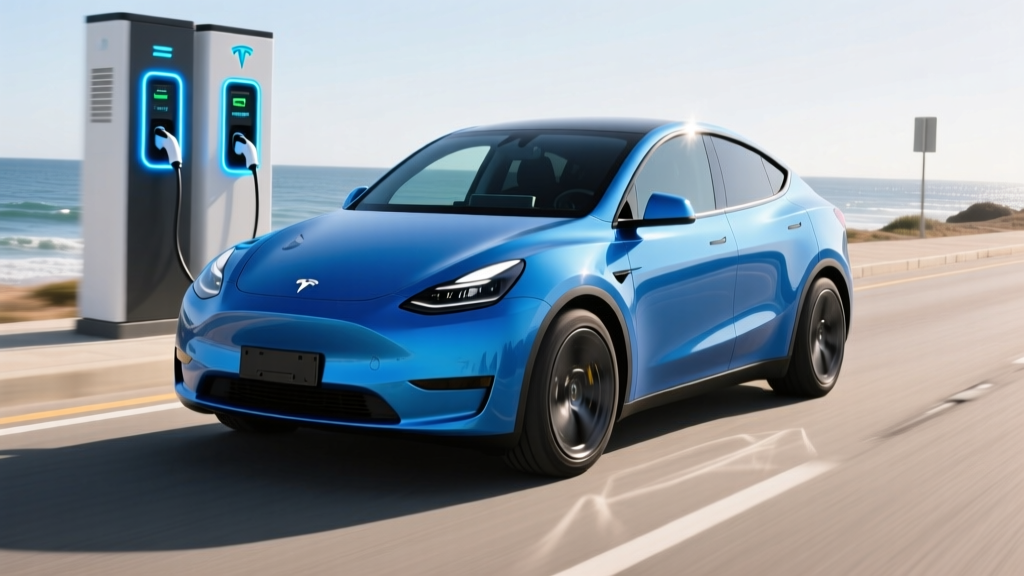
Tesla's Supercharger network remains its strongest competitive moat. With over 6,500 V3 (250 kW) and V4 stalls in North America as of early 2026, the network delivers consistent, reliable charging that third-party networks like Electrify America and EVgo still struggle to match in uptime.
| Charging Level | Power | Miles Added per Hour | Notes |
|---|---|---|---|
| Level 1 (120V outlet) | ~1.4 kW | ~5 mi/hr | Emergency only; overnight adds ~50 mi |
| Level 2 (240V, Wall Connector) | 11.5 kW | 44 mi/hr | Full charge in ~7 hours; ideal home setup |
| Level 2 (public, 7.2 kW) | 7.2 kW | 28 mi/hr | Common at workplaces and hotels |
| DC Fast (V3 Supercharger) | 250 kW peak | ~1,000 mi/hr (peak) | 10–80% in ~27 min; tapers above 60% |
| DC Fast (CCS adapter, EA 350 kW) | ~170 kW sustained | ~650 mi/hr | Tesla CCS adapter required; speed limited by car |
The charging curve matters: the Model Y peaks at 250 kW only between approximately 10–30% SoC. From 30–60%, it sustains around 150–170 kW. Above 80%, the rate drops sharply to protect battery health — a 80–100% top-up can add another 25+ minutes. For road trips, the optimal strategy is to charge from 10–80% and drive on.
Home charging with the Tesla Wall Connector ($420 for the unit, plus $600–$1,800 for professional installation depending on panel proximity) is the ownership sweet spot. A full overnight charge costs roughly $8–$14 depending on your utility rate — equivalent to 2–3 gallons of gas for 300+ miles of range.
Pricing, Trims, and Federal Tax Credit Eligibility
| Trim | Base MSRP | Federal §30D Credit | Effective Price |
|---|---|---|---|
| Long Range RWD | $42,490 | Up to $7,500 (see rules) | As low as $34,990 |
| Long Range AWD | $44,990 | Up to $7,500 (see rules) | As low as $37,490 |
| Performance AWD | $48,990 | Up to $7,500 (see rules) | As low as $41,490 |
Tax credit eligibility is not automatic. Under current IRS §30D rules, the $7,500 credit requires:
- MSRP cap: Vehicle must be under $80,000 (SUVs/vans/crossovers) — all Model Y trims qualify
- Buyer income cap: AGI must not exceed $150,000 (single) / $300,000 (joint) / $225,000 (head of household)
- Battery sourcing: A percentage of critical minerals and battery components must be sourced from the US or FTA partners — Tesla's US-built LFP and NMC packs have met partial requirements; the full $7,500 has been available for most 2025–2026 Model Y configurations, but sourcing percentages shift annually. Verify current eligibility at the point of sale
- Point-of-sale transfer: As of 2024+, you can transfer the credit to the dealer at purchase, reducing your out-of-pocket cost immediately rather than waiting for a tax refund
Always confirm eligibility with your tax professional and the dealer's point-of-sale verification tool before assuming the full credit.
Model Y vs. Key Competitors: Is It Still Worth It?
The 2026 Model Y faces its strongest competition in years. Here's how it stacks up on paper against the top rivals:
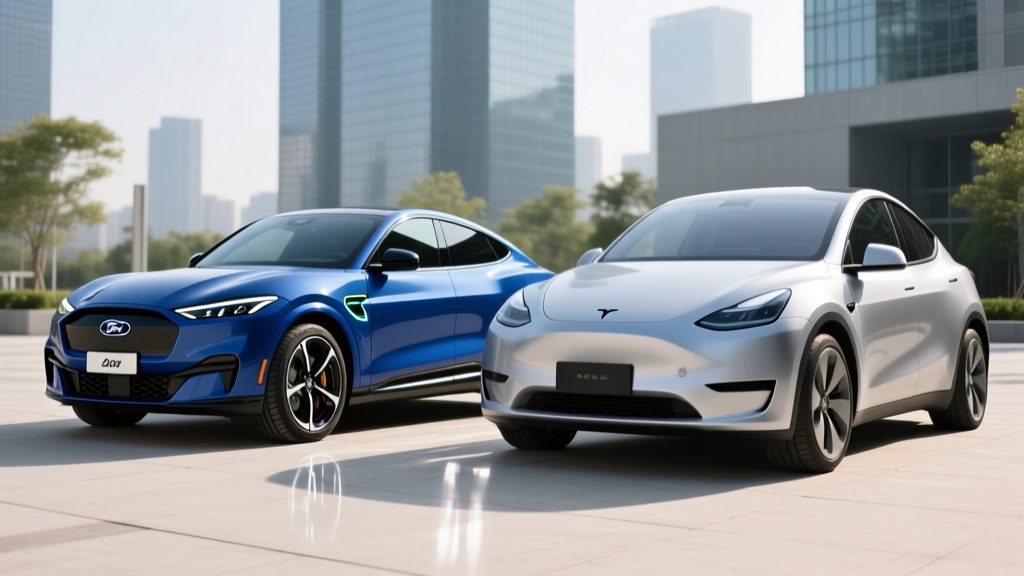
| Spec | Tesla Model Y LR AWD | Hyundai Ioniq 5 Limited | Ford Mustang Mach-E Premium |
|---|---|---|---|
| EPA Range | 320 mi | 305 mi | 312 mi |
| Battery | 78.1 kWh NMC | 84.0 kWh NMC | 88.0 kWh NMC |
| Peak DC Charge | 250 kW | 238 kW | 150 kW |
| 10–80% Charge | ~27 min | ~29 min | ~41 min |
| 0–60 mph | 4.8 sec | 5.1 sec | 5.2 sec |
| Apple CarPlay | No (adapter required) | Yes (wireless) | Yes (wireless) |
| Base MSRP | $44,990 | $49,500 | $45,995 |
| Charging Network | Supercharger (proprietary) | NACS (Supercharger access) | NACS (Supercharger access) |
- Supercharger reliability is your top road-trip priority
- You value OTA updates that meaningfully add features over time
- You prefer the minimal-interior aesthetic and glass roof
- You don't mind the CarPlay workaround or prefer Tesla's native UI
- Efficiency (28 kWh/100mi) matters for your electricity costs
- Native Apple CarPlay or Android Auto is non-negotiable
- You want physical buttons for climate and volume
- Hyundai's 800V architecture charges at comparable speed with broader adapter compatibility
- Ford's BlueCruise hands-free highway driving appeals more than Tesla's FSD subscription
- You need more rear-seat comfort (Mach-E and Ioniq 5 have slightly more rear legroom)
Pros and Cons: The Honest 2026 Model Y Assessment
- Class-leading efficiency at 122 MPGe combined
- Supercharger network still the gold standard for reliability
- Spacious cargo area (72.1 cu ft max) with practical frunk
- Strong performance: 4.8-sec 0–60 with dual motors
- Excellent over-the-air update track record
- Competitive pricing after §30D tax credit
- 8-year/120,000-mile battery warranty
- No native Apple CarPlay or Android Auto — the core complaint
- Minimalist interior lacks physical controls; everything on the screen
- FSD (Supervised) remains a $8,000 option or $99/mo subscription — still SAE Level 2, requires driver engagement
- Insurance costs run 15–25% higher than segment average
- Ride quality firm on 20-inch wheels; road noise noticeable at highway speed
- CCS adapter required for non-Supercharger DC fast charging
- No heads-up display
Who the 2026 Tesla Model Y Suits Best
Ideal for: Tech-forward commuters who charge at home, take 2–4 road trips per year on well-established Supercharger corridors, and value efficiency and cargo versatility. The Model Y remains one of the most practical family EVs on the market — two child seats fit easily in the rear, and the combined 76.2 cu ft of cargo space handles weekly groceries plus luggage.
Less ideal for: Buyers who prioritize infotainment familiarity (CarPlay/Android Auto loyalists), those in areas with sparse Supercharger coverage who need reliable CCS public charging, or drivers who want a more traditional cockpit with physical gauges and buttons.
Towing note: The Model Y is rated for 3,500 lbs of towing capacity — adequate for a small utility trailer or a pair of dirt bikes, but not for a camper or boat. If towing is a priority, look at the Ford F-150 Lightning or Rivian R1S.
Frequently Asked Questions
Does any Tesla model support Apple CarPlay natively?
No. As of 2026, no Tesla vehicle — Model 3, Model Y, Model S, Model X, or Cybertruck — supports Apple CarPlay or Android Auto natively. Tesla uses its proprietary infotainment system exclusively across all models.
What's the best CarPlay adapter for a Tesla in 2026?
The Carlinkit T2C Plus and Hansshow Tesla CarPlay adapter are the most-reviewed options, priced around $200–$300. Both inject a CarPlay-like display into the Tesla browser. Expect minor lag (~300ms) and occasional compatibility breaks after Tesla OTA updates. Test return policies before buying.
What is the real-world range of the 2026 Tesla Model Y?
The EPA rates the Long Range AWD at 320 miles. In real-world highway driving at 70–75 mph, expect 265–285 miles. In sub-freezing temperatures, that drops to 220–250 miles. City driving with regen braking can match or exceed the EPA estimate.
How fast does the Model Y charge at home and on the road?
At home with a Tesla Wall Connector (240V, 48A), the Model Y charges at 11.5 kW, adding about 44 miles of range per hour — a full charge takes roughly 7 hours. On a V3 Supercharger, it peaks at 250 kW and charges from 10–80% in approximately 27 minutes, though speed tapers significantly above 60% SoC.
Does the 2026 Model Y qualify for the $7,500 federal tax credit?
The Model Y qualifies for up to $7,500 under IRS §30D, provided the buyer meets income caps ($150K single / $300K joint), the MSRP is under $80,000 (all trims qualify), and battery-sourcing requirements are met. Sourcing percentages update annually — verify at point of sale. The credit can be transferred to the dealer for an immediate price reduction.
Is the Tesla Model Y still worth buying over the Hyundai Ioniq 5 or Ford Mach-E?
It depends on your priorities. The Model Y wins on efficiency (122 MPGe), Supercharger network reliability, and cargo space. The Ioniq 5 and Mach-E win on native CarPlay/Android Auto, physical controls, and (for Hyundai) 800V charging architecture. If CarPlay is a dealbreaker, the Ioniq 5 is the strongest alternative. If charging infrastructure reliability is paramount, the Model Y still leads.
Is Tesla's FSD actually self-driving?
No. Tesla's Full Self-Driving (Supervised) is an SAE Level 2 driver-assistance system. It requires the driver to remain fully attentive, keep hands available, and be prepared to take over at any moment. It is not autonomous driving. Only Level 4 services like Waymo operate without a human driver — and those are limited to specific geofenced urban areas.