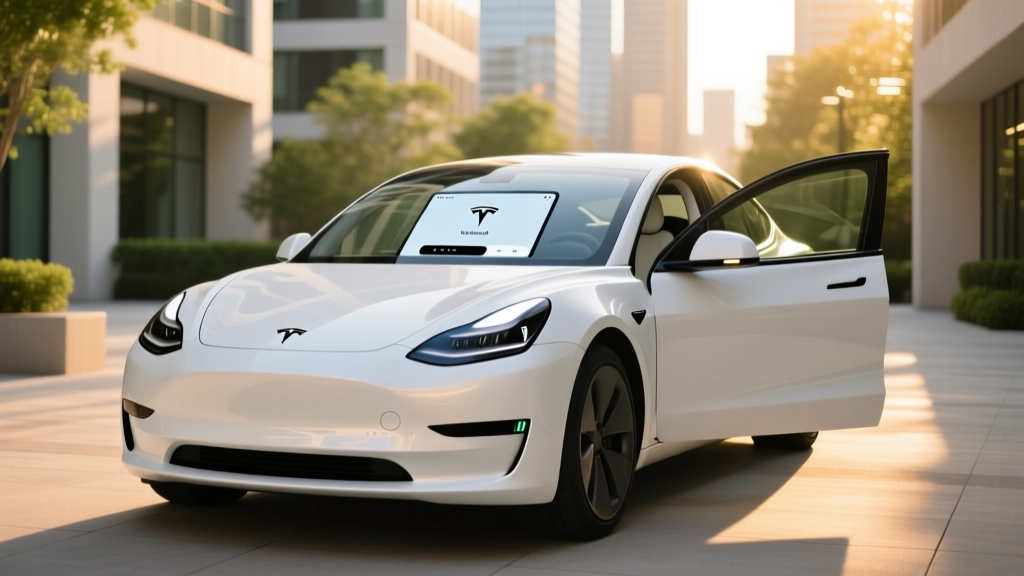
If you've ever stood in a parking lot tapping your phone while the Tesla app refuses to unlock your car, you're not alone. "Tesla app not working" remains one of the most-searched owner issues in 2026, and it's usually fixable in under two minutes. But app glitches aside, the 2026 Tesla Model 3 remains the benchmark compact electric sedan — and this review covers every spec, charging figure, and ownership cost you need before buying.
Why Your Tesla App Isn't Working (And How to Fix It)
Before we get into range and pricing, let's address the keyword that brought you here. The Tesla app serves as your key fob, climate controller, and vehicle monitor. When it fails, it's almost always one of five causes:
- Bluetooth permission revoked — iOS and Android updates occasionally reset app permissions. Go to Settings > Privacy > Bluetooth and confirm Tesla is toggled on.
- Background app refresh disabled — Without it, Phone-as-Key won't passively unlock. Enable it in Settings > General > Background App Refresh (iOS) or Battery > Unrestricted (Android).
- Tesla server outage — Check status.tesla.com or Downdetector. During regional outages, use your NFC key card on the B-pillar to enter and start the car.
- App cache corruption — Force-close the app, then clear cache (Android) or offload and reinstall (iOS). Your login credentials remain stored on Tesla's servers.
- Outdated app version — Tesla pushes updates frequently. Check the App Store or Google Play for the latest build; 2026 versions include improved BLE handshake stability.
2026 Tesla Model 3: Quick Verdict
The 2026 Model 3 carries over the "Highland" refresh introduced for the 2024 model year, with minor software and battery-management refinements. It remains the best-selling electric sedan in the U.S. for good reason: class-leading efficiency, access to the 17,000+ Supercharger network, and a starting price that undercuts rivals. The Long Range AWD variant is the sweet spot — 341 miles of EPA range, dual-motor grip, and federal tax credit eligibility make it hard to beat at $42,630 before incentives.
| Spec | RWD (Base) | Long Range AWD | Performance AWD |
|---|---|---|---|
| EPA Range | 272 mi | 341 mi | 315 mi |
| Battery (usable) | 57.5 kWh (LFP) | 75 kWh (NMC) | 75 kWh (NMC) |
| Max DC Fast Charge | 170 kW | 250 kW | 250 kW |
| 10-80% DCFC Time | ~30 min | ~25 min | ~25 min |
| Level 2 Rate | 11.5 kW (~44 mi/hr) | 11.5 kW (~44 mi/hr) | 11.5 kW (~44 mi/hr) |
| 0-60 mph | 5.8 sec | 4.2 sec | 2.9 sec |
| Horsepower | 271 hp | 346 hp | 450 hp |
| Drivetrain | RWD | AWD (Dual Motor) | AWD (Dual Motor) |
| Efficiency | 132 MPGe / 25 kWh/100mi | 131 MPGe / 26 kWh/100mi | 119 MPGe / 28 kWh/100mi |
| Base MSRP | $38,990 | $44,630 | $52,990 |
Source: fueleconomy.gov, Tesla.com. Prices exclude $1,390 destination fee.
Real-World Range: What to Actually Expect
EPA Estimated: 341 miles (Long Range AWD)
Real-World Highway (70 mph): ~280-300 miles
Real-World City/Mixed: ~310-330 miles
Cold Weather (below 30°F): ~230-270 miles (20-30% reduction)
Range varies with speed, temperature, elevation, and HVAC use. Preconditioning while plugged in recovers significant cold-weather range.
The Long Range AWD's 75 kWh NMC pack delivers impressive efficiency. In warm-weather mixed driving, owners routinely report 310-330 actual miles. Highway cruising at 70+ mph drops that to roughly 280-300 miles because aerodynamic drag increases exponentially at speed. The base RWD model's LFP (lithium iron phosphate) battery sacrifices some range at 272 EPA miles but gains a major longevity advantage — LFP chemistry tolerates repeated 100% charging without degradation concerns, unlike NMC packs where Tesla recommends an 80% daily limit.
Cold weather is the great equalizer for all EVs. Below freezing, expect a 20-30% range reduction due to battery resistance and cabin heating demands. The Model 3's standard heat pump (introduced with the Highland refresh) significantly mitigates this compared to older resistive-heater models, but physics wins. On a 20°F morning highway run, plan for ~240 usable miles in the Long Range.
Charging Speed: Home, Supercharger, and CCS
The 2026 Model 3 uses Tesla's NACS (North American Charging Standard) connector natively, giving it plug-and-play access to every Supercharger without adapters. With the broader industry adopting NACS for 2025+ models, the Model 3 is now compatible with Electrify America, EVgo, and ChargePoint CCS stations using a simple NACS-to-CCS adapter (included with new vehicles since late 2024).
| Level | Power (kW) | Speed | Use Case |
|---|---|---|---|
| Level 1 (120V) | ~1.4 kW | ~5 mi/hr | Emergency/overnight trickle |
| Level 2 (240V, 48A) | 11.5 kW | ~44 mi/hr | Home daily charging |
| DC Fast (Long Range) | Peak 250 kW | 10-80% in ~25 min | Road trips |
| DC Fast (RWD/LFP) | Peak 170 kW | 10-80% in ~30 min | Road trips |
A critical nuance most buyers miss: the charge curve. The 250 kW peak on the Long Range only holds between roughly 10-30% state of charge (SoC). From 30-60%, it tapers to ~150 kW, and from 60-80% it drops to ~75 kW. That 10-80% average is roughly 130 kW sustained — which is why the ~25-minute figure is realistic, not marketing fluff. Preconditioning the battery by navigating to a Supercharger in the nav system warms the pack and unlocks peak charge rates immediately upon plugging in. Arriving at a Supercharger without preconditioning can add 5-10 minutes to your stop in cold weather.
Home charging on a Level 2 Wall Connector (48 amps) fully replenishes the Long Range in about 7-8 hours — ideal for overnight top-ups. Installation typically costs $500-$1,500 depending on panel proximity and whether your home's 200A electrical panel needs an upgrade (which can push costs to $2,000-$3,500).
Performance and Driving Impressions
Even the base RWD Model 3 hits 0-60 mph in 5.8 seconds — quicker than most gas-powered sport sedans. The Long Range AWD drops that to 4.2 seconds with dual-motor traction, while the Performance variant's 2.9-second sprint enters supercar territory. All trims feature regenerative braking with adjustable intensity, enabling near-one-pedal driving in most conditions.
The Highland refresh added frequency-selective dampers, a redesigned suspension, and improved sound insulation. Road noise at highway speed dropped measurably from pre-2024 models. Ventilated front seats, ambient lighting, and a rear touchscreen for passengers elevated the cabin from "minimalist" to genuinely premium.
Standard Autopilot provides SAE Level 2 lane centering and adaptive cruise control — meaning you must remain fully engaged with hands on the wheel. Full Self-Driving (Supervised) remains a $8,000 option (or $99/month subscription) and is still Level 2 despite the name. It handles city streets, stoplights, and highway lane changes, but requires constant driver supervision and is not autonomous driving.
Pricing, Tax Credits, and Total Cost
| Trim | MSRP (incl. dest.) | Est. §30D Credit | Net Price |
|---|---|---|---|
| RWD | $40,380 | $3,750* | ~$36,630 |
| Long Range AWD | $46,020 | $3,750* | ~$$42,270 |
| Performance AWD | $54,380 | $3,750* | ~$50,630 |
*Under IRS §30D rules, the credit is split into two $3,750 halves: one for critical-minerals sourcing and one for battery-component manufacturing. As of early 2026, Tesla's U.S.-built Model 3 qualifies for at least the $3,750 critical-minerals half; full $7,500 eligibility depends on evolving FEOC (Foreign Entity of Concern) sourcing rules. Verify current eligibility at purchase.
Eligibility requirements (IRS §30D):
- Buyer AGI must not exceed $150,000 (single) / $300,000 (joint) / $225,000 (head of household)
- Vehicle MSRP must not exceed $55,000 for sedans (all Model 3 trims qualify)
- Vehicle must be assembled in North America (all Model 3s are built in Fremont, CA or Austin, TX)
- Battery components and critical minerals must meet escalating domestic-content thresholds
- Credit can be transferred to the dealer at point of sale for an instant price reduction
Always consult a tax professional and check irs.gov for current-year rules before purchasing. State incentives (e.g., California's CVRP, Colorado's $5,000 credit) stack on top but vary by jurisdiction.
Interior, Cargo, and Technology
The Model 3 interior is famously minimalist — a single 15.4-inch center touchscreen handles navigation, media, climate, and vehicle settings. The Highland refresh added a rear 8-inch touchscreen for passengers, ventilated front seats, and multi-color ambient lighting. There are no physical stalks; turn signals and wipers live on the steering wheel, which takes 1-2 weeks of adjustment.
Cargo and passenger dimensions:
- Front trunk (frunk): 3.1 cu ft
- Rear trunk: 21.5 cu ft (64.9 cu ft with rear seats folded)
- Front legroom: 42.4 inches
- Rear legroom: 35.3 inches
- Seating: 5 passengers
Rear legroom is adequate for adults under 6'2" but tighter than a Hyundai Ioniq 6 or BMW i4. The glass roof creates an airy cabin but offers no shade option — Tesla includes a tinted panel, though some owners add an aftermarket sunshade for summer heat. Build quality has improved significantly post-Highland, with tighter panel gaps and better interior material quality.
Pros, Cons, and Who Should Buy
✓ Pros
- Class-leading efficiency (25-28 kWh/100mi)
- Access to 17,000+ Tesla Superchargers (most reliable DCFC network)
- Over-the-air updates add features continuously
- Strong resale value vs. competitors
- Low maintenance (no oil changes, minimal brake wear with regen)
- LFP option for buyers who want 100% daily charging without degradation worry
✗ Cons
- App/Bluetooth connectivity issues frustrate some owners
- No Apple CarPlay or Android Auto
- Rear legroom tighter than midsize rivals
- Turn signals on steering wheel take adjustment
- FSD (Supervised) still requires full driver attention despite $8,000 cost
- Insurance premiums 15-30% higher than comparable gas sedans
Who this EV suits best: The Model 3 Long Range AWD is ideal for tech-forward commuters and small families who have home Level 2 charging access, drive 30-80 miles daily, and take occasional road trips. The RWD/LFP variant suits budget-conscious buyers who primarily drive locally and can charge to 100% daily. The Performance trim is for driving enthusiasts who want sports-car acceleration with zero emissions. If you regularly carry tall rear passengers, need more than 22 cu ft of cargo, or prefer physical controls, look at the Hyundai Ioniq 6, BMW i4, or Tesla Model Y instead.
Warranty Coverage
Tesla's warranty structure for the 2026 Model 3:
- Basic Vehicle: 4 years / 50,000 miles
- Battery & Drive Unit (RWD/LFP): 8 years / 100,000 miles (70% minimum capacity retention)
- Battery & Drive Unit (Long Range/Performance): 8 years / 120,000 miles (70% minimum capacity retention)
The 70% retention threshold is standard for the industry. Real-world data from Tesla's 2025 Impact Report shows average Model 3 battery degradation at ~12% after 200,000 miles — well within warranty limits. LFP packs historically show slightly slower degradation than NMC in Tesla's fleet data.
Frequently Asked Questions
What is the real-world range of the 2026 Tesla Model 3?
The EPA rates the Long Range AWD at 341 miles. Expect 280-300 miles at highway speeds, 310-330 in mixed city driving, and 230-270 in sub-freezing temperatures. The RWD model delivers ~230-250 real-world miles.
How fast does the Model 3 charge at home and on road trips?
On a 48-amp Level 2 home charger, you get ~44 miles of range per hour (full charge in 7-8 hours). On a V3 Supercharger, the Long Range peaks at 250 kW and charges 10-80% in ~25 minutes. The RWD/LFP peaks at 170 kW for a ~30-minute 10-80% session.
How much does the 2026 Model 3 cost after tax credits?
After the estimated $3,750 federal credit, the RWD starts around $36,630, the Long Range around $42,270, and the Performance around $50,630. State incentives may reduce prices further. Verify §30D eligibility on irs.gov before purchasing.
Is the Model 3 worth buying vs. the Hyundai Ioniq 6 or BMW i4?
The Model 3 wins on Supercharger network access, efficiency, and software. The Ioniq 6 offers more rear legroom and an 800V architecture for faster 10-80% charging (~18 min). The BMW i4 provides a more traditional luxury interior and Apple CarPlay. Choose the Model 3 if Supercharger access and efficiency are priorities; choose the Ioniq 6 for space and charging speed; choose the i4 for luxury feel.
Does the 2026 Model 3 qualify for the full $7,500 federal EV tax credit?
As of early 2026, the Model 3 qualifies for at least $3,750 (critical-minerals half). Full $7,500 eligibility depends on battery-component sourcing rules that change periodically. All trims pass the $55,000 MSRP cap. Check irs.gov for current eligibility at time of purchase.
Why is my Tesla app not connecting to my Model 3?
The most common causes are revoked Bluetooth permissions, disabled background app refresh, outdated app versions, or a temporary Tesla server outage. Force-close the app, verify Bluetooth and location permissions are enabled, and ensure you're running the latest app version. Keep your NFC key card as a backup entry method.
Is Tesla's Autopilot or FSD self-driving?
No. Both Autopilot and Full Self-Driving (Supervised) are SAE Level 2 driver-assistance systems. You must keep your hands on the wheel and eyes on the road at all times. The car does not drive itself. True autonomous (Level 4) driving is currently only available in limited robotaxi services like Waymo in select cities.