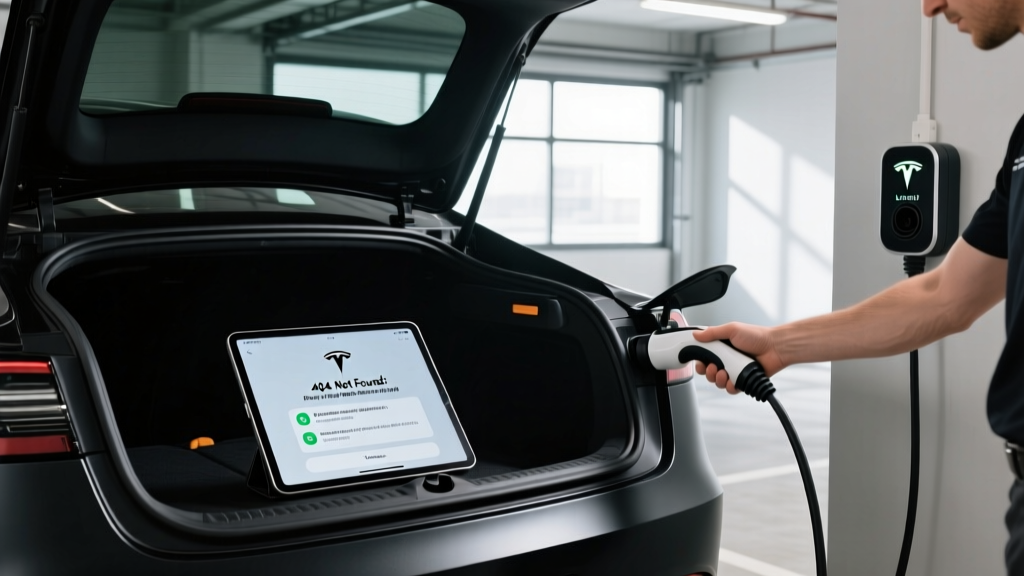
If you've opened the Tesla app recently only to be greeted by a Tesla app 404 not found error, you aren't alone. This error—typically appearing when trying to load vehicle details, service appointments, or the ownership dashboard—has surfaced periodically across Tesla's mobile interface. Below, we'll walk through proven fixes for the 404 error, and then deliver the comprehensive 2026 Tesla Model 3 review you were probably trying to access in the first place.
Fixing the Tesla App 404 Not Found Error
The "404 not found" message in the Tesla app usually means the app failed to retrieve your vehicle's data from Tesla's servers. It's rarely a problem with your car. Here's what works:
- Force-close and relaunch the app. Double-swipe to fully kill the Tesla app process, then reopen. This clears stale cached API calls.
- Log out and log back in. Go to Settings → Log Out within the app. Re-authenticate with your Tesla account credentials. This refreshes your OAuth token.
- Update to the latest app version. Tesla pushes frequent app updates. An outdated version may hit deprecated API endpoints, triggering a 404. Check the App Store or Google Play for updates.
- Check Tesla server status. Occasionally Tesla's backend experiences outages. Search "Tesla status" on X (formerly Twitter) or check community forums like Tesla Owners Online for real-time reports.
- Clear app cache (Android only). Go to Settings → Apps → Tesla → Storage → Clear Cache. iOS users should delete and reinstall the app.
- Remove and re-add your vehicle. As a last resort, remove the vehicle from your Tesla account via the web portal, then re-pair it.
Once you're back in the app, you'll have full access to your vehicle's telemetry, charging controls, and climate pre-conditioning. Now, let's get into the data on the 2026 Tesla Model 3—the car most likely populating your garage.
2026 Tesla Model 3: Range, Battery, and Efficiency
| Spec | Model 3 RWD | Model 3 Long Range AWD | Model 3 Performance |
|---|---|---|---|
| EPA Range | 272 mi | 341 mi | 315 mi |
| Battery Capacity (usable) | 57.5 kWh (LFP) | 75 kWh (NMC) | 75 kWh (NMC) |
| Efficiency | 132 MPGe / 25 kWh/100mi | 134 MPGe / 25 kWh/100mi | 121 MPGe / 28 kWh/100mi |
| Drivetrain | RWD | Dual-Motor AWD | Dual-Motor AWD |
| Horsepower | 271 hp | 346 hp | 510 hp |
| 0–60 mph | 5.8 sec | 4.2 sec | 2.9 sec |
Charging Speed: DC Fast Charge and Home Level 2
| Charging Level | Rate | Model 3 RWD | Model 3 Long Range / Perf. |
|---|---|---|---|
| Level 1 (120V household) | ~1.4 kW | ~3 mi/hr | ~3 mi/hr |
| Level 2 (240V, 48A Wall Connector) | 11.5 kW | ~30 mi/hr | ~44 mi/hr |
| DC Fast Charge (peak) | 170 kW (RWD) / 250 kW (LR/Perf) | 10–80% in ~30 min | 10–80% in ~18 min |
Tesla's Supercharger network remains the gold standard for reliability, with over 65,000 connectors globally. The Model 3 Long Range and Performance trims support up to 250 kW peak on V3 Superchargers. However, peak rate isn't sustained—the charge curve tapers significantly above 60% state of charge (SoC). Expect the bulk of charging (10–60%) to happen at near-peak speeds, with the final 20% (60–80%) adding roughly 8–10 extra minutes.
The RWD model uses an LFP battery that caps DC fast charging at around 170 kW, making 10–80% sessions roughly 12 minutes longer. If road-tripping frequently, the Long Range's faster charging curve and NMC chemistry deliver a meaningfully better experience at Superchargers.
For home charging, Tesla's Gen 3 Wall Connector ($475) delivers up to 11.5 kW on a 60-amp circuit (48A continuous). Most owners will need a licensed electrician to install a NEMA 14-60 outlet or hardwire the unit—expect $500–$1,500 for installation depending on panel proximity and local permitting. If your electrical panel is maxed at 100A, a panel upgrade to 200A can add $1,500–$3,000.
Pricing, Trims, and Federal Tax Credit Eligibility
| Trim | Base MSRP | Est. After §30D Credit | Eligible for $7,500? |
|---|---|---|---|
| Model 3 RWD | $38,990 | ~$31,490 | Yes (if sourcing rules met) |
| Model 3 Long Range AWD | $45,740 | ~$38,240 | Yes (if sourcing rules met) |
| Model 3 Performance | $52,990 | ~$45,490 | Yes (under $55K sedan cap) |
All 2026 Model 3 trims fall under the $55,000 MSRP cap for sedans under IRS §30D rules. However, eligibility for the full $7,500 federal tax credit depends on two moving targets:
- Buyer income caps: Modified adjusted gross income (MAGI) must not exceed $150,000 (single), $225,000 (head of household), or $300,000 (joint). See IRS §30D guidelines for current-year rules.
- Battery component and critical mineral sourcing: The credit splits into two $3,750 halves—one for battery components manufactured in North America, one for critical minerals sourced from the U.S. or free-trade-agreement partners. Tesla has worked to localize supply chains, but exact eligibility can shift by production batch. Always verify with your dealer and consult fueleconomy.gov before purchasing.
As of 2026, the §30D credit can be transferred to the dealer at point of sale, reducing your purchase price directly rather than waiting for a tax refund. This makes the effective price immediately lower if you qualify.
Interior, Cargo, and Tech Features
The refreshed Model 3 (introduced for the 2024 model year and carried into 2026) brought meaningful interior improvements: ventilated front seats, ambient lighting, a rear-seat touchscreen, and substantially improved cabin noise isolation. The minimalist design remains polarizing—no physical turn signal stalk (signals are on the steering wheel) and no instrument cluster behind the wheel.
- Cargo volume: 23 cu ft (rear trunk + frunk combined)
- Front legroom: 42.7 inches
- Rear legroom: 35.2 inches
- Infotainment: 15.4-inch center touchscreen with Netflix, YouTube, arcade gaming while parked
- Driver assist: Standard Autopilot (SAE Level 2); FSD (Supervised) available for $8,000 or $99/month
The 15.4-inch touchscreen handles everything: navigation, climate, media, vehicle settings, and even the glovebox release. The rear 8-inch screen lets passengers control climate and media. Wireless phone charging, HEPA air filtration, and a panoramic glass roof are standard across all trims.
Pros and Cons
Pros
- Best-in-class Supercharger network access (65,000+ connectors)
- Class-leading efficiency (25 kWh/100 mi on Long Range)
- Over-the-air updates continuously add features
- Strong resale value relative to EV market average
- 250 kW peak DC fast charging on LR/Performance
- Low maintenance costs (no oil changes, minimal brake wear with regen)
Cons
- No physical turn signal stalk—steering-wheel buttons take adaptation
- FSD (Supervised) remains Level 2 despite the "Full Self-Driving" name
- Firm ride quality on 19-inch sport wheels
- Service center wait times can be long in some metro areas
- No Apple CarPlay or Android Auto
- Rear visibility limited by sloping roofline and small rear window
Warranty Coverage
- Basic vehicle: 4 years / 50,000 miles
- Battery & drive unit (RWD): 8 years / 100,000 miles
- Battery & drive unit (Long Range/Performance): 8 years / 120,000 miles
- Battery capacity retention threshold: Tesla warrants at least 70% capacity retention over the warranty period
Tesla's battery warranty is competitive with the industry standard. Real-world data from high-mileage owners suggests NMC packs in the Model 3 typically retain ~88–92% capacity after 100,000 miles, well above the warranty floor. LFP packs in the RWD model show even slower degradation due to the chemistry's inherent stability and tolerance for 100% SoC charging.
Who Should Buy the 2026 Tesla Model 3?
- Choose the RWD ($38,990) if: You commute under 40 miles daily, live in a mild climate, and want the lowest entry price with LFP battery longevity. Best for urban and suburban drivers with reliable home charging.
- Choose the Long Range AWD ($45,740) if: You road-trip regularly, live in a cold-weather state, or need AWD traction. The 341-mile EPA range and 250 kW charging make this the most versatile daily driver.
- Choose the Performance ($52,990) if: You want a 2.9-second 0–60 sports sedan that also happens to be electric, and you don't mind sacrificing ~26 miles of range for adaptive dampers and track capability.
- Look elsewhere if: You need more than 23 cu ft of cargo space (consider the Model Y), require Apple CarPlay, or prefer physical buttons and a traditional instrument cluster.
Model 3 vs. Key Competitors
The 2026 Model 3 competes against the Hyundai Ioniq 6 (EPA 361 mi, 800V architecture, ~$42,000), the BMW i4 eDrive40 (EPA 301 mi, premium interior, ~$57,000), and the Polestar 2 (EPA 276 mi, Google built-in, ~$50,000). The Model 3 wins on efficiency, Supercharger network access, and price-to-range ratio. The Ioniq 6 charges faster on 350 kW Electrify America stations (10–80% in ~18 min with 800V). The BMW i4 wins on interior materials and ride comfort. The Polestar 2 offers Android Automotive natively for Google-centric users.
For the best overall value in a compact electric sedan in 2026, the Model 3 Long Range AWD at ~$38,240 after the federal credit remains the benchmark—provided you're comfortable with Tesla's minimalist interior and app-centric ownership model (including the occasional Tesla app 404 not found glitch).
Frequently Asked Questions
What is the real-world range of the 2026 Tesla Model 3?
The EPA rates the Long Range AWD at 341 miles, but expect 280–300 miles on highway road trips and 220–255 miles in freezing weather. The RWD model delivers roughly 225–240 real-world miles in mixed driving.
How fast does the Model 3 charge at home and on the road?
At home on a Tesla Wall Connector (11.5 kW / 48A), the Long Range adds ~44 miles per hour—enough to fully recharge overnight. On a V3 Supercharger, the Long Range and Performance trims peak at 250 kW, reaching 10–80% in approximately 18 minutes.
Does the 2026 Model 3 qualify for the $7,500 federal EV tax credit?
All trims fall under the $55,000 sedan MSRP cap. Full $7,500 eligibility depends on your income (MAGI caps apply) and Tesla's current battery-sourcing compliance. Verify at fueleconomy.gov and consult a tax professional before relying on the credit.
Is the Model 3 worth buying over the Hyundai Ioniq 6 or BMW i4?
If Supercharger access, over-the-air updates, and price-to-range value matter most, yes. If you prioritize 800V ultra-fast charging on non-Tesla networks, the Ioniq 6 is compelling. If interior luxury is paramount, the BMW i4 edges ahead—at a higher price.
What causes the Tesla app 404 not found error?
It's typically a server-side API timeout or stale authentication token. Force-closing the app, logging out and back in, or updating to the latest app version resolves it in most cases. If the issue persists across multiple devices, Tesla's backend may be experiencing a temporary outage.
Is Tesla's FSD actually self-driving?
No. FSD (Supervised) is an SAE Level 2 system. You must remain fully attentive with hands on the wheel and eyes on the road. It assists with lane changes, highway navigation, and some city streets, but it does not replace the driver.