Searches for "how much money does Tesla make a year" spike every earnings season, and the answer shapes what you pay at the dealership. Tesla's corporate profitability determines its pricing power — and in early 2026, the company's financials tell a story that directly impacts whether the refreshed Model Y Long Range is a smart buy or a margin-padding exercise. Here's the financial picture, followed by a complete real-world review of the vehicle that drives most of Tesla's revenue.
Tesla's Annual Revenue and Profit: The 2025 Numbers
For full-year 2025, Tesla reported approximately $97 billion in total revenue and $7.1 billion in net income (GAAP), according to its investor relations filings. That net profit margin of roughly 7.3% is down from the heady 12-16% margins of 2022-2023, reflecting aggressive price cuts, increased competition from Chinese automakers, and heavier spending on AI and energy infrastructure.
Where does the money come from? Automotive sales still represent about 78% of revenue, but Tesla's Energy Generation & Storage division (Megapack, Powerwall) has grown to roughly 12%, and Services/Other fills the rest. The takeaway for buyers: Tesla's automotive margins have compressed, which means the company is less likely to offer steep discounts but also less likely to raise prices dramatically. The Model Y remains Tesla's cash cow — it accounts for more than half of all vehicle deliveries globally.
2026 Tesla Model Y Long Range: Full Specifications
The 2026 Model Y Long Range AWD carries over the Juniper refresh architecture introduced in 2025. Here are the exact figures you need to evaluate it.
| Spec | Value |
|---|---|
| EPA Range | 320 miles |
| Battery (usable) | 75 kWh, NMC (nickel manganese cobalt) |
| Drivetrain | Dual-motor AWD |
| Horsepower | 384 hp (combined) |
| 0–60 mph | 4.8 seconds |
| Efficiency | 122 MPGe / 28 kWh/100 mi |
| Max DC Fast Charge | 250 kW (peak) |
| 10–80% DC Charge Time | ~27 minutes |
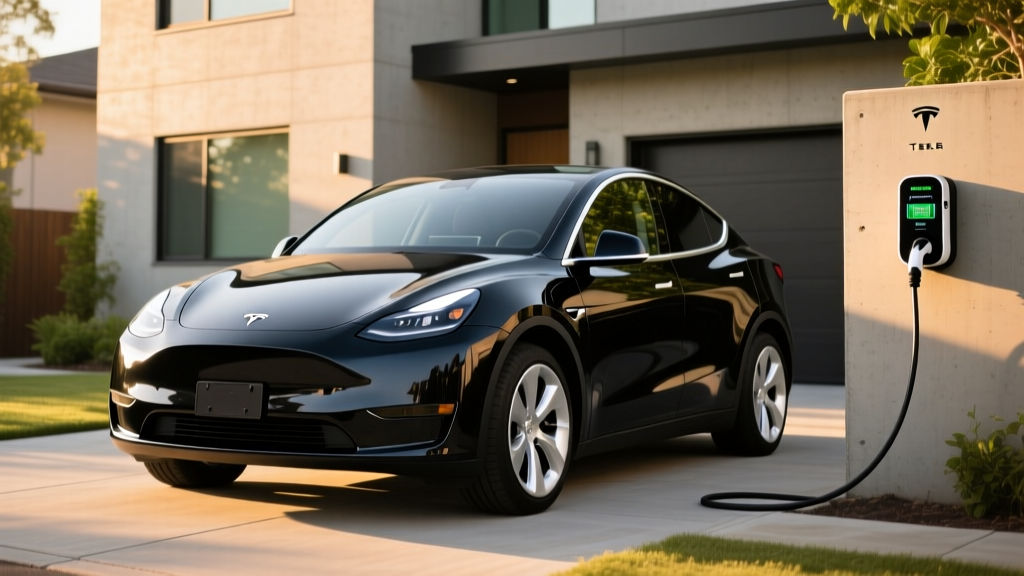
| Level 2 Home Charge Rate | 11.5 kW (~44 mi/hr) |
| Cargo Volume (rear seats up/down) | 30.2 / 72.1 cu ft |
| Rear Legroom | 41.6 inches |
| Base MSRP | $44,990 (excl. destination) |
| Battery Warranty | 8 years / 120,000 miles |
Real-World Range: What the EPA Sticker Doesn't Tell You
Tesla's NMC pack delivers strong energy density, but highway efficiency is where EVs lose ground. At sustained 75–80 mph, the Model Y consumes roughly 30–32 kWh/100 mi versus its EPA-rated 28 kWh/100 mi. The heat pump (standard on all 2026 models) significantly reduces cold-weather cabin heating losses compared to resistance heaters, but battery chemistry itself loses efficiency below freezing. If you regularly drive 250+ miles in winter without mid-trip charging, this is your constraint.
Charging Speed: DC Fast and Home Level 2
Tesla's Supercharger network remains the gold standard for reliability, but the Model Y's 250 kW peak charge rate is no longer class-leading. Competitors on Hyundai/Kia's 800V architecture (Ioniq 5, EV6) accept up to 350 kW and complete 10–80% in 18 minutes versus the Model Y's ~27 minutes.
| Charging Level | Power / Rate | Speed | Notes |
|---|---|---|---|
| Level 1 (120V) | ~1.4 kW | ~5 mi/hr | Emergency/trickle only |
| Level 2 (240V, 48A) | 11.5 kW | ~44 mi/hr | Full charge in ~7 hrs |
| DC Fast (Supercharger V3) | 250 kW peak | 10–80% in ~27 min | Tapers above 60% SoC |
| DC Fast (Supercharger V4) | 250 kW peak (vehicle-limited) | Same as V3 for this vehicle | V4 stalls deliver more kW but Model Y caps at 250 |
Charging-curve reality: The Model Y holds near-peak 250 kW from roughly 10–35% SoC, then steps down to ~170 kW through 60%, and drops further to ~80 kW by 80%. If you're road-tripping, plan stops from 10–70% for the fastest average rate rather than waiting for 80%.
Pricing, Trims, and Federal Tax Credit Eligibility
| Trim | MSRP | Est. After §30D Credit |
|---|---|---|
| Long Range AWD | $44,990 | ~$37,490* |
| Performance AWD | $51,490 | ~$43,990* |
*Federal tax credit eligibility depends on multiple factors. See checklist below.
Under current IRS §30D rules, the Model Y Long Range qualifies for the $7,500 federal EV tax credit — but only if you meet all criteria. Tesla offers point-of-sale transfer, meaning the $7,500 can come off the purchase price directly at delivery rather than waiting for tax filing.
- MSRP cap: SUVs/crossovers must be ≤$80,000 — Model Y qualifies ✓
- Buyer income cap: Modified AGI ≤$150,000 (single), ≤$300,000 (joint) ✓ (buyer-dependent)
- Battery sourcing: Critical minerals and battery components must meet phased percentages from US/FTA partners — Tesla's US-built LFP and NMC packs currently meet requirements ✓
- Final assembly: Must be in North America — Fremont, CA ✓
Warning: Battery-sourcing rules tighten annually. Confirm eligibility on fueleconomy.gov at the time of purchase, as supply-chain changes can shift eligibility mid-year.
Technology, Driver Assistance, and Drawbacks
The Juniper-refreshed Model Y brings a quieter cabin (acoustic glass all around), ventilated front seats, a rear-seat touchscreen, and ambient lighting. The 15.4-inch front display runs Tesla's latest UI with improved navigation and trip planning.
Autopilot and FSD (Supervised): Standard Autopilot includes adaptive cruise and lane-centering. The $8,000 FSD (Supervised) upgrade adds automated lane changes, traffic-light recognition, and city-street navigation — but this remains SAE Level 2. You must keep hands on the wheel and eyes on the road at all times. Tesla's camera-only vision system has improved in rain and low light, but it is not autonomous driving.
Notable drawbacks: The minimalist interior still lacks physical buttons for climate and mirrors, requiring touchscreen dives while driving. Turn-signal stalks have been removed in favor of steering-wheel buttons — a polarizing choice that takes weeks to habituate. The absence of Apple CarPlay/Android Auto frustrates buyers accustomed to phone projection. Panel-gap quality, while improved, still lags Hyundai/Kia and BMW at this price point.
Who Should Buy the Model Y — and Who Shouldn't
Pros
- Supercharger network reliability (20,000+ stalls in North America)
- Class-leading software and OTA updates
- 320 mi EPA range is competitive for the segment
- Strong resale value relative to non-Tesla EVs
- Spacious cargo area (72.1 cu ft) and frunk
Cons
- 250 kW peak DC rate trails 800V competitors
- No Apple CarPlay/Android Auto
- Steering-wheel turn signals require adaptation
- FSD costs $8,000 extra and is still Level 2
- Ride quality is firm on 19/20-inch wheels
Buy the Model Y Long Range if: You value Supercharger access for frequent road trips, want strong software/OTA longevity, and prioritize cargo space and efficiency. It's ideal for a two-adult household with occasional rear passengers and a daily commute under 80 miles round-trip.
Look elsewhere if: You need the fastest DC charging available (consider the Ioniq 5 or EV6), you rely on CarPlay, you want a smoother ride (BMW iX, Genesis GV60), or you need three-row seating (Kia EV9).
Is the Model Y Worth It vs. Key Competitors?
At ~$37,490 after the federal credit, the Model Y Long Range competes with the Hyundai Ioniq 5 ($41,500 base, 310 mi, 350 kW charging), the Ford Mustang Mach-E Extended Range ($45,995, 312 mi), and the BMW iX xDrive45 ($58,000+, more luxury but pricier). The Model Y's advantage remains the Supercharger ecosystem and Tesla's software. Its disadvantage is that the Juniper refresh, while improved, didn't fundamentally change the charging architecture or add CarPlay. If public charging reliability in your region is strong (Electrify America, ChargePoint), the Ioniq 5's faster charging and CarPlay support make it a serious alternative.
Frequently Asked Questions
How much money does Tesla make a year from car sales alone?
In 2025, Tesla's automotive revenue was approximately $75.6 billion, with automotive gross margins around 17–18%. Net profit across all segments was ~$7.1 billion. The Model Y and Model 3 together account for roughly 85% of vehicle deliveries.
What is the real-world range of the 2026 Model Y Long Range?
EPA-rated at 320 miles. Real-world highway driving yields 270–290 miles. Cold weather (below 30°F) drops this to 230–255 miles without preconditioning. City driving in mild conditions can approach or exceed 300 miles thanks to regenerative braking.
How fast does the Model Y charge at home and on DC fast chargers?
On a 48-amp Level 2 home charger (240V), it gains ~44 miles per hour, fully charging in about 7 hours. On a 250 kW Supercharger, 10–80% takes approximately 27 minutes, though the charge curve tapers significantly above 60% SoC.
Does the 2026 Model Y qualify for the $7,500 federal EV tax credit?
Yes, provided the buyer meets income caps (≤$150K single / ≤$300K joint), the MSRP is under $80K (it is), and battery-sourcing requirements are met at the time of purchase. Tesla offers point-of-sale transfer. Always verify on IRS.gov and fueleconomy.gov before purchasing.
Is the Model Y better than the Hyundai Ioniq 5?
It depends. The Model Y wins on Supercharger network access, cargo space (72.1 vs 59.3 cu ft), and software. The Ioniq 5 wins on DC charging speed (350 kW, 10–80% in ~18 min), Apple CarPlay/Android Auto, and ride comfort. Both are strong choices; your priority determines the winner.
What is the battery warranty on the 2026 Model Y?
Tesla covers the battery and drive unit for 8 years or 120,000 miles (whichever comes first), with a minimum 70% capacity retention threshold over the warranty period. NMC chemistry in the Long Range typically shows 5–8% degradation in the first 50,000 miles, then slows considerably.