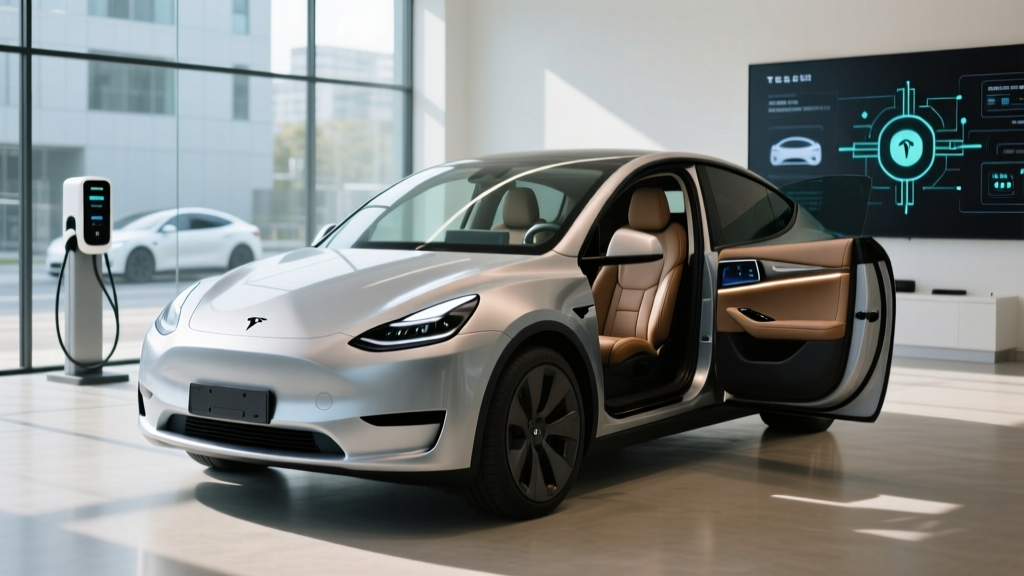
The Tesla annual meeting 2025 delivered more than shareholder votes — it confirmed the trajectory of Tesla's most important vehicle: the refreshed Model Y (codenamed Juniper). With a redesigned exterior, updated interior, revised battery options, and a recalibrated price structure heading into the 2026 model year, buyers need a clear-eyed look at what this EV actually offers on the road. Below, we reconcile Tesla's claims with EPA data, real-world charging behavior, and federal tax credit eligibility so you can decide whether the post-refresh Model Y earns a spot in your driveway.
2026 Tesla Model Y: Quick Verdict
The 2026 Model Y Long Range AWD remains the default choice for most EV shoppers — a midsize electric crossover with competitive range, access to the Supercharger network, and a starting price that undercuts several rivals. The Juniper refresh tightens the cabin quality gap with Hyundai and Ford, adds ventilated front seats, a rear-seat touchscreen, and a slightly stiffer suspension tune. However, the absence of Apple CarPlay, the camera-only driver-assist approach, and the still-mandatory $8,000 FSD upsell for advanced features remain friction points. If you need a two-row electric SUV with 300+ miles of range and DC fast charging under 30 minutes, the Model Y Long Range still sits near the top of the segment.
Range, Battery, and Real-World Efficiency
| Spec | Long Range AWD | Performance AWD | RWD (Standard) |
|---|---|---|---|
| EPA Range | 320 mi | 295 mi | 270 mi |
| Battery Capacity (usable) | ~75 kWh (NMC) | ~75 kWh (NMC) | ~60 kWh (LFP) |
| Battery Chemistry | NMC (Nickel Manganese Cobalt) | NMC | LFP (Lithium Iron Phosphate) |
| Drivetrain | Dual-Motor AWD | Dual-Motor AWD | Rear-Wheel Drive |
| Horsepower | 384 hp | 456 hp | 295 hp |
| 0–60 mph | 4.8 sec | 3.5 sec | 6.2 sec |
| Efficiency (MPGe combined) | 111 MPGe | 103 MPGe | 118 MPGe |
| Efficiency (kWh/100 mi) | 30 kWh | 33 kWh | 28 kWh |
| Base MSRP | $44,990 | $51,490 | $36,490 |
Tesla confirmed at the 2025 annual meeting that the Model Y will continue offering both NMC (for Long Range and Performance trims) and LFP chemistry (for the RWD base model). LFP vs NMC trade-offs: LFP batteries tolerate daily 100% charging without accelerated degradation and use no cobalt or nickel, but they are heavier, offer lower energy density (hence the shorter range), and perform less optimally in extreme cold. NMC provides higher energy density and better cold-weather performance but Tesla recommends daily charging to 80–90% for longevity. Source: fueleconomy.gov.
Charging Speed: DC Fast, Level 2, and Level 1
| Level | Power / Rate | Miles Added per Hour | Notes |
|---|---|---|---|
| Level 1 (120V household) | ~1.4 kW | ~4–5 mi/hr | Emergency/trickle only; ~60+ hrs for full charge |
| Level 2 (240V home, 48A) | 11.5 kW | ~37 mi/hr | Full charge overnight (~8 hrs 0–100%) |
| DC Fast Charge (V3 Supercharger) | Peak 250 kW | ~162 mi in 15 min | 10–80% in ~23 min (Long Range NMC) |
| DC Fast Charge (V4 Supercharger) | Peak 250 kW (limited by vehicle) | Same as V3 for Model Y | V4 hardware supports higher rates; Model Y doesn't yet exceed 250 kW |
Charging curve reality: The 250 kW peak is not sustained. The Long Range NMC model hits ~250 kW between roughly 10–30% State of Charge (SoC), then tapers to ~150 kW by 50%, and drops below 50 kW past 80%. This is why the 10–80% time is ~23 minutes rather than the theoretical ~18 minutes a flat 250 kW rate would suggest. The LFP RWD variant peaks closer to 170 kW due to its smaller battery's thermal and C-rate constraints.
At home, the Model Y's onboard charger accepts up to 11.5 kW (48 amps) on a 240V Level 2 circuit. A 60-amp dedicated circuit with a NEMA 14-60 or hardwired Tesla Wall Connector is the typical installation. Budget $500–$1,500 for the electrician if your panel has capacity; $2,000–$4,500+ if a panel upgrade (to 200A) is needed. Always get a licensed electrician's assessment before purchasing equipment.
Performance and Driving Dynamics
The Long Range AWD's dual-motor setup delivers 384 hp and a 4.8-second 0–60 mph time — brisk enough for confident highway merging without the neck-snap of the Performance trim's 3.5 seconds (456 hp). The Juniper refresh brought a slightly retuned suspension: firmer damping reduces body roll in corners, though some owners report a stiffer ride over broken pavement compared to the pre-2025 model.
Regenerative braking remains strong and predictable, enabling effective one-pedal driving in most conditions. The heat pump (standard on all trims) improves cold-weather cabin heating efficiency and reduces the range penalty compared to older resistive-heater EVs.
Interior, Cargo, and Tech Features
The Juniper interior is a meaningful step up from the 2020–2024 Model Y. Soft-touch materials replace hard plastics on the dash and door panels, ambient lighting is standard, and the 15.4-inch center touchscreen now runs a faster processor with smoother map rendering. A new 8-inch rear-seat touchscreen controls climate, media, and gaming for passengers — a direct response to complaints from families who felt rear occupants were an afterthought.
Cargo and passenger dimensions:
- Cargo behind 2nd row: 30.2 cu ft
- Cargo with 2nd row folded: 72.1 cu ft
- Front trunk (frunk): 4.1 cu ft
- Rear legroom: 41.6 inches
- Front headroom: 40.3 inches
Standout tech: Tesla's infotainment remains the benchmark for responsiveness — native navigation with real-time Supercharger routing, over-the-air updates, Sentry Mode dashcam recording, and a robust app ecosystem. However, Apple CarPlay and Android Auto are not available, which remains a dealbreaker for some buyers accustomed to phone-mirroring interfaces.
Driver assistance (SAE Level 2):
Tesla Autopilot (standard) and Full Self-Driving Supervised ($8,000 option) are SAE Level 2 driver-assist systems. The driver must remain actively engaged, hands on or near the wheel, and eyes on the road at all times. These are NOT self-driving systems. Only Level 4 services like Waymo operate without a human driver in geofenced areas. Source: SAE International J3016.
Autopilot includes Traffic-Aware Cruise Control and Autosteer (lane centering). FSD Supervised adds automatic lane changes, navigation-guided on/off-ramp transitions, traffic-light and stop-sign recognition, and Smart Summon (low-speed parking-lot movement). Real-world FSD performance varies significantly by geography and road-marking quality — it excels on well-mapped divided highways but can hesitate in construction zones or poorly marked urban streets.
Pricing, Trims, and Federal Tax Credit Eligibility
| Trim | Base MSRP | Est. After §30D Credit* | Destination |
|---|---|---|---|
| RWD (LFP) | $36,490 | ~$28,990 | $1,390 (included above) |
| Long Range AWD | $44,990 | ~$37,490 | $1,390 (included above) |
| Performance AWD | $51,490 | ~$43,990 | $1,390 (included above) |
*§30D credit eligibility is not automatic. The following conditions must ALL be met:
- MSRP cap: SUVs/crossovers must have an MSRP ≤ $80,000 (all Model Y trims qualify)
- Buyer income cap: Modified AGI ≤ $150,000 (single), $225,000 (head of household), $300,000 (joint) — per IRS §30D guidelines
- Battery sourcing: Critical minerals and battery components must meet escalating domestic-content thresholds (2026: 80% critical minerals from US/FTA partners, 100% battery components manufactured/assembled in North America). Tesla has shifted significant supply chain to meet these rules, but eligibility can change — confirm at purchase
- Point-of-sale transfer: Eligible buyers can apply the up-to-$7,500 credit as a down-payment reduction at the dealer (Tesla) rather than waiting for tax filing
- VIN and delivery verification: The vehicle must be delivered new to the buyer and registered in the US
Consult a tax professional to confirm your specific eligibility. State and local incentives (e.g., California's CVRP, Colorado's state credit, utility rebates) stack on top of federal credits and vary by jurisdiction — check your state energy office or utility provider for current programs.
Warranty, Ownership Costs, and Longevity
| Coverage | Term |
|---|---|
| Basic Vehicle | 4 years / 50,000 miles |
| Battery & Drive Unit (Long Range/Performance) | 8 years / 120,000 miles |
| Battery & Drive Unit (RWD/LFP) | 8 years / 100,000 miles |
| Battery Capacity Retention Threshold | ≥ 70% of original capacity during warranty period |
The 70% retention threshold is standard across the industry (Hyundai, Ford, and VW use similar benchmarks). Independent fleet data from sources like Recurrent Auto suggests that Tesla's NMC packs typically retain 85–90% capacity at 100,000 miles under normal charging habits (avoiding frequent 100% charges and DC fast charging exclusively). LFP packs show even slower degradation curves, with many exceeding 90% retention at equivalent mileage — a key reason Tesla recommends daily 100% charging for LFP owners.
Insurance costs: Model Y insurance premiums run 15–30% higher than comparable gas-powered crossovers (e.g., Toyota RAV4) due to repair costs and Tesla's aluminum/structural-battery construction. Expect $1,800–$2,600/year depending on your state, driving record, and coverage level. Tesla Insurance is available in select states and can be competitive — get quotes from both before committing.
How the Model Y Stacks Up Against Key Competitors
| Spec | Tesla Model Y LR AWD | Hyundai Ioniq 5 AWD | Ford Mustang Mach-E ER AWD |
|---|---|---|---|
| EPA Range | 320 mi | 290 mi | 305 mi |
| Peak DC Charge | 250 kW | 238 kW (350-kW capable w/ 800V) | 150 kW |
| 10–80% DC Time | ~23 min | ~18 min | ~36 min |
| Base MSRP (AWD) | $44,990 | $49,500 | $48,995 |
| Apple CarPlay | No | Yes | Yes |
| Charging Network | Supercharger (native NACS) | NACS adapter for Superchargers | NACS adapter for Superchargers |
The Ioniq 5's 800V architecture enables faster 10–80% charging on compatible 350 kW chargers, but those chargers are less ubiquitous than Tesla's Supercharger network. The Mach-E offers CarPlay and a more traditional dealer-service experience but charges significantly slower on DC. The Model Y's advantages remain the Supercharger network's reliability, OTA update cadence, and cargo volume; its weaknesses are the lack of CarPlay, the camera-only Autopilot approach (no lidar or radar redundancy), and panel-gap variability in build quality.
Choose the Hyundai Ioniq 5 if: You want the fastest DC charging, prefer CarPlay/Android Auto, value Hyundai's dealer service network, and don't mind slightly less range.
Choose the Ford Mustang Mach-E if: You want CarPlay, prefer a traditional dealership purchase experience, and prioritize a more engaging driving feel over maximum range.
Pros and Cons
- Class-leading 320-mi EPA range (Long Range AWD)
- Supercharger network — most reliable public charging in the US
- Spacious cargo area (72.1 cu ft max) and generous rear legroom
- OTA updates continuously add features post-purchase
- LFP option (RWD) allows daily 100% charging without degradation worry
- Heat pump standard — better cold-weather efficiency
- No Apple CarPlay or Android Auto
- FSD costs $8,000 extra and remains SAE Level 2 (not self-driving)
- Firmer ride post-refresh vs. pre-2025 models
- Insurance premiums 15–30% above gas crossover averages
- Camera-only Autopilot — no radar/lidar redundancy
- DC charge rate capped at 250 kW while rivals offer 350 kW capability
Frequently Asked Questions
What is the real-world range of the 2026 Tesla Model Y?
The Long Range AWD's EPA rating is 320 miles, but expect ~265–285 miles on highway road trips at 70+ mph and ~220–245 miles in sub-freezing temperatures. The RWD/LFP variant delivers ~225–240 real-world highway miles from its 270-mi EPA rating.
How fast does the Model Y charge at home and on the road?
At home on a 240V Level 2 charger (48A), the Model Y adds ~37 miles of range per hour, reaching a full charge overnight in ~8 hours. On a V3 Supercharger (DC fast), it peaks at 250 kW and charges 10–80% in approximately 23 minutes, though the rate tapers significantly above 80% SoC.
How much does the Model Y cost after federal tax credits?
If you qualify for the full §30D credit ($7,500), the Long Range AWD drops from $44,990 to ~$37,490, and the RWD base model falls to ~$28,990. Eligibility depends on your income (≤$150K single / $300K joint), the vehicle's MSRP (≤$80K — all trims qualify), and battery-sourcing requirements that can change. Confirm with a tax professional before purchasing.
Does the 2026 Model Y qualify for the $7,500 federal EV tax credit?
All Model Y trims fall under the $80,000 SUV MSRP cap, and Tesla has worked to meet the 2026 battery-sourcing and critical-mineral thresholds. However, your personal income must fall within IRS limits, and sourcing rules are subject to regulatory updates. The credit can be applied at point of sale as a down-payment reduction. Always verify current eligibility on irs.gov before finalizing your order.
Is the Model Y worth buying vs. the Ioniq 5 or Mach-E?
It depends on your priorities. The Model Y wins on range (320 mi), Supercharger access, and cargo space. The Ioniq 5 wins on DC charging speed (~18 min 10–80% on 350 kW chargers) and CarPlay availability. The Mach-E wins on driving engagement and traditional dealer service. For road-trip-heavy owners who value charging convenience, the Model Y's Supercharger advantage is still meaningful in 2026.
What did the Tesla annual meeting 2025 announce that affects Model Y buyers?
The 2025 annual meeting confirmed the Juniper-refreshed Model Y's production ramp, expanded LFP battery sourcing for the RWD trim, continued investment in the Supercharger network (now open to non-Tesla EVs via NACS), and updates to FSD Supervised's neural-net architecture. No new Model Y trims or major hardware changes beyond the Juniper refresh were announced — the focus was on manufacturing efficiency and software refinement heading into 2026.
Who is the 2026 Model Y best suited for?
The Model Y Long Range AWD is ideal for commuters and road-trip families who need 300+ miles of range, frequent the Supercharger network, and value cargo versatility. The RWD/LFP suits budget-conscious daily drivers who charge at home nightly and want a low-degradation battery. The Performance trim targets enthusiasts who want sports-sedan acceleration in a crossover body. It's less suited for buyers who demand CarPlay, prefer dealer-based service, or need third-row seating (consider the Kia EV9 or Rivian R1S for three rows).