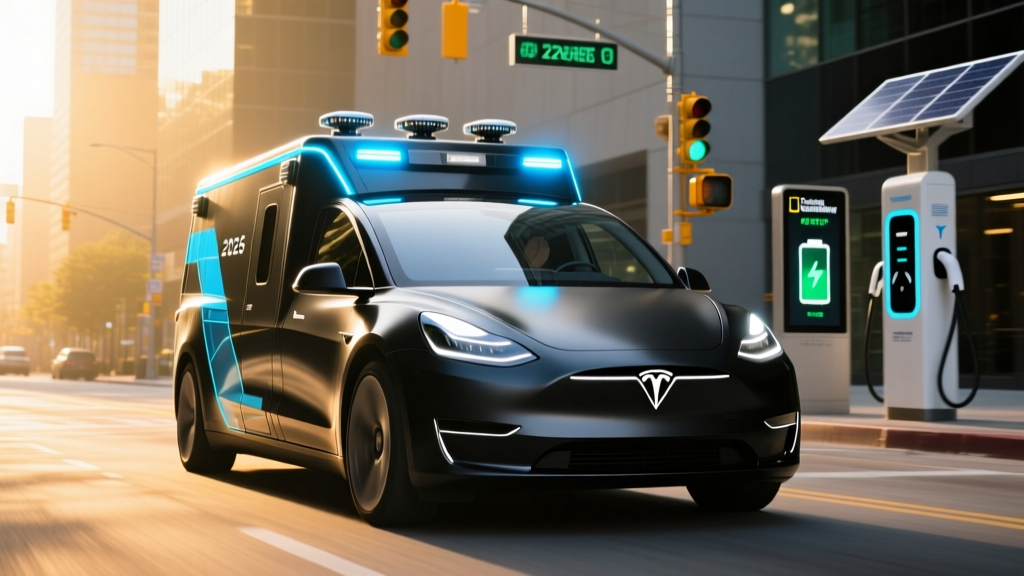
Search for "Tesla ambulance" and you'll find viral renders, concept art, and a few municipal pilot programs — but no production Tesla-badged ambulance rolling off a Fremont or Austin line. Tesla does not manufacture ambulances, and no OEM ambulance built on a Tesla chassis is currently available for purchase in the United States. What does exist is a small but growing ecosystem of third-party coachbuilders converting Tesla vehicles — primarily the Model X and, increasingly, the Cybertruck — into emergency medical response and patient transport units.
This article cuts through the concept-art hype to examine the real-world state of Tesla-based ambulances in 2026: which platforms are being used, what range and charging look like under EMS duty cycles, what conversions cost, and whether electrified ambulances make operational sense for fleet buyers.
What a "Tesla Ambulance" Actually Is in 2026
A Tesla ambulance is not a single vehicle you can order from Tesla's website. It's a post-manufacture conversion performed by specialty upfitters — companies like Emergency Vehicles Group, Osage Industries, and a handful of European firms — that take a Tesla donor vehicle and retrofit it with ambulance lighting, patient compartments, stretcher mounts, medical equipment power systems, and EMS livery.
The two platforms most commonly used are:
- Tesla Model X (Long Range AWD) — used for rapid-response paramedic units, BLS (Basic Life Support) fly-cars, and supervisor vehicles. Its falcon-wing doors and low floor ease stretcher loading in tight urban scenes.
- Tesla Cybertruck (AWD / Cyberbeast) — used experimentally for heavier-duty EMS and rescue applications, though upfit options remain limited due to the stainless-steel exoskeleton complicating body modifications.
Neither platform replaces a full Type I or Type III ambulance (those are built on Ford E-Series, Chevrolet Express, or Freightliner M2 chassis with dedicated patient modules). Tesla-based units fill the rapid-response and BLS transport niche — think first-on-scene paramedic rigs, not rolling emergency rooms.
Specs: Tesla Model X Long Range as an Ambulance Platform
Since the Model X Long Range AWD is the most proven Tesla ambulance donor vehicle, here are the baseline specs any fleet buyer or EMS planner needs to evaluate:
| Specification | 2026 Tesla Model X Long Range AWD |
|---|---|
| EPA Estimated Range | 335 miles |
| Battery Capacity | ~100 kWh usable (NMC chemistry) |
| Drivetrain | Dual-motor AWD |
| Horsepower | 670 hp |
| 0–60 mph | 3.8 seconds |
| Max DC Fast-Charge Rate | 250 kW (V3 Supercharger) |
| 10–80% DC Charge Time | ~32 minutes |
| Level 2 Home/Depot Charge Rate | 11.5 kW (~34 miles/hr) |
| EPA Efficiency | 100 MPGe combined / 34 kWh/100 mi |
| Cargo Volume (behind 2nd row) | 88.1 cu ft |
| Battery/Drive Unit Warranty | 8 years / 150,000 miles |
| Base MSRP | $79,990 |
Charging Under an EMS Duty Cycle
Ambulances don't follow commuter charging patterns. An EMS unit might idle at a station for 4 hours, then run two back-to-back transports, then idle again. Here's what charging looks like for a Tesla Model X–based ambulance:
| Charging Level | Power | Miles Added per Hour | EMS Use Case |
|---|---|---|---|
| Level 1 (120V) | ~1.4 kW | ~4 mi/hr | Not viable for fleet ops |
| Level 2 (240V, 48A) | 11.5 kW | ~34 mi/hr | Depot overnight charging; adds ~270 mi in 8-hr shift downtime |
| DC Fast (V3 Supercharger) | Peak 250 kW | ~200 mi in 15 min | Mid-shift top-ups; 10–80% in ~32 min |
Charging-curve reality: The 250 kW peak only holds between roughly 10–30% state of charge. Above 50%, the rate tapers to ~100 kW; above 80%, it drops further to ~40 kW. For fleet operations, the practical play is charging to 80% at a Supercharger during crew breaks (about 30 minutes) rather than topping to 100%, which wastes time at the low end of the curve.
Depot charging is the backbone. Most EMS fleets installing Tesla-based units will need Level 2 depot chargers (ideally 48A/11.5 kW Wall Connectors or commercial equivalents). An 8-hour off-peak window adds roughly 270 miles — enough to reset the pack for a full day shift. Budget $1,200–$2,500 per Level 2 stall for equipment and installation, plus potential panel upgrades if your station's service is below 200A.
Conversion Costs and Tax Credit Eligibility
Buying a Tesla and driving it to the ER is not the same as putting it into ambulance service. Conversion costs are substantial:
- Tesla Model X Long Range AWD (donor vehicle): $79,990 MSRP
- EMS upfit (light bar, sirens, stretcher mount, medical cabinet, partition, graphics): $25,000–$45,000 depending on spec level
- Medical power system (inverter, auxiliary battery buffer, shore-power tie-in): $8,000–$15,000
- Total estimated unit cost: $113,000–$140,000
Compare this to a conventional Ford E-450 Type III ambulance, which typically runs $180,000–$250,000 fully equipped — but offers a full patient module, not just a BLS rapid-response layout.
Federal Tax Credit: §30D Eligibility for Fleet Buyers
The IRS §30D Clean Vehicle Credit provides up to $7,500 for qualifying new EVs, but eligibility depends on several factors that complicate fleet purchases:
- MSRP cap: SUVs/vans (which the Model X qualifies as) must have an MSRP ≤ $80,000. The Model X Long Range at $79,990 squeaks under this cap, but adding options can push it over.
- Buyer income cap: Modified AGI must not exceed $300,000 (joint), $225,000 (head of household), or $150,000 (individual). Municipalities and fleet entities don't qualify for §30D directly — this credit is for individual taxpayers.
- Battery sourcing: Critical minerals and battery components must meet phased-in domestic-sourcing thresholds. As of 2026, vehicles with battery components from a "foreign entity of concern" (FEOC) are disqualified.
- Commercial Clean Vehicle Credit (§45W): Tax-exempt entities (cities, counties, fire districts) can claim up to $7,500 per vehicle via the §45W credit as a direct payment — this is the relevant credit for municipal EMS fleets.
Bottom line: municipal EMS agencies should consult a tax professional about §45W direct-pay eligibility. Don't assume the full $7,500 applies to every unit — battery sourcing rules and vehicle configuration matter.
Tech, Driver Assistance, and EMS-Specific Considerations
The Model X brings Tesla's full tech stack to an ambulance conversion, which offers both advantages and complications:
Advantages:
- Autopilot (Level 2 driver assist): Adaptive cruise, lane-keeping, and automatic emergency braking reduce driver fatigue on long highway transports. Note: this is SAE Level 2 — the driver must remain fully engaged. It is not autonomous driving.
- Over-the-air updates: Fleet managers can push software updates remotely, reducing downtime for recalls and feature additions.
- Frunk + cargo flexibility: The front trunk adds ~6.5 cu ft of secure storage for medical supplies, separate from the patient compartment.
- Regenerative braking: One-pedal driving reduces brake wear — a significant maintenance savings for stop-and-go urban EMS duty.
- Bioweapon Defense Mode: The HEPA filtration system is a genuine asset for patient transport, filtering airborne pathogens and particulates.
Drawbacks:
- Touchscreen-dependent controls: No physical knobs for HVAC, wipers, or lights. In high-stress EMS scenarios, fumbling through menus is a safety concern. Upfitters often add auxiliary physical switch panels.
- Service network: Tesla's service centers are not set up for emergency-vehicle priority. A downed unit may wait days or weeks for parts, unlike a Ford or Chevy ambulance that any heavy-duty shop can wrench on.
- Falcon-wing doors: Dramatic but problematic — they require overhead clearance (won't open under low hospital canopies or parking structures without manual override), and the hydraulic struts add maintenance complexity.
- No V2L (Vehicle-to-Load): The Model X cannot natively power external 120V medical equipment. Upfitters must install a separate inverter/buffer system, adding weight and cost.
Who Should Consider a Tesla-Based Ambulance?
Choose a Tesla-based EMS unit if:
- Your agency runs BLS rapid-response or paramedic fly-car operations in an urban/suburban area with reliable depot charging
- You want to reduce fuel and maintenance costs (no oil, no transmission, reduced brake wear)
- Your daily operational radius is under 200 miles and you can charge during shift downtime
- You value instant torque for quick scene response and quiet operation in residential areas
Stick with a conventional diesel/gas ambulance if:
- You need a full Type I or Type III patient module with standing room and full ALS equipment
- Your service area includes rural routes without reliable DC fast-charging access
- You need 24/7 uptime with minimal service dependency (any heavy-duty shop can service a Ford E-450)
- You tow heavy rescue equipment or operate in extreme cold for extended periods
Pros and Cons at a Glance
Pros
- 335-mile EPA range; ~200+ miles realistic in EMS duty
- 250 kW DC fast charging; 10–80% in ~32 min
- Zero tailpipe emissions; ideal for idling at scenes (no exhaust risk)
- 670 hp / 3.8-sec 0–60 for rapid scene response
- HEPA "Bioweapon Defense" air filtration
- Lower per-mile energy cost vs diesel (~$0.10–0.14/mi electricity vs ~$0.40–0.60/mi diesel)
- OTA software updates reduce recall downtime
- Regen braking slashes brake pad replacement frequency
Cons
- Not a full Type I/III ambulance — BLS/rapid-response only
- $113K–$140K total unit cost after conversion
- Touchscreen controls are a liability in high-stress EMS use
- Falcon-wing doors need overhead clearance; unreliable in tight hospital bays
- Tesla service network not optimized for fleet/emergency priority
- No native V2L for medical equipment power
- Cold-weather range loss (25–30%) shrinks operational radius
- §30D/§45W tax credit eligibility depends on sourcing rules and entity type
Frequently Asked Questions
Does Tesla make an official ambulance?
No. Tesla does not manufacture ambulances. All Tesla-based ambulances are third-party conversions using a Tesla Model X or Cybertruck as the donor vehicle. No OEM Tesla ambulance is available for purchase.
What is the real-world range of a Tesla Model X ambulance?
The EPA rates the 2026 Model X Long Range at 335 miles. In EMS duty — with accessory loads, stop-and-go driving, highway transports, and HVAC use — expect 220–260 miles. In cold weather (below 32°F), plan for 180–210 miles. Fleet planners should design shifts around a 200-mile operational radius.
How fast does a Tesla ambulance charge?
On a V3 Supercharger (250 kW peak), the Model X charges from 10–80% in approximately 32 minutes. On a Level 2 depot charger (11.5 kW), it adds about 34 miles per hour, fully replenishing in 8–9 hours — ideal for overnight shift downtime.
How much does a Tesla ambulance cost after tax credits?
A converted Tesla Model X ambulance runs $113,000–$140,000 all-in (vehicle + upfit). Municipal agencies may qualify for up to $7,500 per unit via the §45W Commercial Clean Vehicle Credit (direct-pay for tax-exempt entities). Individual buyers or private EMS companies may qualify for §30D, subject to MSRP caps ($80K for SUVs), income limits, and battery-sourcing rules. Consult a tax professional for your specific situation.
Is a Tesla ambulance worth it vs a conventional ambulance?
For BLS rapid-response and paramedic fly-car roles in urban areas with depot charging, a Tesla-based unit offers lower operating costs, instant response acceleration, and zero-idle emissions. For full ALS patient transport, rural coverage, or 24/7 uptime requirements, a conventional Ford E-Series or Freightliner-based ambulance remains the more practical choice.
Can a Tesla ambulance power medical equipment?
Not natively. The Model X lacks Vehicle-to-Load (V2L) capability. Upfitters install separate inverter and auxiliary battery systems ($8K–$15K) to power monitors, defibrillators, and suction units. This adds weight (reducing range by ~5–8%) but is essential for patient care.
What warranty covers a Tesla ambulance?
Tesla's battery and drive unit warranty covers 8 years or 150,000 miles (whichever comes first) with a minimum 70% capacity retention threshold. However, the ambulance conversion itself is warranted by the upfitter, not Tesla. Modifications to the electrical system or body may affect Tesla's warranty coverage — clarify this with both Tesla and the upfitter before purchasing.
Sources: EPA Fuel Economy — Tesla Model X, IRS §30D Clean Vehicle Credit, NHTSA Automated Vehicle Safety.